- A utility patent protects function and structure. A design patent protects ornamental appearance. Neither covers the other, so most commercial products need both evaluated.
- Utility patents last 20 years from the effective filing date and require maintenance fees at 3.5, 7.5, and 11.5 years. Design patents resulting from applications filed on or after May 13, 2015 last 15 years from grant with no maintenance fees.
- Obviousness is the most common rejection in utility patent prosecution, which is why a prior art search should come before filing.
- Early public disclosure can permanently bar patenting in absolute-novelty jurisdictions such as those in Europe, even though the United States offers a one-year grace period.
- Filing the wrong patent type, or filing either without enforceable claim scope, wastes money and market position.
*Written by Craige Thompson, Patent Attorney, MBA, Electrical Engineer.* Craige Thompson is a Managing Principal Patent Attorney, electrical engineer, professional engineer, and MBA who helps innovators protect and monetize complex technologies. His experience spans patent prosecution, licensing, prior art searching, due diligence, opinions, reexamination, and litigation across electrical engineering, software, mechanical engineering, medical devices, and energy-efficiency technologies.
The single most expensive mistake inventors make is assuming one patent covers everything about their product. It does not. In the utility vs design patent decision, one protects how your invention works and the other protects how it looks, and choosing wrong can leave your best asset exposed to copycats. Many inventors focus on functional protection yet overlook design protection entirely, leaving their intellectual property rights only partially secured. For a broader view of how patents fit alongside trademarks and copyrights, see the four main categories of intellectual property.
The Core Difference Between a Utility Patent and a Design Patent Comes Down to One Question
Ask yourself one thing, is my invention valuable because of what it does, or because of how it looks?
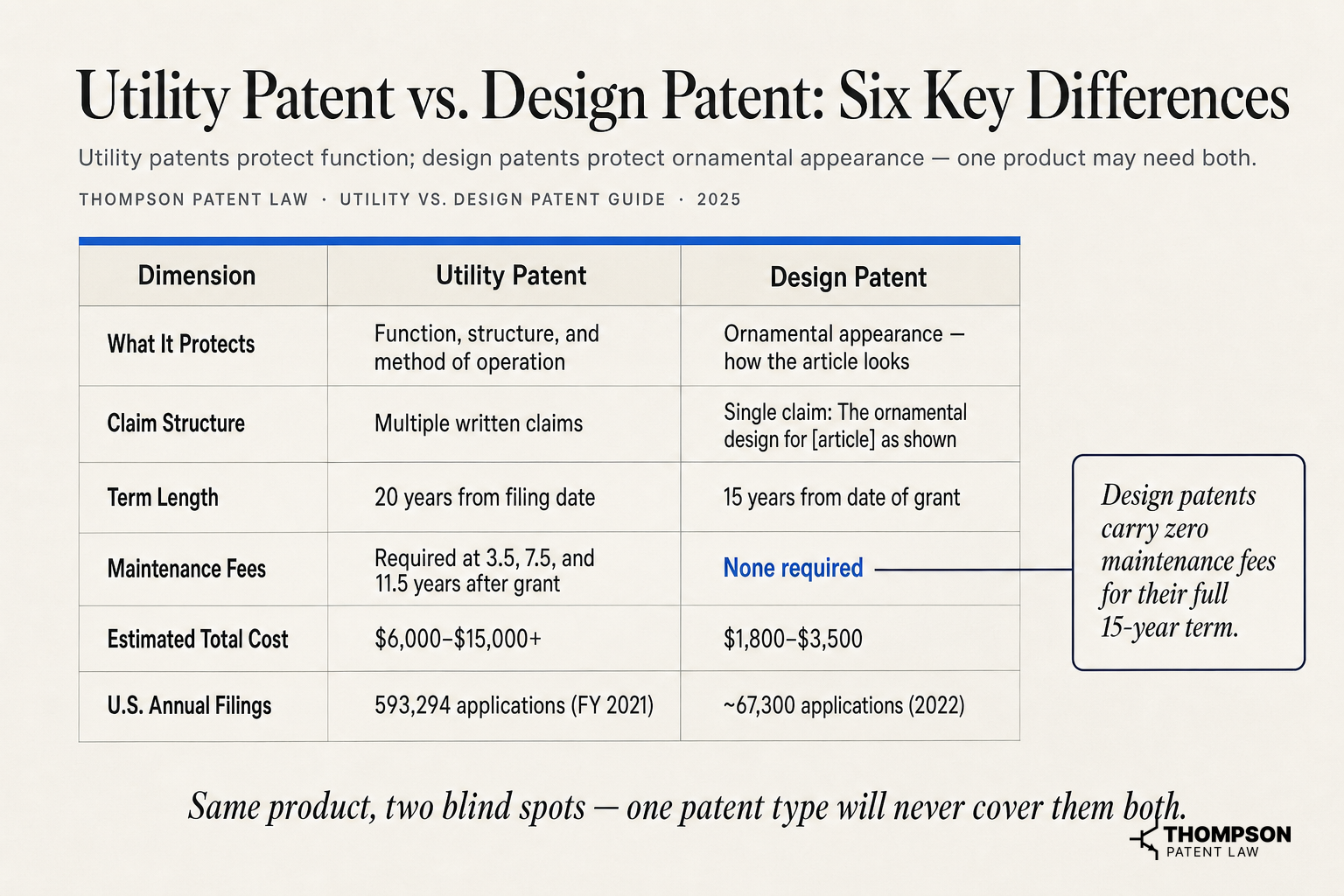 Utility Patent vs. Design Patent: Six Key Differences — Source: USPTO FY 2021 Performance Report (patentdocs.org, 2022); WIPO IP Statistics (wipo.int, 2023); Fit Small Business Patent Cost Guide (fitsmallbusiness.com, 2025); 35 U.S.C. §§ 101, 1
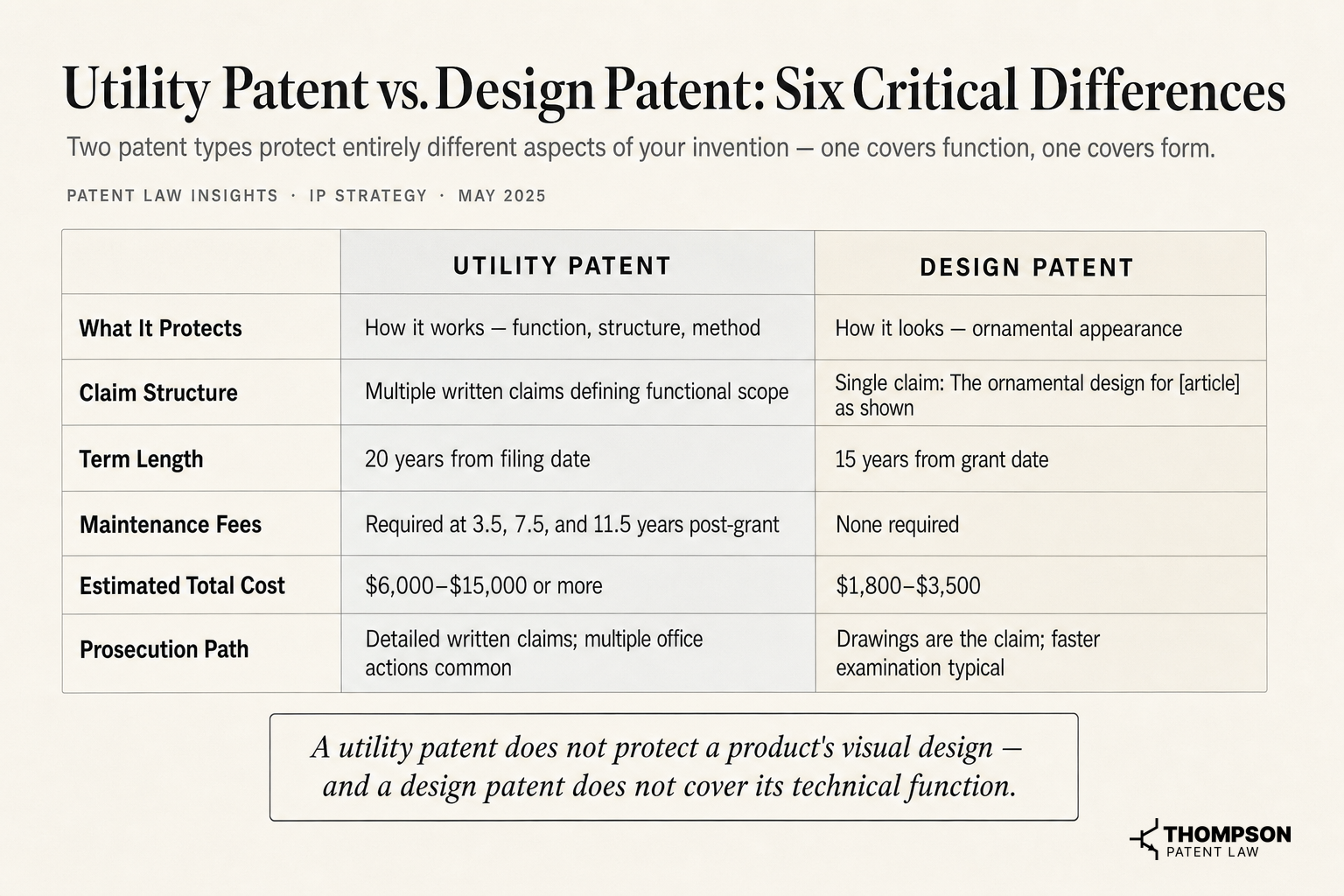 Utility Patent vs. Design Patent: Six Critical Differences — Source: 35 U.S.C. § 101, § 171, § 173; USPTO Fee Schedule, 2025; Fit Small Business, 2025
What a Utility Patent Protects
Utility patents protect how an invention works, its function, structure, and method of operation. Under 35 U.S.C. § 101, a utility patent covers any new and useful process, machine, manufacture, or composition of matter, and is by far the most common filing type. For a deeper walkthrough, see the complete guide to utility patent requirements in 2025.
What a Design Patent Protects
A design patent protects how an invention looks, its ornamental appearance, not its functional aspects, in a single claim supported entirely by drawings. If competitors could copy your product's look without copying how it works, design patent protection fills a gap a utility patent cannot.
Why Inventors Frequently Confuse the Two
Apple protected its iPhone with utility patents on features like pinch-to-zoom and design patents on the phone's shape and icon grid, per Legal Clarity. Had it filed only one type, rivals could have copied the other dimension freely. If you are still mapping the landscape, understanding the different types of patents explains why the distinction matters.
How Long Each Patent Type Lasts and What It Costs to Keep It
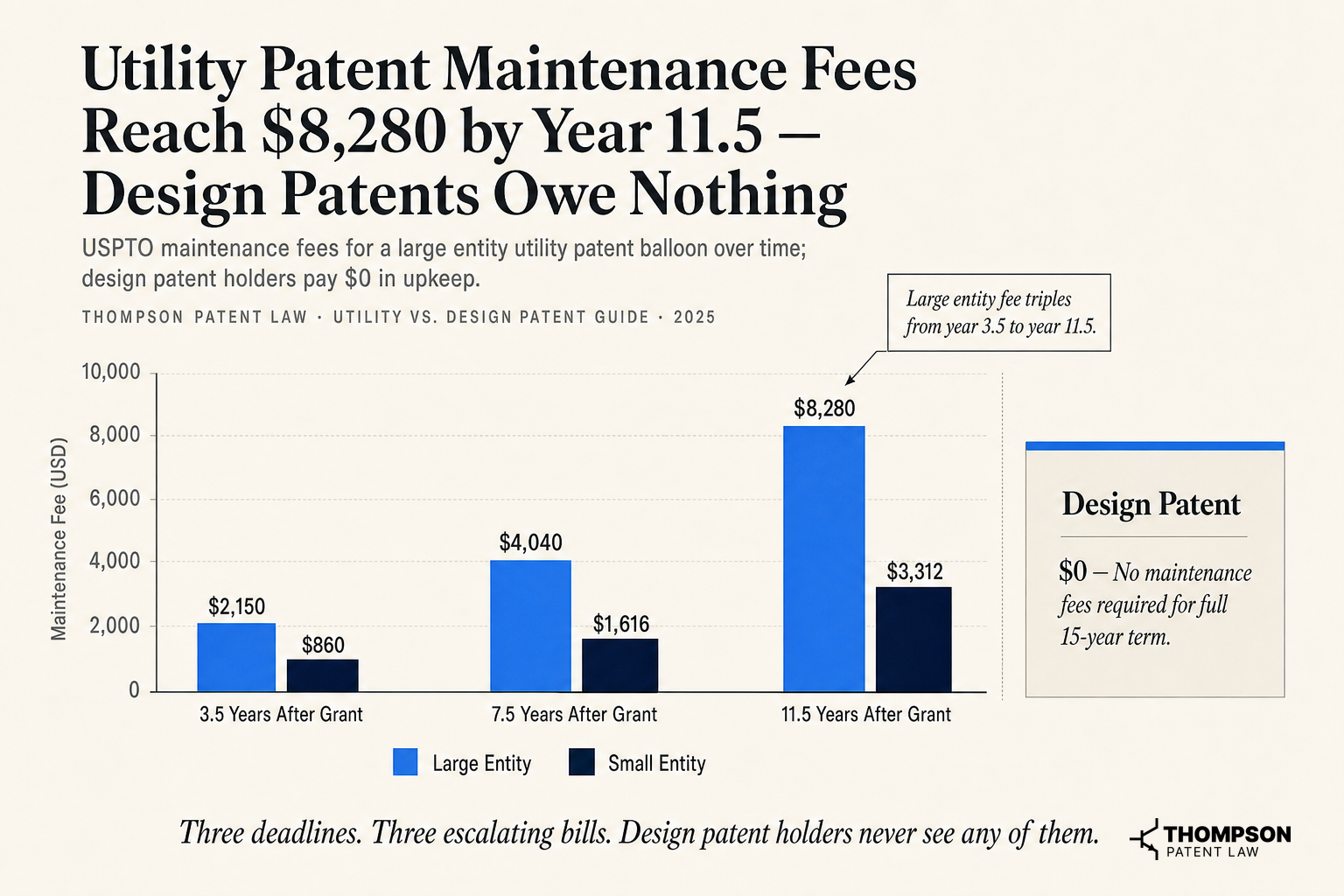 Utility Patent Maintenance Fees Reach $8,280 by Year 11.5 — Design Patents Owe Nothing — Source: USPTO Fee Schedule, Effective 2025
Utility Patent Term and Maintenance Fees
Utility patents last 20 years from the effective filing date. They require maintenance fees at 3.5, 7.5, and 11.5 years after grant, or the patent expires early. Fees increase at each stage, and small and micro entities pay reduced rates. Check the current USPTO fee schedule for exact figures. Budget for these from day one, because a lapsed utility patent abandons your exclusivity.
Design Patent Term and No Maintenance Fees
Real Cost Comparison Across the Patent Application Process
Utility patent prosecution usually involves multiple office actions addressing prior art and obviousness, while the design patent application process tends to be shorter. The lower cost of a design patent means different strategic value, not lower value.
What Qualifies for a Utility Patent Under U.S. Patent Law
Before you spend money on a patent search at the united states patent office, a U.S. patent office filing is only worthwhile if your invention meets utility patent eligibility, so self-assess first.
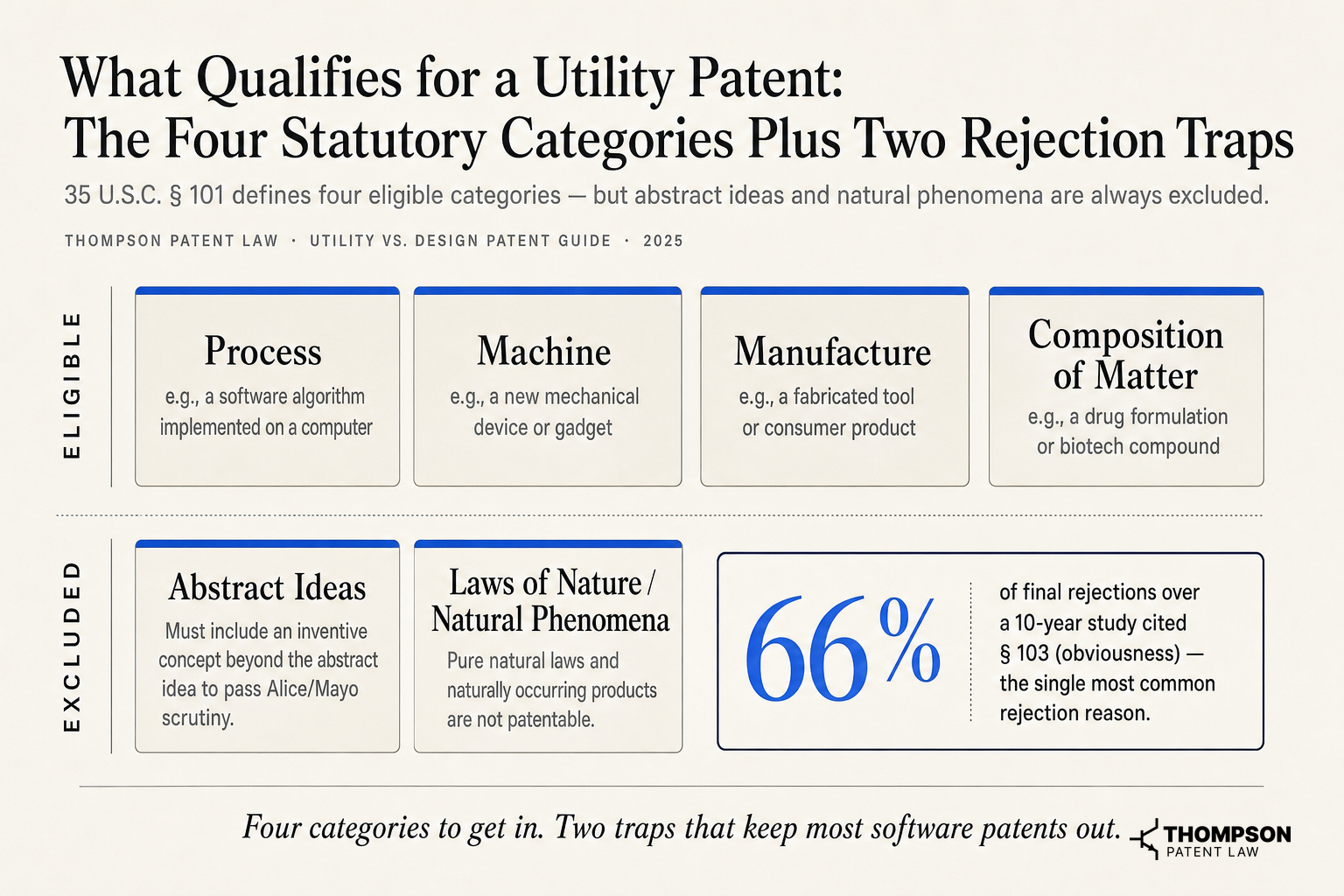 What Qualifies for a Utility Patent: The Four Statutory Categories Plus Two Rejection Traps — Source: 35 U.S.C. § 101 (uscode.house.gov); IPWatchdog Study of USPTO Rejections (ipwatchdog.com, 2016); Supreme Court Alice Corp. v. CLS Bank (lexology.com)
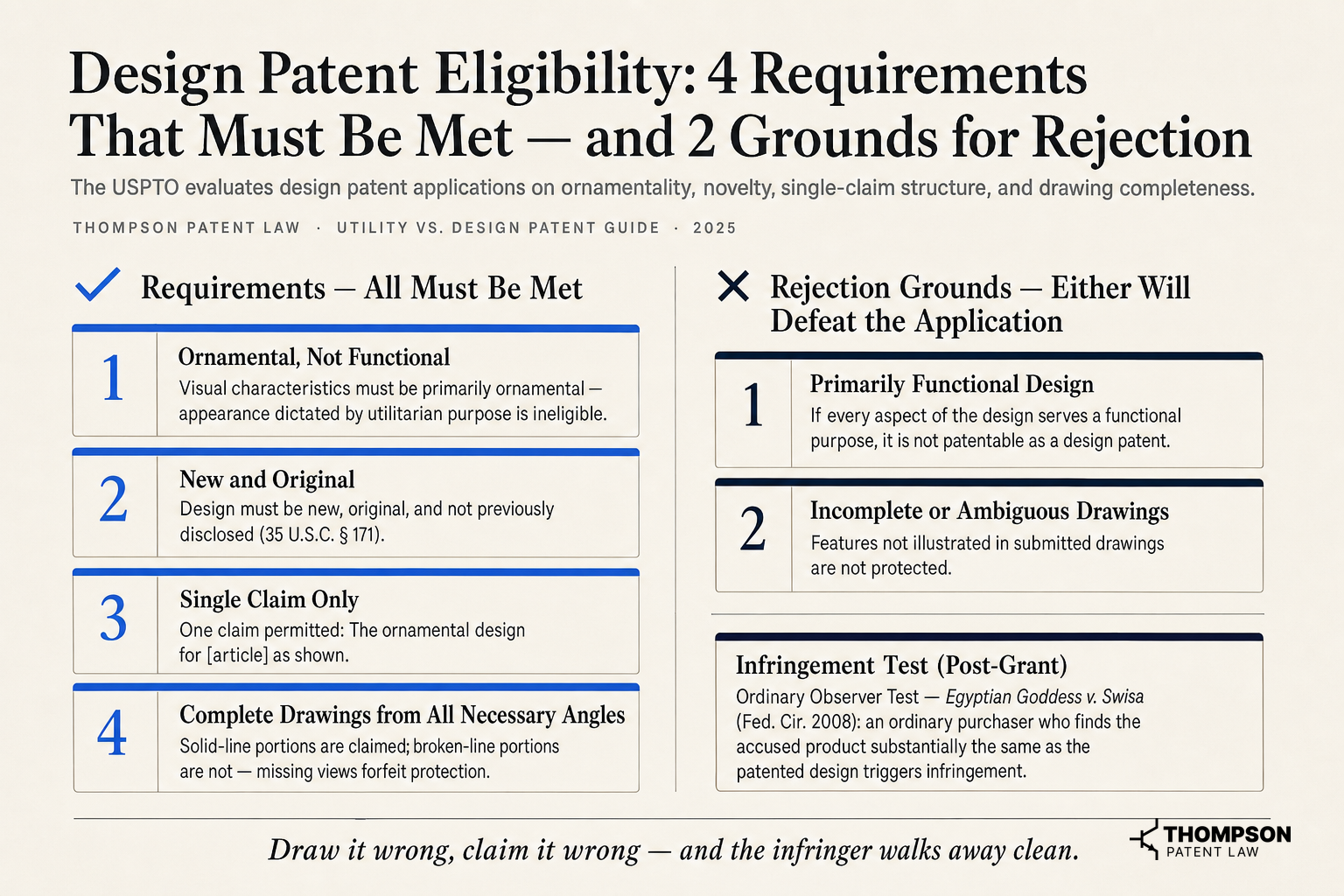 Design Patent Eligibility: 4 Requirements That Must Be Met — and 2 Grounds for Rejection — Source: 35 U.S.C. § 171; USPTO Design Patent Application Guide (uspto.gov); BitLaw MPEP 1504.01(c) (bitlaw.com); Egyptian Goddess v. Swisa, Fed. Cir. 2008 (bitlaw.com)
The Four Statutory Categories of Patentable Subject Matter
Section 101 defines four categories, processes, machines, manufactures, and compositions of matter. A software algorithm is a process, a gadget is a machine or manufacture, a chemical formulation is a composition of matter. Abstract ideas, natural phenomena, and laws of nature are excluded. For software and AI inventions, eligibility under Alice Corp. v. CLS Bank International requires an inventive concept beyond the abstract idea itself.
Novelty and Non-Obviousness Requirements
An invention must also be novel under 35 U.S.C. § 102 and non-obvious under 35 U.S.C. § 103. In a study of first final rejections from 2005 to 2014, 66% cited § 103, according to IPWatchdog, making obviousness the dominant ground of rejection. A professional prior art search before filing saves money and calibrates claim strategy. To see how examiners apply these standards, the US patent process guide breaks down surviving rejections step by step.
The Role of the Provisional Patent Application
A provisional patent application establishes an earliest filing date without starting the 20-year term, giving you 12 months to refine the invention or attract investment before filing a non-provisional. Miss that window and the priority benefit is forfeited. A provisional application applies only to utility applications, and only protects what it fully describes.
What Qualifies for a Design Patent and What Gets Rejected
The Ornamental Appearance Standard
A design patent covers only ornamental appearance, including the visual ornamental characteristics and surface ornamentation, not function. The USPTO will reject a design patent application if the claimed design is dictated solely by function, per the USPTO MPEP chapter 1500. The curved shape of a smartphone can be ornamental, the internal chip layout cannot. If your product's shape serves a purely functional purpose, you need a utility patent strategy instead.
The Role of Drawings in a Design Patent Application
Unlike utility patent applications with written patent claims, a design patent application relies almost entirely on drawings to define scope. The single claim normally reads, in formal terms, "The ornamental design for [article], as shown" (many issued patents also add "and described"), according to the USPTO. What is shown is protected, what is not shown is not. Invest in professional patent drawings, because they are your claims.
The Ordinary Observer Test for Infringement
Design patent infringement is judged under the ordinary observer test from Egyptian Goddess, Inc. v. Swisa, Inc., which asks whether an ordinary observer would mistake the accused product for the patented design. Broad, well-executed drawings create stronger protection and a unique visual presentation that is harder to design around. Narrow drawings create exploitable gaps.
When to File Both a Utility and a Design Patent Application
The smartest inventors think in portfolios, not either-or choices. Building a layered filing plan early is one of the patent tactics that protect your invention before competitors move first.
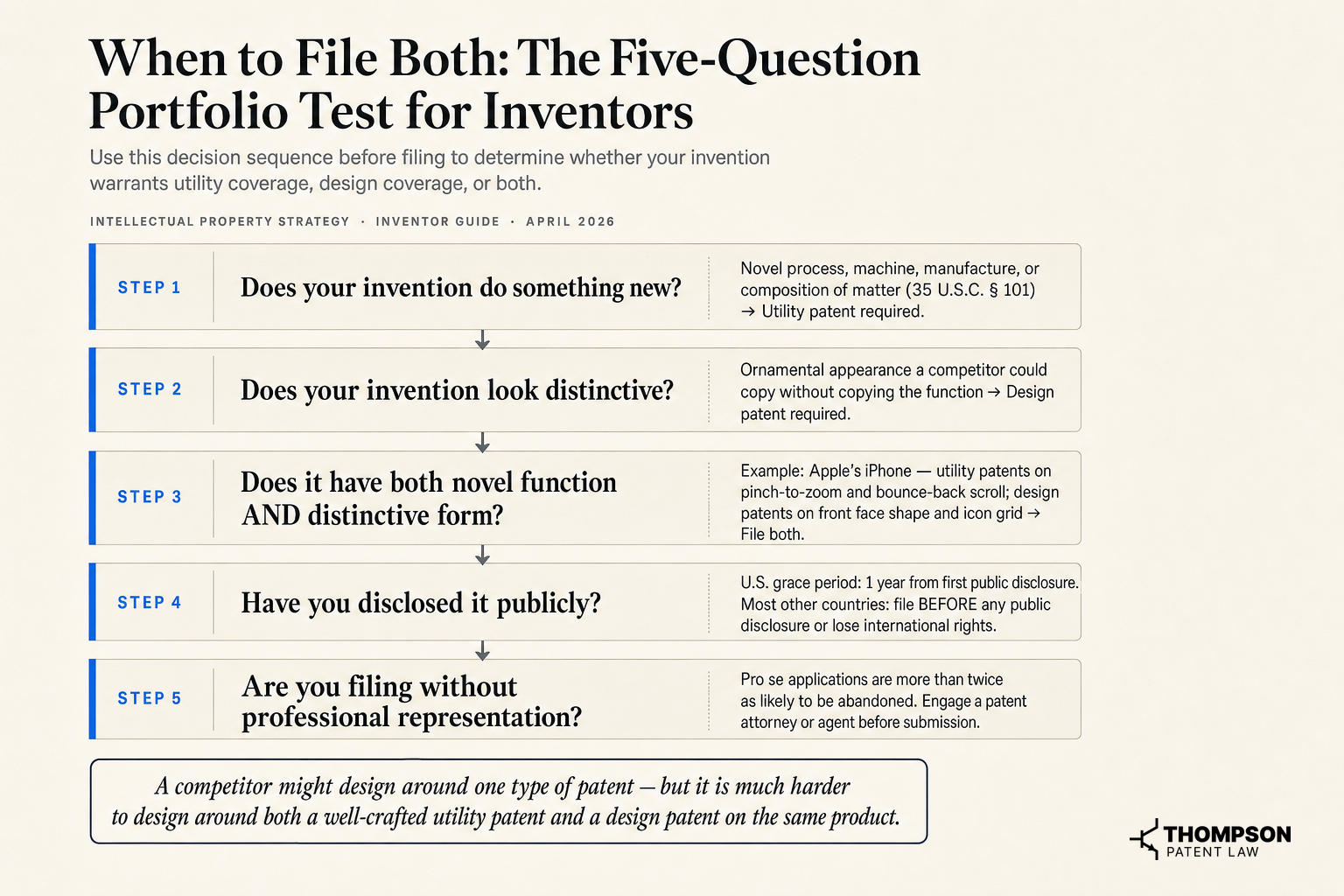 When to File Both: The Five-Question Portfolio Test for Inventors — Source: 35 U.S.C. § 101; LegalClarity — Apple v. Samsung, 2026; PLOS ONE pro se study (journals.plos.org)
Products Where Both Apply and Why
Consumer electronics, medical devices, automotive components, and IoT devices often combine functional innovation with distinctive product design, making them candidates for both utility patent applications and design applications. In the Apple v. Samsung litigation, Apple asserted utility patents for scroll and gesture features alongside design patents for the iPhone's face and icon grid, and the design patents carried significant damages weight, per Legal Clarity and the Supreme Court's decision in Samsung Electronics Co. v. Apple Inc.. Filing both is often cheaper than losing market position.
Timing Considerations Between the Two Filings
You can file a design application and a utility patent application simultaneously or sequentially, and a provisional preserves an earliest filing date for the utility side. Watch the disclosure trap. The United States offers a one-year grace period for inventor-originated disclosures, but many jurisdictions, including Europe, apply an absolute-novelty standard with no general grace period, so early public disclosure can permanently bar patenting there. A PCT application filed under the patent cooperation treaty can help preserve international rights when cross-border protection matters. Define your IP strategy before any public disclosure, since patent applications become public at defined stages.
IP Strategy as a Business Asset
Patents are business tools, not paperwork. A 2023 study found European startups that filed patents were 6.4 times more likely to secure venture funding, according to the EUIPO. The best filing sequence often hinges on your business model, product cycle, and market timing. A Complimentary Patent Needs Assessment with our team can clarify which filings deliver the highest return.
The Most Common Mistakes Inventors Make Choosing Between These Two Patent Types
Two numbers frame the stakes. In FY2023 the USPTO reported 54,632 design patent applications filed, according to the USPTO Design Patents Dashboard, while pro se applications carry an abandonment rate more than double that of represented applicants, per a PLOS ONE study.
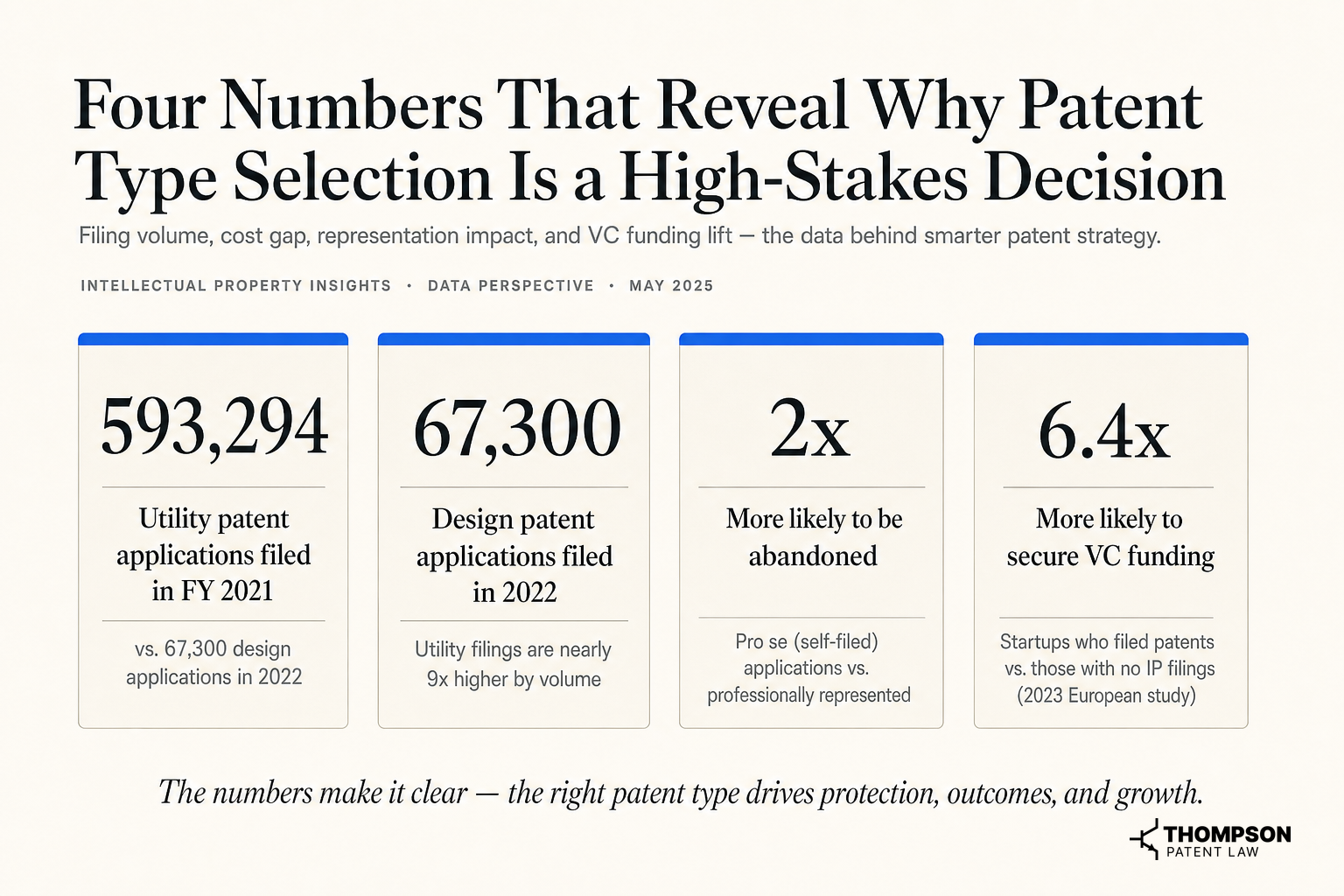 Four Numbers That Reveal Why Patent Type Selection Is a High-Stakes Decision — Source: USPTO FY2021 Performance Report (patentdocs.org); WIPO, 2023; PLOS ONE (journals.plos.org); EUIPO Startup Finance Study, 2023
Assuming a Utility Patent Automatically Covers the Look of the Product
A utility patent protects functional claims, not visual ones. If a competitor builds an identical-looking product with a different internal mechanism, utility patent applications alone may not stop them. Review your product for both functional and ornamental exposure before deciding a single patent type is enough. Learning how to patent an idea in six steps helps you map that exposure early.
Filing a Design Patent Application When Utility Coverage Was Needed
The reverse error is choosing a design patent because it is faster and cheaper while the real competitive risk is functional copying, especially when a competitor copies a functional item and merely changes its appearance. A design patent that does not protect the right dimension provides false security.
Waiting Too Long or Relying on a DIY Approach
Public disclosure starts the one-year U.S. grace period and can eliminate rights in absolute-novelty countries immediately. Pro se applications were more than twice as likely to be abandoned than represented ones, per a PLOS ONE study, and those that issued tended to have narrower claims. An experienced patent attorney evaluates the right filing type, claim scope, and timing before a dollar is spent — providing legal advice that no online tool can replicate.
Frequently Asked Questions About Utility vs Design Patent
How much is a utility patent vs design patent?
Design patents typically cost a few thousand dollars versus mid to high four figures or more for a utility patent, according to Fit Small Business.
Is a utility patent better than a design patent?
Neither is universally better. A utility patent is stronger when your value is in how it works, a design patent when your advantage is in how it looks. For many products, both together provide stronger protection, and an experienced ip attorney can map the right combination for your situation.
What are the three types of patents?
The USPTO issues utility patents, design patents, and one additional category not covered here. Utility and design patents are the most common and commercially relevant, and both are administered by the united states patent and trademark office.
What qualifies for a utility patent?
An invention qualifies if it falls within the statutory categories under 35 U.S.C. § 101 and is novel, non-obvious, and useful. Software and AI inventions face the additional hurdle of the Alice framework.
What is the difference between a patent and a utility patent?
"Patent" is the general term for the right to exclude others from making, using, or selling an invention. A utility patent is the most common type, covering functional inventions. When people say "patent" in a product context, they usually mean a utility patent.
Which Patent Application Is Right for Your Invention
The right patent type depends on what creates your competitive value, function, appearance, or both. Utility patent applications protect how something works for 20 years, require maintenance fees, and demand careful claim strategy. Design patents protect how something looks for 15 years, require no maintenance fees, and live or die by drawing quality.
A weak patent, filed under the wrong category or with claims a competitor can design around, offers little more than false security and can invite costly patent disputes that jeopardize your intellectual property rights. The worst outcome is filing the wrong type, or filing either without the claim scope to enforce it, leaving you without a clear path to legal action. Every month you wait, a competitor can disclose first, design around a hasty filing, or capture market share you cannot reclaim.
Take these next steps:
- Schedule a Complimentary Patent Needs Assessment and speak with a member of our team about which patent application strategy fits your invention, business, and budget.
- Review your product for both functional and ornamental exposure before choosing a single filing path.
- Explore more strategy resources at the Innovation Hub to sharpen your filing plan.
Thompson Patent Law is a team of registered patent attorneys with engineering degrees, led by Craige Thompson, a patent attorney, MBA, and electrical engineer. The firm helps inventors and businesses turn the right filing strategy into a durable competitive advantage and lasting return on their innovation. No attorney client relationship is formed by reading this article; contact the firm directly for counsel specific to your situation.
Keep Innovating.
Craige Thompson
Patent Attorney, MBA, Electrical Engineer
Thompson Patent Law