


- The four main types of intellectual property under U.S. law are patents, copyrights, trademarks, and trade secrets, each protecting a different type of asset through a different legal mechanism.
- Copyright protection attaches automatically the moment an original work is created, while patents require a formal application and an examination process that runs well over a year.
- Choosing the wrong category is a strategic error, not a technicality — publicly disclosing something through a patent application can permanently destroy the option to protect it as a trade secret.
- Trademark protection is the only category that can last indefinitely, but only as long as the mark stays in active use and the owner polices unauthorized use.
- The strongest IP portfolios layer multiple categories on the same product — for example a utility patent on the mechanism, a design patent on its appearance, a trademark on its name, and copyright on its packaging.
Intangible assets now account for roughly 92% of the S&P 500's market value, according to Ocean Tomo's Intangible Asset Market Value Study. That single statistic explains why understanding the categories of intellectual property has shifted from a legal formality to a core business strategy question — and why getting it wrong costs real money.
Key Takeaways
- The four main types of intellectual property under U.S. law are patents, copyrights, trademarks, and trade secrets. Each protects a different type of asset through a different legal mechanism.
- Copyright protection attaches automatically upon creation of an original work. Patents, by contrast, require a formal application and examination process that averages over two years from filing to grant.
- Choosing the wrong IP category is a strategic error, not just a technicality. A process you should keep as a trade secret may be permanently compromised if you patent it and publicly disclose it instead.
- Trademark protection is the only IP category that can last indefinitely, but only if you actively use the mark and police unauthorized use.
- Before any investor conversation, you should be able to map each business asset to its IP category and identify which protections are in place versus where gaps exist.
Why Intellectual Property Categories Exist in the First Place
Intellectual property law was built on a single premise: creators who cannot protect their work have less reason to create it. The United States Constitution reflects this directly. Article I, Section 8 grants Congress the power to "promote the Progress of Science and useful Arts" by securing exclusive rights to inventors and authors. That constitutional foundation spawned the patent system, the copyright system, and eventually the federal trademark registration system that businesses depend on today.
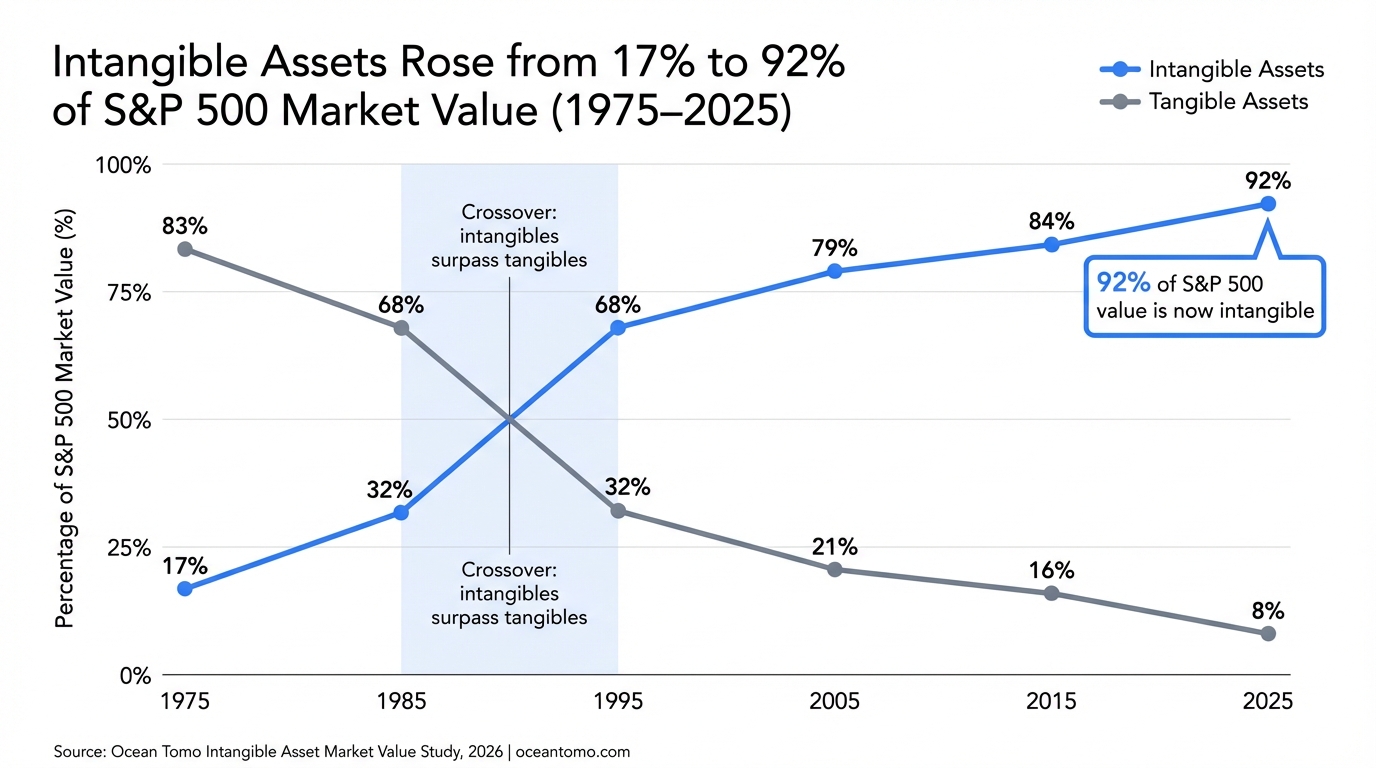 Intangible Assets Rose from 17% to 92% of S&P 500 Market Value (1975–2025) — Source: Ocean Tomo Intangible Asset Market Value Study, 2026
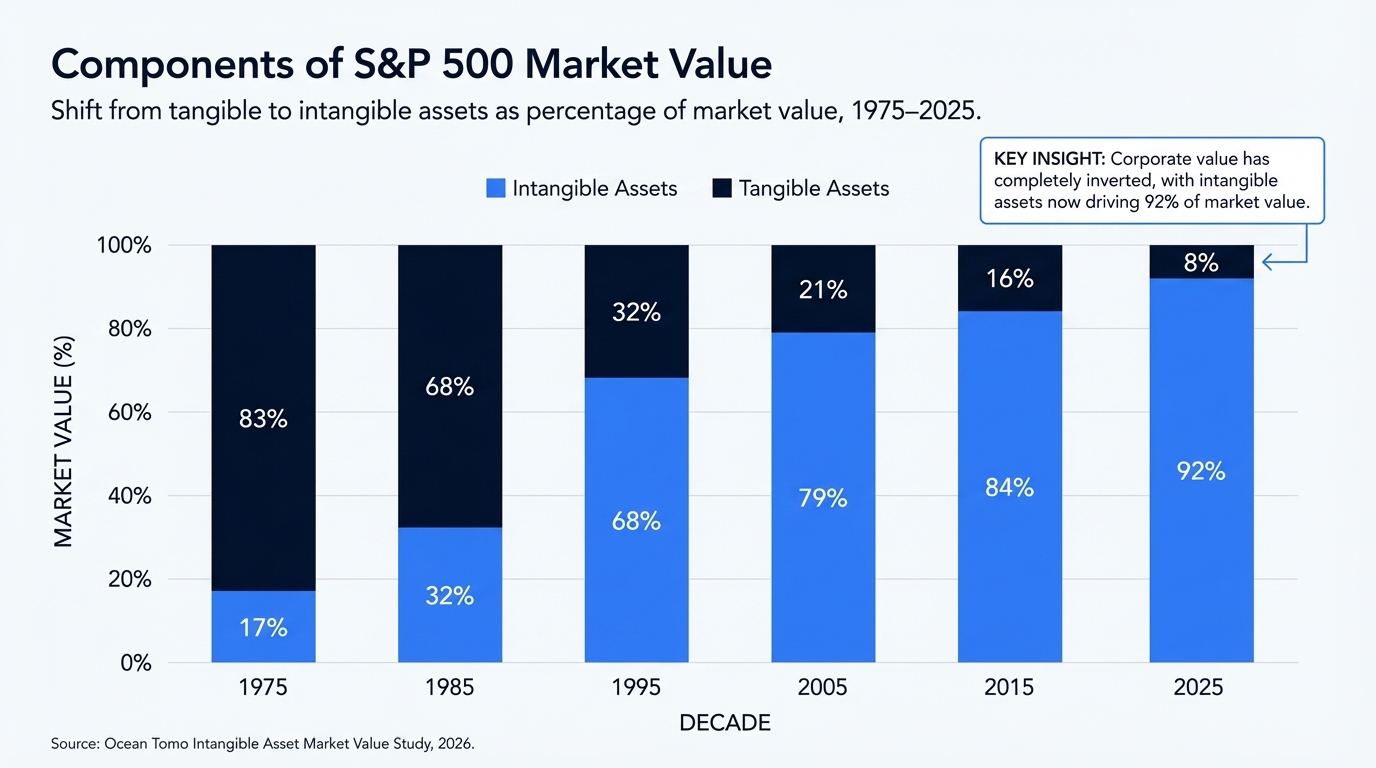 Ocean Tomo. What changed is not the law, but what businesses are actually worth — patents, brand equity, proprietary algorithms, and trade secrets now constitute the bulk of corporate value in nearly every sector.
This shift is why the categories of intellectual property matter to founders and engineers, not just lawyers. When investors value technology companies, they are largely valuing the intellectual property portfolio of each firm. When a competitor emerges, the question of what you can enforce depends entirely on which category of protection you secured and whether you secured it correctly. Understanding the different types of patents alone can mean the difference between enforceable exclusivity and a gap a competitor walks right through.
What Qualifies as Intellectual Property and Why It Matters to Your Business
Intellectual property rights are legal rights over intellectual works — inventions, artistic works, names, symbols, and confidential business information — that arise from creations of the human intellect. Unlike physical assets, intellectual property assets can be licensed, sold, leveraged for investment, and enforced across borders without the asset ever leaving your possession.
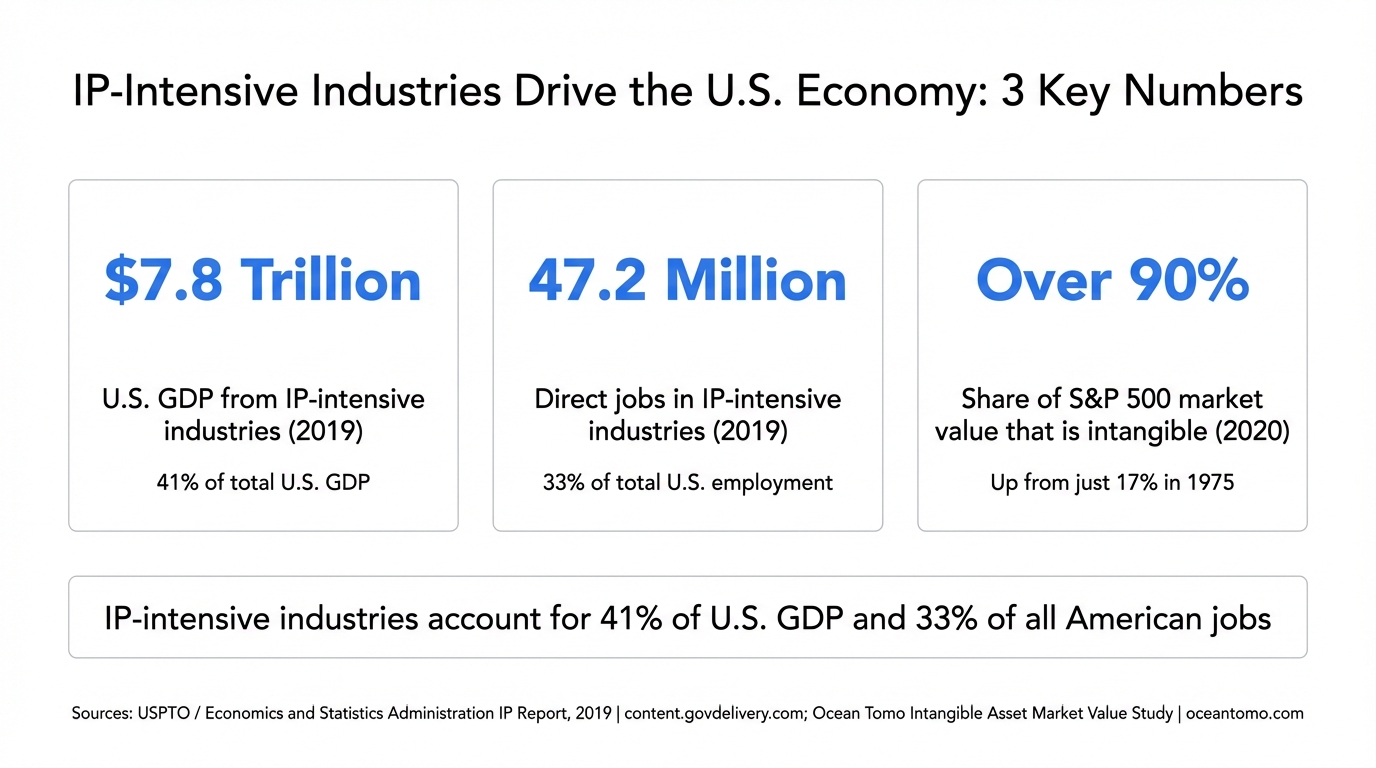 IP-Intensive Industries Drive the U.S. Economy: 3 Key Numbers — Source: USPTO / Economics and Statistics Administration IP Report, 2019; Ocean Tomo Intangible Asset Market Value Study
The Economic Value of Intangible Assets Has Fundamentally Changed Business Valuation
The numbers behind IP-intensive industries are substantial. According to a USPTO economic study, IP-intensive industries contributed $7.8 trillion to the U.S. economy in 2019, representing 41% of GDP and supporting 47.2 million direct jobs — about 33% of U.S. employment. Those figures come from 127 industries the USPTO identified as IP-intensive, spanning pharmaceuticals, software, consumer goods, and manufacturing.
For startups seeking venture funding, research shows that a credible IP strategy correlates directly with higher valuations and funding success. Investors conducting due diligence want to see that core innovations are protected or in prosecution before they close a term sheet. Understanding how to calculate patent value before those conversations gives founders a concrete advantage at the negotiating table.
Intellectual Property Rights Give Owners the Exclusive Right to Commercialize Their Work
An intellectual property right is an exclusive right — meaning the owner can exclude others from using, copying, selling, or profiting from the protected asset without authorization. These exclusive rights are not automatic for every category. Patents require a formal application. Copyrights attach automatically upon creation of an original work fixed in a tangible medium. Trademarks can be common law or registered. Trade secrets require active internal protection measures to maintain their status.
Knowing whether protection is automatic or requires registration determines how urgently you need to act after creating something valuable. A software developer whose code is automatically protected by copyright law the moment it is saved to disk faces a very different decision timeline than an inventor whose patent application window closes at disclosure.
Failing to Identify the Right IP Category Means Choosing the Wrong Protection Strategy
A business that tries to patent something it should have kept as a trade secret publicly discloses the very information competitors need to develop workarounds. A company that relies on trade secret protection for a brand name it should have registered as a trademark loses the ability to enforce nationwide rights against intellectual property infringement by unauthorized parties. Each category has its own legal framework, timelines, costs, and enforcement mechanisms. Misidentification is not a technicality — it is a competitive advantage given away.
How Patents Protect New Inventions and How Long That Protection Lasts
A patent grants an inventor exclusive rights to make, use, sell, and import a specific invention in the United States for a defined period. In exchange, the inventor publicly discloses how the invention works. The United States Patent and Trademark Office (USPTO), also known as the U.S. Patent Office, administers the patent system, and a granted patent is among the most powerful forms of intellectual property protection available — but also one of the most demanding to obtain. If you are starting from scratch, learning how to patent an idea before you file can prevent costly missteps early in prosecution.
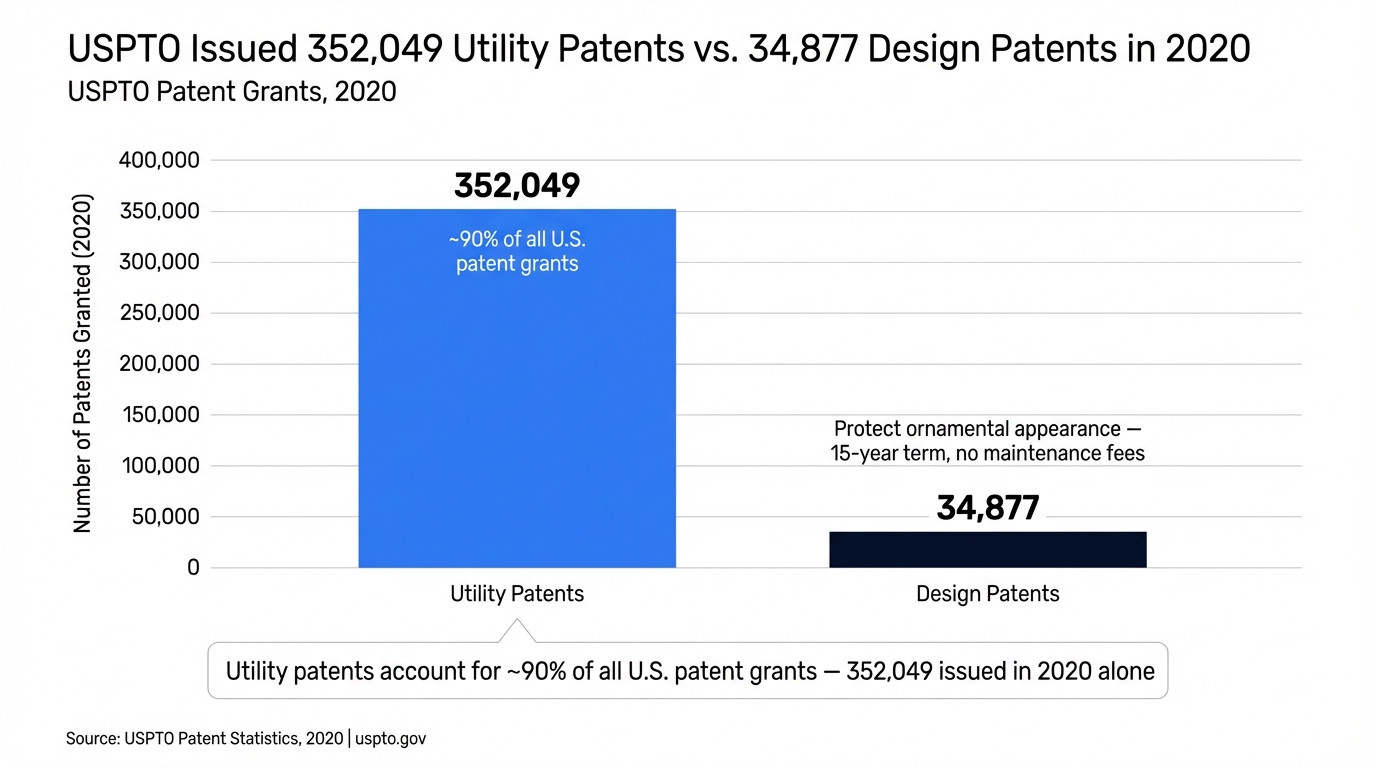 USPTO Issued 352,049 Utility Patents vs. 34,877 Design Patents in 2020 — Source: USPTO Patent Statistics, 2020 In 2020, the USPTO issued 352,049 utility patents and 34,877 design patents, a ratio that illustrates just how dominant utility protection is in practice.
Utility Patents Cover How an Invention Works and Are the Most Common Patent Type
Utility patents protect new and useful processes, machines, articles of manufacture, and compositions of matter. They represent approximately 90% of patents granted by the USPTO each year. A utility patent gives the patent owner patent rights consisting of a 20-year term of exclusivity measured from the application date, not the grant date, and requires maintenance fee payments at 3.5, 7.5, and 11.5 years to keep the patent in force. For a full breakdown of how those durations work across patent types, see Patent Terms Made Simple.
This category covers most software-implemented inventions, mechanical devices, medical devices, and new technology systems. According to the USPTO Patents Pendency Dashboard, first office action pendency currently runs approximately 22.6 months, with total pendency reaching 26.3 months (excluding RCEs) and 31.1 months when RCEs are included as of FY2025 — figures that vary significantly by technology area. For those who deploy sophisticated prosecution strategies, experienced counsel can compress effective timelines considerably. If your invention solves a functional problem in a new way, a utility patent application is almost certainly the right starting point.
Many inventors also file a provisional patent application first, securing a priority date while finalizing their claims. A provisional patent application gives you 12 months to file the full nonprovisional application before that priority date expires.
Design Patents Protect the Ornamental Appearance of a Product
Design patents protect how a physical invention looks, not how it works. They carry a 15-year term from grant and are less expensive to prosecute than utility patents. Apple's design patent enforcement in its litigation against Samsung illustrates how commercially significant ornamental protection can be. Apple was awarded approximately $539 million in damages by the court in the 2018 phase of their smartphone patent dispute — a figure driven in significant part by design patent damages.
A single product can carry both utility patent and design patent protection when it has both a novel function and a novel appearance. The Coca-Cola bottle, for example, achieved iconic status that overlaps design protection with trademark trade dress rights.
The Patent Application Process Requires Clearing Prior Art and Surviving Examination
Every patent application goes through examination by a USPTO patent examiner who searches for prior art — prior patents, publications, and public disclosures that might anticipate or render obvious the claimed invention. Obviousness under 35 U.S.C. § 103 is the most common rejection basis. A patent attorney's work during prosecution is to distinguish the claimed invention from prior art through precise claim drafting and legal argument. Understanding utility patent requirements before filing helps inventors avoid the most common rejection pitfalls.
Overall patent grant rates in the U.S. run around 75 to 77% after responses and allowances are accounted for, according to Patently-O's March 2026 analysis of USPTO disposal data. That figure improves meaningfully with experienced prosecution. Experienced prosecution counsel can improve grant outcomes meaningfully — rates that come from treating claim drafting as a strategic exercise, not a documentation formality.
How Copyright Law Covers Creative Work From the Moment It Exists
Copyright law provides broad, automatic, and inexpensive protection. It attaches the moment an original work of authorship is fixed in a tangible medium — the instant a developer saves a line of computer code, a musician records a composition, or an author completes a manuscript. No registration is required for copyright to exist, but registration with the U.S. Copyright Office dramatically strengthens enforcement rights and is a prerequisite for filing an infringement lawsuit over a U.S. work.
Copyright Law Protects Original Works Across a Wide Range of Creative Categories
Under the Copyright Act of 1976, copyright law covers literary works, musical compositions, sound recordings, dramatic works, choreography, pictorial and graphic works, audiovisual works, and — critically for technology businesses — computer software, computer programs, and software code. The U.S. Copyright Office received over 443,900 registration applications in fiscal year 2020 across all these categories, reflecting the breadth of what copyright law governs.
Copyright law does not require novelty. It requires only originality, meaning the work must originate from the author and reflect at least a minimal degree of creativity — a standard that makes copyright law one of the broadest forms of legal protection for creative subject matter. The Supreme Court established this standard in Feist Publications v. Rural Telephone Service (1991), confirming that facts are not copyrightable — only the original expression surrounding them.
Derivative works receive their own copyright protection. A software update that adds original code to an existing codebase creates new copyright interests even if the underlying platform is owned by a third party. Understanding how derivative works interact with the original works they are built on is essential for technology businesses that build on open-source platforms or license third-party code.
Copyright Duration Extends Far Beyond What Most Creators Expect
For works created by an individual author on or after January 1, 1978, copyright protection lasts for the author's life plus 70 years. For works made for hire — works created by employees within the scope of their employment or certain commissioned works — protection lasts 95 years from publication or 120 years from creation, whichever expires first. As of 2024, any work first published before 1928 has entered the public domain, according to the U.S. Copyright Office.
These are long durations. Original works created today by a young author could remain protected well into the 22nd century. If your business relies on third-party content, verifying the copyright status of that material before use is essential — assuming something is old enough to be in the public domain without confirming it is a litigation risk.
Registering With the U.S. Copyright Office Unlocks Statutory Damages and Attorney's Fees
Copyright registration is not mandatory for protection to exist, but unregistered copyright owners can recover only actual damages in an infringement lawsuit — which are often difficult to prove and modest in value. Registered copyright owners can pursue statutory damages of $750 to $30,000 per work, or up to $150,000 per work for willful infringement under 17 U.S.C. § 504(c), plus attorney's fees.
For derivative works and software products that will be commercially exploited, registration is standard practice. The fee is as low as $65 per work through the U.S. Copyright Office online portal. Registering before public release preserves your right to maximum statutory damages — waiting until after an infringement occurs can eliminate your access to those remedies entirely.
How Trademarks Protect Brand Identity and What the Registration Process Involves
A trademark is any word, name, symbol, device, or combination thereof that identifies and distinguishes the source of goods or services in the marketplace. The McDonald golden arches identify McDonald's as a source of goods and services. The Nike swoosh identifies athletic goods from a specific source. Trademark rights arise from use in commerce, but registration with the USPTO's Trademark Office delivers nationwide constructive notice and significantly stronger legal protection and enforcement rights.
Trademarks Cover a Broader Range of Identifiers Than Most Business Owners Realize
Beyond standard word marks and logos, trademark protection can extend to trade dress (product packaging or store design), color marks (Tiffany blue, UPS brown), sound marks (the NBC chimes), and scent marks in limited circumstances. Service marks function identically to trademarks but identify services rather than goods. The USPTO organizes trademark registrations across 45 international classes of goods and services.
The scope of what can function as a trademark is defined by distinctiveness. Fanciful or arbitrary marks receive the strongest trademark protection. Generic terms cannot be trademarked at all. Before investing in brand development, a trademark clearance search is essential — building a brand on an unregistrable or already-registered mark means an expensive forced rebrand down the road.
Federal Trademark Registration Delivers Nationwide Rights and Legal Presumptions
Under trademark law, a registered trademark owner gains nationwide constructive notice of ownership under 15 U.S.C. § 1072, a legal presumption of ownership and the exclusive right to use the mark for registered goods and services, and the ability to display the ® symbol. The USPTO reported approximately 824,000 new trademark classes filed in fiscal year 2025, a 7.4% increase from the prior year, underscoring how aggressively businesses are competing for brand protection.
The average time from filing to registration currently runs around 11 to 12 months. After five years of continuous use, a registered mark can achieve "incontestable" status under Section 15 of the Lanham Act (15 U.S.C. § 1065), making it significantly harder to challenge. File a trademark application as soon as you have a brand name you intend to commercialize — trademark rights go to first-to-use, and delays create vulnerability.
Trademark Protection Requires Active Policing to Remain Enforceable
Unlike patents and copyrights, which have fixed terms, trademark rights can last indefinitely as long as the mark remains in use in commerce and the owner files required maintenance documents with the Trademark Office and actively polices unauthorized use. A trademark that becomes generic falls into the public domain regardless of prior registration. "Aspirin," "escalator," and "thermos" all lost trademark protection this way.
Trademark owners are legally expected to pursue infringers. Failure to do so consistently can be raised as an acquiescence defense by subsequent infringers. A registered trademark requires an ongoing monitoring and enforcement strategy — registration alone is not a set-it-and-forget-it form of intellectual property protection.
How Trade Secrets Protect Confidential Business Information Without Registration
Trade secrets are the category of intellectual property that receives no formal registration and requires no public disclosure. A trade secret is any confidential information — a formula, process, device, customer list, algorithm, or business strategy — that derives economic value from not being generally known and that the owner takes reasonable measures to keep secret. The KFC recipe and the Google search algorithm are among the most cited examples. Unlike a patent on an invention, trade secret protection over something like the Google search algorithm can theoretically last forever, as long as secrecy is maintained.
Federal and State Law Both Govern Trade Secret Protection in the United States
At the federal level, the Defend Trade Secrets Act of 2016 (DTSA), codified at 18 U.S.C. § 1836, created a federal civil cause of action for trade secret misappropriation for the first time, allowing trade secret owners to sue in federal court without relying on state law. The Economic Espionage Act of 1996 separately criminalizes trade secret theft. At the state level, 49 states have adopted versions of the Uniform Trade Secrets Act (UTSA), with New York as the remaining exception.
Trade secret law requires that the owner have taken "reasonable measures" to protect the information's secrecy. Without those measures, the protection does not exist, even if the theft is unambiguous. Non-disclosure agreements with employees, contractors, and partners are the first line of documentation. If a trade secret is ever litigated, your internal security practices become the evidence that you took reasonable measures.
Trade Secrets and Patents Protect Different Aspects of Innovation and Require a Strategic Choice
A company with a novel manufacturing process faces a direct strategic decision: patent it and receive 20 years of exclusivity in exchange for full public disclosure, or keep it as a trade secret and maintain protection indefinitely. The Coca-Cola formula has remained a trade secret for over 130 years — far longer than any patent could have protected it. That example illustrates when secrecy wins.
The right choice depends on two factors. First, whether the innovation is reverse-engineerable from the finished commercial product — if competitors can work backward to your process, a patent gives you enforceable rights; a trade secret gives you nothing once they figure it out. Second, whether the competitive advantage degrades as the industry advances — if it does, the 20-year patent window may be exactly right; if it remains stable, a trade secret strategy may deliver more durable protection. The process of patent registration itself involves strategic decisions about disclosure timing that directly affect this calculus.
Reasonable Efforts to Maintain Secrecy Are the Foundation of Trade Secret Protection
Courts evaluate whether a company's protection measures were "reasonable under the circumstances." This typically means non-disclosure agreements with all employees and contractors who have access to the information; access controls limiting exposure on a need-to-know basis; physical and digital security measures for sensitive systems; confidentiality markings on sensitive documents; and documented exit protocols for departing employees covering the return and deletion of proprietary information.
According to WIPO's guidance for small and medium-sized enterprises, the foundation of any trade secret protection program is documentation — written policies, signed agreements, and audit trails. Without a documented trade secret protection program, trade secret claims fail in court even when the underlying theft is undeniable.
Geographical Indications Protect Region-Specific Products and Their Market Value
A geographical indication links a product's quality or reputation to its geographic origin. Champagne, Parmigiano-Reggiano cheese, and Darjeeling tea are protected geographical indications under international agreements administered by WIPO. In the United States, geographical indications can be protected as certification marks registered through the USPTO's Trademark Office.
For food and beverage producers, geographical indications represent a form of intellectual property protection that competitors cannot replicate regardless of formula — because they cannot replicate geography. If your product's market value is tied to its region of origin, investigating certification mark protection before competitors establish conflicting marks is a direct competitive advantage.
Industrial Designs Protect the Visual Appearance of Products Under International Frameworks
Industrial designs, a recognized category of industrial property, protect the ornamental or aesthetic aspects of a product — its shape, pattern, lines, or color configuration. In the United States, this protection is provided through design patents. Internationally, industrial design protection is governed by the Hague Agreement administered by WIPO, which allows a single application to secure protection in multiple countries simultaneously.
Fashion houses, consumer electronics manufacturers, and furniture designers are among the heaviest users of industrial design protection globally. If you sell products internationally, the Hague Agreement offers a cost-effective path to multi-country design protection without filing separate applications in each jurisdiction.
How to Build an Intellectual Property Strategy That Matches Your Business Model
Understanding the categories of intellectual property is necessary but not sufficient. The real question is which categories apply to your specific assets and which protection mechanisms deliver the best competitive advantage given your business model, timeline, and resources.
Startups Need an IP Audit Before Their First Funding Round
Venture investors conduct IP due diligence before closing. They want to see that the company owns its intellectual property outright — including written assignment agreements from all founders and contractors — that core innovations are protected or in active prosecution, and that no obvious third-party IP conflicts exist. A startup that has been operating for two years without addressing IP ownership is not starting from zero on due diligence. It may be starting from a deficit.
Key inventions that were publicly disclosed without a patent application on file may be unpatentable. Computer programs whose copyright ownership was never formally assigned from a contractor to the company may belong to the contractor. Copyright law registration for software and content assets may be missing entirely, reducing the firm's enforcement leverage. Before any investor conversation, conduct a basic IP audit that maps every asset to its category and identifies the gaps in IP protection. Learning how to patent a product early in the development cycle avoids the scramble of filing after disclosure has already occurred.
The Right IP Strategy Aligns Protection Duration With Competitive Advantage Horizon
A brand built on customer recognition needs perpetual trademark protection through the Trademark Office. A manufacturing process that will be displaced in ten years by a superior technology needs the 20-year window of a utility patent and the public disclosure that comes with it. Proprietary customer data and internal business processes often make better trade secrets than patents, because a patent application would require public disclosure and competitors could design around the published claims.
Digital assets, computer programs, and content platforms rely primarily on copyright law protection, which attaches automatically and costs almost nothing to secure at creation. The most defensible intellectual property portfolios layer multiple categories of protection on the same underlying asset. A consumer product might carry a utility patent on its core mechanism, a design patent on its appearance, a registered trademark on its name and logo, and copyright law protection on its packaging artwork — all protecting different aspects of the same commercial investment. For software-based innovations, understanding patents for software adds another layer to that defensive stack.
Frequently Asked Questions About Categories of Intellectual Property
Which are the four main types of intellectual property? The four main types of intellectual property recognized under United States law are patents, copyrights, trademarks, and trade secrets. International frameworks administered by WIPO also recognize geographical indications and industrial designs as distinct categories. Each protects a different type of asset through a different legal mechanism, with different registration requirements, durations, and intellectual property rights.
What are the 4 main types of intellectual property? Patents protect inventions. Copyrights protect original works of authorship, including computer programs, literary works, and sound recordings. Trademarks protect brand identifiers — names, logos, and other source indicators. Trade secrets protect confidential business information that derives economic value from not being generally known. These four types cover the vast majority of commercially valuable intellectual property assets held by U.S. businesses.
What are the categories that constitute intellectual property? Intellectual property is constituted by any creation of the human intellect to which the law attaches exclusive rights. The categories are defined by the nature of the creation: inventive functionality (patents), creative expression (copyrights and copyright law), commercial identity (trademarks), and confidential competitive information (trade secrets). Additional categories like geographical indications and industrial designs cover specialized cases where the source or appearance of a product carries independent market value.
What is the difference between a patent and a trade secret? Both patents and trade secrets can protect inventions and proprietary processes, but through opposite mechanisms. A patent requires public disclosure in exchange for a 20-year exclusive right — after which the invention enters the public domain. A trade secret requires no disclosure and can last indefinitely, but the protection ends the moment the information becomes publicly known or is independently discovered. The strategic choice depends on whether the innovation can be reverse-engineered from the commercial product and how long its competitive value will persist. For a deeper look at this tradeoff, see Can Ideas Be Patented?
Do copyrights need to be registered to be enforceable? Copyright law protection attaches automatically to original works upon creation — no registration with the U.S. Copyright Office is required for copyright to exist. However, registration is required before filing an infringement lawsuit for U.S. works, and only registered copyrights qualify for statutory damages up to $150,000 per willful infringement and attorney's fees. For commercially exploited works including software, registration is strongly recommended before public release.
How long does trademark protection last compared to other IP categories? Trademark protection is potentially indefinite, as long as the mark remains in use in commerce and the owner files required maintenance documents with the USPTO and actively defends it against infringement. This distinguishes trademarks from every other IP category: utility patents expire after 20 years, copyrights expire 70 years after the author's death, and trade secrets end when secrecy is lost. Active policing is not optional — a trademark owner who tolerates unauthorized use risks losing the mark entirely.
The Right Category Is Only the First Step
Identifying which category of intellectual property applies to your asset tells you which legal framework governs it. What it does not tell you is whether your protection strategy is actually strong enough to withstand a challenge, whether your patent claims are broad enough to deter competitors, or whether you have left valuable assets in a gap between categories.
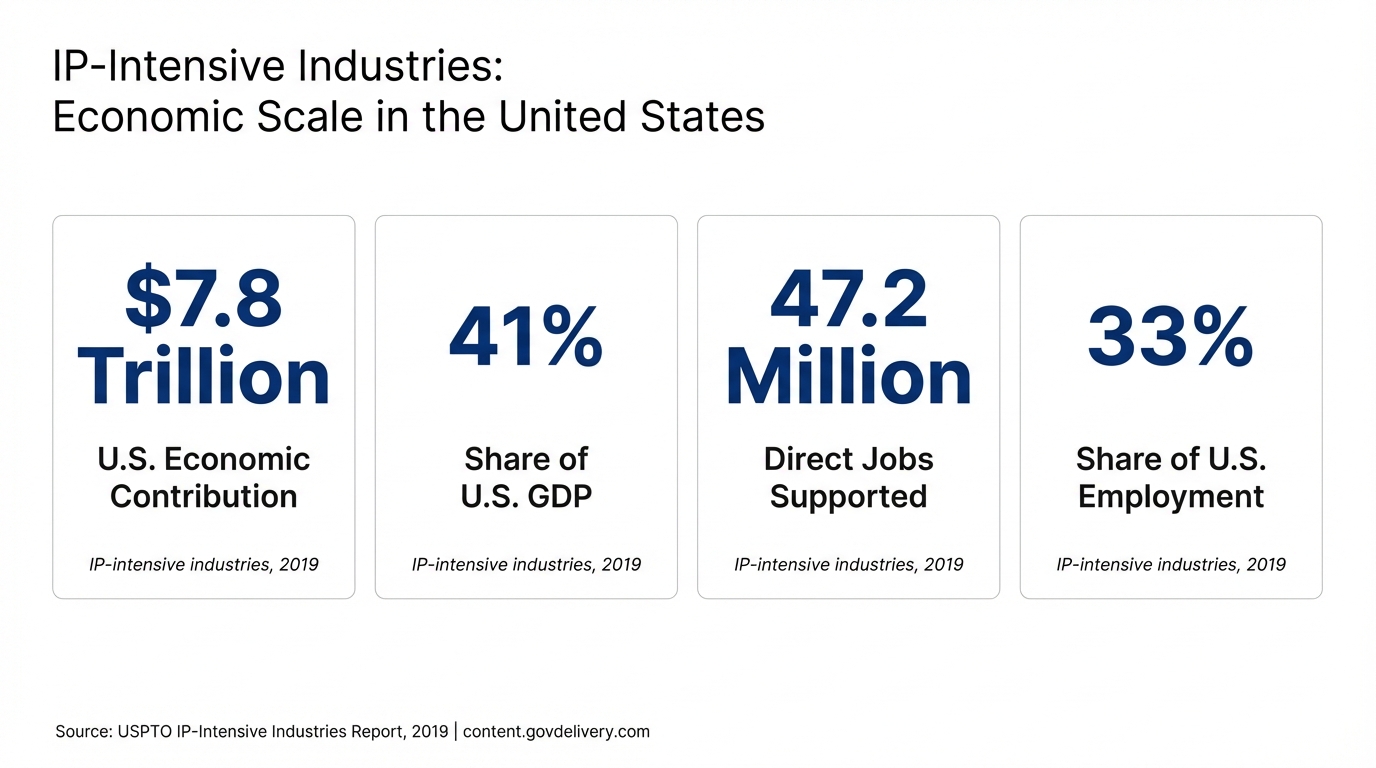 IP-Intensive Industries: $7.8 Trillion, 41% of GDP, 47.2 Million Jobs — Source: USPTO IP-Intensive Industries Report, 2019
Thompson Patent Law has prosecuted more than 1,500 patents, with results that come from treating every application as a strategic document, not just a filing requirement. Founders, engineers, and independent inventors who approach IP without a clear category-level strategy routinely under-protect their most valuable assets — or choose the wrong category entirely, at a cost of years of prosecution time and five-figure fees they cannot recover.
Your Next Steps to Intellectual Property Protection Success
The bottom line: businesses that map their assets to the correct IP categories before filing — and deploy sophisticated prosecution and registration strategies — achieve durable competitive protection. Those that don't face the risk of unenforceable claims, gaps competitors can exploit, and remedies that fall short when infringement actually occurs.
Every day without proper IP protection is a day competitors can move closer to your market position without legal consequence. The four main types of intellectual property each carry distinct timelines, costs, and strategic tradeoffs. Getting those decisions right early saves substantial time and money later.
- Schedule a Complimentary Patent Needs Assessment to map your specific assets to the right IP categories and identify where gaps exist
- Review which of your innovations qualify for patent protection before any public disclosure occurs
- Confirm that copyright registration is in place for all commercially exploited software, content, and creative assets
- Audit your trademark portfolio against current brand usage and flag any marks that need maintenance filings
- Evaluate whether any proprietary processes are better protected as trade secrets than as patent applications
Thompson Patent Law's team of registered patent attorneys and intellectual property lawyers — each with engineering degrees and backgrounds spanning individual inventors to Fortune 500 companies including Apple, Google, Intel, and Microsoft — provides the kind of strategic IP counsel that has helped clients achieve strong allowance outcomes while sparing them one to two years and five figures in prosecution costs compared to less strategic approaches. A Complimentary Patent Needs Assessment is the right starting point for understanding which protections fit your situation and what your next move should be.
Keep Innovating
Craige Thompson
Patent Attorney, MBA, Electrical Engineer
Craige Thompson is a patent attorney, MBA, and electrical engineer leading a team of registered patent attorneys at Thompson Patent Law. The team brings engineering degrees and experience spanning individual inventors to Fortune 500 companies including Apple, Google, Intel, and Microsoft, along with backgrounds from major law firms and industry.


