- Patentable subject matter falls into four statutory categories under 35 U.S.C. § 101: process, machine, manufacture, and composition of matter, plus any new improvement.
- An invention must satisfy five requirements: statutory subject matter, novelty, non-obviousness, utility, and adequate written description.
- Obviousness is the toughest bar. IPWatchdog’s analysis of 2005-2014 USPTO data found it cited in about 66% of first-final rejections.
- Abstract ideas, laws of nature, and natural phenomena cannot be patented on their own, though practical applications often can.
- Passing the patentability test is only step one. Claim scope and filing timing determine whether your intellectual property becomes a real business asset.
*Written by Craige Thompson, Patent Attorney, MBA, Electrical Engineer.* Craige Thompson is a Managing Principal Patent Attorney, electrical engineer, professional engineer, and MBA who helps innovators protect and monetize complex technologies. His experience spans patent prosecution, licensing, prior art searching, due diligence, opinions, reexamination, and litigation across electrical engineering, software, mechanical engineering, medical devices, and energy-efficiency technologies.
An inventor spends six months building a new software method, only to learn the claims are rejected under Section 101. This happens constantly. Knowing what is patentable is not the same as having a good idea. Patentability turns on specific legal criteria that trip up even experienced inventors. This guide walks through what qualifies for patent protection, what does not, and the five requirements every invention must clear before an application is worth filing.
The Four Types of Inventions That Can Receive Patent Protection
Under U.S. patent law, 35 U.S.C. § 101 defines four statutory categories of patentable subject matter, a new and useful process, machine, manufacture, or composition of matter. A new improvement to any existing invention also qualifies. If you are unsure where your concept sits, our guide on can ideas be patented draws the line between raw concepts and protectable inventions.
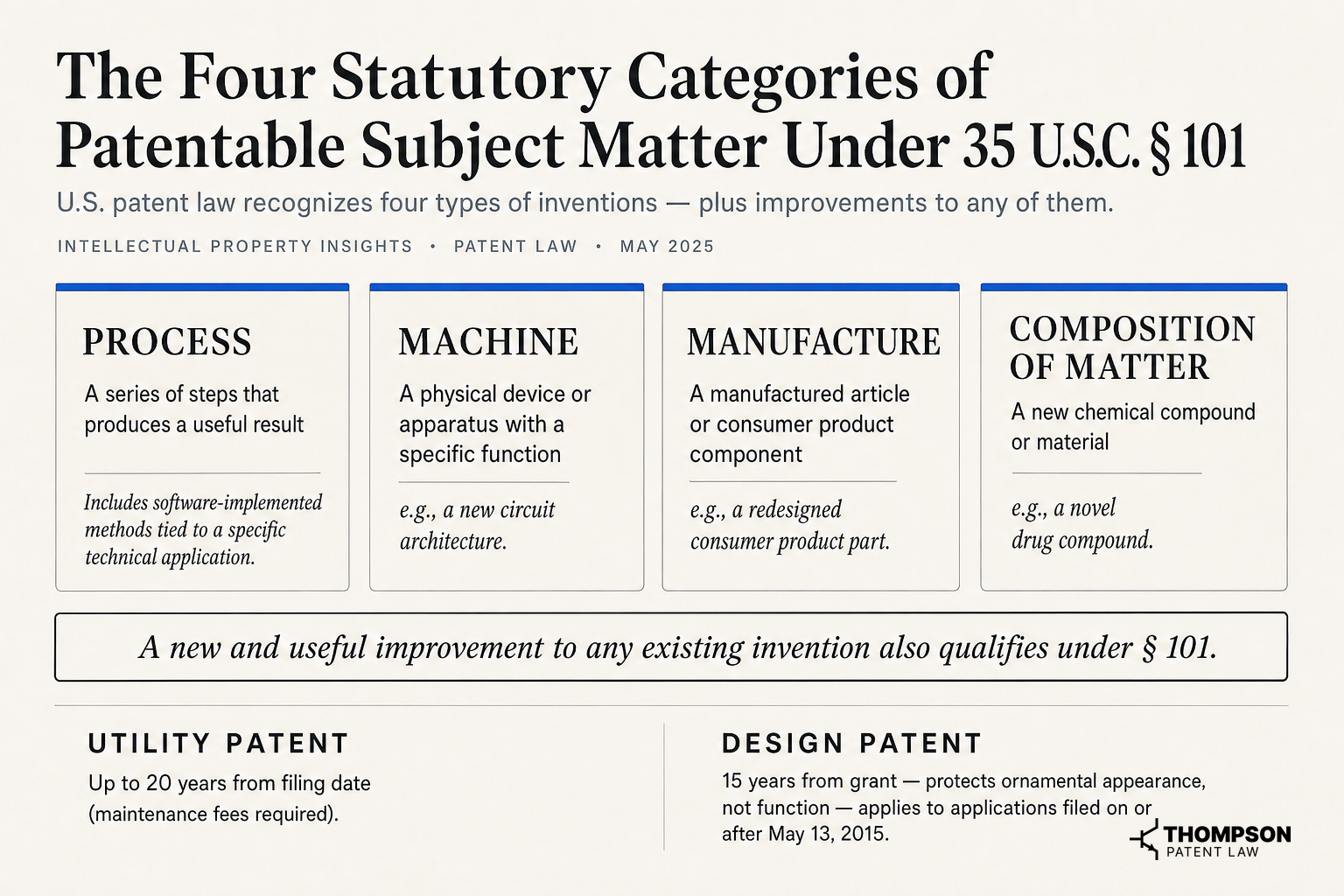 The Four Statutory Categories of Patentable Subject Matter Under 35 U.S.C. § 101 — Source: 35 U.S. Code § 101 via Cornell Law LII, 2018; USPTO MPEP, 2017
Processes and Methods
A new process is a series of steps that produces a useful result, and it need not produce a physical object to qualify. Any new process submitted through patent applications is examined against all five patentability criteria. This includes software-implemented methods tied to a specific technical application with clear technical character. To see how a process becomes a valuable asset, read can you patent a method.
Machines, Manufactures, and Compositions of Matter
These cover physical devices, manufactured articles, and chemical compounds or materials, and the patent system also recognizes plant patents for distinct, asexually reproduced plant varieties. A novel circuit architecture, a new medical device component, or a redesigned consumer product all fit here. If it has physical structure or produces a tangible result, it likely fits a statutory category.
Design Patents Protect Appearance, Not Function
Design patents protect the ornamental, non-functional appearance of an article, distinct from utility patents. According to the USPTO, design patents run 15 years from grant. The same product can sometimes support both a utility and a design patent, and a plant patent may protect a distinct asexually reproduced plant variety. For more on scope, see what does a patent protect.
The Five Requirements Every Patentable Invention Must Meet
Meeting a statutory category is only step one. According to Cornell Law School's Legal Information Institute, an invention must satisfy five criteria, and an examiner applies all of them. Fall short on any one and the USPTO issues a rejection.
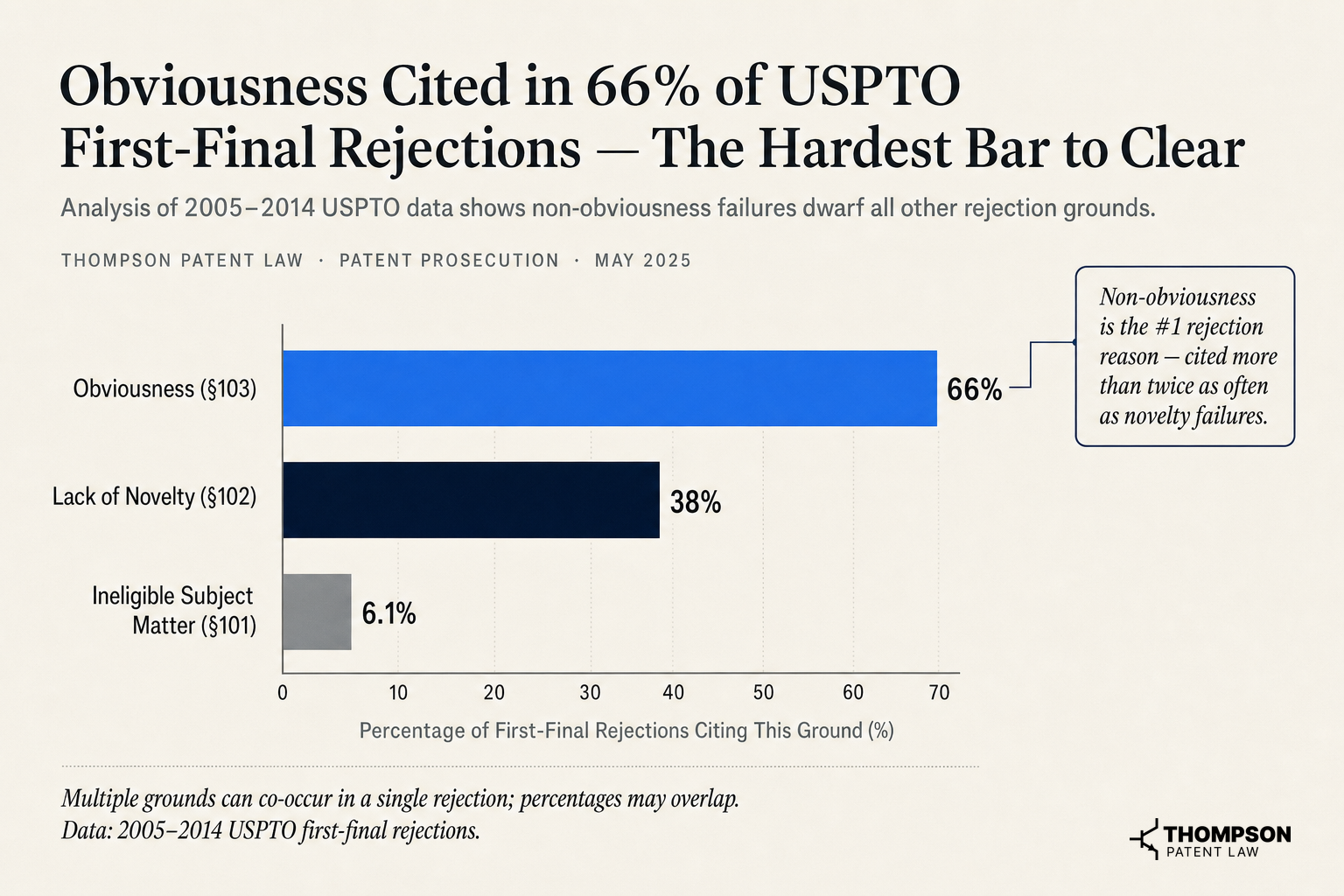 Obviousness Cited in 66% of USPTO First-Final Rejections — The Hardest Bar to Clear — Source: IPWatchdog (analysis of USPTO data), 2016
Novel Means No Prior Art Anywhere in the World
Novelty means the invention cannot already exist in any publicly available form, patents, publications, public use, or sale, anywhere before your filing date. A prior art search is how inventors test this, and running one before a full application is one of the benefits of a prior art search.
The Inventive Step Requirement, Non-Obvious to a Skilled Person
Even a genuinely new invention can be rejected if the differences from prior art would have been obvious to someone skilled in the field. This is the single biggest hurdle. Analysis of USPTO data by IPWatchdog found obviousness cited in 66% of first-final rejections, versus roughly 38% for lack of novelty and 6.1% for ineligible subject matter.
Utility, Industrial Applicability, and Why Theoretical Ideas Fail
The invention must have a specific, credible, and substantial utility. The European Patent Office uses the equivalent term industrial applicability, and under the European Patent Convention an invention must also show an industrial application to qualify. Purely theoretical discoveries with no practical use fail this test, and the same industrial application standard applies under European patent law.
What Is Not Patentable Under U.S. Patent Law
The USPTO recognizes three judicial exceptions to Section 101: abstract ideas, laws of nature, and natural phenomena. These block a claim no matter how novel or useful the idea seems. Our overview of things you can't patent covers the fallout for inventors.
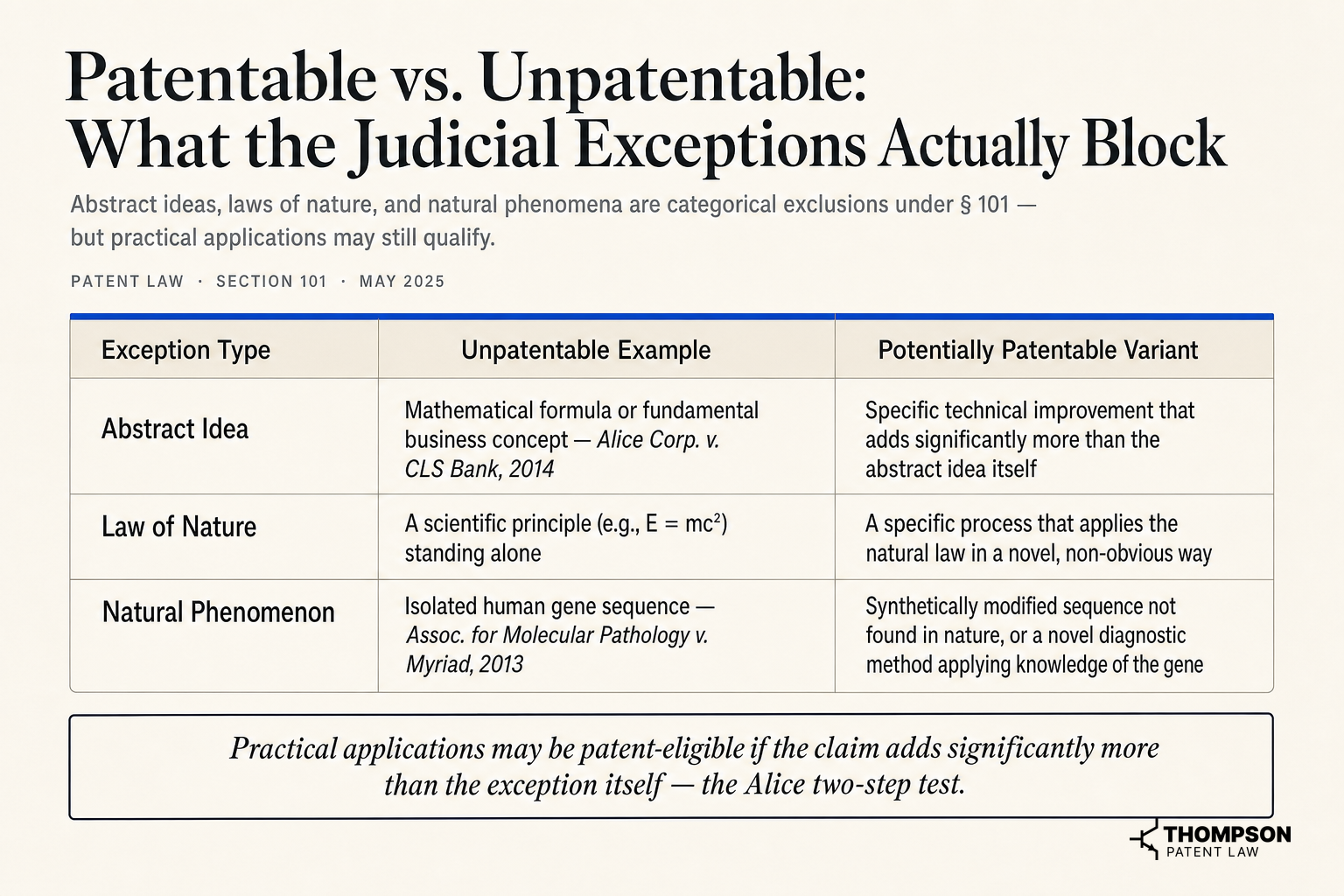 Patentable vs. Unpatentable: What the Judicial Exceptions Actually Block — Source: USPTO MPEP 2106, 2019
Abstract Ideas, Mathematical Formulas, and Mental Processes
Abstract ideas, including mathematical formulas, mental steps, and pure algorithms, cannot be patented by themselves. The Supreme Court's ruling in Alice Corp. v. CLS Bank International (2014) established the two-step test still used to judge whether a software or business method claim crosses that line. An abstract idea paired with a specific technical implementation may still be patentable.
Laws of Nature and Natural Phenomena
Naturally occurring phenomena, products of nature, and scientific principles are not patentable subject matter. In Association for Molecular Pathology v. Myriad Genetics (2013), the Court held an isolated human gene sequence unpatentable as a product of nature. Applying a natural phenomenon via a new process in a non-obvious way can be patentable, but the phenomenon itself cannot.
Other Categorical Exclusions Worth Knowing
The USPTO will not grant a patent on a perpetual motion machine because it lacks credible utility. Purely aesthetic works fall to copyright instead. When the USPTO applies a categorical exclusion, no claim drafting overcomes it, and the patent process ends at that stage. For a fuller picture, see 2 reasons your idea may not be patentable.
How Software and AI Inventions Navigate Patentable Subject Matter
Software patents exist, but claims must be drafted to clear the Alice eligibility framework. After Alice in 2014, Section 101 rejections spiked. IPWatchdog reported that before Bilski, § 101 accounted for just 8.5% of all USPTO rejections, rising to 12.2% of all rejections in the post-Alice era, while TC 3600—the technology center with the highest concentration of § 101 rejections—had 32% of its rejections citing § 101 post-Alice. USPTO guidance issued in 2019 later cut Section 101 rejection rates by about 25% in affected fields. Many patentable inventions in the software space qualify when framed as concrete technical improvements.
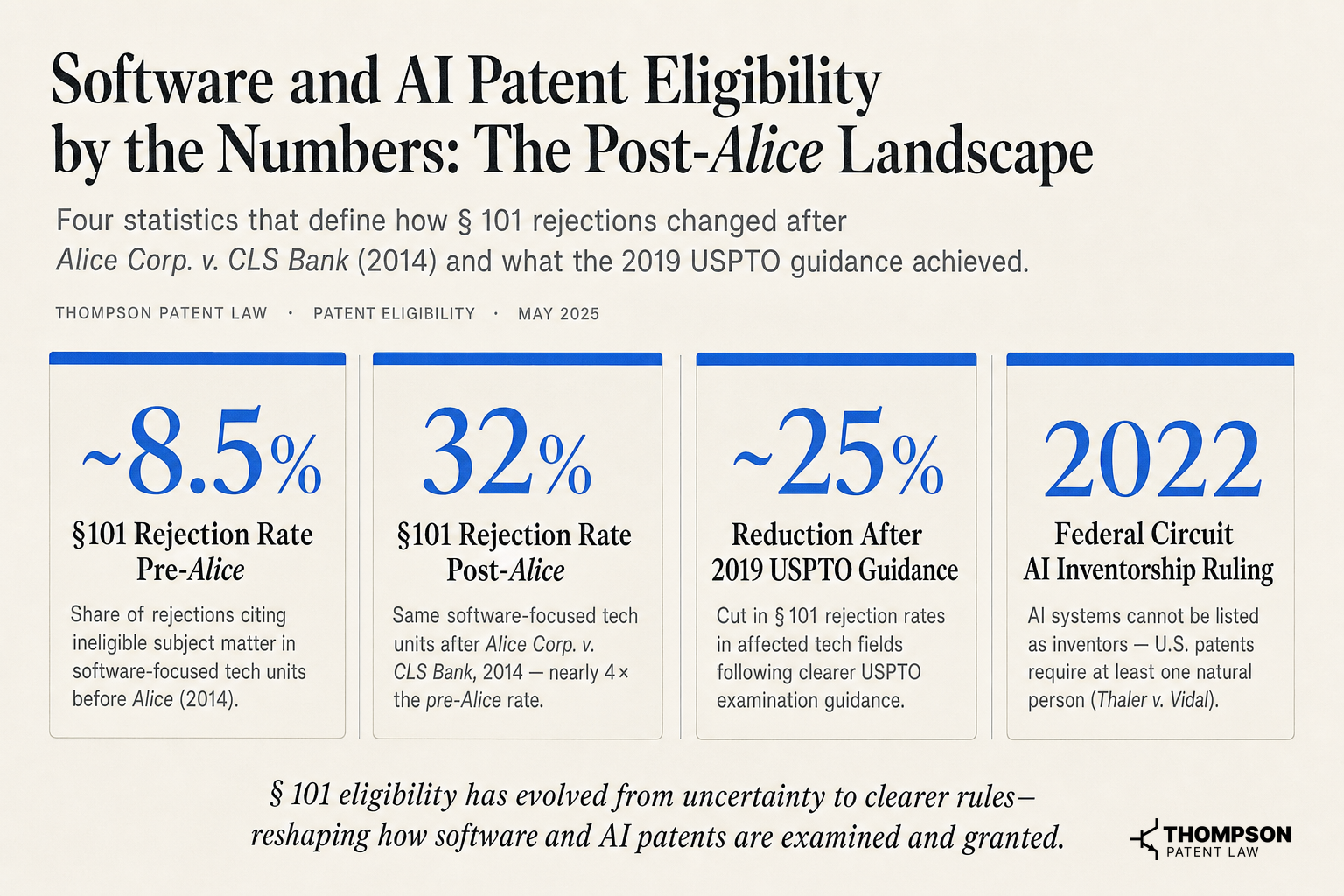 Software and AI Patent Eligibility by the Numbers: The Post-Alice Landscape — Source: USPTO Office of Chief Economist report, 2020; Thaler v. Vidal, Fed. Cir. 2022
The Alice Two-Step Test in Plain English
Step one asks whether the claim is directed to an abstract idea. Step two asks whether it adds significantly more. Software claims must be anchored to a specific technical improvement, not just a desired result, and the claimed invention must add significantly more than an abstract idea.
AI Inventions and the Human Inventorship Requirement
The USPTO requires at least one human inventor on every application. In Thaler v. Vidal (2022), the Federal Circuit held that an AI system cannot be named as an inventor, ruling the Patent Act requires a natural person. Document each human inventor's specific contribution before filing any AI-assisted invention, as this is required under us patent law.
The Difference Between Patentable and Actually Worth Patenting
An invention that qualifies is not automatically worth patenting. Weak claims leave competitors free to design around them. A Patently-O analysis of USPTO maintenance data shows only about 49% of U.S. patents survive to full term, roughly 84% clear the first fee at year four, 63% at year eight, and 49% at year twelve. Owners drop the rest when the patent stops earning its keep, usually a sign of thin claims.
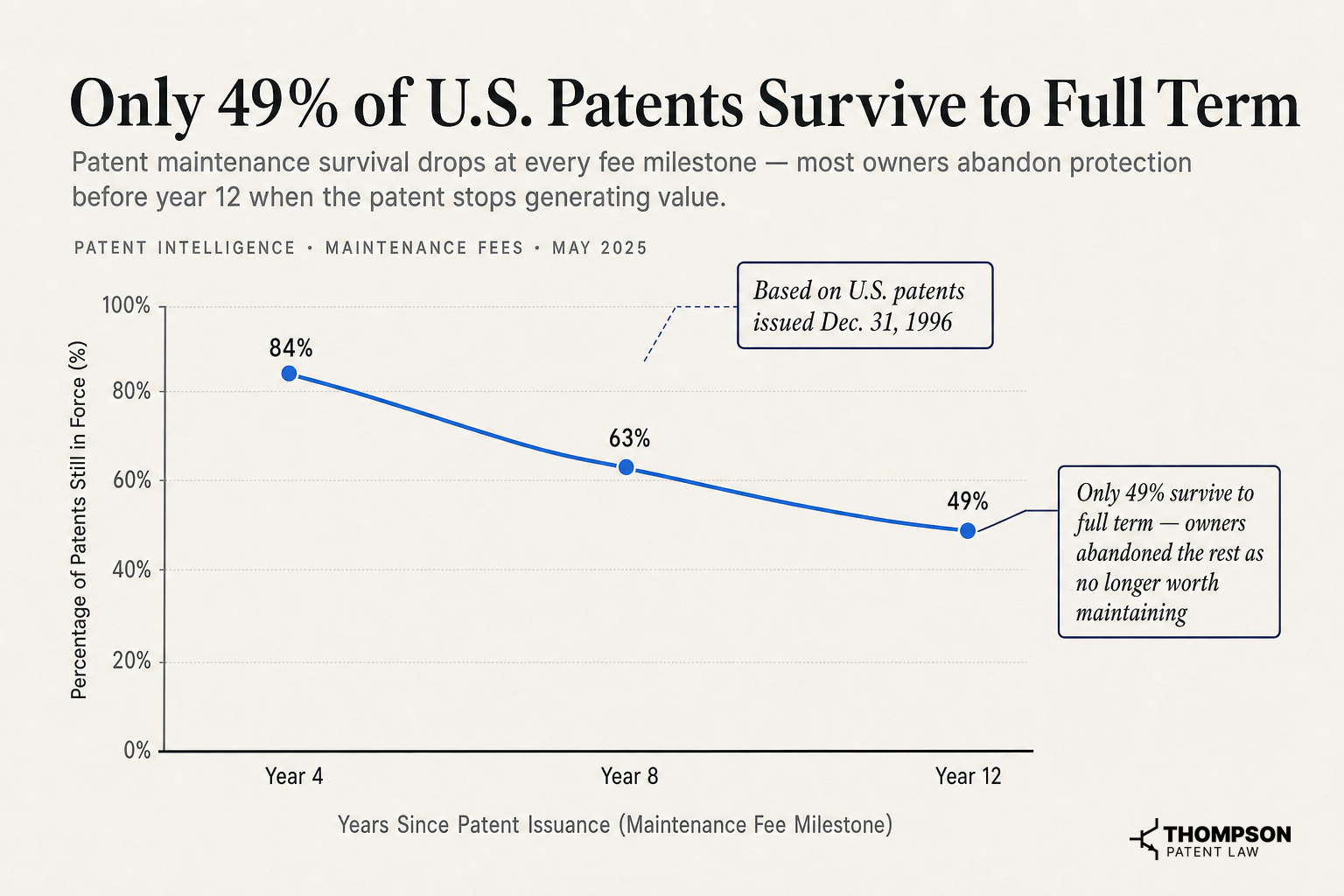 Only 49% of U.S. Patents Survive to Full Term — Source: Patently-O blog analysis, 2009
Claim Scope Determines Competitive Value
Patent protection is only as strong as the claims granted, and a patent owner must actively enforce those claims to prevent patent infringement. Overly narrow claims let competitors copy the core innovation with minor tweaks, leaving the patent owner with limited patent rights to enforce. Strategic patent claims drafting maximizes scope while surviving prior art challenges.
Timing and Public Disclosure Rules
In the U.S., inventors get a one-year grace period after public disclosure to file. Grace periods vary by jurisdiction, and some countries (such as Europe under the European Patent Convention) generally offer none, so disclosure before filing can destroy patentability abroad.
What Comes After Confirming Your Invention Is Patentable
Once patentability looks likely, the next move is a prior art search, followed by a choice between a provisional and a full utility patent application, with the patent process often also including a Patent Cooperation Treaty filing for international coverage. The full workflow is in our guide on how do you patent a product.
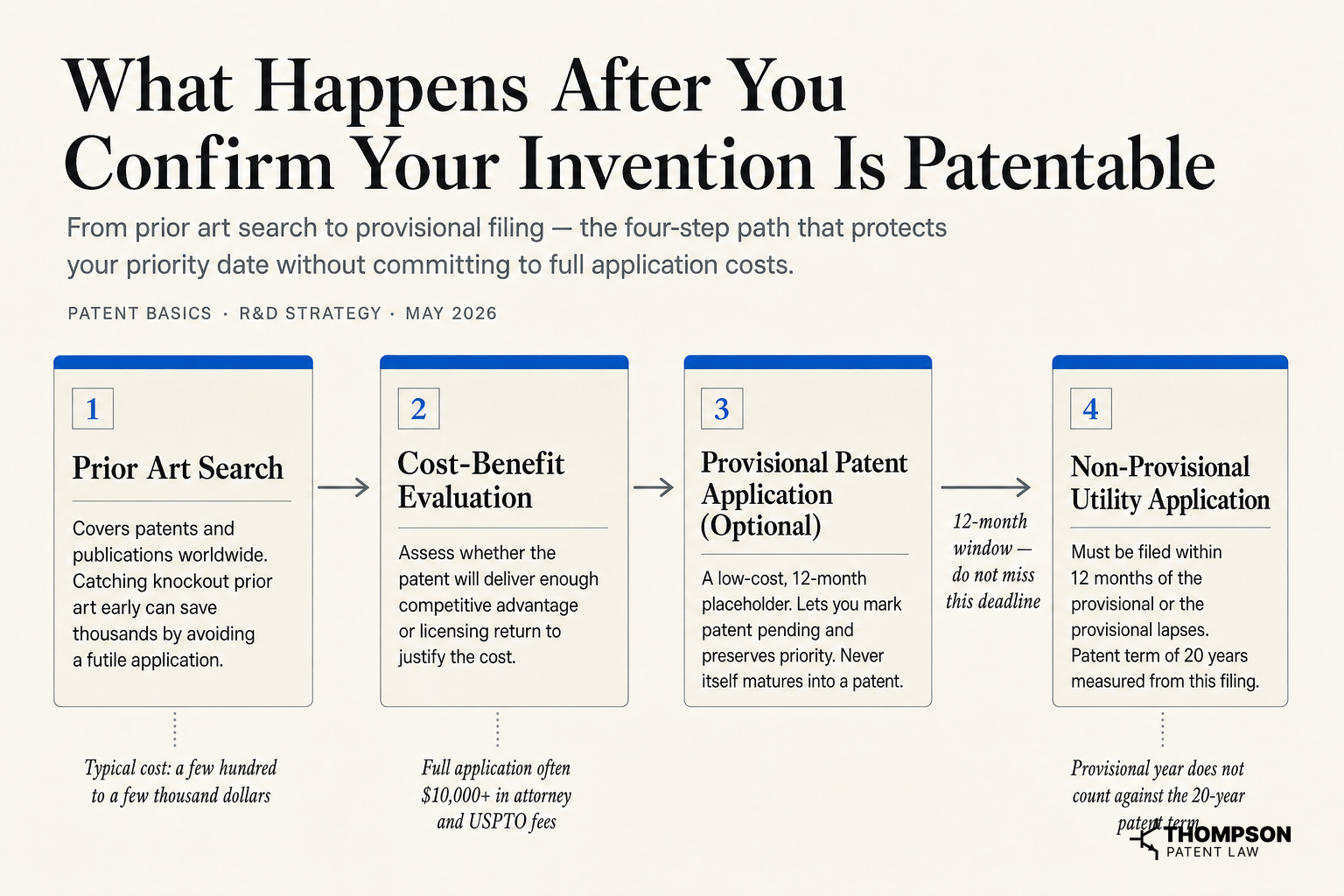 What Happens After You Confirm Your Invention Is Patentable — Source: USPTO patent basics, 2024; CASRAI patent cost guide, 2025
Prior Art Search as the First Real Decision Gate
A prior art search reviews existing patents, published applications, and non-patent literature to confirm novelty, and patent attorneys recommend completing this step before any patent filing. A professional search is far more thorough than a keyword search alone, and typically costs a fraction of a full application; patent attorneys can also advise on patent laws across jurisdictions. Catching a knockout reference early spares an inventor from filing on an invention that is not novel, and can prevent a costly patent grant from issuing on unenforceable claims.
Provisional vs. Full Patent Application
A provisional patent application secures a priority date, gives you 12 months to file a complete utility application, and lets you mark the invention "patent pending." It does not mature into a patent on its own, and does not count against the 20-year term. Provisional applications are available for utility inventions, not design patents.
Frequently Asked Questions About What Is Patentable
What is considered patentable?
An invention is patentable if it fits one of the four statutory categories and is novel, non-obvious, and useful without falling into a judicial exception; a patented invention must have cleared all of these bars. See is my idea patentable.
What is an example of a patentable invention?
A new image processing system that improves how a digital camera records photos. A novel chemical composition or mechanical device with no prior art equivalent also qualifies.
What products are patentable?
Machines, manufactured goods, and chemical compositions can qualify for utility patents, products with a distinctive ornamental appearance may qualify for design patents. Existing products with only minor tweaks still must clear the non-obviousness bar.
What are the 5 requirements of patentability?
Statutory subject matter under Section 101, novelty, non-obviousness, utility, and an adequate written description. All five must be satisfied.
What cannot be patented?
Abstract ideas, mathematical formulas, laws of nature, and natural phenomena on their own, plus inventions that are not novel, are obvious, or lack utility. Our page on what may not be patentable goes deeper.
Your Next Steps to Patentability Success
Understanding what is patentable and confirming an invention qualifies is only the beginning, and this guide does not constitute legal advice specific to your situation. A weak application produces a patent competitors work around in months, while a strategically drafted one becomes a durable asset with meaningful legal protection. Claim scope, application type, filing timing, and prosecution approach determine whether your intellectual property rights earn their keep.
Every month an invention stays undisclosed and unfiled is a month a competitor can file first.
If you are ready to move forward, Schedule a Complimentary Patent Needs Assessment to evaluate where your invention stands and speak with a member of our team. This guide reflects the perspective of the team at Thompson Patent Law, led by patent attorney
Craige Thompson
Patent Attorney, MBA, Electrical Engineer
Thompson Patent Law