- Most United States patent applications publish 18 months after the earliest filing date, often long before any patent issues. Average total pendency runs about 22.8 months, per USPTO data.
- A provisional patent application is never published on its own, but its filing date starts the 18-month publication clock for any non-provisional that claims it.
- A non-publication request can keep an application confidential, but it bars you from filing abroad. Only about 7.3% of applicants use it.
- Once published, your claims, drawings, and specification become a searchable roadmap competitors can read and use as prior art.
*Written by Craige Thompson, Patent Attorney, MBA, Electrical Engineer.* Craige Thompson is a Managing Principal Patent Attorney, electrical engineer, professional engineer, and MBA who helps innovators protect and monetize complex technologies. His experience spans patent prosecution, licensing, prior art searching, due diligence, opinions, reexamination, and litigation across electrical engineering, software, mechanical engineering, medical devices, and energy-efficiency technologies.
A founder files a patent application, assumes the details stay locked away until a patent issues, then learns a competitor already read the full filing. So are patent applications public? Yes, most United States patent applications become public, but not immediately. Under 35 U.S.C. § 122, the United States Patent and Trademark Office publishes most applications 18 months after the earliest effective filing date. By the end of this article, you will know when disclosure happens, which applications stay private, and what decisions you need to make before the clock runs out.
The Default Rule Means Most Patent Applications Become Public After 18 Months
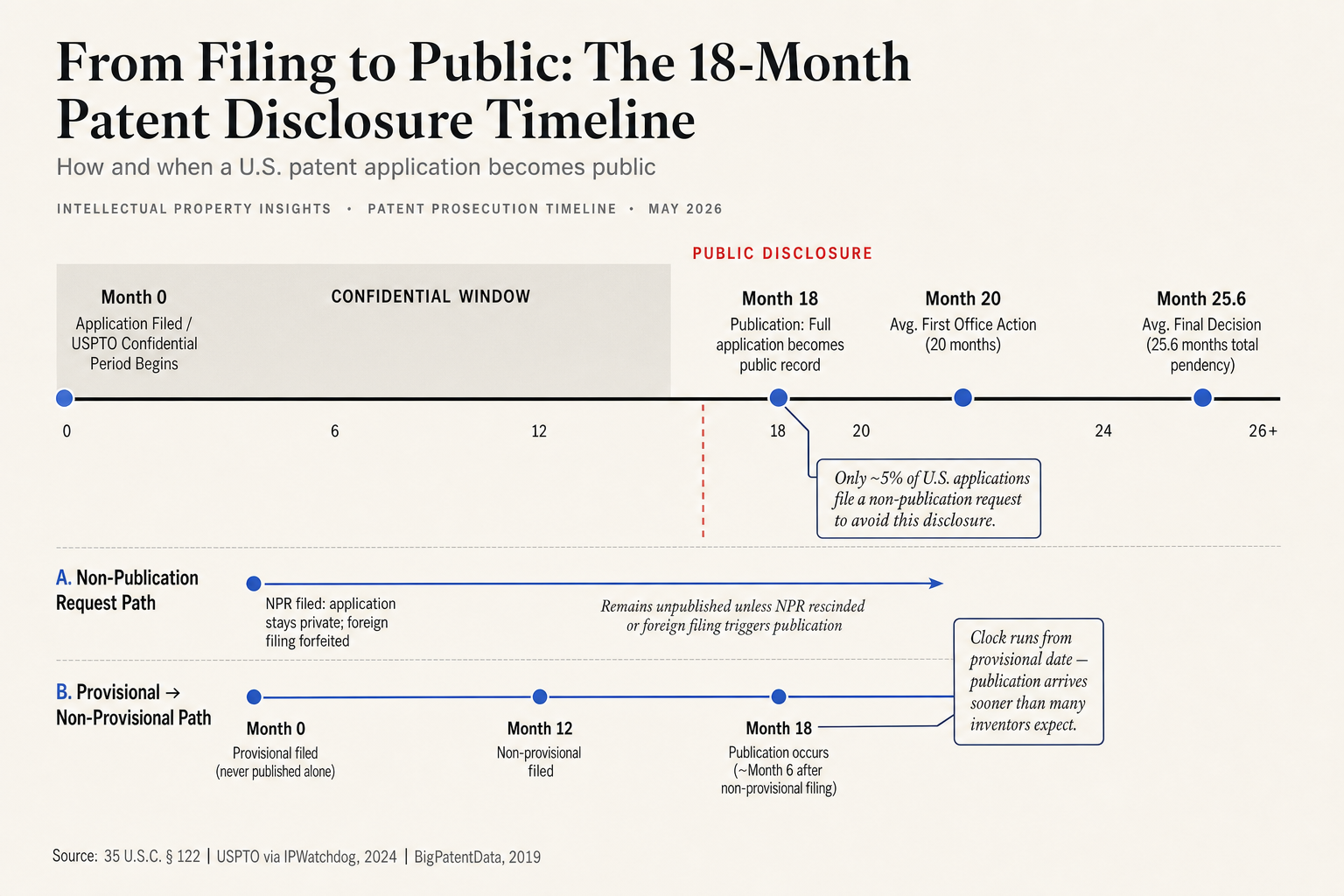 From Filing to Public: The 18-Month Patent Disclosure Timeline — Source: 35 U.S.C. § 122 (U.S. Code, 2026); IPWatchdog, 2024; BigPatentData, 2019
When the 18-Month Clock Starts
The USPTO publishes most applications 18 months after the earliest effective filing date, according to 35 U.S.C. § 122. That clock runs from the application's filing date, or, if priority is properly claimed, from the earliest effective U.S. filing date of an earlier application — including a provisional filing date claimed as the priority date by the non-provisional. The provisional itself is never published and does not trigger publication on its own. The filing date, not the issue date, triggers the timeline, which is why timing your application matters so much.
What Publication Means for Your Invention
A published patent application is an official, searchable public record. The full subject matter, including claims, drawings, and specification, becomes accessible through the USPTO Patent Public Search tool and Google Patents. Competitors can read it and cite it as prior art before any patent rights are granted. Knowing how to find out if something is patented works both ways, since rivals can do the same to you.
The Gap Between Publication and a Granted Patent
Publication and grant are separate events. A published application carries pending patent status but no enforceable rights until the patent issues.
Are Patent Applications Public Record the Moment They Are Filed
What Public Record Means in the Patent Context
Filing creates an official government record, but the USPTO keeps it confidential. By statute, the patent office will not disclose information about a pending application before publication without the applicant's consent, under 35 U.S.C. § 122(a). Unlike court filings, a patent application file is sealed until publication or issuance. This is why your patent filing date is established privately before anyone else can see your work.
What Information Is Visible Before Publication
Before the 18-month publication date, the public assignment database returns only issued patents and published applications. A competitor running regular patent searches generally cannot find your filing or read your claims during the confidential period.
How Abandoned Applications Are Treated
If you abandon an application before the 18-month mark and have not triggered foreign filing obligations, it stays confidential. The USPTO does not publish applications that are no longer pending at the 18-month deadline.
How Unpublished Patent Applications Work and When They Stay Private
The Non-Publication Request Option
Inventors who will not file foreign patent applications can request that the patent office keep their application unpublished. Under 35 U.S.C. § 122(b)(2), a non-publication request filed with the application withholds it from publication until the patent issues. If the patent never issues, the application stays confidential. About 5% of applications are filed with a nonpublication request, per BigPatentData (2019), a figure not adjusted for eligibility. Choosing this path well is one reason a patent-first filing strategy pays off.
The Trade-Off of No Foreign Filing Allowed
Non-publication binds you to a U.S.-only strategy. If you later file a foreign patent application on the same invention, you must rescind the request within 45 days of that filing. Failing to notify the patent office causes the U.S. application to be deemed abandoned.
There is an additional consequence worth understanding. If you elect to abandon the application or prevent its publication — rather than rescinding the non-publication request and proceeding — the prior application effectively becomes prior art against yourself. Because you are unable to claim priority to that earlier filing, a competitor or examiner can use it against any later application you file on the same subject matter. In practical terms, abandoning or blocking publication of a prior filing without preserving the priority claim can render your own earlier work as prior art against you.
When the Office Publishes Despite a Request
A non-publication request only protects you if filed and rescinded properly. Applicants pursuing international protection through the Patent Cooperation Treaty cannot use it at all. PCT applications are automatically published 18 months from the priority date, according to WIPO.
What Happens to Provisional Patent Applications and Public Disclosure
Provisional Applications Are Not Published on Their Own
A provisional patent application establishes a priority date and creates a 12-month window to file a non-provisional, but the USPTO never publishes a standalone provisional. The subject matter only becomes public when the related non-provisional is published or issued. For a deeper look at the deadlines, see the complete provisional patent timeline.
The 12-Month Window and Its Effect on the Timeline
When a non-provisional claims the provisional filing date as its priority date, the 18-month publication clock still runs from the provisional filing date. An inventor who files a provisional and waits the full 12 months before filing a non-provisional may see publication just 6 months after the non-provisional filing. The clock starts earlier than most inventors expect, so understanding how long a provisional patent application lasts is essential.
How to Search for Published and Pending Patent Applications
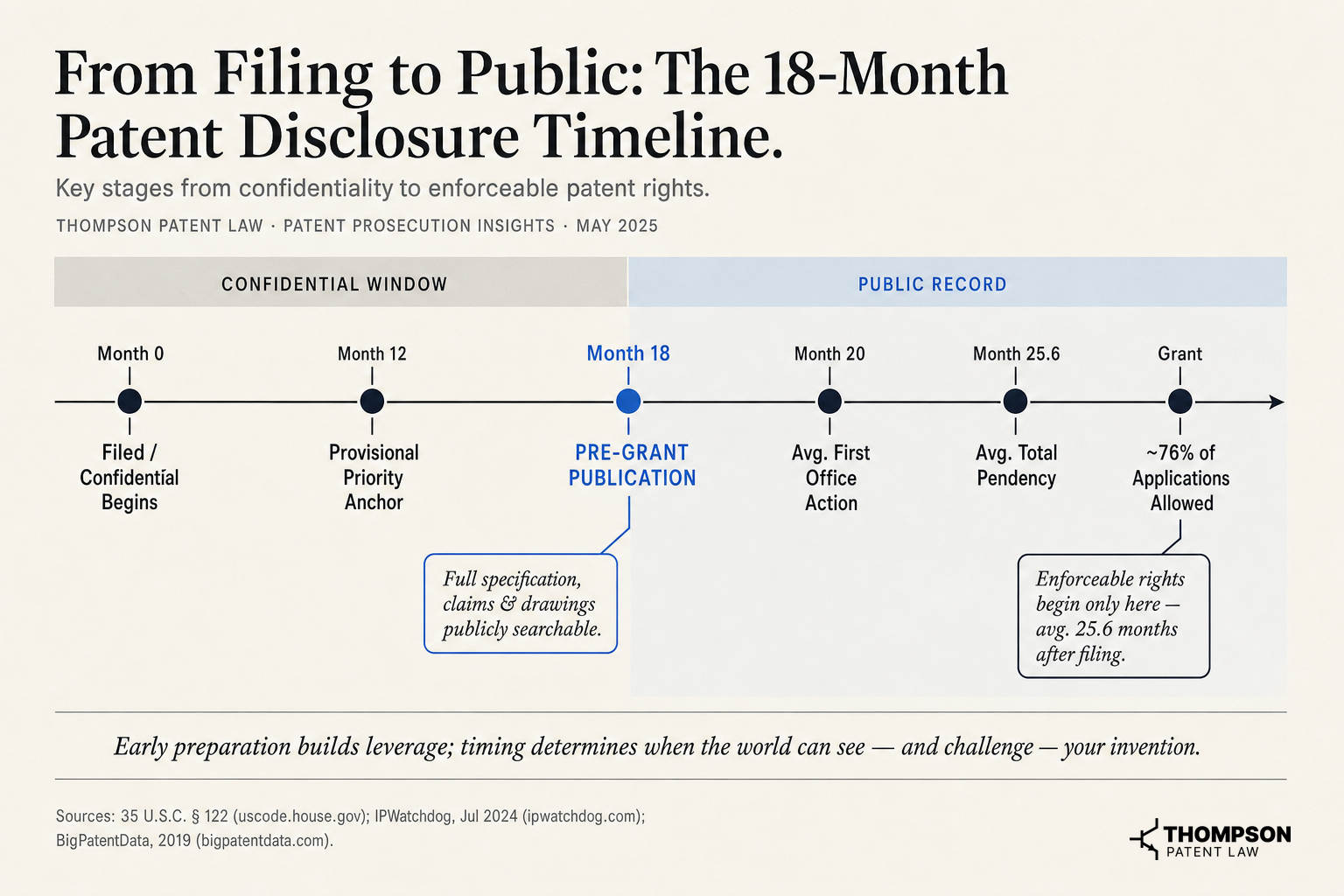 From Filing to Public: The 18-Month Patent Disclosure Timeline — Source: 35 U.S.C. § 122, U.S. Code; IPWatchdog, July 2024; BigPatentData, 2019
USPTO Patent Public Search and Google Patents
Published applications and granted patents are freely searchable through the USPTO Patent Public Search tool and Google Patents. You can search by inventor name, assignee, application number, or subject matter. Pre-publication applications within the confidential 18-month window will not appear. Anyone can search published applications, including your competitors. Running a thorough prior art search before you file uses these same databases to your advantage.
What You Can Learn from a Published Application
A published application reveals the invention's subject matter, the claims as drafted, the prosecution history, and the assignee. Companies routinely monitor competitors' filings to anticipate R&D directions. It is a detailed roadmap to your technology strategy, visible to the entire market.
Why Disclosure Timing Matters for Your Patent Strategy
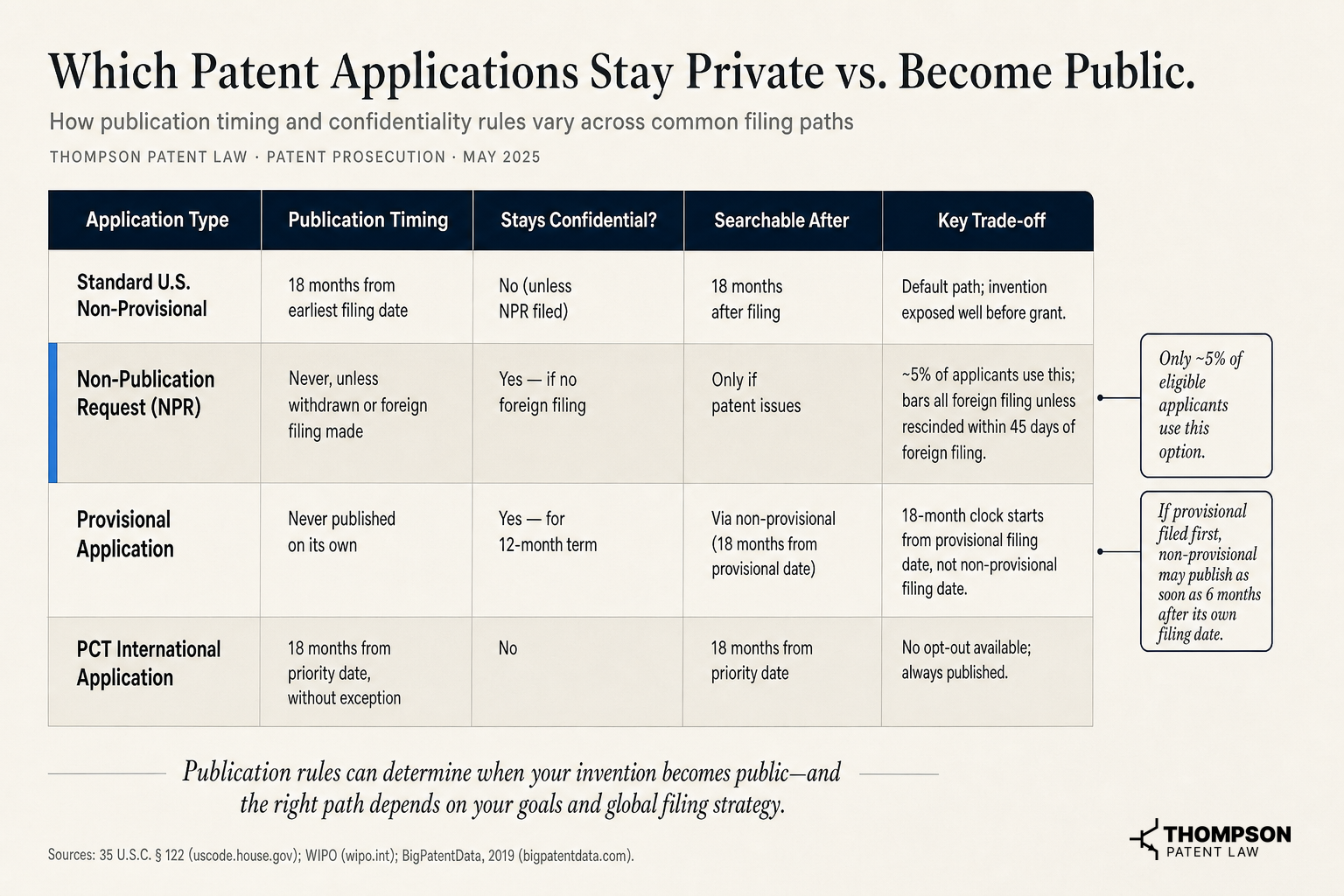 Which Patent Applications Stay Private vs. Become Public — Source: 35 U.S.C. § 122, U.S. Code; WIPO PCT FAQ, 2024; BigPatentData, 2019
The 18-Month Window Is a Strategic Decision Point
The interval between filing and publication is the one window where you can monitor progress and adjust strategy before competitors gain full visibility. Use this time to ensure claims are drafted to full scope, decide whether to file continuations, and evaluate a non-publication request. Very few applications issue before the 18-month mark, which is why a disciplined process for filing a patent matters from day one.
Disclosure Before Filing Creates Prior Art Against You
Any public disclosure before filing, such as a pitch deck, published paper, or trade show demo, starts a one-year clock in the United States. Under the America Invents Act grace period, your own disclosure is not prior art only if you file within 12 months. After one year, it can invalidate the application. File before you disclose publicly. Inventors learning how to turn ideas into protected assets should treat this deadline as absolute.
Frequently Asked Questions
Can you tell if someone has filed a patent?
Not right away. The USPTO keeps new applications confidential until publication, usually 18 months after filing, or until a patent issues.
Can I look up patent applications?
Yes, if they have been published. USPTO Patent Public Search and Google Patents both provide free access, applications still within the first 18 months will not appear.
Are all patent applications eventually made public?
Not necessarily. Applications with a valid non-publication request that never issue stay confidential permanently. Expired provisionals are a similar case: a provisional patent application that expires and is never used to claim priority for a non-provisional application, a PCT application, or any other foreign filing remains effectively a trade secret — it is not published and is accessible only to you and your patent attorney.
However, if a provisional application is relied upon to claim priority — whether for a U.S. non-provisional, a PCT application, or another foreign filing — it does not publish on its own, but the subject matter becomes searchable after the 18-month period runs from the provisional filing date. The large majority of utility filings do become public.
What is a provisional patent application?
A provisional establishes a filing date without starting formal examination, giving inventors 12 months to develop the invention. It is never published on its own and must be followed by a non-provisional within 12 months to preserve the priority date.
What to Do Before Your Application Goes Public
Most patent applications become public 18 months after filing, and that disclosure is permanent. Before the window closes, the scope of your claims, the breadth of your specification, and your international filing strategy all need to be right. Weak claims published to the world are a gift to competitors.
The bottom line, a weak application disclosed to the public hands rivals a roadmap they can design around, while a strong application backed by Litigation Quality Patent® services turns that same disclosure into a durable competitive advantage. Every month you wait pushes your filing date later and narrows your options.
As a patent attorney and electrical engineer, I have seen how the pre-publication window separates strong patents from missed opportunities. Take these next steps before the clock runs out:
- Schedule a Complimentary Patent Needs Assessment to understand where your application stands before disclosure.
- Confirm your filing date and claim scope while your application is still confidential.
- Decide on your foreign filing and non-publication strategy before you file.
Get these right and the 18-month window becomes an advantage instead of a liability.
Keep Innovating.
Craige Thompson, Patent Attorney MBA, Electrical Engineer
Thompson Patent Law
The Thompson Patent Law team includes registered patent attorneys with engineering degrees and backgrounds spanning industry and major law firms, serving clients from individual inventors to established technology companies.