- A provisional patent application secures a filing date but is never examined and never becomes a patent on its own. You must file a non-provisional within 12 months to keep that priority date.
- The 20-year patent term for a utility patent runs from the non-provisional filing date. Provisional time does not count against it.
- A 2024 study in the *International Review of Intellectual Property and Competition Law* found that a substantial share of U.S. provisional applications are never used as priorities in later non-provisional filings, meaning many are ultimately abandoned.
- Design patent applications are never provisional. Ornamental designs must be filed directly and last 15 years from the date of grant.
- A thin provisional can destroy the priority date it was meant to protect. The written description must support every claim you later pursue.
*Written by Craige Thompson, Patent Attorney, MBA, Electrical Engineer.* Craige Thompson is a Managing Principal Patent Attorney, electrical engineer, professional engineer, and MBA who helps innovators protect and monetize complex technologies. His experience spans patent prosecution, licensing, prior art searching, due diligence, opinions, reexamination, and litigation across electrical engineering, software, mechanical engineering, medical devices, and energy-efficiency technologies.
A founder demos a working prototype at a trade show, explains how it works to a crowd of prospects, and walks away energized. What that founder does not realize is that a one-year countdown just started. For an inventor-originated enabling public disclosure or offer for sale, U.S. law provides a one-year grace period, if no patent application is filed within that period, that disclosure ordinarily becomes a bar to U.S. patenting. That is why understanding provisional patent vs non provisional patent decisions matters before you go public. This article explains what separates a provisional from a non-provisional application, when each makes strategic sense, what the real costs look like, and how to avoid the most common mistake inventors make. This is a choice between two strategic paths, each carrying distinct legal consequences for your intellectual property.
What a Provisional Patent Application Actually Does and Does Not Do
A Provisional Application Secures Your Filing Date, Not Your Patent
A provisional patent application establishes a priority date with the United States Patent and Trademark Office — also known as the United States patent office — but it does not become a patent on its own. Understanding the two types of patent applications — provisional and non-provisional — is essential before approaching the trademark office with any filing strategy. According to the USPTO, a provisional has a pendency of 12 months and is not examined. Without a corresponding non-provisional filed within that window, the provisional expires and the priority date disappears. It is a placeholder, not a patent. For what "pending" means during this stage, see our guide on pending patent status.
What Patent Pending Status Actually Means
Filing a provisional lets you mark products and marketing materials "patent pending." That pending application label deters copycats but grants no enforceable rights. Per Cornell Law School, you cannot sue anyone for infringement until a patent actually issues. A competitor who copies your invention during the provisional period cannot be stopped for patent infringement based on the provisional alone.
What a Provisional Must Include to Be Useful
A poorly written provisional undermines the entire strategy. Because new matter cannot be added, any subject matter not disclosed in the provisional will only be entitled to the filing date of the later application in which it first appears, under 35 U.S.C. §§ 112, 119 through 120, and USPTO practice. The detailed description and written description must together support what eventually becomes your formal patent claims. The Stanford v. Roche lesson on bad patent documentation shows what sloppy records can cost. A provisional's value is only as strong as its written description.
What a Non-Provisional Patent Application Actually Starts
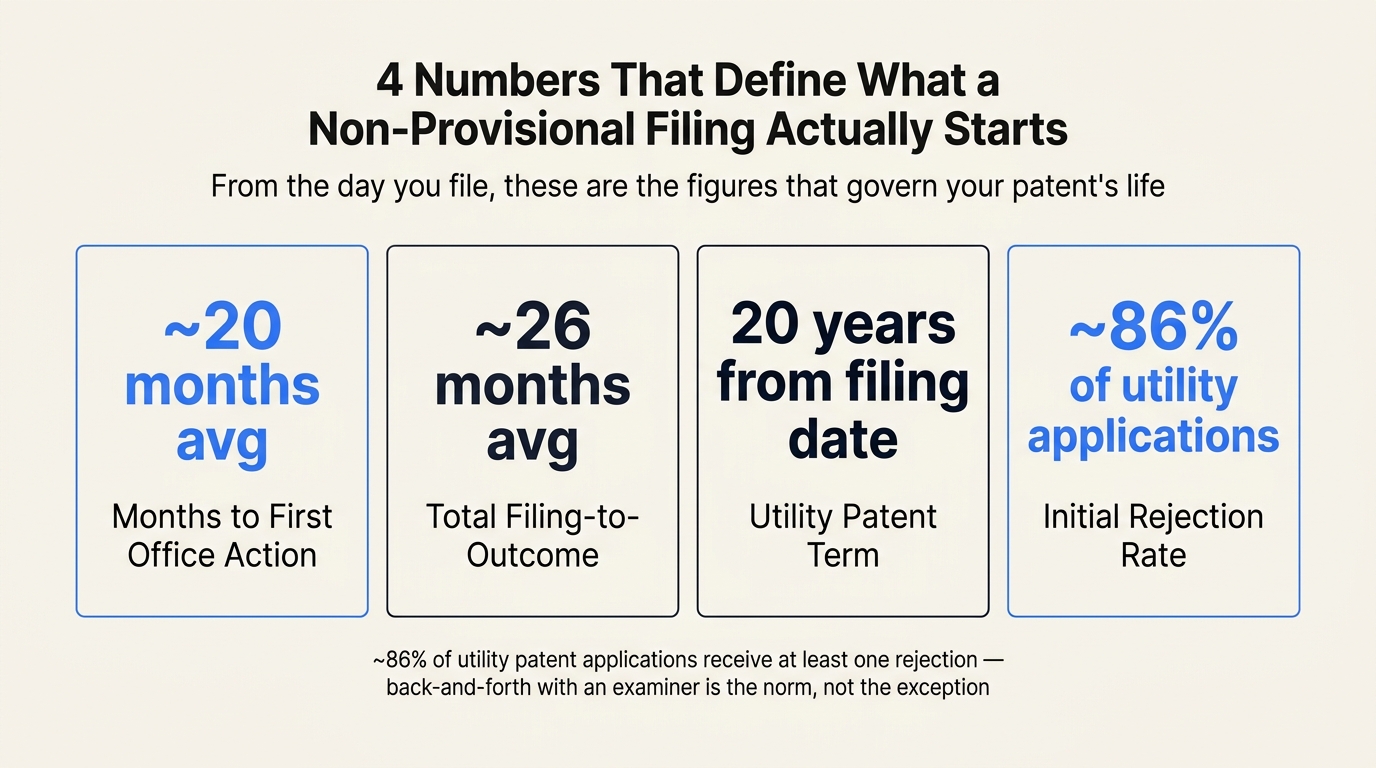 4 Numbers That Define What a Non-Provisional Filing Actually Starts — Source: USPTO Patents Dashboard, 2024; casrai.org; patenttrademarkblog.com
Examination Begins and the Patent Term Starts
When a non-provisional is filed, it enters the examination queue and an examiner reviews it against prior art and formal legal requirements. This is the only filing that can result in an issued patent and enforceable patent rights. The 20-year term for utility patent protection runs from the non-provisional's filing date, not from issuance. According to USPTO 2024 pendency data, average pendency runs about 20 months to a first Office Action and roughly 26 months to a final outcome without acceleration tools. The non-provisional is the only path to enforceable protection, and getting your patent filing date right anchors that timeline.
Formal Requirements That Provisionals Skip
A non-provisional requires formal patent claims, an abstract, drawings meeting USPTO standards, an application data sheet, and a full fee structure. Provisionals have no formal claim requirement, a meaningful difference in preparation time and attorney fees. For a full checklist, see our guide to utility patent requirements in 2025.
Design Patent Applications Follow a Different Path
Design patents protect the ornamental appearance of a functional product, including its shape, configuration, and surface ornamentation, not how it works. A design patent application cannot claim the benefit of a provisional, because provisionals apply only to utility patents. Design patents last 15 years from the date of grant and carry no maintenance fees, unlike utility patents whose 20-year term is subject to periodic maintenance payments. If you are protecting a product's look, design patent protection is pursued directly, and design patent applications are filed directly with the trademark office.
How the 12-Month Window Changes Your Strategy
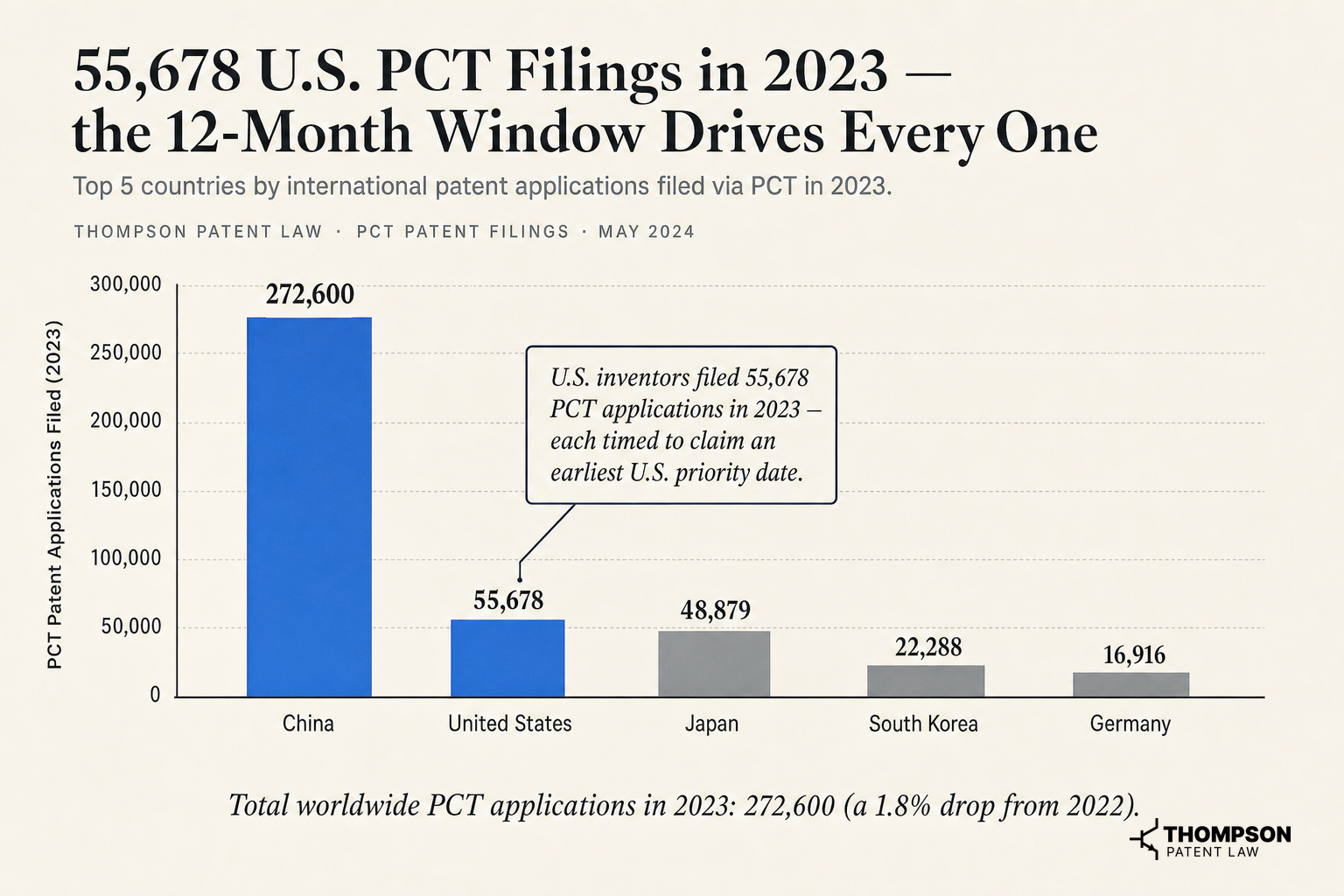 55,678 U.S. PCT Filings in 2023 — the 12-Month Window Drives Every One — Source: WIPO, 2024
The Provisional Buys Time, But Time Has a Price
The 12-month window after filing a provisional can be used to refine the invention, test the market, or secure funding. The clock does not pause. Miss the deadline and the priority date is lost, and any public disclosures made during that year could become prior art blocking the patent. A 2024 study in the International Review of Intellectual Property and Competition Law found that many U.S. provisional applications are never followed by a non-provisional, meaning a significant share are effectively abandoned. This outcome is largely avoidable when inventors work with experienced patent counsel who track deadlines and build a strategic prosecution plan from the start — treating the provisional as the first step in a deliberate filing strategy, not a low-effort placeholder. This outcome is largely avoidable when inventors work with experienced patent counsel who track deadlines and build a strategic prosecution plan from the start — treating the provisional as the first step in a deliberate filing strategy, not a low-effort placeholder. Our complete provisional patent timeline maps every critical deadline. Treat the window as a deadline, not a cushion.
Why Investors Often Demand a Filing Date
A provisional with a solid written description gives a startup a documented priority date before the full non-provisional cost is incurred. Research from LMU Munich and co-authors found that ventures with patent applications tend to secure venture capital financing earlier, consistent with patents acting as credibility signals. Securing the provisional application filing date is a real business asset even before the patent issues.
International Decisions Are Tied to the Filing Date
If you plan to seek international intellectual property protection, the provisional's filing date starts the clock on a Patent Cooperation Treaty (PCT) deadline, generally 12 months, and also governs the timing of any PCT application or international applications you pursue. In 2023, China led PCT filings by origin, with the United States second and Japan and the Republic of Korea following, according to WIPO. Discuss international patent strategy with a patent attorney before filing, and seek qualified legal advice before making any disclosure that could affect your rights.
What It Costs to File Each Type of Application
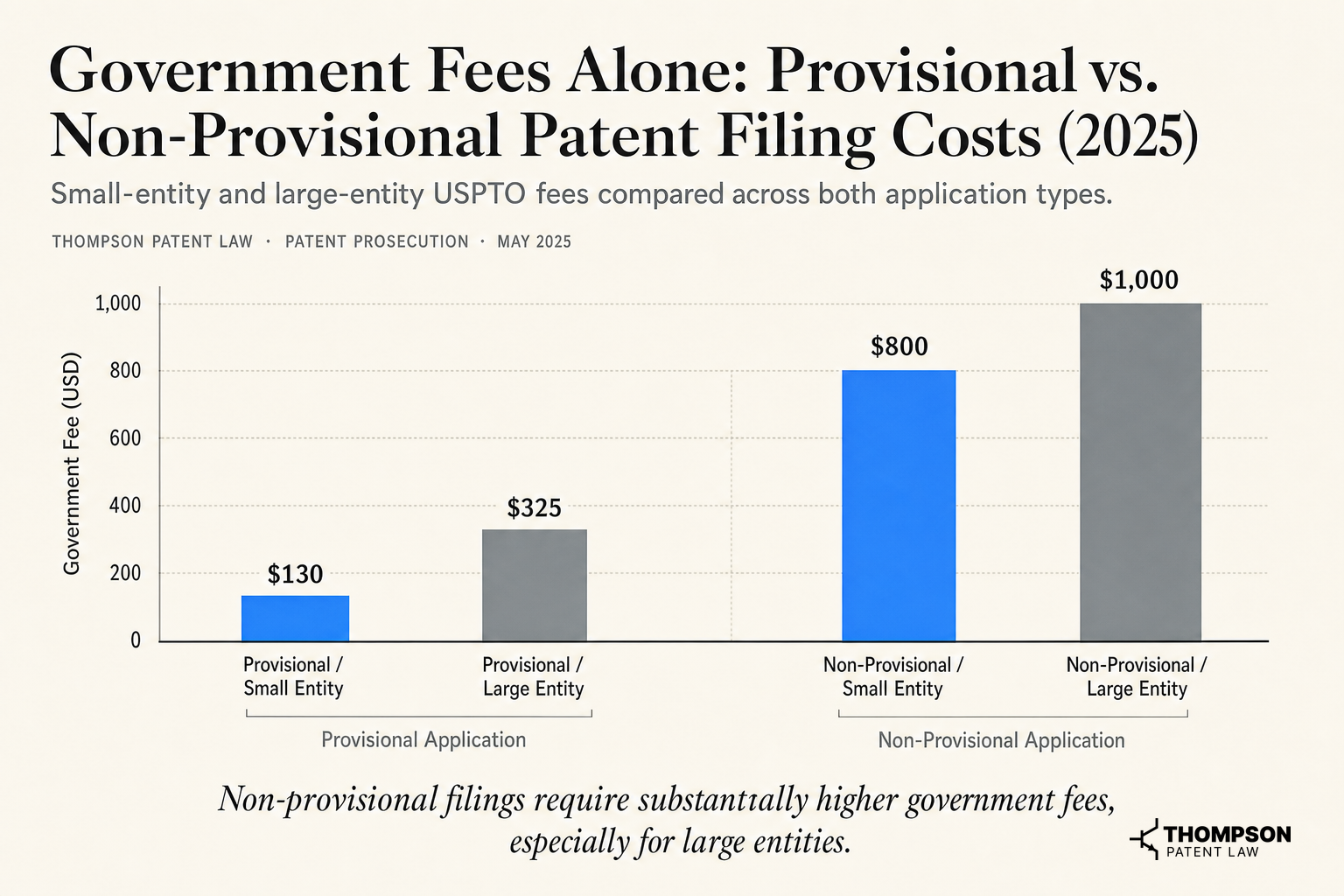 Government Fees Alone: Provisional vs. Non-Provisional Patent Filing Costs (2025) — Source: USPTO Fee Schedule, 2025; casrai.org
USPTO Filing Fees Compared
The USPTO filing fee for a provisional is far lower than for a non-provisional. As of 2025, per the USPTO fee schedule, provisional filing fees are a fraction of non-provisional costs — visit the USPTO fee schedule directly for current figures by entity size. A non-provisional utility application adds search and examination fees that can multiply that baseline several times over. Government fees are the floor, professional fees are the larger variable.
Attorney Fees Reflect the Work, Not the Label
A well-prepared provisional that genuinely supports future claims requires nearly as much technical writing as a non-provisional. Treating a provisional as a rough draft often creates a document that fails to protect you. Non-provisional patents require the full formal patent application process, including claims, drawings, and an application data sheet. According to CASRAI, attorney and prosecution fees typically bring the total cost of a moderately complex utility patent into the low five figures. A cheap provisional that does not hold up can cost more than a properly prepared non-provisional. Our overview of the process for filing a patent walks through where that work goes.
When Filing Directly Makes Financial Sense
If the invention is fully developed, the market is validated, and you are ready to commit, filing directly as a formal patent application skips the provisional step and avoids paying attorney fees twice. The provisional path is not automatically cheaper. It depends on how you use those 12 months.
The Biggest Mistakes Inventors Make Choosing Between These Filings
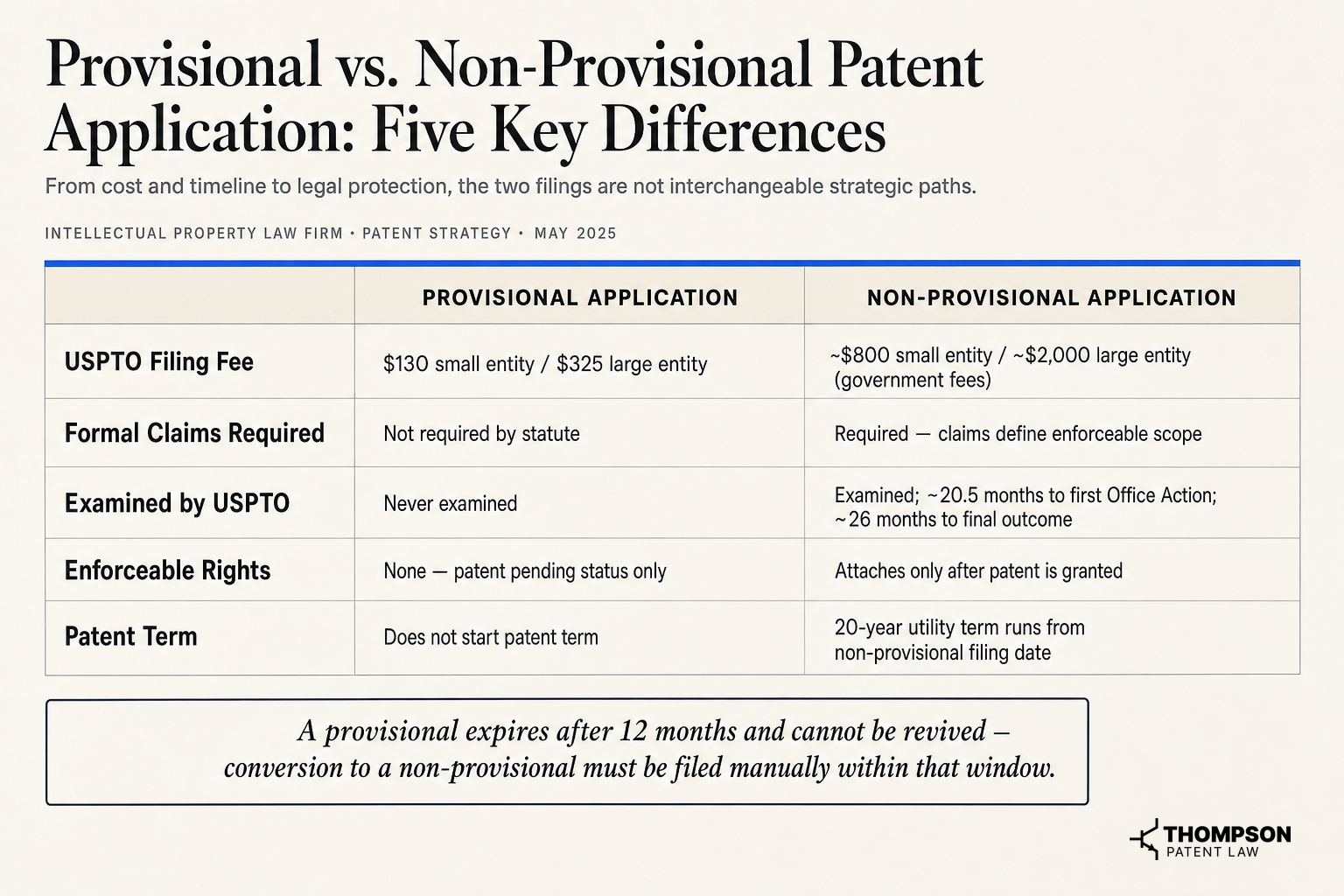 Provisional vs. Non-Provisional Patent Application: Five Key Differences — Source: USPTO Fee Schedule, 2025; USPTO Pro Se Assistance Program; 1stcounsel.com Patent Pendency, 2024; law.cornell.edu 35 U.S.C. § 111
Filing a Thin Provisional and Calling It Done
The most common mistake is treating the provisional as a placeholder needing minimal effort. If the written description is thin, the priority date is unreliable. Under 35 U.S.C. §§ 112 and 119(e), an examiner can find that the claimed subject matter is not supported by the provisional's disclosure, meaning those claims cannot rely on the provisional's filing date — a critical issue under U.S. patent law that inventors often overlook. The provisional must describe the invention in the same detail you want the final patent to cover. If you are still learning the fundamentals, start with our guide on how to patent an idea.
Waiting Too Long After a Public Disclosure
U.S. law provides a one year grace period for certain inventor-originated public disclosures under AIA 35 U.S.C. § 102(b)(1), but that grace period is limited in scope and not global. Many countries follow absolute novelty rules, meaning any public disclosure before filing destroys foreign patent rights, as Priority IP notes about the European Patent Convention. File before you disclose publicly, not after. Understanding when patent applications become public helps you plan disclosures without forfeiting rights.
Assuming a Provisional Converts Automatically
A provisional does not convert to a non-provisional on its own. Per 35 U.S.C. § 111, if you do not file the non-provisional within 12 months, the provisional is abandoned by law. Set the conversion deadline in your calendar the day you file.
How Patent Claims Fit Into This Decision
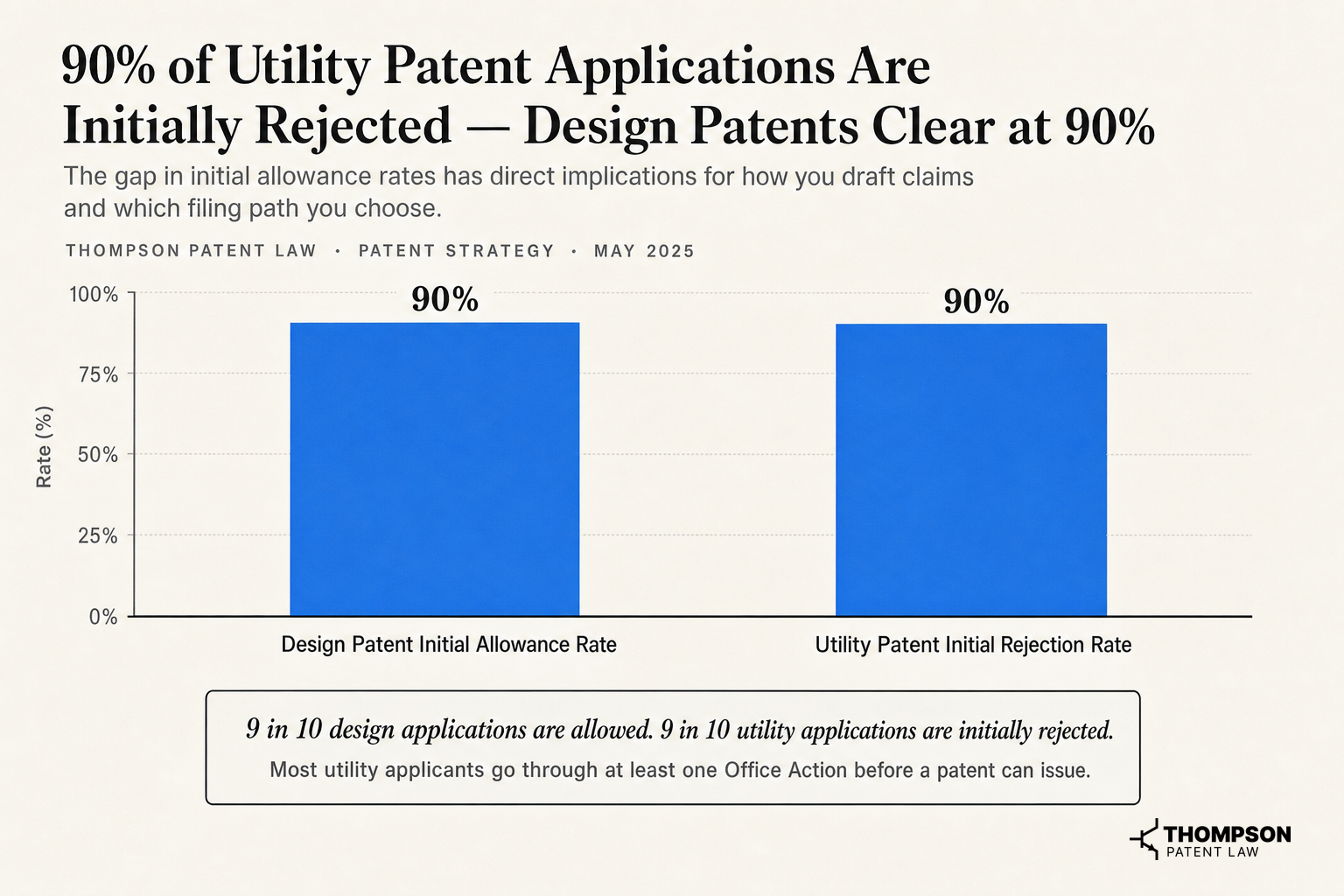 86% of Utility Patent Applications Are Initially Rejected — Design Patents Clear at 85% — Source: USPTO Patent Statistics, 2022, via patenttrademarkblog.com
Provisional Applications Have No Formal Claim Requirement
A provisional requires no formal patent claims. Under 35 U.S.C. § 111(b), the specification and drawings alone establish the filing date that later non-provisional claims can rely on, provided they are fully supported. That lowers the barrier to getting a date quickly, but the provisional receives no examination and creates no presumption about scope.
Claim Drafting Determines What Gets Protected
The written claims in a non-provisional define the legal boundaries of your rights. Broad, well-engineered claims are harder for competitors to design around, narrow or poorly drafted claims leave portions of the invention exposed. Claim drafting is the highest-stakes part of the application, not a step to rush or hand to a non-attorney service. This is exactly where our team's Litigation Quality Patent® services focus, drafting claims built to survive challenge, not just to issue.
Prior Art Searches Change How Claims Should Be Written
A patent search before filing reveals what the examiner will use to challenge your claims and maps the competitive landscape for your invention. Most utility patent applications receive at least one rejection before allowance, often for obviousness, while design patents clear at roughly an 85% allowance rate, according to USPTO data — outcomes that experienced patent counsel can significantly improve through a sophisticated prosecution strategy. Understanding the prior art landscape lets a patent attorney draft claims that distinguish the invention, protect both functional aspects and ornamental features, and reduce obviousness rejections. A prior art search separates a strategic filing from an expensive guess.
Which Filing Path Is Right for Your Situation
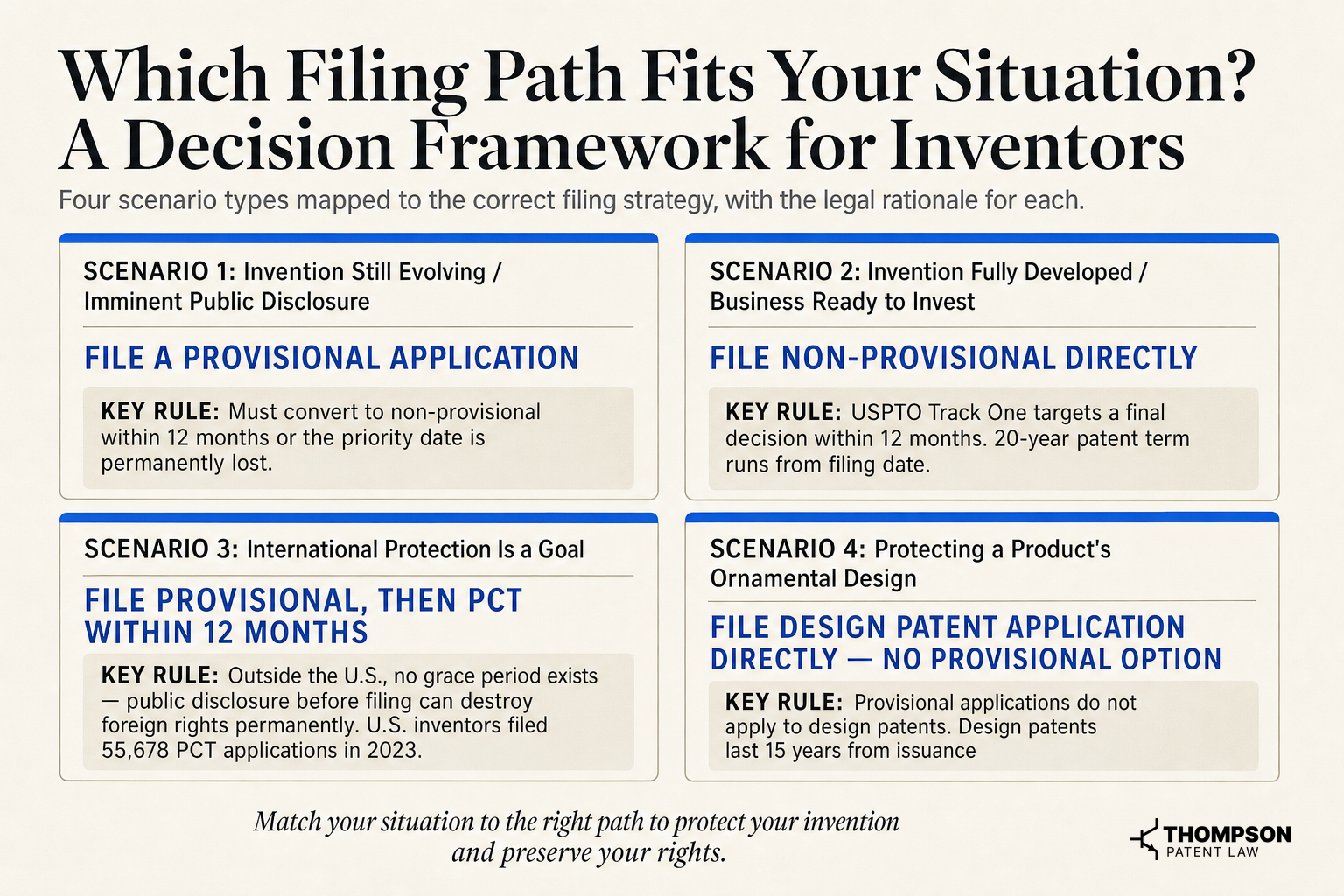 Which Filing Path Fits Your Situation? A Decision Framework for Inventors — Source: USPTO Pro Se Assistance Program; WIPO PCT Statistics, 2023 (wipo.int); legalclarity.org; priority-ip.co.uk
When a Provisional Application Makes Strategic Sense
A provisional is the right first move when the new invention is still being refined, a product launch or trade show is imminent, funding conversations are starting, or international filings are planned within the year. In life sciences and other research-intensive industries, a significant share of filings start as provisional patent applications to secure an early date while research continues, as recent empirical work shows. Software founders face the same timing pressure, our guide to patenting mobile apps covers the provisional decision for app inventors.
When Filing Directly Is the Better Choice
A direct non-provisional filing makes sense when the invention is fully developed, the market strategy is clear, the budget is available, and time to issuance matters. The USPTO's Track One program even targets a final disposition within about 12 months, and the patent center assigns the application to an expedited queue. Skipping the provisional avoids paying attorney fees twice. If you are ready now, there is no strategic advantage to delaying.
Design Inventions Are Never Provisional
Because provisionals apply only to utility inventions, ornamental designs must be filed directly as design patent applications through the design application process at the trademark office. Design patent protection runs 15 years from the date of grant with no maintenance fees. If your innovation is primarily visual, skip the provisional question and talk to a patent attorney about design applications and design patent protection.
What to Expect From the Patent Process After You File
After a Provisional the 12-Month Clock Starts
After filing, the USPTO issues a filing receipt confirming your application number and priority date. No examination occurs, and the provisional stays confidential. You have 12 months to file the corresponding non-provisional and claim priority as patent holder of the provisional. To understand how much runway you have, read our explainer on how long a provisional patent application lasts. Verify your filing receipt immediately, it is your proof of the priority date.
After a Non-Provisional Comes Examination and Prosecution
Once a non-provisional is filed, the application process moves forward as the USPTO assigns it to an examiner. According to The World Data, the first Office Action averages about 20.5 months (FY 2025) and final disposition around 26 months (FY 2024), timelines set by the U.S. patent office after a patent examiner reviews the file. That first action is usually a rejection citing prior art or patent eligibility issues under § 101, requiring a substantive response. For inventors who prepare well, these rejections are routine hurdles rather than dead ends. Plan for at least one round of prosecution before allowance.
Continuation Applications Extend the Patent Family
Once a non-provisional is pending, continuation and divisional applications, which are utility applications, can pursue additional claim coverage on related aspects of the invention. This is how patent portfolios are built strategically. The non-provisional is the foundation, not the ceiling.
Frequently Asked Questions
What are the disadvantages of a provisional patent application?
It provides no enforceable rights, expires in 12 months with no extension, and can undermine the priority date if the written description is weak.
Is a provisional patent application worth anything?
Its value is real but indirect. A provisional buys an early effective filing date and "patent pending" status, which matters for investors and licensing, but has no enforcement power by itself.
How long does a non-provisional patent last?
A utility patent lasts 20 years from its filing date, per CASRAI, adjustable for patent office delays in some cases. A design patent lasts 15 years from the grant date.
Am I protected with a provisional patent application?
Not in the sense of enforceable rights. A provisional gives you patent pending status but cannot stop infringers until a non-provisional is filed and granted.
What is a provisional patent vs non provisional patent?
Understanding the provisional patent vs non provisional patent distinction starts here: a provisional is a preliminary filing with a specification and drawings but no formal claims, establishing an early filing date for 12 months. A non-provisional is the formal filing that gets examined and must include claims and a declaration. Our provisional patent basics page covers the fundamentals.
Your Next Steps to Choosing the Right Filing Path
The bottom line: A weak provisional or poorly drafted non-provisional can produce a patent competitors can design around or challenge, wasting the entire investment — while a strategically engineered filing protects the invention, holds up under scrutiny, and becomes a genuine business asset. A strong filing, built on a thorough written description and carefully engineered claims, is the difference between a document that merely issues and one that delivers lasting competitive protection.
This decision was never about which application is easier or cheaper. It is about which filing path serves your actual goals at this moment in your product development. If the invention is still evolving, public disclosure is imminent, or international filing is planned, a well-prepared provisional is the right first step. If the invention is complete and the timing is right, filing directly to a non-provisional gets the examination clock running.
The urgency is real. Every day between a public disclosure and a filing narrows your options, and a missed 12-month conversion deadline is not recoverable. Waiting can cost you foreign rights, priority dates, and your competitive edge.
Take these next steps:
- Schedule a Complimentary Patent Needs Assessment with Thompson Patent Law to connect with a member of our team and discuss your invention, timeline, and business goals. You will speak with a member of our team, not sign up for a commitment.
- Document your invention in writing before any public demo, sale, or pitch.
- Set your conversion or filing deadlines in your calendar the day you file.
A filing strategy chosen deliberately, with claims built to survive challenge, returns far more than it costs. Keep innovating.
By Craige Thompson, Patent Attorney, MBA, Electrical Engineer. Craige leads a team of registered patent attorneys with engineering degrees and backgrounds spanning industry and major law firms, serving inventors from independent founders to Fortune 500 companies across electrical, mechanical, software, and medical device technologies.
Craige Thompson Patent Attorney, MBA, Electrical Engineer Thompson Patent Law