


- You cannot patent a bare app idea, but you can patent the specific technical method your mobile app uses to implement it — the difference lies entirely in how the claims are written.
- U.S. law gives a 12-month grace period after public disclosure (launch, demo, pitch without an NDA) to file; once that window closes, the right to patent that invention is permanently gone.
- A provisional patent application locks in a priority date for a fraction of full-application cost and buys 12 months to prepare the full filing, but only works if the disclosure is comprehensive — a thin provisional provides no real protection.
- The large majority of software and mobile app patent applications receive an eligibility rejection under the Alice framework on first Office Action, and the specific claim language, not the underlying technology, determines whether an application survives it.
- DIY patent applications are abandoned at a far higher rate than attorney-drafted ones, and a weak, easily-designed-around patent can be worse than no patent because it signals an undefended position to competitors.
The app market generated over $500 billion in revenue in 2022, according to Data.ai (App Annie), yet UC Berkeley research found that 66% of software startup founders report having no patents and not seeking any. Those founders are leaving the most valuable exclusivity right in intellectual property law on the table, often without realizing the one-year clock started the moment they launched.
Key Takeaways
- You cannot patent a bare app idea, but you can patent the specific technical method your mobile application uses to implement it. The difference is entirely in how the claims are written.
- The U.S. patent system gives you a 12-month grace period after public disclosure to file. Once that window closes, the right to patent is gone permanently.
- A provisional patent application locks in your priority date for roughly $1,500 to $3,500 in attorney fees and buys you 12 months to prepare the full application. It only works if the disclosure is comprehensive.
- Over 70% of software and mobile app patent applications receive an Alice rejection on first Office Action. The right claim language, not the technology itself, determines whether you survive it.
- DIY patent applications are abandoned at a rate of 76.4% compared to 34.8% for attorney-drafted applications, according to published research. A weak or abandoned patent is worse than no patent.
Why Mobile App Patents Are Worth More Than Most Founders Realize
Patenting mobile apps is a business decision before it is a legal one. The global app market exceeding $500 billion in revenue in 2022 means that every category of mobile application functionality has commercial value worth protecting, and competitors with capital can replicate a working product faster than most founders expect. A granted patent converts that risk into a legal barrier: the right to exclude others from using your specific method, system, or interface, enforced by federal courts.
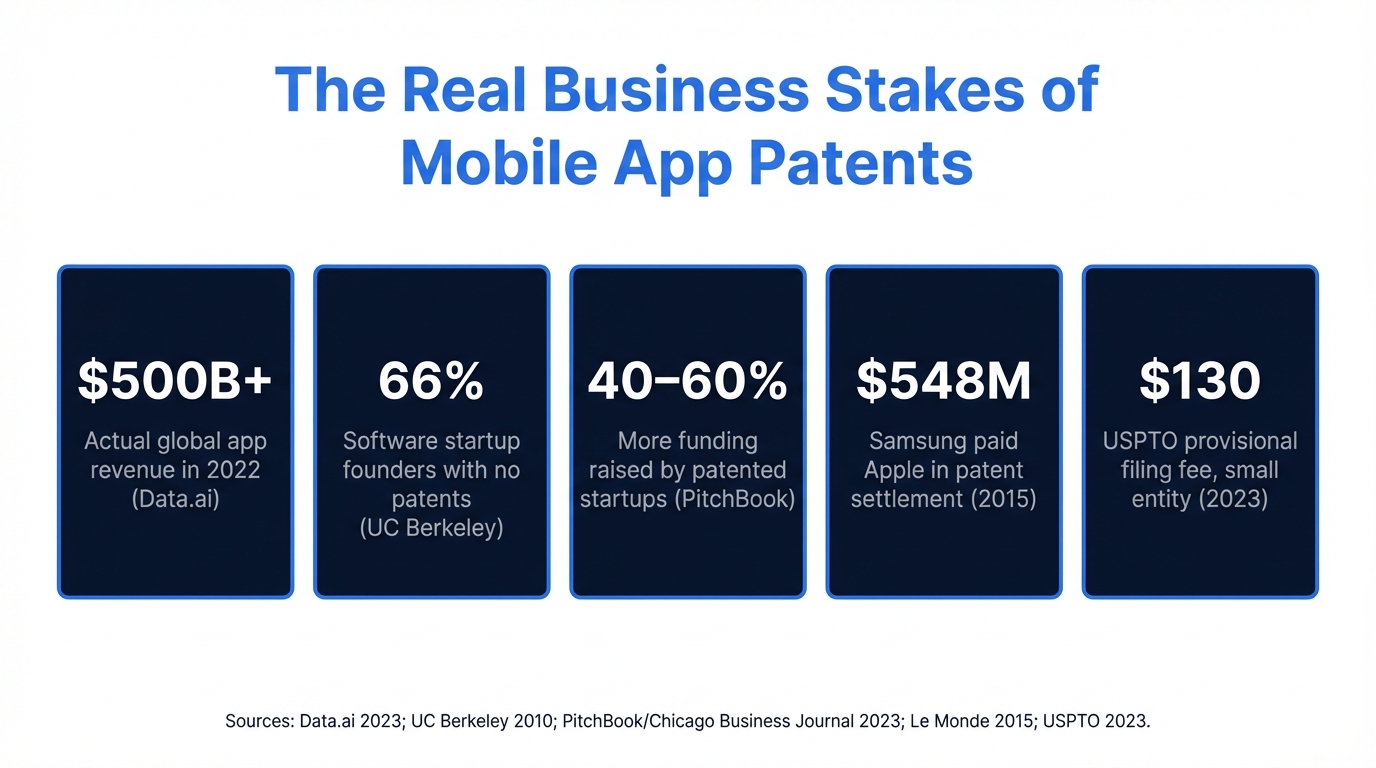 The Real Business Stakes of Mobile App Patents — Source: Data.ai 2023; UC Berkeley Samuelson et al. 2010; PitchBook/Chicago Business Journal 2023; Le Monde 2015; USPTO 2023
What a Patent Actually Gives a Mobile App Company
A patent is not a certificate of accomplishment. It is a property right with teeth: the right to sue any company using your patented invention’s method without a license, regardless of whether they copied you directly or independently developed the same approach. For mobile app companies, this means a competitor cannot legally ship a product that implements your patented functionality, full stop.
The commercial stakes are real. In 2014, a U.S. court awarded patent holder Vringo a 1.36% royalty on Google’s AdWords revenue for infringing app-related patents, a figure that reached hundreds of millions of dollars. On the product side, Samsung paid Apple $548 million in 2015 to settle a verdict covering iPhone patents including touch gestures and UI design. These are not edge cases. They are the normal operation of a patent system designed to reward exactly the kind of technical innovation that powers mobile apps.
The chart above captures the real business stakes: the global app market, the funding gap between patented and unpatented startups, and what it costs to not act.
The Window Closes Faster Than Most Founders Know
Under U.S. patent law, specifically 35 U.S.C. § 102, filing a patent application within one year of any public disclosure of your app is a hard requirement. Launching on the App Store, posting a demo on YouTube or social media platforms, presenting at a conference, or even pitching to investors without a non-disclosure agreement can start that clock. Miss the one-year window and the right to patent that specific invention is permanently forfeited under U.S. law, with no exceptions.
A provisional patent application is the fastest mechanism for stopping the clock. The United States patent office filing fee for a provisional is $320 for small entities and $160 for micro entities as of 2024. Add legal fees for attorney preparation of roughly $1,500 to $10,000 depending on the complexity of the disclosure and you have a priority date secured for a fraction of what the full application costs. A thorough provisional that fully covers the invention also reduces the overall cost of the non-provisional by building in the technical disclosure work upfront. The critical caveat: a provisional patent application that fails to fully describe the invention provides no real protection for claims that go beyond what was disclosed. Filing a thin provisional just to claim “patent pending” is a common and expensive mistake. For a deeper look at timing strategy, When To Get A Patent: Timing Your Application For Maximum Protection walks through exactly when founders should act.
How Patents Compare to Copyright for Mobile Apps
Copyright protection for software is real and automatic, but it covers only what you wrote, not the functional aspects of what your app does — which is why patenting mobile apps provides a fundamentally different and stronger form of protection. As the U.S. Copyright Office confirms, copyright extends to the expression in code and user interface design but explicitly excludes the ideas, algorithms, methods, and systems the software implements. A competitor who reads your mobile application’s functionality, builds the same product using different code, and releases it on the App Store or other third party features infringes no copyright whatsoever.
The Lotus v. Borland decision from the First Circuit Court of Appeals in 1995 made this concrete: copying the menu commands of a software program was not copyright infringement because the menu hierarchy was a method of operation, and methods are outside copyright’s scope. Mobile app copyright protects your specific lines of code and your original visual expression. A utility patent protects what your app actually does, including the technical aspects of its core functionality. These are not substitutes. Copyright is free and attaches automatically; a patent requires prosecution but creates protection that cannot be replicated by a developer who simply builds the same thing from scratch.
Can You Actually Patent a Mobile App Idea
You cannot patent a mobile app idea. You can patent the specific technical method, system, or apparatus your mobile application uses to implement that idea. The line between those two statements is where the majority of DIY patent applications fail and where experienced patent attorneys create the most value. Understanding that line before you file saves both money and priority date.
Navigating things you can’t patent versus what is protectable is a foundational skill in intellectual property law, and for software-based inventions, the boundary of patent eligibility shifts depending entirely on how claims are drafted.
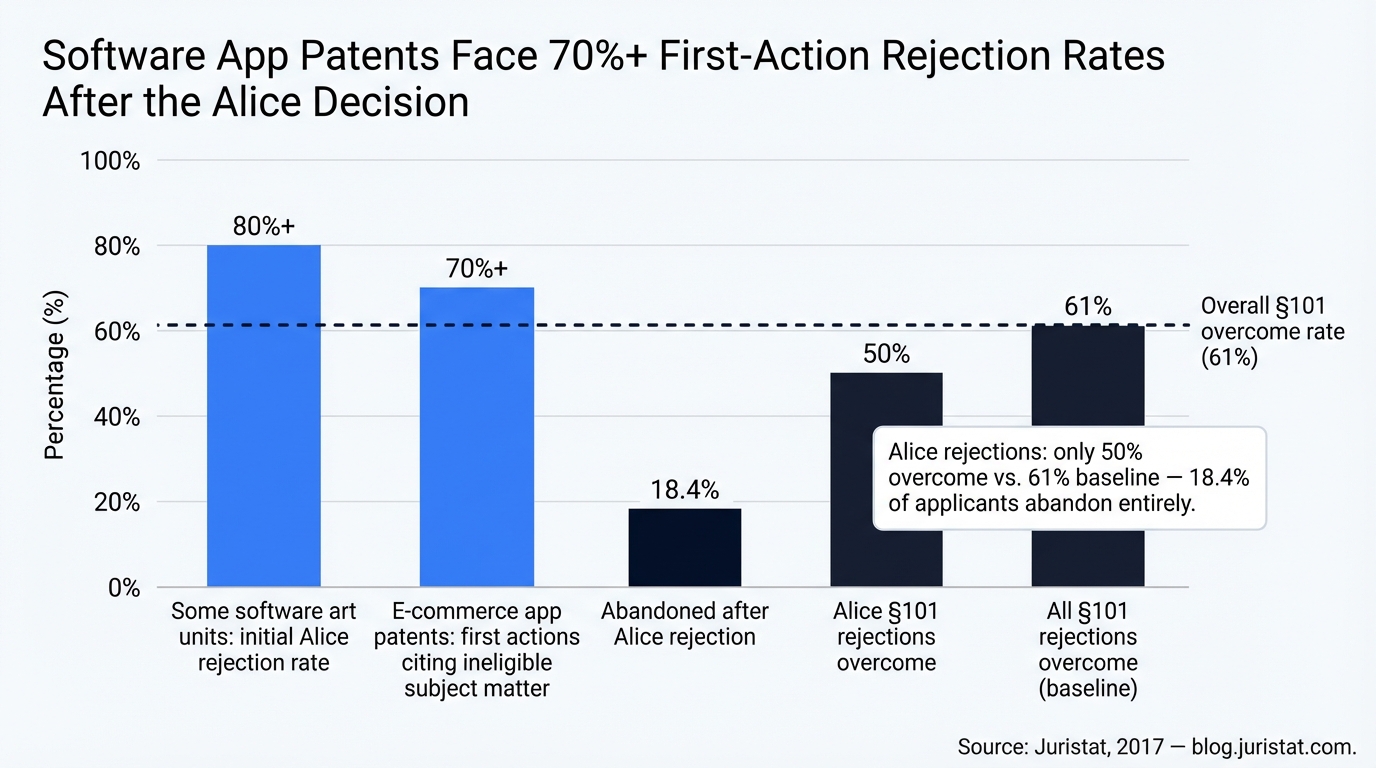 Software App Patents Face 70%+ First-Action Rejection Rates After the Alice Decision — Source: Juristat, 2017
The Alice Problem and Why It Kills More App Patents Than Anything Else
The Supreme Court’s 2014 decision in Alice Corp. v. CLS Bank International created a two-step eligibility test that governs every software and mobile application patent application filed today, making its practical application essential knowledge for any founder seeking protection. Step one asks whether the claim is directed to an abstract idea. Step two asks whether the claim adds an “inventive concept” beyond the abstract idea — one of many abstract ideas courts have scrutinized — something meaningfully more than simply implementing that idea on a generic computer or smartphone.
 A patent application that claims “a method of displaying user preferences on a mobile device using a database” will almost certainly fail Step one. The same underlying technology claimed as “a method of generating a dynamic user interface state by executing a weighted preference algorithm that produces a device-specific rendering sequence in real time” stands a materially better chance. The technology is identical. The claim language determines eligibility.
The data on failure rates is stark. According to Juristat’s analysis, some USPTO art units saw over 80% of software patents initially rejected as abstract under § 101 following the Alice decision. Applicants who receive an Alice-based rejection have only about a 50% chance of overcoming it, compared to 61% for § 101 rejections overall, and 18.4% abandon their applications after receiving an Alice rejection. According to Thompson Patent Law, its Alice eligibility strategies have improved § 101 outcomes by 25 to 50% compared to standard prosecution approaches. That difference comes from how claims are drafted before filing, not from how they are argued afterward.
For a practical breakdown of how Software Technologies are approached from a claim-drafting perspective, Thompson Patent Law’s software patent resource covers the specific techniques that survive Alice scrutiny.
What Makes a Mobile App Patentable: Novelty, Non-Obviousness, and Utility
Beyond Alice eligibility, three classic legal requirements apply to every patent application, and understanding them is essential to patenting mobile apps successfully. Novelty under § 102 means no prior art covers the same invention: no existing patent, published patent application, academic paper, or public app store listing discloses what you are claiming. Non-obviousness under § 103 means a person of ordinary skill in mobile app development would not have combined existing elements to arrive at the same result. Utility for apps is rarely the hurdle but is required.
According to Project PQAI’s analysis, obviousness under § 103 is the type of rejection patent examiners issue most often in technology patent examinations. This means the most defensible mobile app patents describe a combination of technical elements that solves a problem in a way that is not simply the sum of its parts. A new UI gesture that produces a specific and unexpected technical result in the device’s rendering pipeline can be novel and non-obvious. A to-do list app that stores items in a database using standard CRUD operations is neither.
The practical test: if an experienced mobile app developer, given the problem your app solves, would naturally combine existing tools to arrive at your solution, you have a non-obviousness challenge. If the result of your technical approach is surprising, produces an unexpected performance gain, or requires a non-obvious architectural decision, you likely have patentable subject matter. The Patent Novelty Playbook: How To Outsmart Competitors and Avoid Rejections provides a structured framework for assessing exactly this question before you file.
What Parts of an App Can Be Patented
When patenting mobile apps, a mobile application can receive protection from multiple patent types, and they protect different things. A utility patent covers the functional method the app performs: the algorithm, the system architecture, the process by which the app produces its core result. A design patent covers the unique visual appearance of specific UI elements: a distinctive screen layout, an original icon arrangement, or a novel interface transition that is ornamental rather than purely functional.
Apple’s approach to the slide-to-unlock feature illustrates both: the company obtained design patent USD 675,639 for the visual appearance of the slide-to-unlock screen and utility patent US 8,046,721 for the functional gesture mechanism itself. Both patents were at issue in the Samsung litigation. The USPTO granted approximately 50,000 design patents in 2020, according to USPTO data, compared to roughly 350,000 utility patents, reflecting that design patents are a meaningful but secondary protection layer for most app companies.
Trademarks protect the app’s name, logo, and brand identity, and trademark protection is a separate intellectual property right outside the patent prosecution process entirely — companies seeking trademark services should address those needs through the trademark office independently of patent prosecution. For most mobile app companies, the priority is a utility patent on the core method, potentially supplemented by a design patent on a distinctive UI element and trademark registration on the brand, along with careful attention to all intellectual property rights that protect the overall product.
How to Conduct a Patent Search Before You File Anything
Skipping the prior art search is the single most expensive mistake founders make when patenting mobile apps. Filing without searching wastes the entire application fee if a blocking patent already exists, and it exposes the applicant to invalidity arguments later if they found the prior art and failed to disclose it. A search is not optional due diligence. It is the foundation of a credible application strategy.
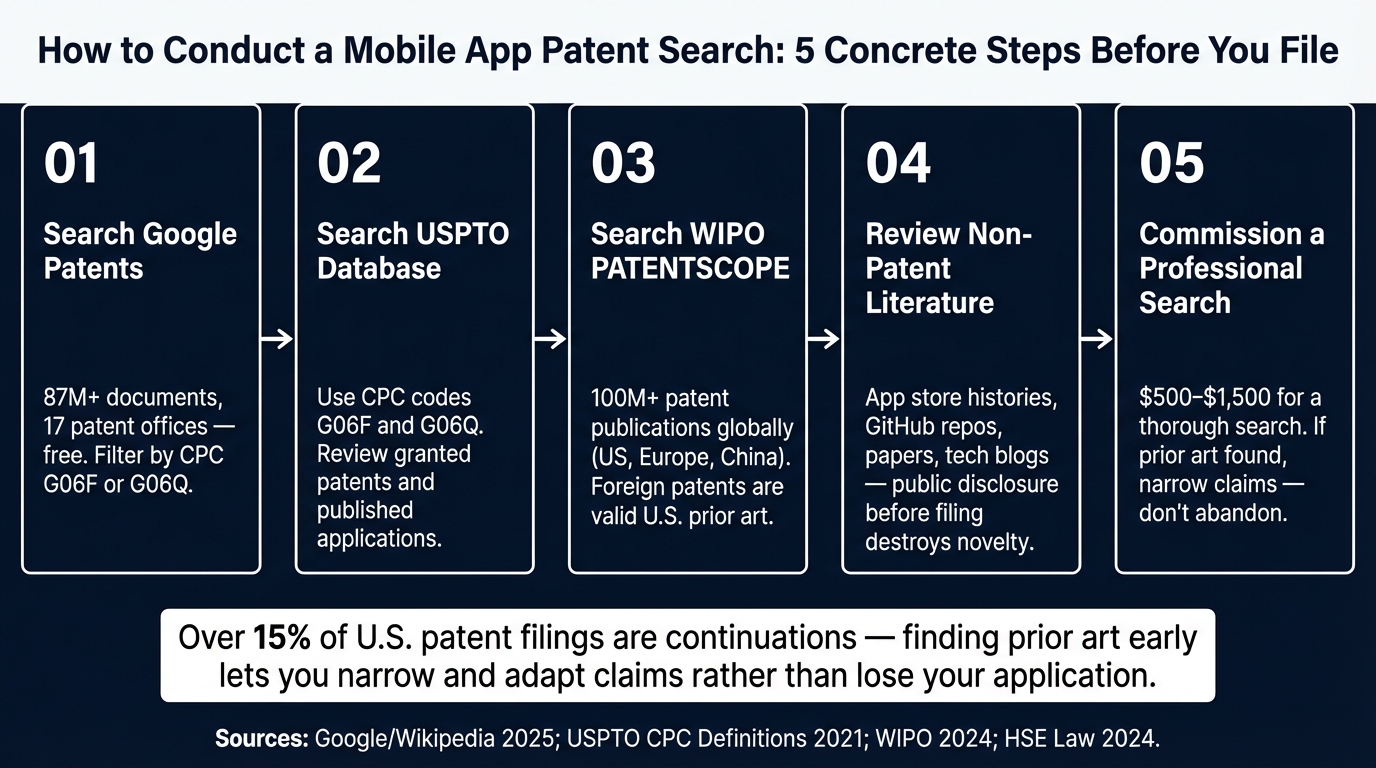 How to Conduct a Mobile App Patent Search: 5 Concrete Steps Before You File — Source: Google/Wikipedia 2025; USPTO CPC Definitions 2021; WIPO 2024; HSE Law 2024
Using Google Patents and the USPTO Database to Find Competing Patents
Google Patents indexes over 87 million patent documents from 17 patent offices worldwide, covering filings from the Google Play Store ecosystem and beyond, and offers free full-text searching. The USPTO’s Patent Full-Text Database provides the same U.S. coverage with more granular classification-based filtering. Both are legitimate starting points for a preliminary search.
The most effective steps when patenting mobile apps begin with CPC (Cooperative Patent Classification) codes rather than keyword searches alone. Mobile application inventions typically fall under CPC code G06F (electrical digital data processing) for computing-related functions or G06Q (ICT specifically adapted for business methods and commerce), as defined by the USPTO’s CPC classification system. Searching by classification code surfaces patents that describe your functionality using entirely different terminology, which keyword searches will miss.
The most common search mistake is using your own vocabulary to describe your invention. A patent on “a method for swiping to reveal content” and a patent on “a gesture-activated content reveal system” may be functionally identical and blocking. Search by what your app does, not by what you call it.
What a Professional Prior Art Search Includes That a DIY Search Misses
A thorough patent search conducted by a patent attorney or qualified search firm examines issued U.S. patents, published patent applications (which become prior art 18 months after filing even if never granted), academic and technical literature, and public app store listings. It also covers foreign patent filings through the World Intellectual Property Organization’s PATENTSCOPE database, which contains over 100 million patent publications globally from patent offices in the U.S., Europe, China, Japan, South Korea, and over 100 other jurisdictions.
Foreign patents are where DIY searches most commonly fail. A German patent filed by a European startup in 2019 that covers a method similar to yours is valid prior art in U.S. prosecution, and it will not appear prominently in a Google Patents keyword search unless you specifically include foreign patent offices. Professional search firms typically charge $500 to $1,500 for a thorough prior art search, according to HSE Law’s analysis of patent prosecution costs. Spending $1,000 on a search before spending $10,000 on a full patent application is not optional caution. It is basic investment management.
How to Read Prior Art Results and Decide Whether to Proceed
A prior art search result is a map of the competitive patent landscape, not a pass/fail determination. Finding a patent in your space does not end the analysis. The question is whether your specific claims can be drafted around the existing prior art while still covering the functionality that matters to your business.
Prior art that discloses the exact technical method with the exact system structure using existing technology is blocking. Prior art that covers only part of your functionality, uses a different technical mechanism to achieve a similar result, or describes only the concept without a specific implementation may leave substantial room for protectable claims. Over 15% of U.S. patent filings are continuation applications, reflecting how commonly applicants adjust and pursue modified claims after encountering prior art rather than abandoning the effort entirely. A search that finds relevant prior art is not a dead end. It is information that shapes the claim strategy and protects the investment in prosecution.
The five-step process shown in the chart above walks through exactly how to move from initial search to a filing decision.
The Two Types of Patent Applications Every App Founder Needs to Understand
The choice between a provisional patent application and a non-provisional patent application is the first strategic decision when patenting mobile apps, and it has real financial and legal consequences. Getting the sequencing wrong costs either priority date protection or thousands of dollars in avoidable prosecution expense. A Complimentary Patent Needs Assessment before making this call is the fastest way to avoid costly sequencing mistakes in the patent process.
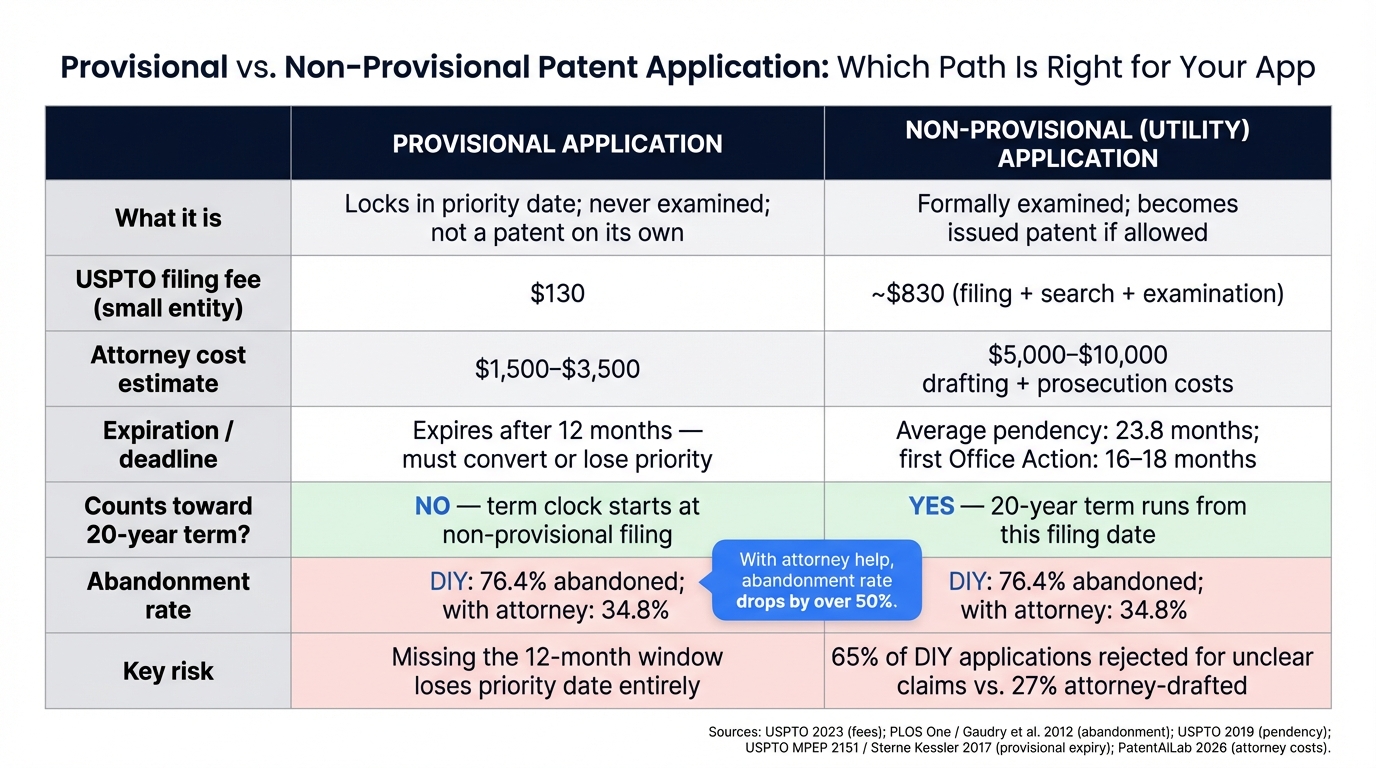 Provisional vs. Non-Provisional Patent Application: Which Path Is Right for Your App — Source: USPTO 2023; PLOS One / Gaudry et al. 2012; USPTO Performance Metrics 2019; USPTO MPEP 2151 / Sterne Kessler 2017; PatentAiLab 2026
What a Provisional Patent Application Does and Does Not Do
A provisional patent application establishes a priority date for a specific application and gives the applicant 12 months to file the full non-provisional application. It is never examined by the USPTO and never becomes a patent on its own. It expires automatically after 12 months if not converted. Its primary value is buying time: time to develop the app further, raise funding, assess the market, and prepare the full application with more resources.
The cost differential is significant. Attorney fees for a well-drafted provisional patent application typically run $1,500 to $10,000 depending on the complexity of the invention and the depth of disclosure required, compared to $5,000 to $10,000 for a non-provisional. Software applications in particular often require significant attorney work to ensure the disclosure is comprehensive. The phrase “patent pending” becomes available immediately on filing, which has real marketing and investor signaling value.
A high-quality provisional also reduces the overall cost of the non-provisional by building the technical disclosure work into the earlier filing, so the investment is not lost.
The critical risk: a poorly drafted provisional that does not fully disclose the invention provides no real priority date benefit for claims that go beyond what was originally disclosed. According to Sterne Kessler’s analysis of USPTO procedure, a provisional application that fails to adequately support the non-provisional claims is legally equivalent to no provisional at all. Filing a thin provisional just to plant a “patent pending” flag, without a comprehensive technical disclosure, is one of the most common and costly mistakes in app patent prosecution. Understanding when to file and what the provisional must contain is essential before committing to this path.
When to File Provisional vs. Going Straight to Non-Provisional
The provisional-first path, a common approach when patenting mobile apps, makes strategic sense when the mobile application is still in active development, the feature set may change before launch, funding is constrained but a public disclosure or launch is imminent, or the inventor needs time to find and engage a patent attorney before the disclosure clock starts running.
Going directly to a non-provisional patent application makes sense when the invention is fully defined, the budget supports full prosecution from the start, and faster examination is a business priority. One underappreciated advantage of this path: examination begins immediately, and the average total pendency for a U.S. patent application is currently about 23.8 months, meaning a direct non-provisional filing can produce a granted patent faster than a provisional-plus-non-provisional sequence.
A significant benefit of the provisional-first path applies specifically to apps with long commercial lives: provisional patents do not count against the 20-year patent term. The 20-year clock starts at the non-provisional filing date, according to USPTO patent term rules. For a mobile application with a 10-year revenue window, those 12 months of provisional pendency are effectively free patent term extension.
What Goes Into a Non-Provisional Patent Application for a Mobile App
A complete non-provisional patent application for a mobile app includes a written specification describing the invention in full technical detail, patent claims defining the legal scope of protection, technical drawings showing the UI and system architecture, an abstract, and formal filing documents including an oath or declaration. Of these components, the claims are the most commercially critical.
The typical U.S. utility patent contains 15 to 20 detailed claims, and every word in those claims can become determinative in court or during examination. According to published research in PLOS One, nearly 65% of DIY applications received rejections for unclear or non-enabling claims, compared to approximately 27% of attorney-drafted applications. The specification must describe every element of every claim with enough detail that skilled software developers and mobile application developers could implement the invention without undue experimentation. Claims that outrun the specification will be rejected and cannot be recovered. For a detailed look at what distinguishes allowed claims from rejected ones, How To Master and Draft Patent Claims That Actually Get Allowed is required reading before any filing decision.
The comparison table below shows exactly how provisional and non-provisional applications differ in cost, timeline, examination status, and strategic use case.
What the Patent Application Process Looks Like From Filing to Grant
The process to patent a mobile app from filing a non-provisional patent application to receiving a granted United States patent takes an average of 2 to 3 years for software-related applications. Most founders have no mental model for what happens during that window, which leads to missed deadlines, lapsed applications, and lost investment. The process is sequential, with defined decision points at each stage.
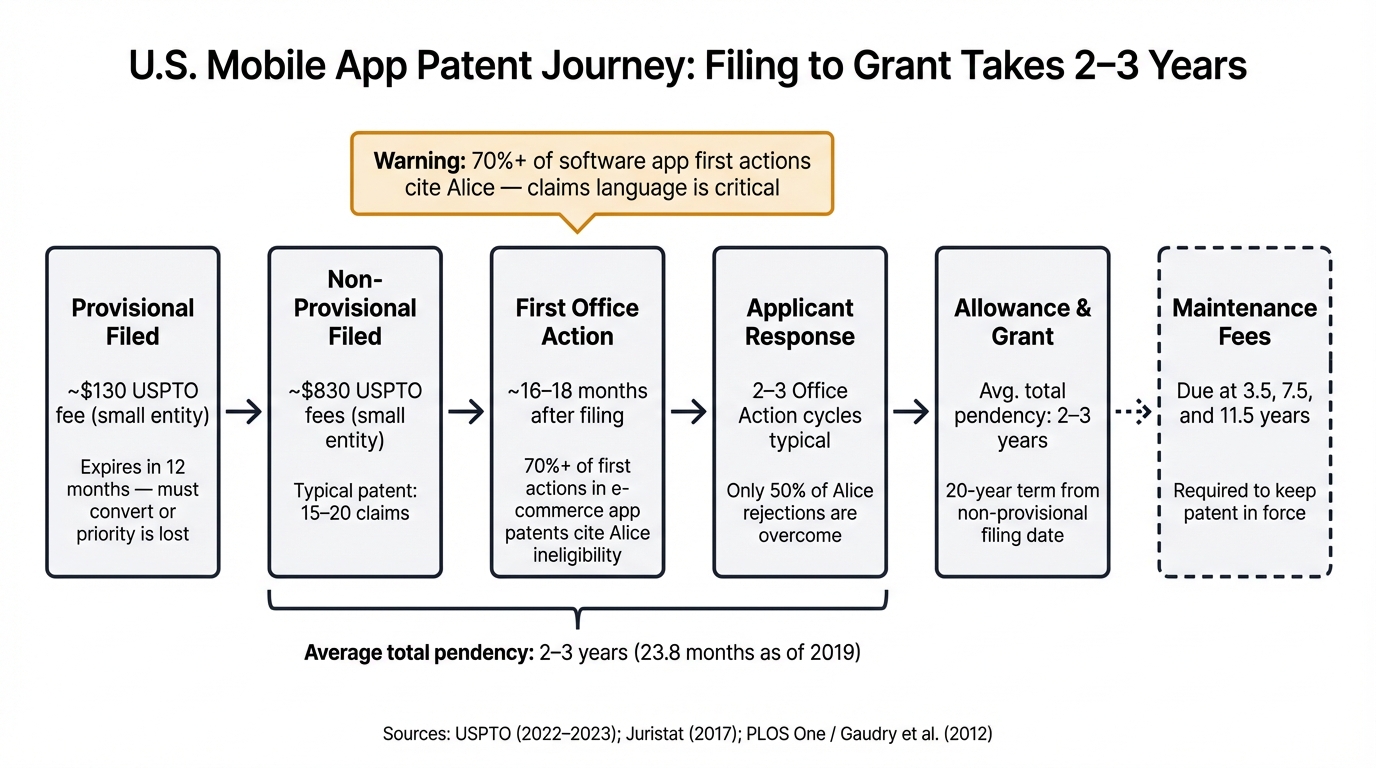 U.S. Mobile App Patent Journey: Filing to Grant Takes 2–3 Years — Source: USPTO (2022–2023); Juristat, 2017; PLOS One / Gaudry et al., 2012
What Happens Between Filing and the First Office Action
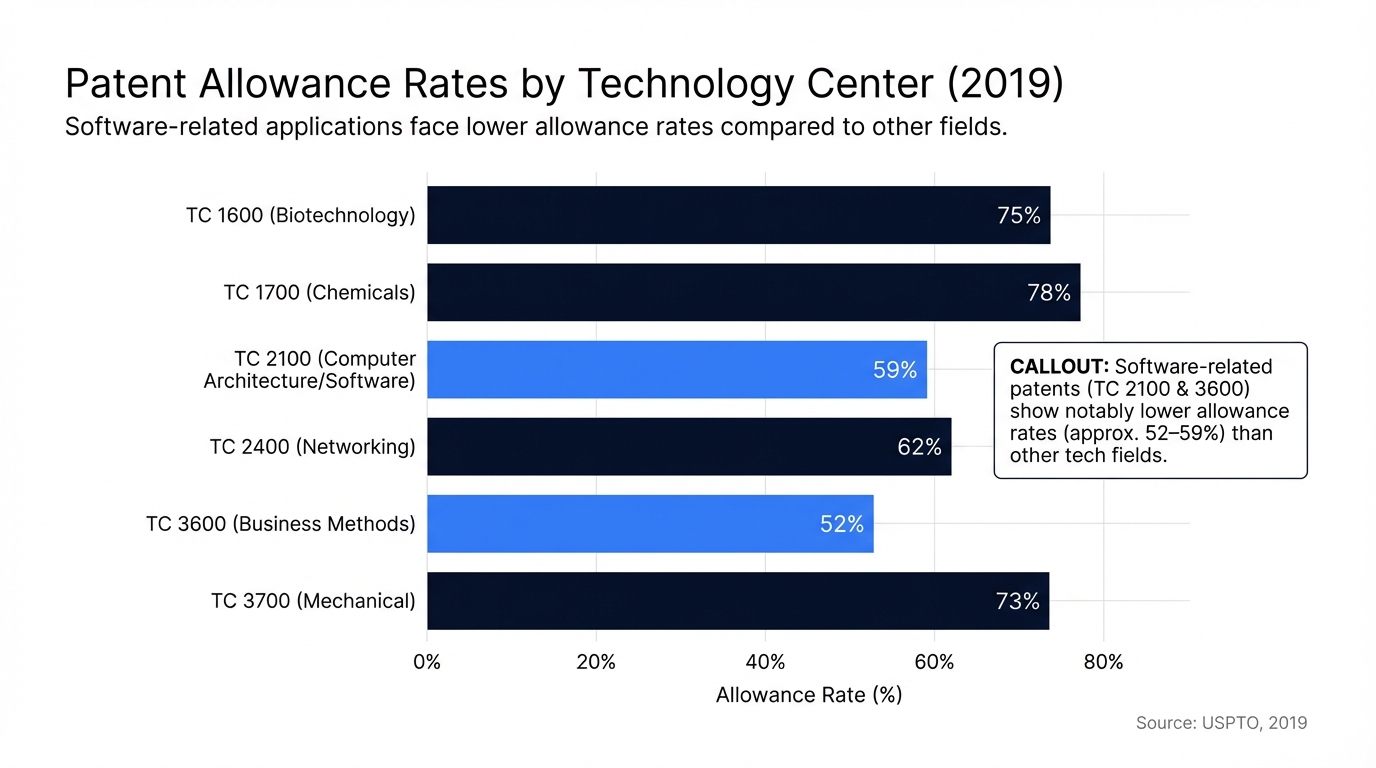
After filing, the USPTO assigns the application to an art unit and a patent examiner. Mobile app and software applications typically land in art units 2100 to 2190, covering computer architecture, software, and information security, or in the 3600s for business method applications. The examiner conducts an independent prior art search and issues a First Office Action, the first formal response in the examination process.
For software and app-related applications, the first Office Action arrives approximately 16 to 18 months after filing on average. According to Juristat’s analysis, over 70% of first actions in e-commerce app patents cite ineligible subject matter under Alice. Rejections under § 102 (novelty) and § 103 (obviousness) are also common in the same Office Action. A first Office Action with multiple rejections is entirely normal and is not a final rejection. It is the opening of a prosecution dialogue, not the end of the application.
How to Respond to Patent Office Rejections Without Losing Claim Scope
Responding to a First Office Action requires amending the claims, arguing against the rejections on the merits, or both. Most software patent applications require 2 to 3 Office Action cycles before reaching allowance, and many require a Request for Continued Examination (RCE) when the examiner issues a final rejection before agreement is reached.
The critical strategic risk in prosecution is claim scope narrowing. Every amendment that overcomes a rejection by limiting the language of a claim creates prosecution history estoppel: a permanent legal record that narrows what the patent can be enforced against. A patent attorney who anticipates examiner arguments at the claim drafting stage can often avoid the need for narrowing amendments entirely, preserving the full commercial scope of protection. According to Thompson Patent Law, this upstream strategy has helped spare clients 1 to 2 years and five figures in prosecution costs by resolving eligibility and prior art issues before the first Office Action rather than through repeated amendment cycles.
What Happens After Allowance and How Long Protection Lasts
After the examiner allows the application, patent approval is confirmed, the applicant pays an issue fee and the patent publishes as a granted United States patent. Utility patents for mobile apps provide 20 years of protection from the non-provisional filing date, subject to maintenance fee payments at 3.5, 7.5, and 11.5 years after grant. Missing a maintenance fee payment results in the patent lapsing. Design patents provide 15 years from the grant date with no maintenance fees.
After grant, the patent holder can enforce the patent by filing suit in federal district court, license the patent to third parties in exchange for royalty payments, or sell the patent outright. The patent also becomes a disclosed public asset that affects company valuation in fundraising and M&A processes.
The full timeline from filing to grant, with average months at each stage, is shown in the chart above.
How Much It Costs to Patent a Mobile App and What Drives the Price
Cost is the first question every founder asks about patenting mobile apps and the one most patent guides answer vaguely. The real numbers vary by complexity and strategy, but they are knowable. More importantly, they are evaluable against the business value a granted patent creates, which is the only framework that makes the investment decision rational.
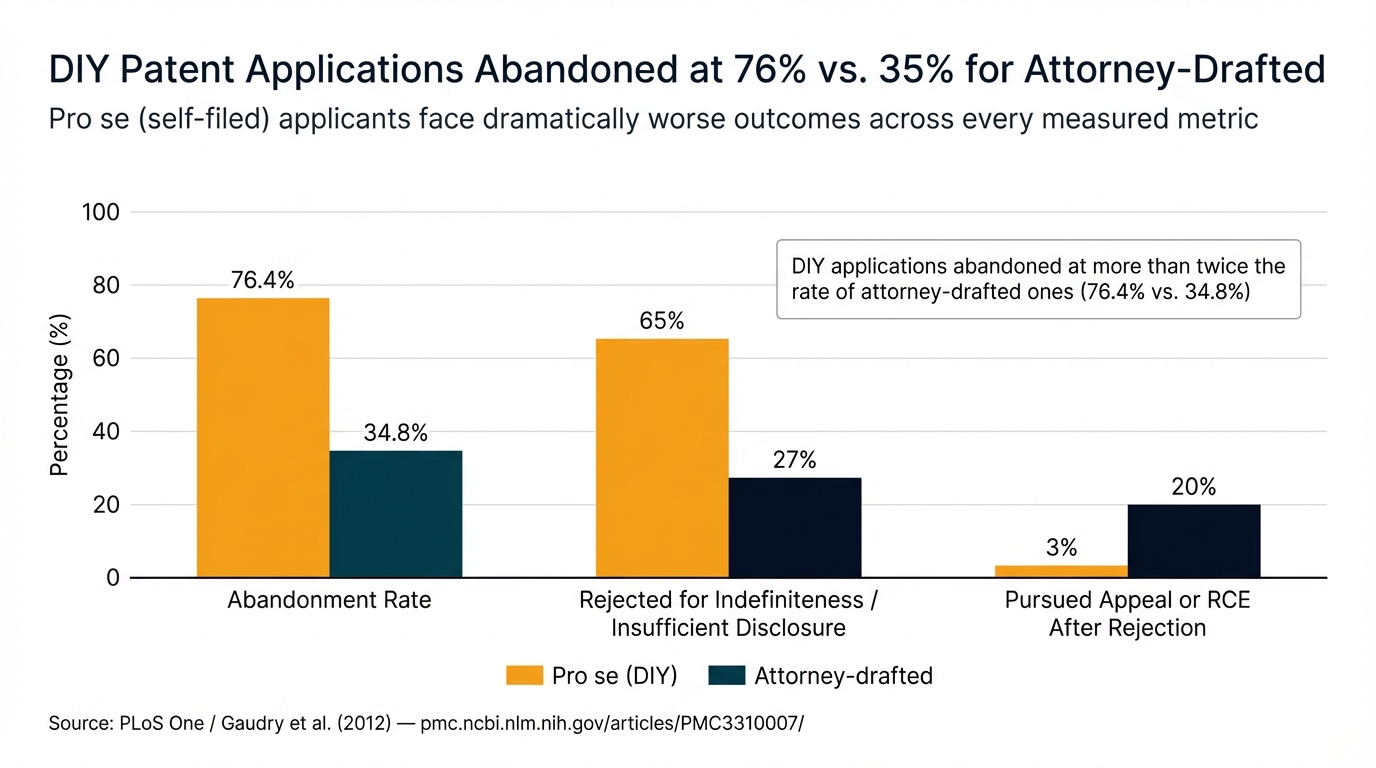 DIY Patent Applications Abandoned at 76% vs. 35% for Attorney-Drafted — Source: PLOS One / Gaudry et al., 2012
The Full Cost Breakdown: Attorney Fees, USPTO Fees, and Prosecution Costs
A complete patent obtained from patenting mobile apps through to grant typically costs between $10,000 and $25,000 in total attorney and USPTO fees, broken across three phases. The provisional patent application phase, if used, runs $1,500 to $10,000 in attorney fees plus USPTO filing fees, with software applications often toward the higher end due to the depth of technical disclosure required. The non-provisional patent application phase runs $5,000 to $10,000 in attorney fees plus USPTO fees depending on entity size and claim count. Prosecution, meaning responses to Office Actions, adds $2,000 to $5,000 per response, and software applications typically require 2 to 3 Office Action cycles.
International patent protection via a Patent Cooperation Treaty (PCT) application adds $3,000 to $5,000 in preparation fees plus national phase entry costs of $2,000 to $5,000 per country when the applicant proceeds in specific jurisdictions. The USPTO’s current fee schedule provides micro entity discounts of 80% and small entity discounts of 60% on most filing fees, which meaningfully reduces the government cost component for early-stage companies.
The abandonment data reinforces why cutting corners on attorney quality is counterproductive. According to research published in PLOS One, pro se (DIY) patent applications are abandoned at a rate of 76.4%, compared to 34.8% for attorney-drafted applications. That gap represents not just lost filing fees but lost priority dates, lost competitive protection, and years of development effort that produces no enforceable intellectual property right.
What Justifies the Cost and How to Calculate ROI
A granted patent that covers a defensible feature of a revenue-generating mobile application creates value in four compounding ways: it blocks direct competitors from implementing the same method, it increases company valuation for investors and acquirers who treat patent portfolios as signals of defensibility, it generates licensing revenue from companies that would otherwise use the method without compensation, and it creates negotiating leverage in partnership and exit discussions.
Research on startup financing consistently shows that companies built around patented technology raise larger funding rounds and are acquired at higher multiples than comparable non-patent-holding peers. The funding advantage for patented startups ranges from 40 to 60% larger rounds, making the cost of a patent portfolio look modest against the financing outcomes it supports. For a practical calculation specific to your app’s revenue, competitive environment, and market, Thompson Patent Law’s 100X ROI Patent Calculator™ provides a structured framework for modeling the return before making the investment decision.
What Happens When Founders Try to Cut Costs with DIY or Non-Attorney Services
The data on DIY patent applications is not ambiguous. A 76.4% abandonment rate means that roughly three out of four applications filed without an attorney never become granted patents. The remainder that do survive DIY prosecution frequently produce patents with narrow, weakly worded claims that competitors can design around with minimal engineering effort.
For mobile app patent applications specifically, the Alice eligibility problem compounds the DIY risk. Functional, abstract claim language, the natural way non-attorneys describe what a mobile application does, is precisely the kind of language that fails Step one of the Alice test. According to Juristat’s tracking of post-Alice prosecution, some software art units initially rejected over 80% of applications as abstract. Overcoming those rejections requires specific technical claim drafting that most non-attorneys and general practice attorneys lack the experience to execute. As When It Comes to a Patent Lawyer’s Experience, “Jack Of All Trades” Usually Means Master Of None! explains, choosing an attorney without deep software patent experience is one of the most costly decisions a founder can make.
A patent that fails prosecution is a waste. A patent that survives prosecution with claims so narrow that a competitor can replicate the core functionality with minor code changes is arguably worse than no patent, because it signals to that competitor that your intellectual property position is undefended. The difference between a weak patent and Litigation Quality Patent® services is almost entirely in how the claims are drafted.
The DIY abandonment data is shown in the chart above alongside the specific rejection categories that most commonly drive failure.
The Mobile App Patent Strategy That Protects More Than Just One Feature
A single patent on a single feature is a starting point, not a strategy. Companies serious about patenting mobile apps build patent portfolios that approach the same product from multiple angles: the core method, design variations, system architecture, and improvements as the app evolves. The goal is to make it progressively harder for a well-funded competitor to replicate the product without infringement.
How to Identify What Parts of Your App Are Worth Patenting First
Not every feature warrants a patent application when patenting mobile apps, and following the wrong steps to patent the wrong features wastes money and attorney time. The features worth patenting first share three characteristics: they directly produce the value proposition that drives app innovation and user retention and revenue, they would take a competitor months or years to independently develop or reverse-engineer, and they cannot be easily replicated through a minor architectural workaround.
The practical priority question is: what are the one or two technical methods your app could not function without? Those are your first patent targets, and for mobile app developers, answering that question honestly before filing saves significant time and money. Secondary features, UI refinements, and edge-case handling can follow once core method protection is secured. A Complimentary Patent Needs Assessment is the most efficient way to identify high-value claim targets before committing filing fees to the wrong subject matter. The patent-first approach outlined in Thompson Patent Law’s tactical guide also addresses how startups should sequence IP strategy relative to product development and fundraising.
Building a Patent Portfolio Around Your App’s Technical Architecture
The most defensible intellectual property positions when patenting mobile apps, and the strongest legal protection a company can build, layer multiple patents across the same product. Utility patents on core methods establish the primary protection. Continuation patents, filed while the original application is still pending, allow new claims to be drafted as the app evolves, preserving the priority date of the original filing. This means a company that filed a provisional patent application in 2022 can still have active patent applications covering feature improvements made in 2025, as long as the original disclosure was comprehensive enough to support those claims.
Design patents on distinctive UI elements add a secondary layer that stops copying of the visual presentation even when a competitor finds a workaround for the functional method. The combination creates overlapping protection zones that are expensive for any single competitor to navigate around entirely. Over 15% of U.S. patent filings are continuation applications, reflecting how widely this portfolio-building strategy is used by sophisticated filers.
A real-world mobile app patent example of layered mobile application protection in practice: the Secure Communications System for Direct Transfer Between Mobile Device patent illustrates how architectural decisions in a mobile application can be protected through carefully constructed claims that cover the method, the system, and the device-level implementation simultaneously.
International patent protection through the Patent Cooperation Treaty (PCT) extends the portfolio into markets where the app generates meaningful revenue. A PCT application filed within 12 months of the original U.S. provisional patent application filing date preserves the right to seek protection in 150 or more countries and defers the cost of national phase entry for up to 30 months. For apps with users and revenue in the EU, UK, Japan, South Korea, or China, leaving those markets unprotected with a U.S.-only patent strategy is a material business risk.
International Patent Protection for Mobile Apps With Global Markets
A United States patent provides no protection outside U.S. borders, which is a critical limitation when patenting mobile apps for global markets. A competitor operating from Germany, Singapore, or South Korea can legally copy a patented U.S. mobile application method and sell it everywhere except the United States. For app companies with any meaningful international user base or revenue, this gap in protection is not a theoretical concern. It is an active commercial vulnerability.
The Patent Cooperation Treaty process allows a single PCT application to preserve national phase rights in over 150 member countries, with WIPO’s PATENTSCOPE database tracking over 100 million patent publications across those jurisdictions. The PCT application itself does not grant international patents or patent rights. It buys time, typically 30 months from the priority date, to evaluate which national markets justify the cost of individual country filings before committing to national phase fees. For a mobile application generating meaningful revenue in Europe or Asia, the PCT path is the standard tool for preserving international intellectual property rights without committing to the full cost of every jurisdiction immediately.
FAQ: Patenting Mobile Apps
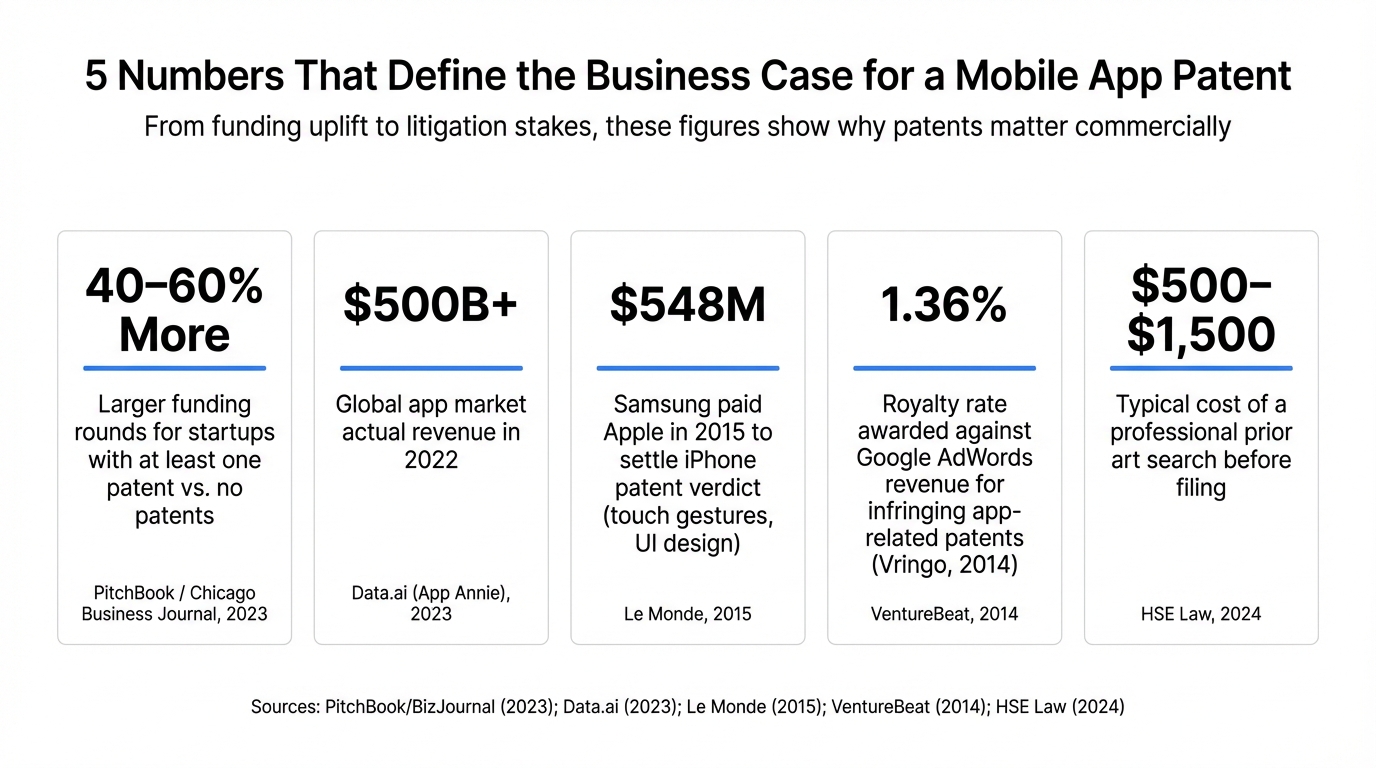 5 Numbers That Define the Business Case for a Mobile App Patent — Source: PitchBook / Chicago Business Journal (2023); Data.ai / App Annie (2023); Le Monde (2015); VentureBeat (2014); HSE Law (2024)
Can you patent a mobile app?
Yes, but not the idea of an app itself. Patenting mobile apps is possible when you focus on the specific technical method, system, or apparatus your mobile application uses to implement a new and non-obvious function. Under the USPTO’s current framework, every patent application for a mobile app must survive the two-step Alice eligibility test: the claims must describe something more than an abstract idea implemented on a generic smartphone. Claims directed to a concrete technical implementation, a specific algorithm, a novel user interface interaction that produces a defined technical result, or a new system architecture constitute an eligible invention that regularly receives patent protection. Claims that describe only a business method or a conventional computing process applied to a mobile device do not. If you are unsure where your app falls, a Complimentary Patent Needs Assessment is the fastest way to find out. Schedule one here.
Is it worth patenting an app?
For most apps generating real revenue or attracting competitive copies, yes. The calculus for patenting mobile apps depends on three factors: the app’s defensible technical differentiation, its revenue trajectory, and how easily a competitor could replicate the core functionality. A granted patent adds measurable value by blocking direct competitors from copying your most valuable method, by increasing company valuation in fundraising and acquisition discussions, and by creating licensing revenue from companies that would otherwise use your method for free. Patented startups raise 40 to 60% larger funding rounds than comparable unpatented peers, according to published research. Before concluding the cost is prohibitive, model the return using the 100X ROI Patent Calculator™.
Can a mobile app be copyrighted?
Yes, and copyright attaches automatically the moment your app’s source code is written. However, copyright protects only the specific expression of that code, not what the code does. A competitor who reverse-engineers your mobile application’s functionality and rebuilds it using different code infringes no copyright. As the U.S. Copyright Office confirms, copyright explicitly excludes ideas, methods, systems, and concepts from protection. This is why mobile app copyright and patent protection serve different purposes and cannot substitute for each other. Copyright is free and automatic but covers only expression. A patent requires prosecution and investment but protects the functional method regardless of how a competitor implements it.
How much does it cost to patent an app?
The total cost of patenting mobile apps from filing through grant typically falls between $10,000 and $20,000 depending on complexity, the number of Office Actions during examination, and whether international protection is pursued. The provisional patent application phase runs $1,500 to $10,000 in attorney fees plus USPTO filing fees, with software applications commonly toward the higher end. The non-provisional patent application phase runs $5,000 to $10,000 in attorney fees plus USPTO fees. Each Office Action response adds $2,000 to $5,000. These costs should be evaluated against the business value created. A patent that blocks a primary competitor or adds to an acquisition valuation can return 10x to 100x the investment. Use the 100X ROI Patent Calculator™ to model your specific situation.
How long does a mobile app patent last?
A utility patent for a mobile app lasts 20 years from the filing date of the non-provisional patent application, subject to maintenance fee payments at 3.5, 7.5, and 11.5 years after grant. A provisional patent application does not count against this 20-year term. The clock starts at non-provisional filing. A design patent protecting the visual appearance of an app’s interface lasts 15 years from the date of grant with no maintenance fees required. Given that most mobile applications have their primary commercial relevance within a 5 to 10 year window, 20 years of utility patent protection typically covers the full commercial life of the technology.
What is the difference between a provisional and non-provisional patent application for an app?
A provisional patent application establishes a priority date and gives the applicant 12 months to file the full application at a fraction of the cost. It is never examined and never becomes a patent on its own. A non-provisional patent application is the complete, examined application that can result in a granted patent. When patenting mobile apps, the standard strategic path is to file a comprehensive provisional patent application when a mobile application launches or before any public disclosure, then file the full non-provisional within 12 months. The primary risk is filing a thin provisional that does not fully describe the invention, which provides no real priority date benefit for claims that extend beyond the original disclosure.
How long does it take to get a patent for a mobile app?
The average pendency for patenting mobile apps at the USPTO is currently between 24 and 36 months from non-provisional filing to grant. Filing a provisional patent application first adds 12 months to the front of the timeline but preserves the priority date. The first Office Action typically arrives 16 to 18 months after filing for software art units. Applicants can request prioritized examination under the USPTO’s Track One program for an additional fee, which can reduce the time to first Office Action to under six months for cases where speed is a business priority.
The five key numbers that define the business case for a mobile app patent are summarized in the chart above.
Your Next Steps to Mobile App Patent Success
Every day a mobile application is live without patent protection is a day a competitor can legally replicate its core functionality. The urgency of patenting mobile apps before that window closes cannot be overstated. The one-year window after public disclosure is finite, it cannot be extended, and it runs from the moment the app is shown to the first investor or submitted to the App Store. A provisional patent application stops that clock for $1,500 to $10,000 in attorney fees depending on complexity, and a high-quality provisional that fully discloses the invention reduces the overall cost of the non-provisional. The cost of not filing is the permanent loss of exclusivity rights on technology that may define the company’s competitive position for the next decade.
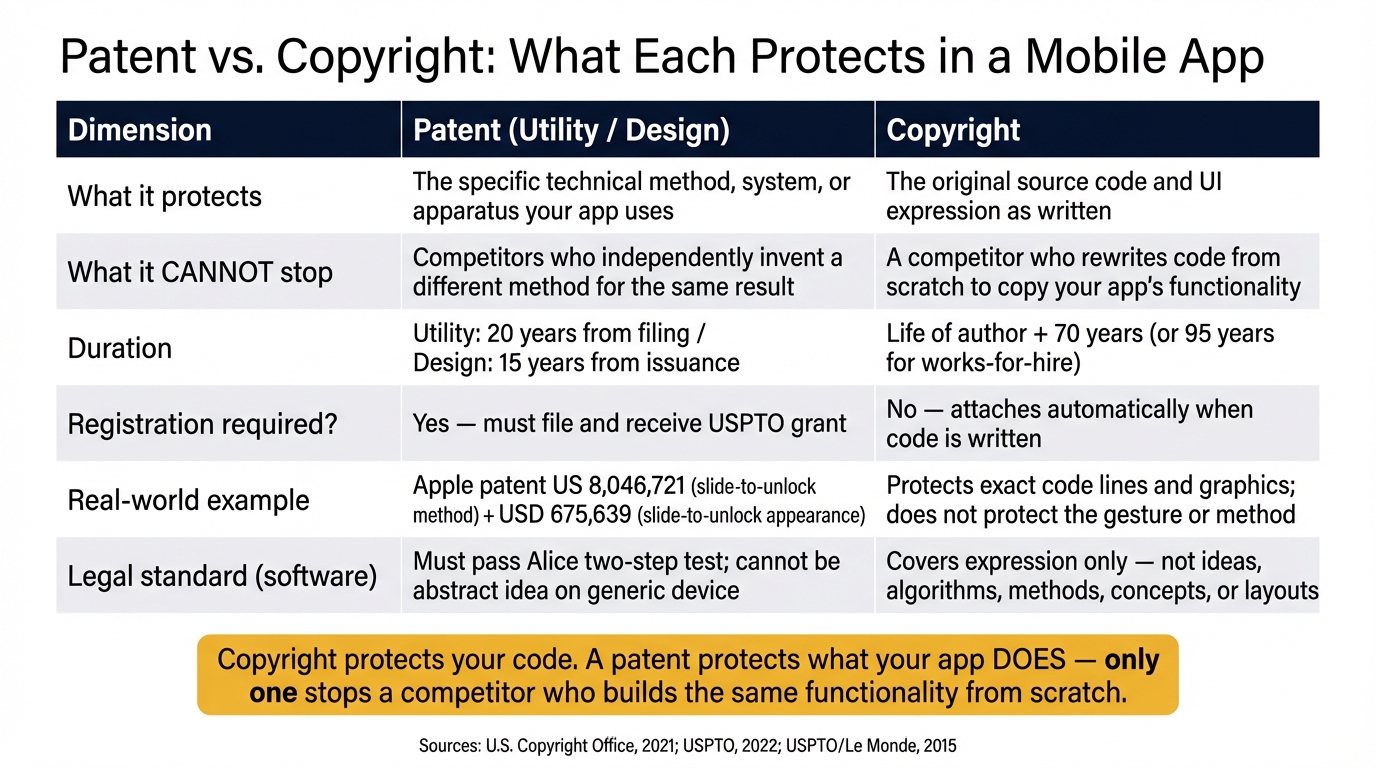 Patent vs. Copyright: What Each Protects in a Mobile App — Source: U.S. Copyright Office, 2021; USPTO, 2022; USPTO/Le Monde, 2015
The bottom line: founders who file thin applications or skip patenting mobile apps entirely face a permanent loss of competitive exclusivity. Founders who deploy sophisticated prosecution strategies can build a patent portfolio that creates real leverage in fundraising, competitive markets, and exit negotiations. The difference is in the approach, not the technology.
According to Thompson Patent Law, the firm has issued 1,500 or more patents and built its practice on the same software and mobile technology domains it developed alongside teams at Apple, Google, Intel, and Microsoft. That background directly informs how claims are drafted to survive Alice scrutiny and how prosecution is structured to avoid the narrowing amendments that make patents easy for competitors to design around. Thompson Patent Law reports that its Alice eligibility strategies have improved § 101 outcomes by 25 to 50% compared to standard prosecution approaches, meaning more patents allowed, faster, with broader claims.
The urgency is real: your disclosure clock may already be running. Every week without a filed provisional patent application is a week closer to losing the right to protect your technology permanently. Founders who act early secure priority dates, preserve claim scope, and position their companies with defensible intellectual property law advantages that compound over time.
Your action items:
- Schedule a Complimentary Patent Needs Assessment to get a structured conversation about what is actually patentable in your product, what type of application fits your timeline and budget, and what a real intellectual property protection strategy looks like for your specific mobile application
- Use the 100X ROI Patent Calculator™ to model the return on a patent investment against your app’s revenue and competitive environment before making any filing decision
- Review the patent-first tactical guide to understand how to sequence patent filings relative to product launches, fundraising, and public disclosures
A Complimentary Patent Needs Assessment with our team costs nothing and takes less than an hour. The alternative is watching a well-funded competitor enter your market with the same core technology and no legal barrier to stop them. Thompson Patent Law’s team of registered patent attorneys with engineering degrees and backgrounds spanning individual inventors to Fortune 500 companies is built specifically for this kind of engagement. Start the conversation today.
Keep Innovating,
Craige Thompson
Patent Attorney, MBA, Electrical Engineer
Craige Thompson is a patent attorney, MBA, and electrical engineer leading a team of registered patent attorneys at Thompson Patent Law. The team brings engineering degrees and experience spanning individual inventors to Fortune 500 companies including Apple, Google, Intel, and Microsoft, along with backgrounds from major law firms and industry.


