- AI produces the appearance of a patent application, not the legal substance. In one 2024 study, ChatGPT-4 hallucinated answers to direct, verifiable legal questions roughly 58% of the time.
- AI-inserted “filler” technical detail creates §112 enablement and written description defects that can void a patent years later, as *Amgen v. Sanofi* (2023) showed.
- Typing your invention into a public AI tool can count as a disclosure, destroying rights in absolute-novelty countries, especially across Europe, unless you manage timing with counsel.
- Startups with patents carry 93% higher valuations at the angel stage, so a strategically weak AI draft undercuts the exact value you are trying to build.
- Use AI as an attorney-supervised efficiency tool, not a replacement. A free [Patent Needs Assessment](https://thompsonpatentlaw.com/patent-needs-assessment/) surfaces issues no AI will catch.
*Written by Craige Thompson, Patent Attorney, MBA, Electrical Engineer.* Craige Thompson is a Managing Principal Patent Attorney, electrical engineer, professional engineer, and MBA who helps innovators protect and monetize complex technologies. His experience spans patent prosecution, licensing, prior art searching, due diligence, opinions, reexamination, and litigation across electrical engineering, software, mechanical engineering, medical devices, and energy-efficiency technologies.
An inventor saves $10,000 by using AI to draft patent documents, then loses the ability to monetize a multimillion-dollar opportunity because the application carried fatal defects no AI ever flagged. That trade is the real question hiding behind "can ai write a patent application." Artificial intelligence can generate text that looks like a patent application, but looking like one and functioning as one are entirely different things. This article gives you a clear-eyed look at what AI actually does in patent drafting, where it fails in ways that permanently damage patent rights, and what choosing it over experienced patent attorneys truly costs.
What AI Is Actually Doing When It "Drafts" a Patent Application
AI Predicts Text It Does Not Practice Law
Large language models predict the most likely next word from training data, and no ai model in this category understands legal strategy. The output is plausible-sounding text, not legally sound patent drafting, with no mechanism to understand your technology, your business goals, or the strategic intent behind any claim. The gap is measurable. A 2024 study published in the Journal of Legal Analysis (open-access preprint on arXiv) found ChatGPT-4 hallucinated answers to direct, verifiable legal questions about 58% of the time, GPT-3.5 about 69%, and Llama 2 about 88%. This is why AI patent drafting without human expertise materially raises the odds of undetected legal errors, and why understanding why AI replacing lawyers in patent prosecution remains a distant dream matters before you rely on a tool. Working with an experienced patent attorney who uses AI as a supervised tool eliminates this risk.
The Difference Between Retrieving Information and Applying It
An AI can retrieve statutes, MPEP sections, and blog articles, but cannot identify relevant prior art with the judgment a practitioner applies. That is not the same as knowing how to apply them to your invention, in your competitive landscape, under your prosecution timeline. The USPTO's 2025 revised inventorship guidance for AI-assisted inventions confirms the same legal standard applies whether or not AI helped, that only natural persons can be inventors, and that AI systems are tools. Patent practitioners bring judgment built from thousands of prosecution cycles — including navigating patent offices and responding to office actions — AI brings pattern frequency. The gap between them is where patent rights are lost. This is also why DIY filings are so often doomed to fail.
The First Mine Is How AI Wastes Time While Missing the Real Problem
A Real Case Where AI Documents Cost More Than They Saved
A client recently arrived with two lengthy AI-generated documents — produced when trying to use ai to draft key transaction materials — an NDA and a term sheet spanning multiple international parties, expecting a quick sign-off. An experienced patent attorney spent over two hours untangling the disorganized text and missing facts. A 30-minute call then found the real problem in the first five minutes, the provisional patent application, previously filed by a patent agent, listed the wrong inventor. Correcting the inventorship and filing a simple assignment resolved the entire transaction. AI generated the wrong deliverables while the actual problem sat unaddressed.
What an Experienced Attorney Finds That AI Cannot
Inventorship errors are not clerical footnotes, and no ai patent drafting tools will flag them for you. Under 35 U.S.C. §256 they can be corrected, but as Mondaq notes, improper inventorship can invalidate a patent or invite inequitable conduct claims. Patent attorneys know which questions to ask because they understand what is at stake across prior art dates, assignment chains, and jurisdictional novelty. A thorough invention disclosure interview, covering technical details, inventorship, and prior disclosures, surfaces facts no AI would think to request. AI cannot ask questions at all. If you are early in the patent application process, that first conversation is where these fundamentals get caught.
The Validity Mine Is How AI Creates Defects That Kill Patents Later
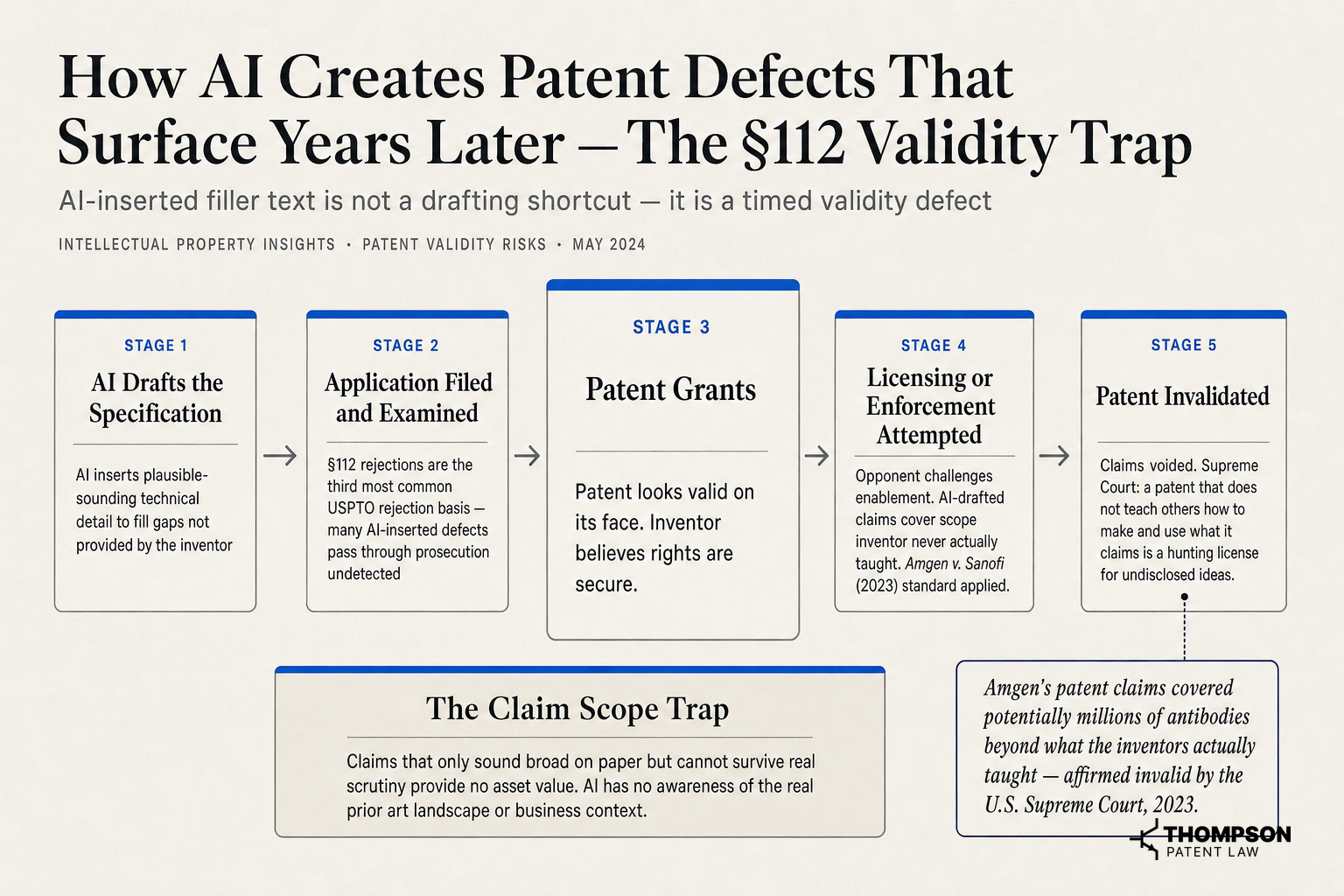 How AI Creates Patent Defects That Surface Years Later — The §112 Validity Trap — Source: IPWatchdog / USPTO Data, 2017; U.S. Supreme Court, Amgen Inc. v. Sanofi, No. 21-757, 2023
The Enablement Trap Under 35 U.S.C. §112
AI fills gaps in the patent specification and detailed description with plausible technical detail. When that detail is not supported by the inventor's actual disclosure, it creates enablement and written description defects under 35 U.S.C. §112. The USPTO's MPEP §2164 requires the specification to teach a person skilled in the art how to make and use the invention across the full scope of the claims, so fabricated text can fail. These defects often survive prosecution unnoticed, then surface during licensing, validity challenges, or enforcement — costing patent professionals and their clients significant time and resources. Across the USPTO, §112(b) rejections are the third most common basis after obviousness and novelty, according to IPWatchdog. In Amgen v. Sanofi (2023), the Supreme Court invalidated claims covering potentially millions of antibodies the inventors never taught, calling such a patent little more than "a hunting license." AI-inserted filler text is a timed validity defect that skilled patent claims drafting is designed to prevent.
The Claim Strategy Trap
Good claim drafting balances breadth against prior art exposure and structures independent and dependent claims for prosecution flexibility. AI cannot perform this balance because it has no awareness of your relevant prior art landscape, your competitors' pending applications, or your monetization strategy. It may generate a dozen sweeping claims, without consistent terminology across independent and dependent claims, that read straight onto known systems and die under §§102 and 103. Learning how to draft patent claims that actually get allowed is exactly the human expertise AI lacks.
The Confidentiality Mine Is How AI Can Destroy Your Patent Rights Before You File
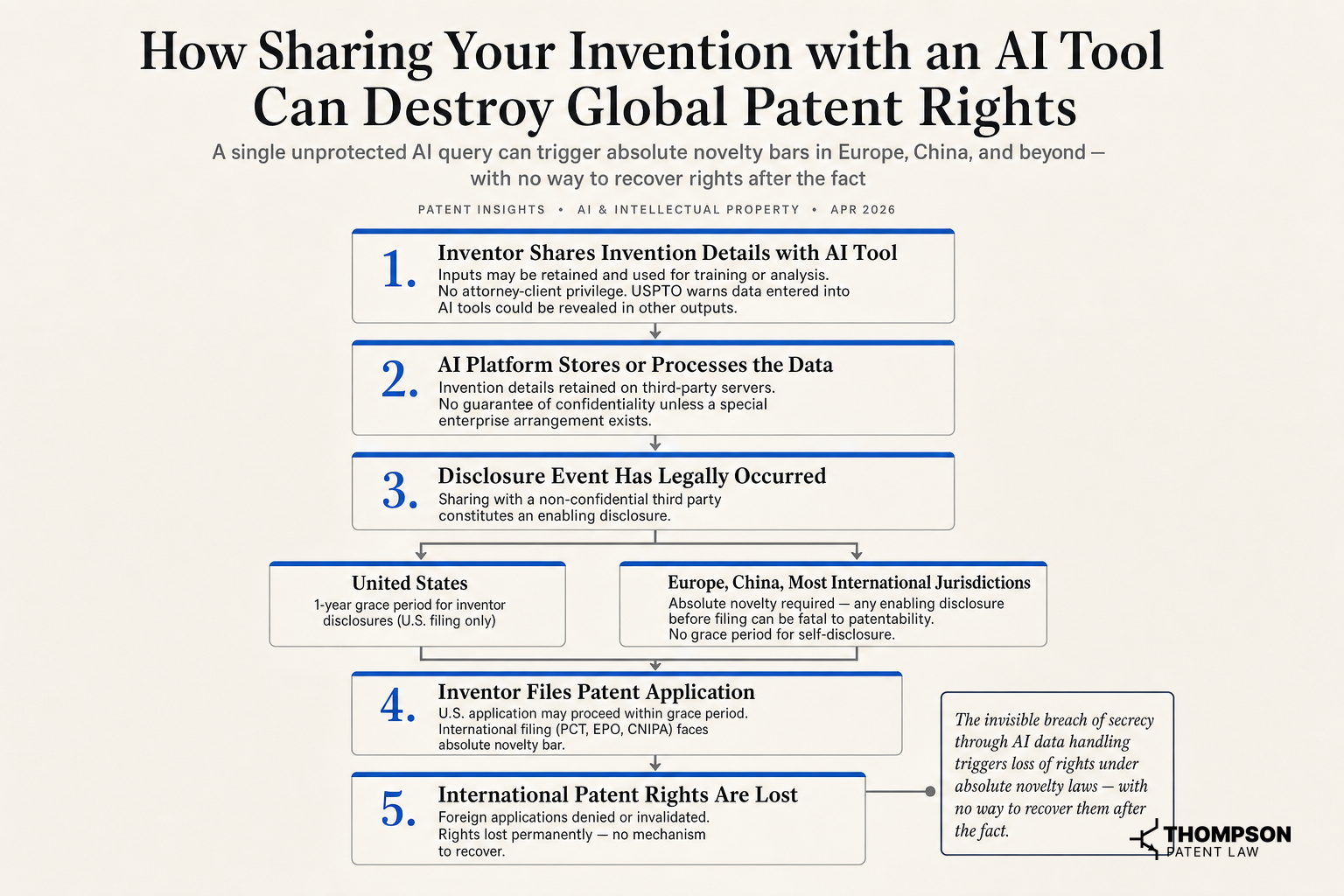 How Sharing Your Invention with an AI Tool Can Destroy Global Patent Rights — Source: National Law Review / USPTO AI Guidance, 2024; LexisNexis Legal Glossary — Absolute Novelty
No Attorney Client Privilege and No Confidentiality Guarantee
Many widely used AI tools, chiefly consumer tiers, retain and process user inputs under their terms of service unless a specific enterprise privacy arrangement is in place, and any confidentiality promise there is contractual, not privilege. There is generally no attorney-client privilege when you share your invention with a public AI tool used independently of counsel, and doing so can waive confidentiality. The USPTO's April 2024 Federal Register guidance cautions that data entered into AI tools may be retained and even surface in other outputs. Describing your unfiled invention — including technical drawings or detailed specifications — to a public AI platform can operate as a third-party disclosure that starts your public disclosure clock without you knowing it. Because patent applications are eventually public, managing what leaves your control before filing matters enormously.
The Absolute Novelty Problem in International Filings
The United States gives inventors a limited one year grace period after disclosure, but only for inventor-originated disclosures, independent third-party prior art is not covered. Under absolute novelty rules in Europe and other EPC jurisdictions, where novelty is assessed against the worldwide state of the art with only narrow exceptions, described by LexisNexis, any enabling disclosure to even one person not bound by confidentiality before your filing or priority date can be fatal to patentability. Outside the United States, many jurisdictions offer no general, U.S.-style grace period after disclosure, though several major economies including Canada, Mexico, Australia, and Japan do provide grace periods, as a WIPO comparative summary explains. An AI-assisted disclosure gets no special exception. If international protection matters, AI-assisted drafting before filing is a risk you cannot undo.
The Strategic Mine Is That AI Cannot Align Your Patent with Your Business Goals
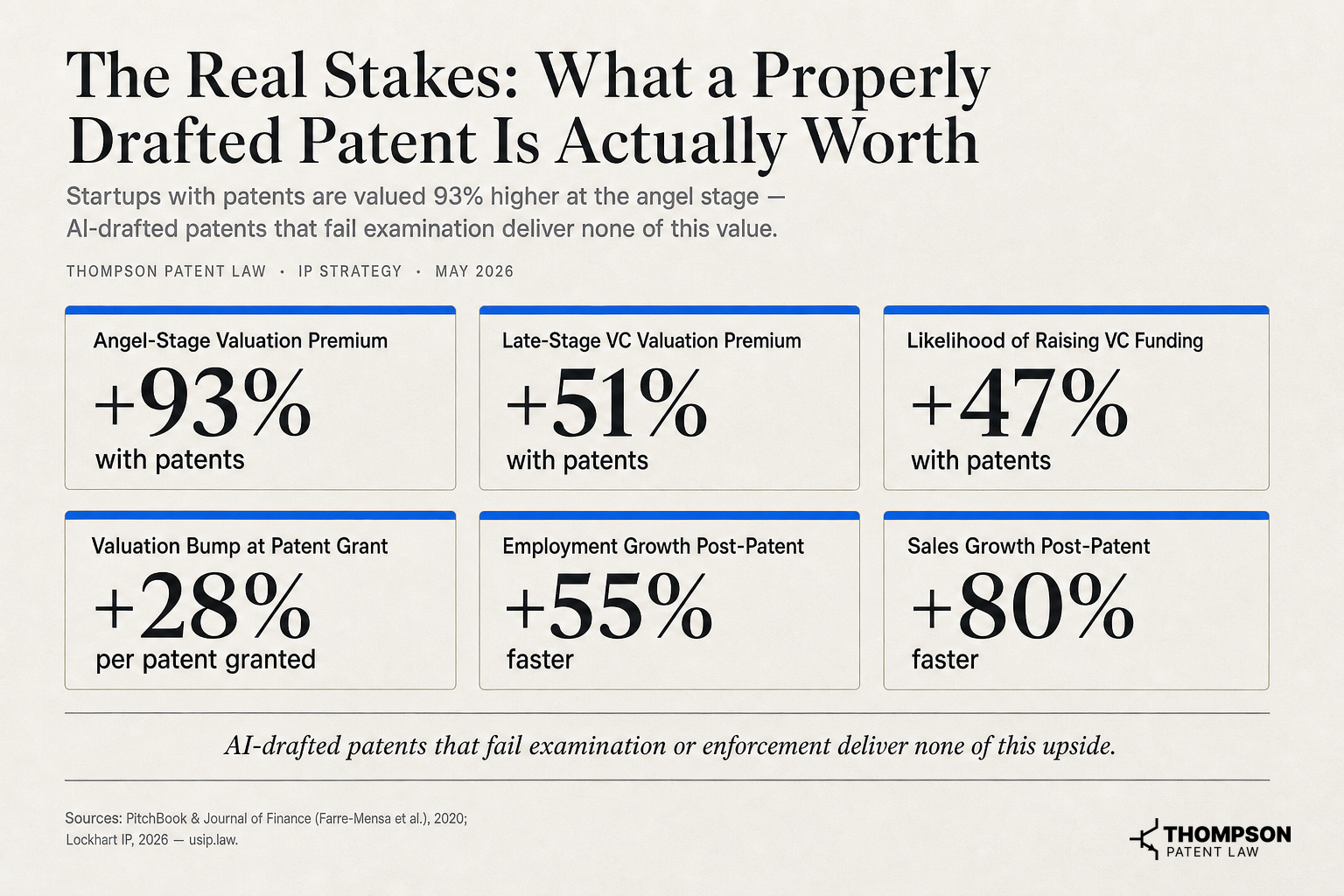 The Real Stakes: What a Properly Drafted Patent Is Actually Worth — Source: PitchBook & Journal of Finance (Farre-Mensa et al.), 2020; Lockhart IP, 2026
AI Has No Access to Your Competitive Strategy
A patent application is a strategic business asset, and selecting the right patent drafting assistant is part of protecting it. The scope you seek, the technology you claim, and the continuation strategy you plan all depend on your business model, market position, and competitors' activities, whether you are patenting a mobile app or a medical device. AI knows none of this. According to USIP, startups with patents carry 93% higher valuations at the angel stage and roughly 51% higher at the late venture stage, are 47% more likely to raise venture capital, and see 80% faster sales growth over five years after a first patent. (Statistics sourced from PitchBook and the Journal of Finance, Farre-Mensa et al., 2020.) A patent that does not align with your business strategy is a document, not an asset, which is why the patent-first inventors who file early tend to win.
The False Confidence Problem
AI output looks authoritative — a polished first draft complete with numbered claims, legal terminology, and professional formatting. This triggers what researchers call the illusion of explanatory depth, the belief that you understand something fully until you must act on it. The inventor thinks the job is done, while legal and strategic vulnerabilities stay invisible until they matter most, often during due diligence or litigation — at which point even experienced patent professionals struggle to remedy the damage. AI cannot warn you about what it never covered.
Where AI Can Legitimately Help When You Ask Can AI Write a Patent Application
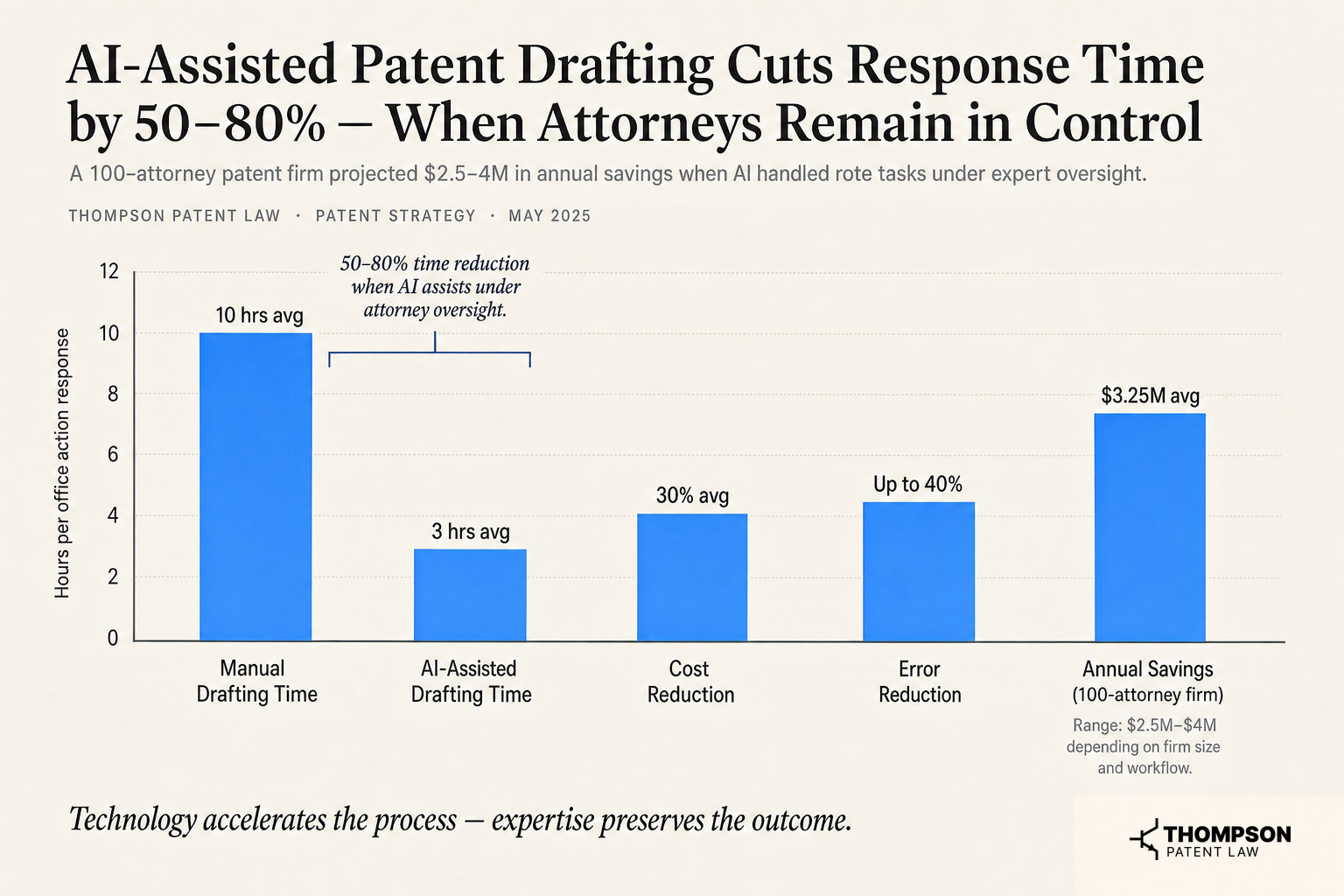 AI-Assisted Patent Drafting Cuts Response Time by 50–80% — When Attorneys Remain in Control — Source: Mactores & Sterne Kessler Goldstein & Fox, 2023
Efficiency Tools Not Replacement Tools
AI has real supporting roles when experienced practitioners stay in control. Prior art search assistance, formatting checks, office action summarization, and translation all reduce time without introducing strategic risk, and in an evolving ip landscape these efficiencies matter. One IP firm's AI-assisted system for drafting office action responses cut work from 8 to 12 hours per response down to 2 to 4 hours, a 50 to 80% efficiency gain, according to a Mactores case study, while attorneys remained in the loop for every judgment call. When a patent attorney uses AI to accelerate work, a human still makes each legal decision and provides legal advice the AI cannot. When an inventor uses ai to draft in place of an attorney, no one does.
The $10,000 Decision That Costs $10 Million
The driver behind AI reliance is loss aversion, not laziness. The cost of experienced patent counsel feels certain and immediate, the far larger cost of a weak, unenforceable, or misaligned patent feels distant, until it arrives — especially as the evolving ip landscape creates new enforcement risks. As BehavioralEconomics.com explains, losses loom about twice as large as equivalent gains. Sophisticated inventors treat patent counsel as a high-ROI investment. For a deeper look at how AI and intellectual property ownership interact, the savings only work if you never try to monetize your invention.
Frequently Asked Questions
Can I use ChatGPT to write a patent application?
ChatGPT can generate text that resembles a patent application, but it cannot evaluate patentability, identify relevant prior art that is invalidating, structure claims against your competitive landscape, or protect your disclosure. The USPTO permits AI assistance but requires a human to review, correct, and sign every filing. A federal court has also ruled that AI-generated legal analyses are not privileged.
Is an AI-drafted patent application legally valid?
The USPTO does not prohibit AI-assisted drafting, but validity depends on the legal and technical quality of the application, not who drafted it. AI-generated applications are prone to §112 written description and enablement defects, poorly scoped claims, and missed relevant prior art, all of which affect validity long after a patent issues.
Does sharing my invention with an AI tool count as a public disclosure?
It may. Many AI platforms retain and process user inputs under their terms of service, with no privilege and no guaranteed confidentiality. In countries with absolute novelty requirements, this kind of disclosure before filing can permanently eliminate patent rights, so consult a patent attorney first.
Can AI replace a patent attorney for provisional patent applications?
A provisional application sets your priority date only for the subject matter it adequately describes. AI-generated provisional patent applications can omit critical detail or add unsupported content that creates later §112 problems. The provisional is a legal baseline, not a rough draft you fix later.
Which AI is best for patent drafting?
There is no single best AI, because no current tool reliably handles end-to-end drafting to a standard of technical accuracy, validity, and strategic alignment without human review. General models like GPT-4, Gemini, and Claude are ai models that can help with descriptions or prior art summaries, and some patent-specific ai patent drafting tools assist with search or figures, but none ensure claims survive examination. The best use is as an assistant under a patent attorney's guidance, and understanding the specific requirements of your technology sector helps determine how much ai assistance is appropriate.
Your Next Steps to Patent Protection Success
The question of can AI write a patent application is really two questions: can it generate a document, and can that document protect your rights. The goal is not merely to file — it is to own enforceable, monetizable patent rights that protect your invention and support your business objectives. AI can generate a document that satisfies the first goal while completely failing the second. The inventors who lose the most are rarely those who get outright rejections, they are the ones who receive a patent that cannot be enforced, cannot survive a validity challenge, and cannot be licensed for meaningful value.
The bottom line: a weak, AI-only patent looks finished but leaves you exposed. A strong, well-engineered patent built with experienced patent attorneys protects the value you are actually trying to capture. The difference is whether the claims, the detailed description, and the strategy hold up when millions are on the line.
Every month you wait, competitors can file first, disclose ahead of you, or design around a poorly scoped claim — which is why understanding what the uspto ai strategy means for examination timelines matters now. The businesses that win pair AI efficiencies with human expertise rather than betting their rights on a prediction engine — and they invest more time in strategy than in generating documents.
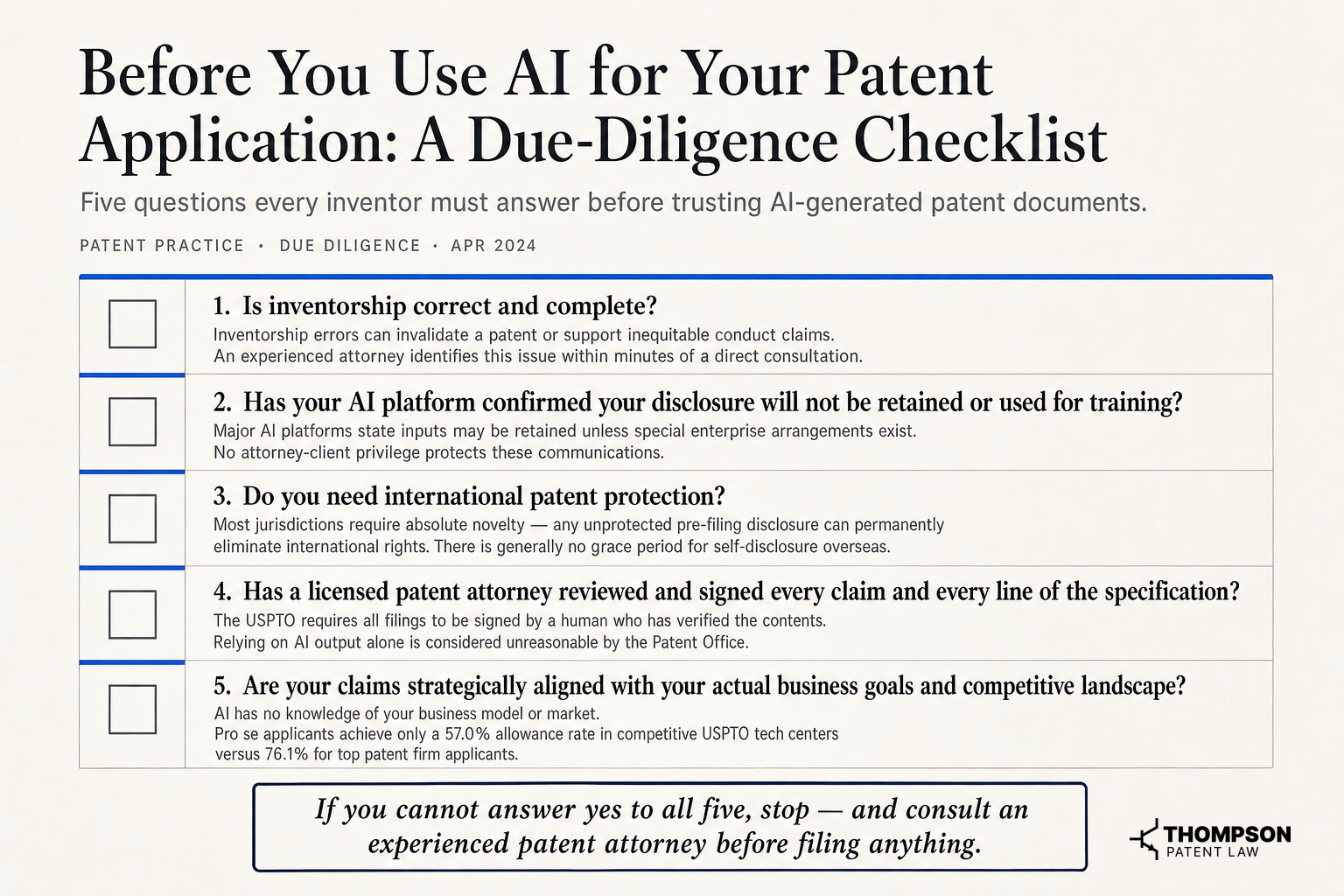 Before You Use AI for Your Patent Application: A Due-Diligence Checklist — Source: USPTO April 2024 AI Guidance; Above the Law, 2016; LexisNexis Absolute Novelty Glossary
Your action items:
- Schedule a Complimentary Patent Needs Assessment and speak with our team before any filing decision. One conversation surfaces the issues no AI will flag, from office action responses to inventorship and claim scope.
- Map your invention disclosures and inventorship before you touch any ai drafting tools.
- Confirm your timing against the one year grace period and any absolute-novelty foreign deadlines, keeping in mind that the enabled patent office filing date controls your priority.
Thompson Patent Law's team of registered patent attorneys — with engineering backgrounds spanning industry and major law firms — is led by Craige Thompson, Patent Attorney, MBA, and Electrical Engineer, serving clients across every enabled patent office and jurisdiction, with 1,500+ patents issued and Fortune 500 clients including Apple, Google, Intel, and Microsoft. The ROI is straightforward — and understanding what the uspto ai strategy means for your filings is part of that calculus — strong, enforceable patent protection is the competitive advantage that AI-only paperwork can never deliver.
Craige Thompson
Patent Attorney, MBA, Electrical Engineer
Thompson Patent Law