


- The realistic outcome is augmentation, not replacement: AI speeds up bounded tasks like document review, prior art searches, and formatting, but it cannot make the strategic judgment calls that determine whether a patent survives examination.
- Obviousness rejections under 35 U.S.C. §103 account for the large majority of first-round final rejections at the USPTO, and overcoming them requires calibrated human judgment that generative AI does not have.
- The USPTO holds the registered practitioner personally accountable for every filing ‘regardless of how it is generated,’ so a lawyer cannot outsource legal responsibility to an AI tool even when it does the drafting.
- Pro se and AI-only patent applicants abandon their applications at a much higher rate than attorney-represented ones, and the patents that do issue tend to have narrower, weaker claims.
- Prosecution history is permanent — language written during examination, including AI-generated responses, can create estoppel that bars reclaiming surrendered claim scope for the life of the patent.
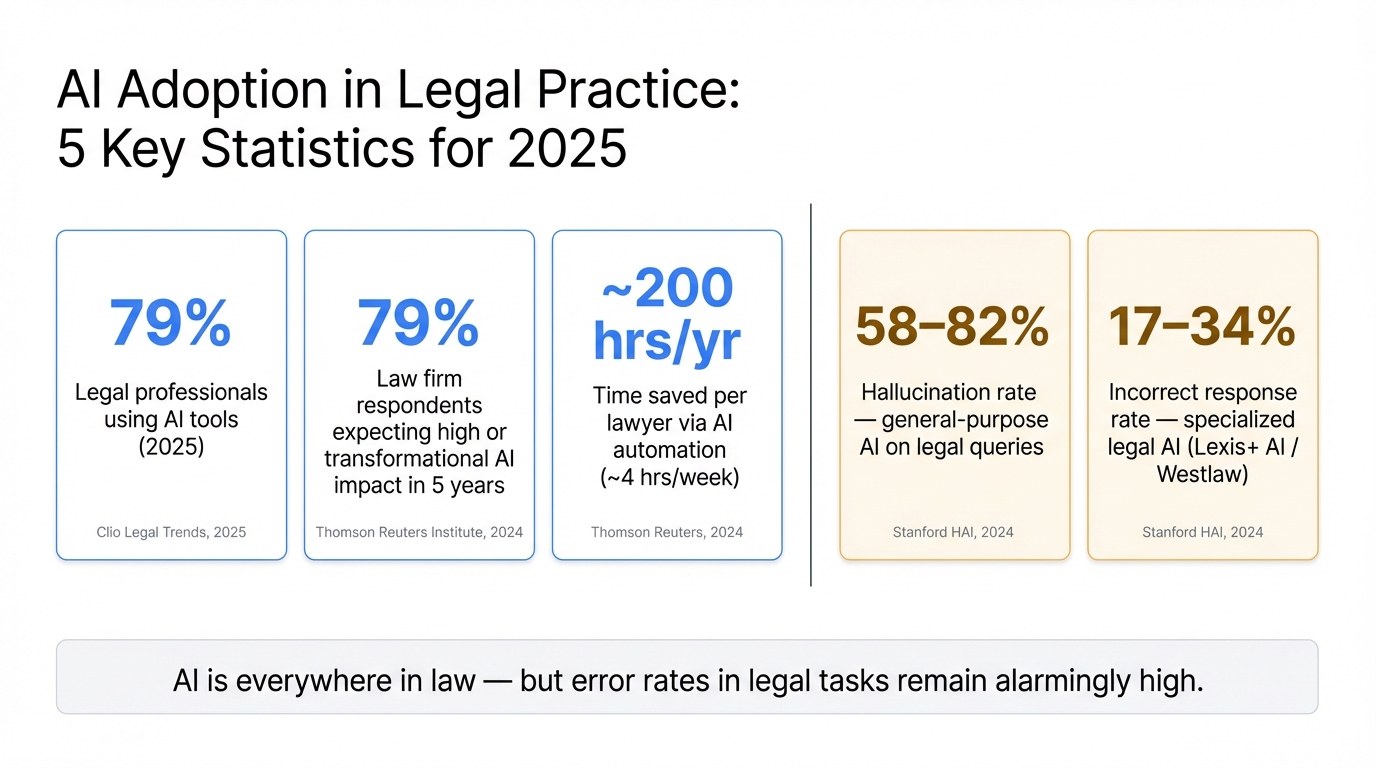
The legal industry is running an uncontrolled experiment with AI — and patent prosecution is where the consequences are most expensive. According to Stanford HAI’s 2024 research, even specialized legal AI tools produce incorrect citations or information in 17% to 34% of responses, and general-purpose chatbots give false information on legal queries 58% to 82% of the time. The question of AI replacing lawyers sounds like a technology debate. In patent prosecution, it is a business risk calculation, and the numbers are not close.
Key Takeaways
- AI tools can accelerate routine patent tasks like document formatting and prior art keyword searches, but they cannot make the strategic judgments that determine whether a patent survives examination, deters competitors, or holds up under challenge.
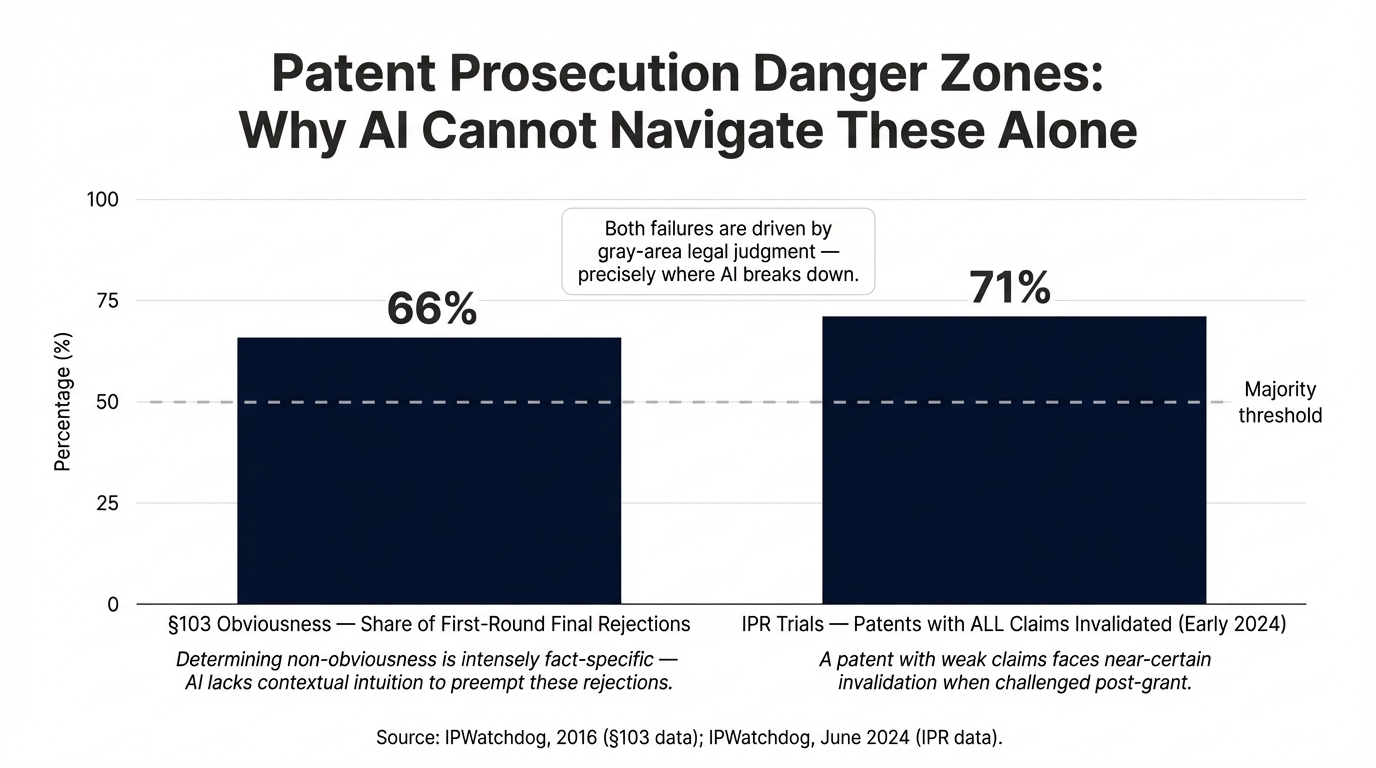
- Obviousness rejections under 35 U.S.C. §103 account for 66% of first-round final rejections at the USPTO, and overcoming them requires calibrated human judgment that generative AI tools do not possess.
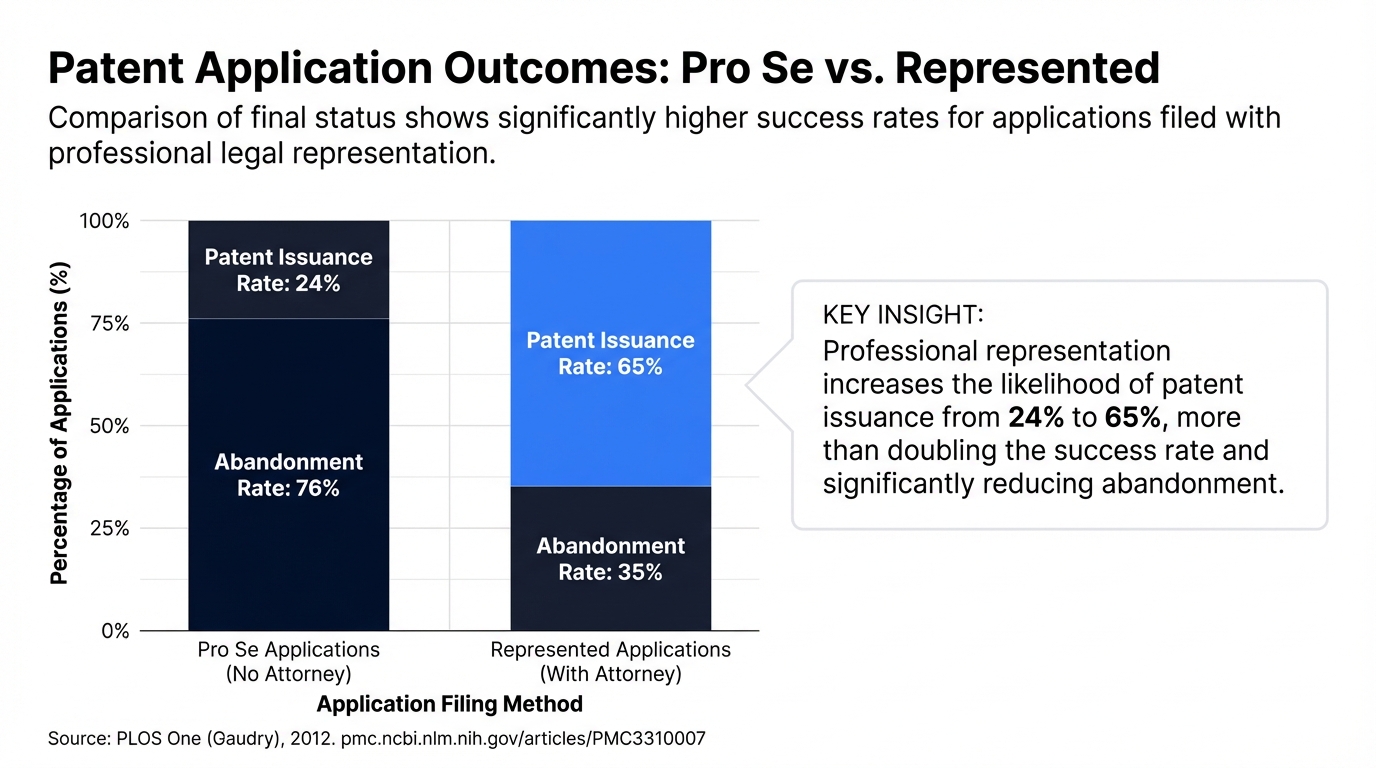
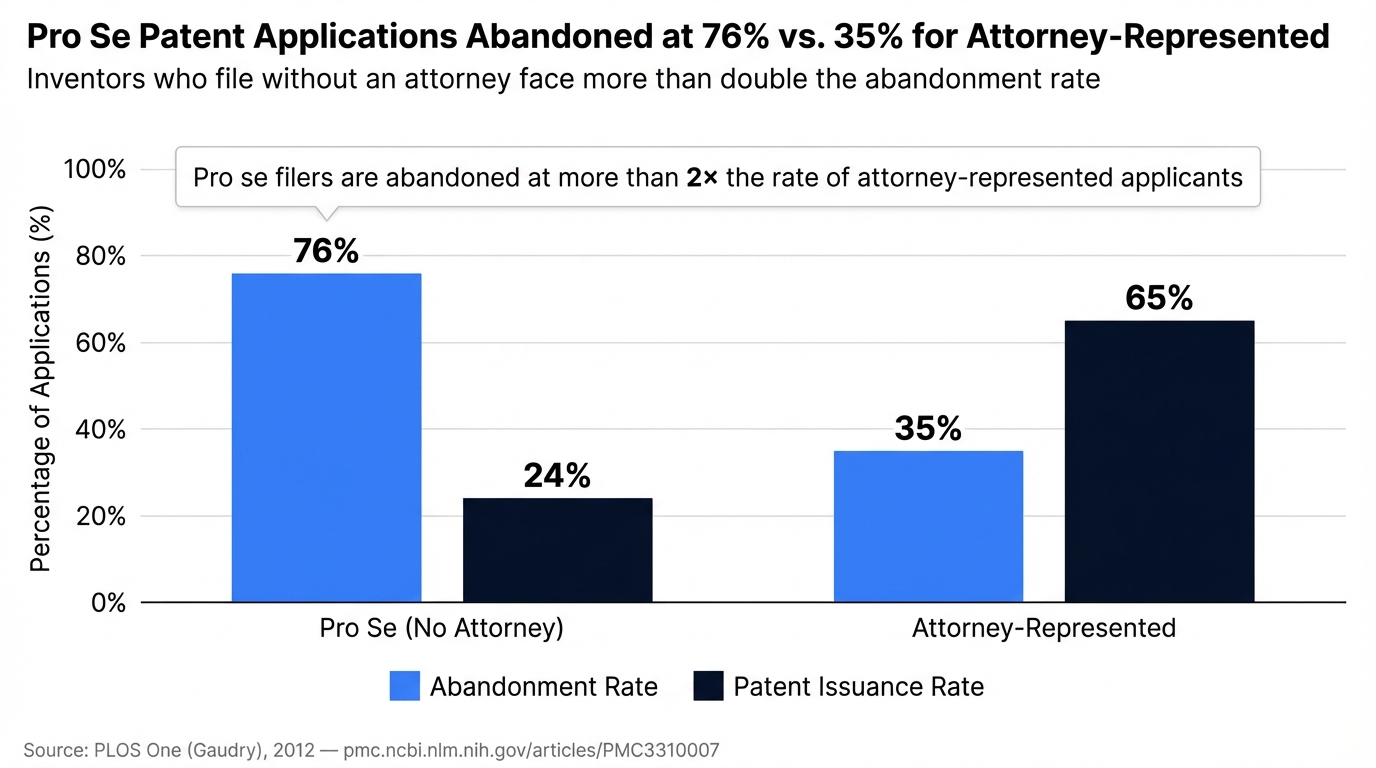
- Pro se patent applicants abandon their applications at a 76% rate, compared to 35% for attorney-represented applications, and the patents that do issue tend to have narrower, weaker claims.
- Every word written during patent prosecution becomes permanent prosecution history that follows your patent for its full 20-year term plus a 6-year enforcement window. A poorly drafted AI-generated response to an Office Action can permanently narrow your claim scope in ways competitors will exploit.
- The decisions that determine whether your patent deters competitors or guides them are made before you file, not after. A Complimentary Patent Needs Assessment is the only point in the process where all options are still open.
What AI Can Actually Do in Patent Law Today
The most credible case for AI in legal work starts with acknowledging what it genuinely does well. Dismissing AI entirely is not just wrong, it is the kind of overstatement that makes readers stop trusting everything that follows. The real picture of AI in the legal industry is more nuanced, and more useful.
The Routine Tasks Where AI Genuinely Helps
AI tools built on large language models have demonstrated real, measurable value in compressing time on defined, bounded legal tasks. Document review, prior art keyword searches, formatting patent application sections, and summarizing case law are all areas where AI models show speed gains that experienced legal professionals can put to use.
According to Thomson Reuters’ 2024 “Future of Professionals” report, generative AI could free up roughly four hours per week for lawyers by automating routine tasks, equating to approximately 200 hours saved per year. The 2025 Clio Legal Trends Report found that 79% of legal professionals now report using AI tools, with 65% citing higher work quality, 63% reporting better client responsiveness, and 54% noting greater capacity.
These are meaningful productivity gains for anyone delivering legal services across the legal field. AI accelerates legal research and routine drafting tasks. But speed gains in document preparation are not the same as competence in prosecution strategy, and conflating the two is where inventors get hurt.
Where Generative AI Breaks Down Fast And Why AI Replacing Lawyers is Distant
Generative AI produces confident, fluent generated content even when that output is factually or legally wrong. This is the core problem for patent work. A large language model cannot distinguish between a claim that will survive an obviousness rejection and one that will collapse on first Office Action. It generates text based on patterns in training data, processing vast amounts of prior text but without calibrated legal judgment.
The landmark example is Mata v. Avianca (2023), where a New York attorney was sanctioned after ChatGPT fabricated case citations that appeared in a legal brief. According to Stanford HAI, even specialized legal AI tools from providers like Lexis and Thomson Reuters still produced incorrect citations or information in 17% to 34% of responses, while general-purpose legal chatbots produced false information on 58% to 82% of queries. In patent prosecution, the cost of an AI error you do not catch is not a correction. It is a compromised patent, a narrowed claim scope, or an abandoned application, and those consequences take years and five figures to address.
The American Bar Association’s Current Stance on AI Competence
The American Bar Association has addressed AI use directly and the message on ai ethics is unambiguous. ABA Formal Opinion 512 (July 2024) advises that lawyers using generative AI must fully consider their obligations of competent representation, confidentiality, informed client consent, and supervision. ABA Model Rule 1.1, Comment 8 already requires lawyers to stay educated about relevant technology to remain competent. This is not aspirational guidance. It is a professional responsibility requirement with license consequences.
The USPTO reinforces this directly. Its guidance states that practitioners are accountable for filings “regardless of how [they are] generated,” meaning the registered patent practitioner bears personal responsibility for every AI-drafted claim submitted under their name. Using AI in patent work without adequate human oversight is not just risky strategy. It is a potential ethics violation.
AI Adoption in Legal Practice: 5 Key Statistics for 2025 — Source: Thomson Reuters Institute, 2024; Clio Legal Trends Survey, 2025; Stanford HAI, 2024
Why Patent Prosecution Is the Wrong Place to Test AI Independence
Patent prosecution exposes the limits of artificial intelligence more sharply than almost any other legal task. The reason is structural: prosecution requires not just knowledge of the law, but calibrated judgment about how that law will be applied by a specific examiner, in a specific art unit, against a specific prior art landscape, with consequences that persist for decades. Understanding the different types of patents and why it matters is itself a strategic decision that generative AI cannot make for you.
Obviousness Is a Judgment Call, Not a Pattern Match
Determining whether an invention is non-obvious under 35 U.S.C. §103 is the single hardest challenge in patent prosecution, and it is the task AI is least equipped to handle. According to IPWatchdog’s analysis of USPTO rejection data, 66% of first-round final rejections cite obviousness, making it by far the most common rejection basis. Obviousness analysis requires a trained human to synthesize prior art, understand the scope of what a person having ordinary skill in the art (PHOSITA) would know, anticipate how a USPTO examiner will frame a rejection, and build a prosecution strategy that counters it before the rejection even arrives.
There is a deeper structural problem that goes beyond examiner behavior. The most powerful arguments for non-obviousness — long-felt unmet need, failed attempts by others, and expert skepticism that the solution was even possible — all presuppose that the invention was considered impossible or unworkable before the inventor solved it.
If an AI tool is trained on a body of prior art that treated the problem as unsolvable, it has no basis to recognize that the invention represents a genuine breakthrough. AI cannot unlearn its training data. It cannot advocate for a solution its training data said could not exist. Understanding the different types of patents and why it matters is itself a strategic decision that requires the kind of human judgment no drafting tool can replicate.
The Prosecution History Problem AI Cannot Solve
Every word written during patent prosecution becomes a permanent part of the prosecution history, and that history follows the patent into every licensing negotiation, every enforcement action, and every validity challenge for the full 20-year patent term, plus the 6-year statute of limitations for enforcement. This is prosecution history estoppel, and it is one of the most consequential concepts in patent law. Poor patent documentation compounds this risk in ways that become impossible to undo.
In Festo Corp. v. Shoketsu Kinzoku Kogyo Kabushiki Co. (2002), the U.S. Supreme Court held that when a patent applicant narrows claims during prosecution to secure allowance, they are barred from later reclaiming that surrendered scope through the doctrine of equivalents. This creates permanent legal concessions that competitors will identify and exploit. An experienced patent attorney knows how to argue non-obviousness and patentability without creating claim-narrowing estoppel. Generative AI tools do not. They have no awareness of the downstream consequences of the language they generate.
Why Weak Patents Actively Help Competitors
This point belongs high in any article about patent quality because it inverts the assumption most inventors bring to the process. A patent with broad but legally vulnerable claims, insufficiently differentiated from prior art, or drafted without an obviousness-hardened strategy does more damage than no patent at all. It creates a public record of your invention’s technical details, your claim boundaries, and your prosecution arguments, all of which competitors can use to design around your patent faster and cheaper than if you had never filed.
The scale of this problem is visible in post-grant proceedings and in legal data on invalidation rates. According to IPWatchdog’s 2024 analysis of PTAB data, roughly 71% of patents that went through AIA Inter Partes Review (IPR) trials had all challenged claims invalidated. That is the rate at which issued patents, patents that already passed examination, are being dismantled at the Patent Trial and Appeal Board. AI patent drafting tools optimize for producing a complete, formatted document. They do not optimize for competitive durability. That distinction is the difference between a patent portfolio that deters competitors and one that hands them a map.
Patent Prosecution Danger Zones: Why AI Cannot Navigate These Alone — Source: IPWatchdog, 2016 (§103 data); IPWatchdog, June 2024 (IPR/PTAB data)
What AI Patent Drafting Tools Can and Cannot Do for Your Application
Inventors and founders searching for AI patent drafting tools deserve an honest breakdown, not a generalized warning. Here is the actual capability picture.
What Current AI Patent Drafting Tools Actually Offer
Dedicated AI patent drafting tools like Specifio and PowerPatent can meaningfully accelerate the production of certain sections of a patent application. Specifio, for example, advertises up to a 60% reduction in time spent writing detailed description sections by generating structured prose from technical input. These tools can ingest a technical disclosure and produce formatted background, summary, and detailed description sections. Some can suggest independent and dependent claim structures based on the disclosure.
For a registered patent attorney or patent agent, these tools represent genuine efficiency gains. They can compress early-stage drafting time, reduce formatting labor, and give practitioners more time for the work that actually determines patent quality. Over 80% of lawyers plan to increase their use of AI tools in the next year as legal operations evolve, according to the 2025 Clio Legal Trends Report. The pattern emerging in sophisticated law firm management is clear: AI is a productivity multiplier for experienced patent attorneys, not a substitute for them. This is especially true for patent computer software, where Alice §101 eligibility challenges demand attorney-level strategic judgment that no drafting tool can supply.
The Gap Between a Drafted Application and a Protected Invention
There is a critical distinction between an application that gets filed and a patent that provides enforceable protection. AI tools can produce the former. Only experienced prosecution, guided by technical understanding and legal strategy, produces the latter.
The claims an AI drafts may be technically accurate descriptions of an invention while simultaneously being legally useless. They may be so broad they will be rejected for lack of novelty, or so narrow they provide no commercial protection. Getting claim scope right requires a patent attorney who understands not just what the invention is, but what market it operates in, what competitors are doing, and what the inventor actually needs to protect.
According to Thompson Patent Law, the firm has achieved a 94% allowance rate across 1,500+ patents issued. That figure sits far above the typical USPTO allowance rate of roughly 65% for represented applications, and it reflects the difference that strategic claim drafting and experienced prosecution make in actual outcomes. Claims that describe your invention are not the same as claims that protect it. That distinction requires human legal judgment, not a drafting tool. Thompson Patent Law reports that this track record was built through Litigation Quality Patent® services for clients including Fortune 500 companies.
The Real Risks of a DIY Patent Application Approach
The USPTO allows inventors to file patent applications without an attorney, a process called pro se filing. Many do. The outcomes are instructive.
What Pro Se Applicants Get Wrong Most Often
Pro se applicants consistently underestimate the technical precision required in claim drafting, lack training to distinguish over prior art cited by examiners, and have no framework for responding to obviousness rejections without creating damaging prosecution history. The numbers tell the story clearly. A peer-reviewed study published in PMC / National Institutes of Health found that 76% of pro se patent applications ended up abandoned, compared to a 35% abandonment rate for applications with professional representation. Barely one in four pro se applicants ever receives an issued patent, and the patents that do issue tend to have noticeably narrower claims that provide substantially less commercial protection.
The upfront cost of going it alone looks like savings. What it actually represents is a higher probability of paying the entire filing cost, waiting 18 to 36 months through prosecution, and ending up with nothing, or worse, an issued patent that does not protect what you built. Whether you actually need an attorney to file a patent is a question the abandonment data answers plainly.
Why NDAs, Google Searches, and ChatGPT Leave You Exposed
Some inventors believe a combination of confidentiality agreements, informal prior art searching, and AI chatbots provides adequate protection before committing to professional patent prosecution. It does not. NDAs protect only the people who signed them and only for the duration of the agreement. A Google search is not a patentability analysis. ChatGPT and similar AI chatbots are generative tools with no access to the full USPTO patent database, no awareness of pending applications, which are confidential for 18 months after filing, and no ability to evaluate the legal weight of prior art — and they cannot substitute for legal advice.
These tools create the feeling of safety without the legal substance, and they do not produce legal opinions on patentability or enforceability. In patent law, that distinction costs market share.
The First-to-File Clock Is Running Whether You Are Ready or Not
Under the America Invents Act, which constitutes new legislation that reshaped U.S. patent law, effective March 16, 2013, the U.S. patent system rewards the first inventor to file, not the first to invent. This means every day a founder waits, researching AI tools and weighing DIY options, is a day a competitor can file first and lock them out of their own technology space.
A professionally-prepared provisional patent application creates an enforceable priority date immediately, generates monetizable intellectual property on your balance sheet, and preserves the full 20-year patent term because provisional patent applications do not count against that term — a key part of the due diligence process for any serious inventor. They work only for utility patents, not design patents. Think of a provisional patent application like a stock option: it gives you a defined 12-month window to act on the underlying value, but it expires if you do not exercise it by filing a non-provisional utility patent application. The clock starts on your competitive window the moment you have an invention, not the moment you decide to get serious about protecting it. Understanding when to get a patent is itself a strategic decision with real financial consequences.
What Separates a Patent That Deters Competitors from One That Guides Them
Getting a patent allowed is not the finish line. The goal is a patent whose claims are broad enough to cover competitive products, specific enough to survive validity challenges, and structured to support enforcement without being limited by prosecution history estoppel.
Engineering Claims for Competitive Durability, Not Just Allowance
This requires claim drafting that works backward from the competitive landscape as well as forward from the technical disclosure. Independent claims need to capture the invention’s core commercial value. Dependent claims need to provide fallback positions if the independent claims are challenged. Prosecution arguments need to distinguish prior art without unnecessarily narrowing claim scope.
The overall USPTO allowance rate is 54%, but it varies dramatically by technology field: biotechnology patents achieve 72% allowance rates, while software patents face only 42%, reflecting the heightened scrutiny software claims receive under Alice §101 eligibility standards. This variation means claim strategy must be calibrated to your specific technology field, not just to the invention itself.
The PTAB invalidation data makes the cost of getting this wrong concrete. Patents that survived full examination are still being invalidated at catastrophic rates once challenged — because passing examination and surviving a validity challenge are two entirely different bars. Claims engineered only to get allowed, not to hold up under adversarial scrutiny, hand competitors a roadmap the moment they are challenged. A patent engineered for competitive durability from day one is worth more than a patent that gets allowed and then collapses when you need it most. Review the process for filing a patent to understand how each step either builds or undermines that durability.
The Experience Gap That AI Cannot Close
Experienced patent attorneys develop an internal model of examiner behavior, prior art landscapes, and rejection patterns across thousands of prosecuted applications. This calibration is not available to generative AI tools, which use machine learning to learn from published text but have no feedback loop tied to actual prosecution outcomes.
A patent attorney who has prosecuted 1,500 applications has seen how specific claim language performs under examination, which arguments successfully overcome §103 obviousness rejections, and how to structure an Alice §101 eligibility response that succeeds at the first Office Action rather than requiring expensive appeal. According to Thompson Patent Law, the firm’s 94% allowance rate across those 1,500+ issued patents reflects Litigation Quality Patent® services delivered for Fortune 500 companies including Apple, Google, Intel, and Microsoft. AI tools can draft. They cannot learn from prosecution results the way an experienced practitioner does. That experience gap is the gap between a document and a competitive weapon.
Crafting the factual and logical arguments that overcome an obviousness rejection is also uniquely dependent on engineering judgment — not just legal knowledge. The patent attorney must understand the technology deeply enough to explain why a person having ordinary skill in the art would not have combined the prior art references in the way the examiner suggests. Where the invention is novel and impossible to anticipate from prior art, there is no training data that prepares an AI to make that argument. Only an engineer with a law degree and prosecution experience can.
How AI Is Actually Changing Patent Law Practice and What That Means for You
The honest picture of AI in the legal profession is not replacement. It is transformation of how experienced legal professionals work, and that distinction matters for anyone evaluating how to protect their invention.
AI as a Force Multiplier for Experienced Practitioners
The most sophisticated law firms are not choosing between AI and attorney judgment. They are using legal technology to accomplish more in less time, while maintaining the human oversight and strategic direction that determines whether the output is actually valuable. AI-assisted prior art searches, automated formatting, and accelerated first-draft generation allow experienced patent attorneys to spend more time on the work that actually determines patent quality: claim strategy, obviousness analysis, Alice eligibility arguments, and prosecution decisions — reflecting the expanded ai capabilities now available to practitioners.
According to Thomson Reuters’ 2024 “Future of Professionals” report, 79% of legal professionals expect ai technology will have a “high or transformational” impact on their work within the next five years. For clients, this means faster turnaround and more focused attorney attention on strategic work, not less competent representation. The legal services landscape is changing, but the professional judgment and human expertise that makes those services valuable is not going anywhere.
What Responsible AI Adoption Looks Like in Patent Practice
Professional responsibility requirements, client confidentiality obligations, and the requirement that a registered practitioner take full responsibility for every USPTO filing create a clear framework. ABA Formal Opinion 512 (2024) requires that attorneys understand the tools they use, verify AI outputs before acting on them, and maintain client data security when using AI platforms — reflecting american bar association best practices for responsible adoption. The 2025 Clio data shows that 53% of law firms still have no formal AI policy, which means many legal teams are using tools without adequate governance frameworks.
At the USPTO, the practitioner of record, whether a patent attorney or patent agent, is personally responsible for the accuracy and ethics of every filing. This accountability framework is not a constraint that disappears as AI improves. It is a feature of the legal system that ensures human responsibility in legal work. Responsible AI adoption in patent work starts with knowing exactly where the tool ends and the attorney’s professional judgment begins.
What This Means If You Have an Invention to Protect Right Now
The intellectual argument about AI and patent prosecution matters less than the practical question in front of you: what does protecting your invention actually require, and what happens if you get it wrong?
The True Cost Comparison Between DIY, AI Tools, and Professional Prosecution
The upfront cost difference between a DIY patent application or AI-assisted filing and professional patent prosecution looks significant. It stops looking significant when you calculate the cost of the alternative. A final rejection on a poorly-drafted pro se application means abandoned claims, a compromised prosecution history, and potentially starting over while your competitor’s professionally-filed application moves toward allowance.
The PMC study on pro se outcomes found pro se applicants experienced 2.7 times higher abandonment rates than represented applicants, with fewer claims and narrower scope when patents did issue. A patent that gets allowed but provides no enforceable protection is a fee you paid to help your competitors understand exactly where your claims end. Use the 100X ROI Patent Calculator to quantify the business value of strategically-prosecuted patent protection against the cost of getting there professionally.
Why the First Conversation Is the Most Important One
The decisions that determine whether your patent will deter competitors or guide them are made before you file, not after. Claim scope, obviousness strategy, eligibility arguments under Alice, and the structure of independent and dependent claims are all established in the initial application. Changing course after filing is expensive, constrained by prosecution history, and sometimes impossible.
A Complimentary Patent Needs Assessment can give you the strategic foundation before a single word goes into the application. This is the only point in the process where all options are still open. It is also the moment to identify whether a provisional patent application is the right first step, what the competitive landscape looks like, and what protection strategy actually serves your business goals. Review the Patent Process Flowchart to understand the full timeline before you decide.
Pro Se Patent Applications Abandoned at 76% vs. 35% for Attorney-Represented — Source: PLOS One (Gaudry), 2012
Frequently Asked Questions
Will attorneys be replaced by AI?
The data does not support replacement, even in the near term. AI systems continue to struggle with legal reasoning tasks requiring contextual judgment, strategic prediction, and accountability. In patent prosecution specifically, the professional responsibility framework requires a registered practitioner to take full responsibility for every USPTO filing. AI can accelerate routine legal tasks like document review and prior art searching, but the strategic judgment that determines whether a patent will survive examination, deter competitors, and hold up under challenge cannot be delegated to an AI system. The accurate description is augmentation, not replacement: experienced legal professionals using AI tools combined with human insight to do better work faster.
Can AI draft a patent application on its own?
AI tools can produce a formatted patent application document from a technical disclosure. What they cannot do is ensure that the claims reflect optimal scope, survive an obviousness rejection, avoid Alice §101 eligibility issues, or protect the inventor’s actual commercial interests. A document that looks like a patent application is not the same thing as a patent strategy. The gap between those two things is where most DIY and AI-only patent attempts fail, and where costs accumulate in abandoned applications, compromised prosecution histories, and competitors who used your public disclosure to design around you. If you are wondering whether a concept alone can even be patented, that question requires the same human judgment AI cannot supply.
What are the biggest risks of using AI for a DIY patent application?
The three most serious risks are: claim scope errors that leave the invention commercially unprotected, prosecution history statements that permanently limit claim scope through estoppel, and obviousness vulnerabilities that were never addressed because the AI had no awareness of prior art strategy. Each of these problems is difficult or impossible to fix after the initial application is filed. According to the PMC study on USPTO filing outcomes, pro se applicants abandon their applications at a 76% rate, and the patents that do issue tend to have narrower, weaker claims than those drafted by attorneys.
What does a patent attorney do that AI cannot?
A patent attorney brings calibrated judgment developed across years of actual prosecution experience: understanding how specific examiners behave, which prior art arguments work in specific technology fields, how to structure claims to survive both examination and post-grant challenges, and how to argue Alice §101 eligibility in a way that succeeds at the first Office Action. They also carry professional responsibility for every filing, which means legal and ethical accountability for the quality of the work. AI tools have no accountability, no calibration from prosecution outcomes, and no ability to make strategic trade-offs. They generate output. Patent attorneys generate protection.
Which jobs will survive AI?
Jobs requiring strategic judgment, contextual accountability, and complex human reasoning are the most durable against AI displacement, a question of will ai ever fully replicate human insight that the data answers clearly. Patent prosecution sits squarely in this category. The legal profession, and patent law in particular, involves high-stakes decisions where the cost of an AI error is measured in years and five-figure losses, and where professional responsibility frameworks require human oversight. Roles involving pure volume and routine pattern-matching, such as basic document review and data entry, face more disruption. But legal professionals who develop expertise in AI-assisted legal work while maintaining strategic judgment are positioned to do more valuable work, not less.
Is a provisional patent application different from a regular patent?
There is no issued patent called a “provisional patent.” A provisional patent application is a temporary filing that establishes a priority date and creates patent pending status for 12 months. It must be followed by a non-provisional utility patent application within that window or the rights expire. Think of it like a stock option: it gives you a defined window to act on the underlying value, but it expires if you do not exercise it. Provisional patent applications do not count against the 20-year patent term, and they create immediately monetizable intellectual property useful for licensing conversations, investor due diligence, and balance sheet value. They are available for utility patents only, not design patents. For a full breakdown of design versus utility protection, see Design Patents Made Simple.
How do I know if my invention is worth patenting?
The honest answer requires a professional patentability assessment, not a Google search or an AI chatbot. A patent attorney can evaluate novelty, non-obviousness, and commercial claim scope in a single conversation, and give you a real business case for or against filing. Thompson Patent Law’s Complimentary Patent Needs Assessment is designed for exactly this purpose: to help inventors and founders understand the competitive value of their invention, identify the right protection strategy, and get a clear picture of what professional prosecution would look like before committing to anything.
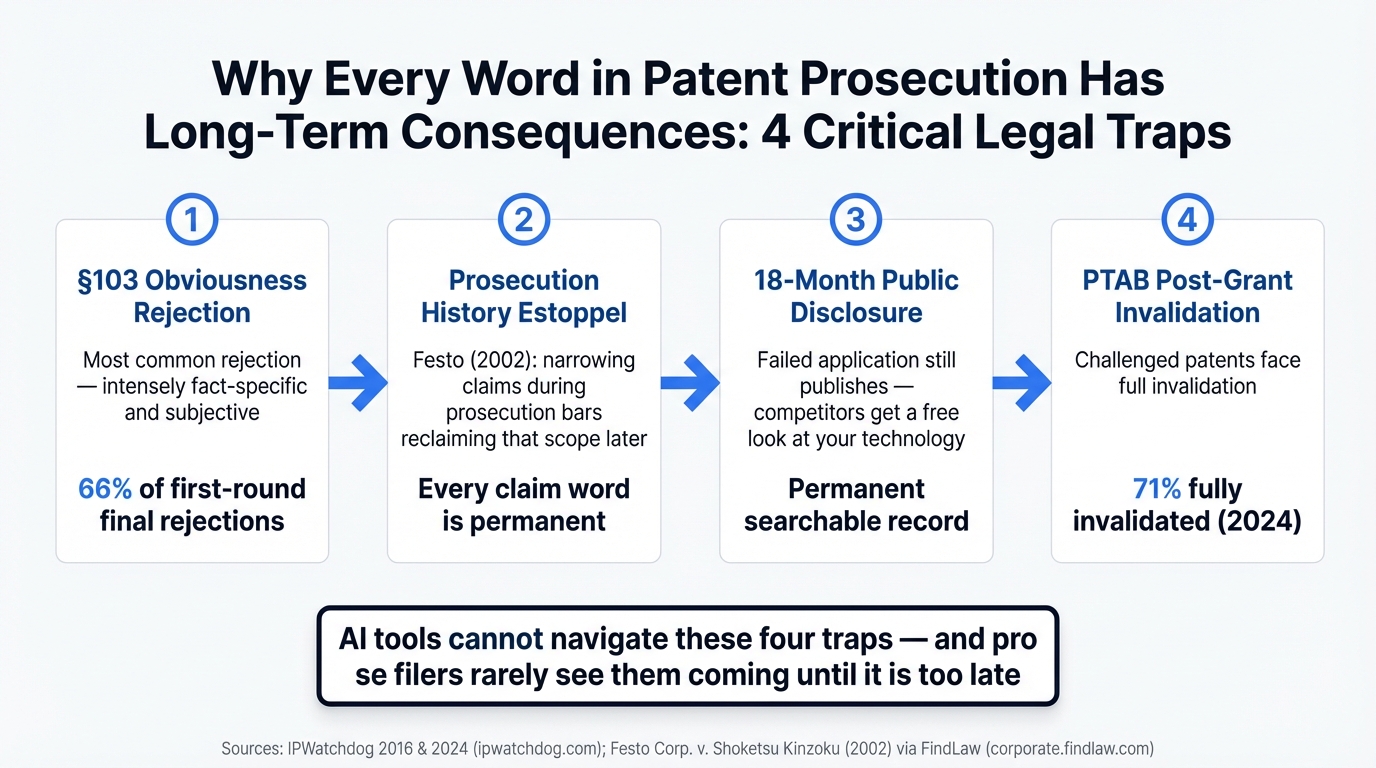
Why Every Word in Patent Prosecution Has Long-Term Consequences: 4 Critical Legal Traps — Source: IPWatchdog, 2016 & 2024; FindLaw (Festo Corp. v. Shoketsu Kinzoku, 2002)
The Bottom Line on AI and Patent Prosecution
Artificial intelligence is transforming how legal work gets done. That is true and important. But in patent prosecution, the gap between an AI-generated document and a strategically-engineered patent is the gap between helping your competitors and stopping them.
The tasks AI handles well, including routine drafting, prior art keyword searches, and document formatting, are not the tasks that determine whether your patent survives examination, deters competitors, and holds up when you need it. Obviousness strategy, prosecution history management, Alice §101 eligibility arguments, and claim scope decisions require calibrated human judgment that generative AI tools cannot replicate, regardless of how fluent their output sounds. The legal profession will use these tools to work smarter. It will not be replaced by them, and in patent law specifically, the professional responsibility framework ensures that a human attorney remains accountable for every word that goes before the USPTO.
If you have an invention worth protecting, the most important decision you can make right now is understanding what that protection actually requires before you file a single word. Schedule a Complimentary Patent Needs Assessment with the Thompson Patent Law team and get a real evaluation of your invention’s patentability, a clear picture of the right protection strategy, and an honest answer on what your patent could be worth. For a deeper look at the full prosecution process, the Patent Process Flowchart and the executive summary of Patent Offense are good places to start.
Keep Innovating,
Craige Thompson
Patent Attorney, MBA, Electrical Engineer


