- Independent inventors account for only 8% of U.S. patent grants — the barrier is process, not creativity.
- The most commercially valuable inventions start with a validated problem, not a spontaneous idea.
- A provisional patent application secures your priority date for as little as $65 (micro-entity) while you refine and prototype your invention.
- Patent quality matters as much as patent ownership — 68% of challenged claims are invalidated, often due to poor drafting rather than weak underlying technology.
- Startups with patents raise funding rounds 40–60% larger than unpatented competitors, according to PitchBook data cited by Biz Journals.
Only 8% of U.S. utility patents are held by independent inventors, according to data from the National Science Foundation. That gap between the people who have ideas and the people who own them is not a creativity problem. It is a process problem. Understanding how to become an inventor is learnable, repeatable, and more accessible today than at any point in history — but it requires taking specific steps in the right order, and protecting your new invention with a patent is the most critical step of all.
Why Most Inventions Never Make It Past the Idea Stage
The USPTO received approximately 646,855 patent applications in fiscal year 2022, yet most inventions conceived that year never became applications at all. The inventors who stay stuck are not less creative than the ones who file. They simply never cross the line from concept to action. Most inventions stall because the inventor lacks a clear picture of the next step, or believes the process is more complex, expensive, or exclusive than it actually is.
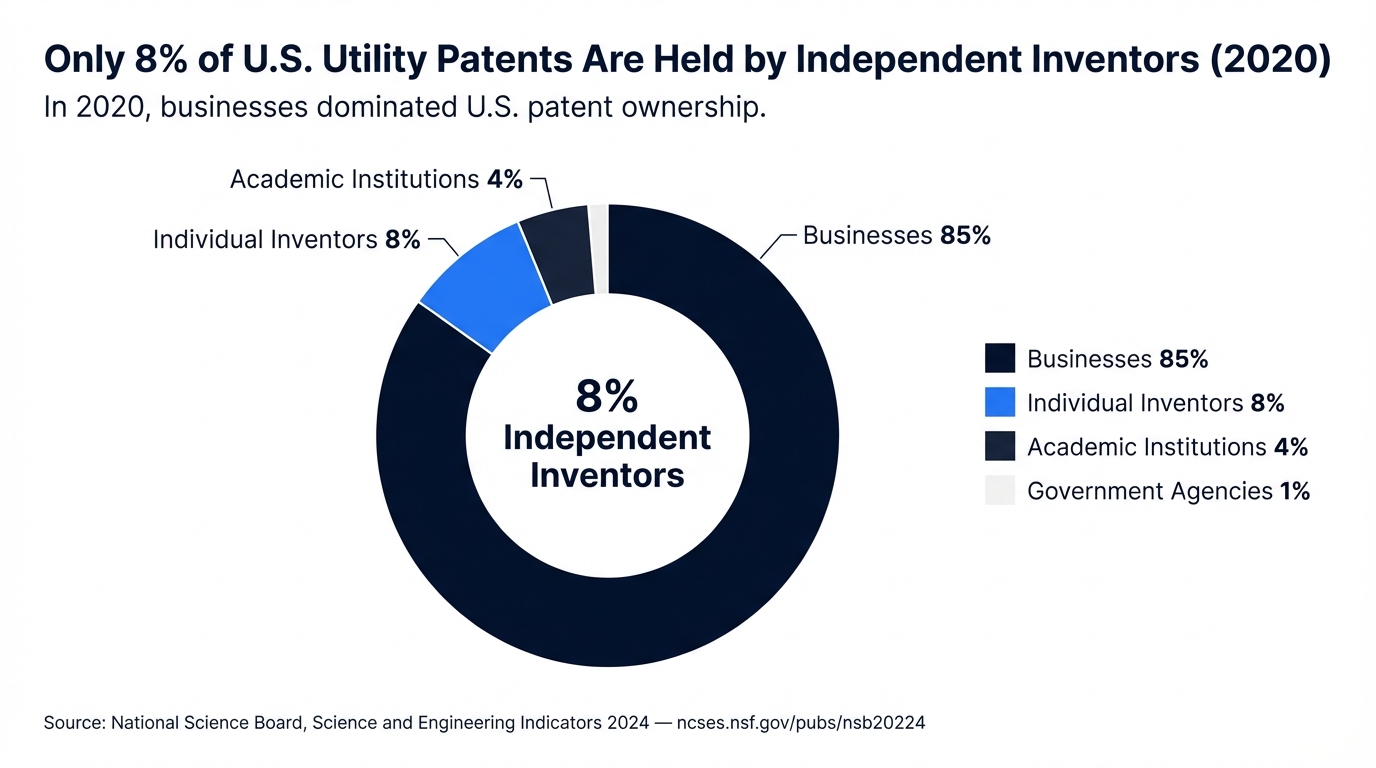 Only 8% of U.S. Utility Patents Are Held by Independent Inventors — Source: National Science Board, Science and Engineering Indicators 2024
The data tells a direct story: independent inventors held only 8% of U.S. patent grants in recent years, with businesses accounting for 85%, academic institutions 4%, and government agencies 1%. That distribution is not evidence that individuals cannot compete. It is evidence that most individuals never try. The process gap — not the idea gap — is what separates people who become inventors from people who wonder why someone else filed their idea first. If you want to understand what the first steps in obtaining a patent for an invention actually look like, the answer begins well before the USPTO ever sees your application.
What It Actually Means to Be an Inventor Today
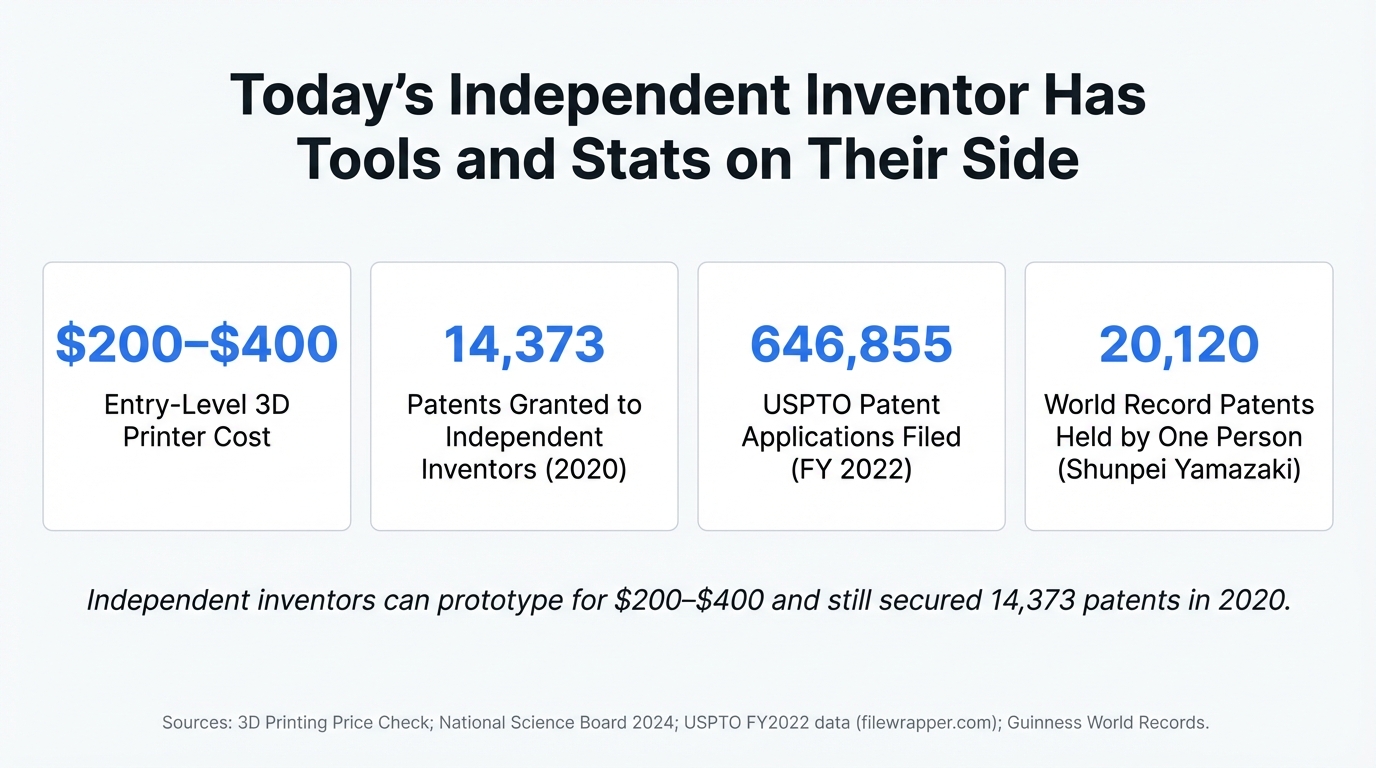 Today's Independent Inventor Has Tools and Stats on Their Side — Source: 3D Printing Price Check (3dprintingpricecheck.com); National Science Board 2024 (ncses.nsf.gov); USPTO FY2022 (filewrapper.com); Guinness World Records (guinnessworldrecords.com)
Inventors Solve Specific Problems, They Don't Just Have Ideas
The most commercially valuable inventions start with a documented, specific problem that existing solutions fail to address adequately. According to CB Insights research on startup failures, 42% of companies fail because there was no market need for their product. That same dynamic kills inventions before they ever reach prosecution. A great inventor does not wait for inspiration in a black space of abstract thinking — they observe friction in the real world and engineer a better answer to something people already struggle with.
Write down the specific problem your invention solves before you ever sketch a solution. That discipline alone separates most inventions that succeed from most inventions that fail.
The Modern Inventor Has More Tools Than Any Prior Generation
Entry-level 3D printers now cost as little as $200–$400, collapsing prototyping costs that once required a corporate R&D budget. Raspberry Pi microcontrollers and other low-cost programmable platforms have similarly democratized electronics prototyping. Cloud-based CAD software, global manufacturing platforms, and machine learning tools have made solo invention genuinely viable. The results are measurable: 14,373 patents were granted to independent inventors in 2020, with annual independent inventor grants holding steadily above 10,000. Today's independent inventor has a bright future precisely because the infrastructure barriers that once protected large companies have come down.
Invention Is a Learnable Skill, Not an Inherited Trait
A longitudinal study by Lewis Terman tracked extremely high-IQ children into adulthood and found their creative achievements were "astonishingly small" — raw intelligence alone does not produce inventions. By contrast, the Guinness World Record for most patents held by a single person stands at 20,120, held by Shunpei Yamazaki — a figure built through decades of systematic, disciplined output, not occasional flashes of genius. Prolific inventors treat observation and problem documentation as daily habits. That is the real foundation of how to become an inventor: consistent practice, not inherited talent.
How to Identify Problems That Are Worth Inventing Around
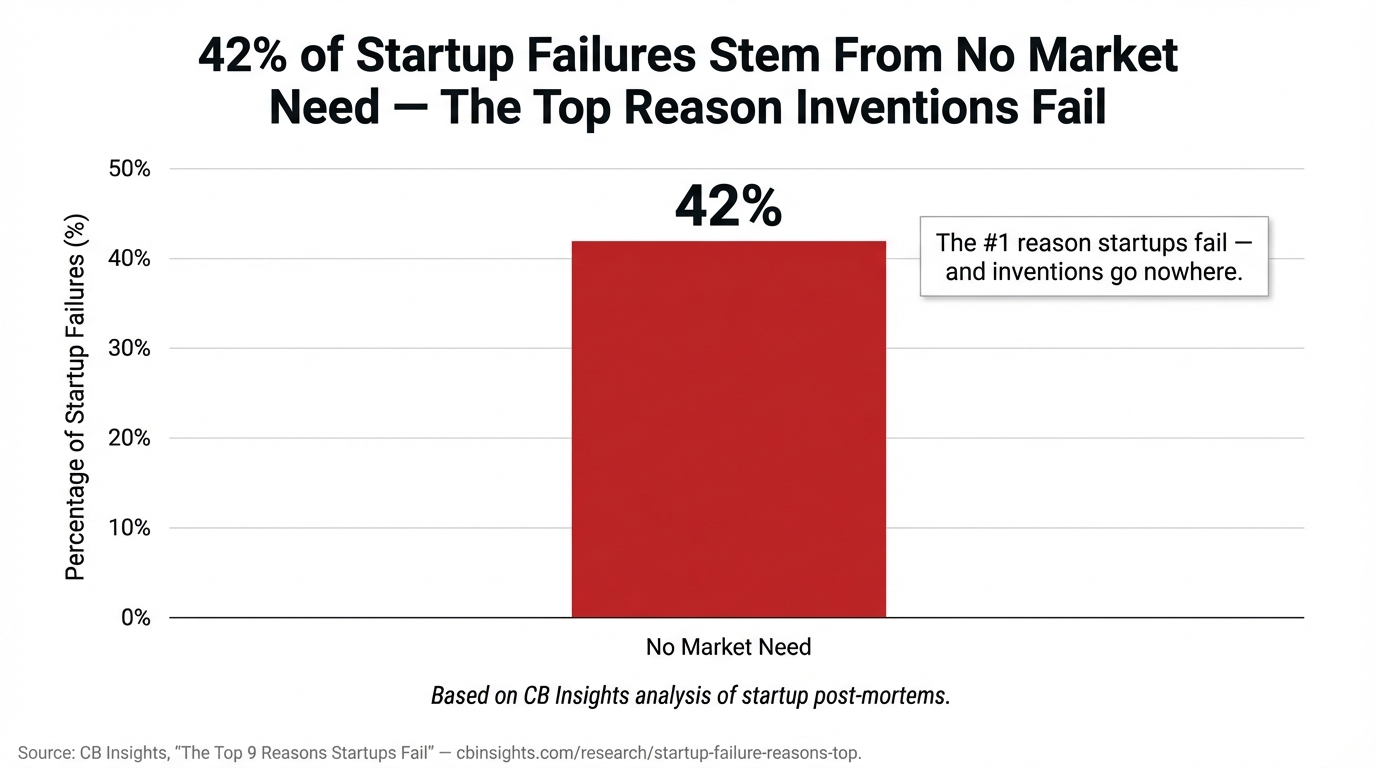 42% of Startup Failures Stem From No Market Need — The Top Reason Inventions Fail — Source: CB Insights, "The Top 9 Reasons Startups Fail"
Start With Your Own Industry, Field, or Daily Life
Domain familiarity is a competitive advantage for anyone figuring out how to become an inventor. An electrical engineer notices inefficiencies in circuit design that a general inventor never would. A nurse sees a workflow problem in medical device use that the device manufacturer overlooked entirely. Your professional expertise or even a serious hobby gives you pattern recognition that outsiders lack. List every process, tool, or system in your field that frustrates you or the people around you. That list is your invention pipeline.
Validate the Problem Before Designing the Solution
A validated problem is one that other people also experience, pay money to address imperfectly, and would switch solutions for. The same CB Insights data showing that 42% of startups fail from no market need applies directly to independent inventors who skip this step. Basic validation methods include online community research, competitor product reviews, and direct conversations with potential users. Confirm that your target problem exists at a scale that justifies the time and cost of patent prosecution before you draft a single claim. This is also the stage where understanding who can apply for a patent becomes relevant — because commercialization strategy affects how inventorship and ownership should be structured from the start.
Document Everything From Day One
Under the America Invents Act of 2011, the United States moved to a first-to-file patent system, meaning the race to the patent office matters more than who invented first. Documentation still serves a critical purpose: the USPTO defines a derivation proceeding as a process for determining whether an earlier filer derived a claimed invention from someone else. Timestamped records of your development process protect you if someone learns of your concept and attempts to file before you do. Start a dated notebook or cloud-synced document today, even before your idea feels fully formed.
Prototyping and Testing Your Invention Before You File Anything
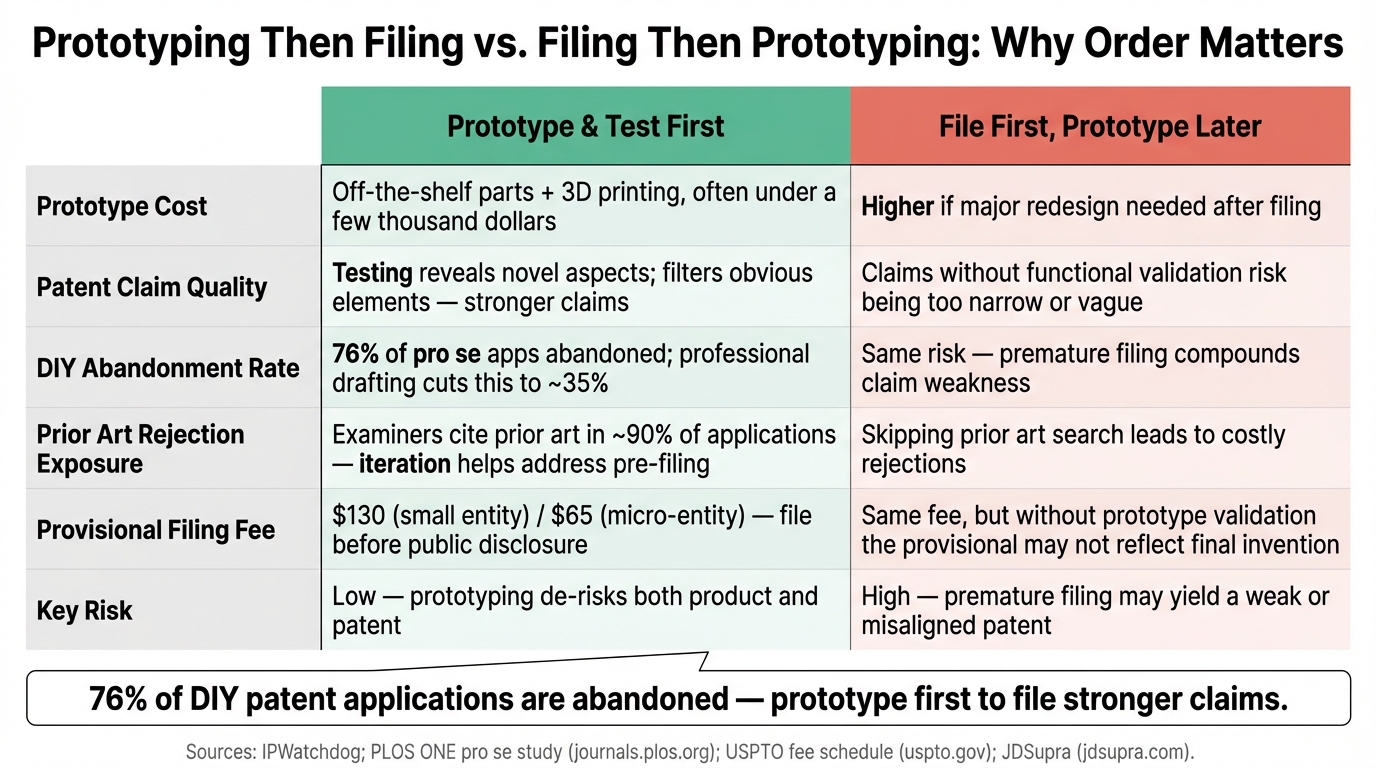 Prototyping Then Filing vs. Filing Then Prototyping: Why Order Matters — Source: IPWatchdog (ipwatchdog.com); PLOS ONE (journals.plos.org); USPTO fee schedule (uspto.gov); JDSupra (jdsupra.com)
Build the Simplest Version That Tests Your Core Claim
A prototype does not need to be market-ready. Its job is to confirm that your invention solves the problem as theorized. Minimum viable prototypes can be built with 3D-printed parts, Raspberry Pi microcontrollers, off-the-shelf components, or simple low-cost mockups — even rubber-band-and-duct-tape assemblies — depending on the technology involved. Simple proof-of-concept models put together with basic materials are often the fastest and most effective way to test an idea and evaluate it before investing in more expensive development.
A lean, iterative approach — sometimes called a lean startup mindset — keeps speed high and avoids relying on risky assumptions. Testing early lets you gain critical experience using the product, identify the next problem to solve, and address it before committing to expensive development steps. As you refine the implementation, you might graduate from a breadboard to a printed circuit board, or use programmable chips before committing to a full application-specific integrated circuit (ASIC).
The critical discipline is isolating the specific mechanism that represents your inventive contribution — that focused test will sharpen your thinking considerably when it comes time to draft patent claims. Many inventors use this stage to determine whether their concept is better protected as an apparatus, a method, or both. Understanding whether you can patent a method is a question worth exploring before you commit to a single claim approach.
Iteration Produces Better Patents, Not Just Better Products
Every round of prototype testing surfaces new insights about what is truly novel in your invention. Patent attorneys consistently report that inventors who arrive with tested, iterated prototypes produce stronger applications than inventors who file on a raw concept. Patent examiners cite prior art in roughly 90% of applications, making obviousness the leading rejection reason, according to JD Supra analysis of USPTO trial data. Applications built on real testing are harder to reject on those grounds because the inventor understands exactly what is genuinely new. Iteration also helps you articulate what is genuinely novel — which is exactly what you need when you do approach a patent attorney.
Importantly, you do not need a finished prototype before speaking with a patent attorney. As soon as you can describe how to make and use your invention clearly enough that a person of ordinary skill in the art could replicate it, you are ready for that conversation. In many cases it is best to consult a patent attorney before building a prototype at all — timing that conversation correctly is often critical to protecting your rights. If you are unsure whether you have reached that point, a consultation can give you direction and help you avoid filing too late.
You do not need a finished prototype before speaking with a patent attorney. As soon as you can describe how to make and use your invention clearly enough that a person of ordinary skill in the art could replicate it, you are ready for that conversation. In many cases it is best to consult a patent attorney before building a prototype at all — timing that conversation correctly is often critical to protecting your rights. If you are unsure whether you have reached that point, a consultation can give you direction and help you avoid filing too late.
Know What Makes Your Invention Distinct Before Talking to Anyone
Before sharing your prototype with potential partners or investors, write a one-paragraph technical differentiation statement that explains how your invention differs from everything that already exists. This is not a marketing pitch — it is the foundation of your prior art search, your claim strategy, and any freedom to operate analysis you will need. Going into licensing or investor conversations without that clarity puts you at a disadvantage you did not need to create.
Why Protecting Your Invention With a Patent Is the Most Important Business Decision You Will Make
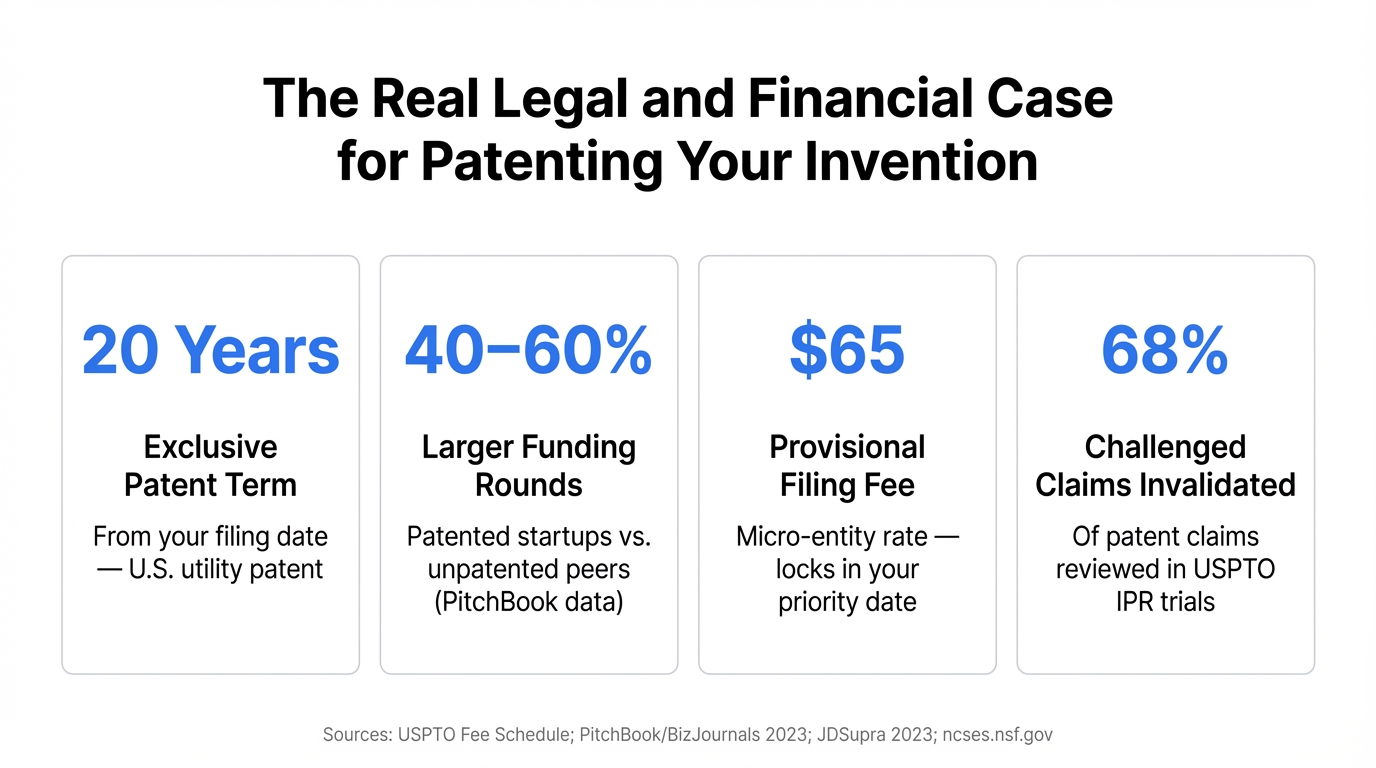 The Real Legal and Financial Case for Patenting Your Invention — Source: USPTO Fee Schedule; PitchBook via BizJournals 2023; JDSupra 2023; ncses.nsf.gov
A Patent Converts Your Idea Into a Legally Enforceable Asset
A granted United States patent gives you the right to exclude others from making, using, selling, or importing your invention for up to 20 years from the filing date. That exclusivity is the engine of every licensing deal, investor conversation, and acquisition negotiation a successful inventor will have. Without patent protection, your new invention is just a product that anyone can copy the moment it reaches the market. With it, you hold enforceable property. According to PitchBook data cited by Biz Journals, startups with patents raise funding rounds 40–60% larger than those without — a direct measure of how investors price IP protection.
Filing a patent application is not a bureaucratic formality. It is the single most important business decision you will make as an inventor, and the timing of that decision determines whether the value of your invention belongs to you or to whoever copies it first. The process of patent registration is a business strategy, not just a legal procedure — and treating it that way from the start separates inventors who build durable assets from those who lose ground to well-resourced competitors.
The Difference Between a Weak Patent and a Litigation Quality Patent
Not all patents provide the same protection. Thompson Patent Law's Litigation Quality Patent® services are engineered specifically to produce patents with claim architecture designed for both breadth and defensibility. A weak patent can actually help a well-funded competitor by drawing a narrow boundary they can design around without liability.
The Provisional Patent Application as a Strategic Starting Point
A provisional patent application is a lower-cost first step that locks in your filing date and gives you 12 months to refine your invention before committing to the full utility application. The USPTO filing fee for a provisional patent application is $130 for small entities and just $65 for micro-entities — a fraction of the cost of a full nonprovisional application. Provisionals do not count against your 20-year patent term, which begins only when the nonprovisional application is filed. File a provisional patent application as soon as your core inventive concept is stable enough to describe in writing. Then use the 12-month window aggressively: prototype, test, build marketing and sales momentum, pursue licensing opportunities, develop client relationships, raise investment capital, build your product, and hire your team.
Speed is critical — do not sit on a provisional. The 12-month window is your runway to commercialize as fast as possible while coordinating your patent filing strategy in real time with your patent attorney. A patent attorney with both business and patent skills can provide just-in-time protection that builds strategic value without over-investing in filings before you know what the market needs.
Note also that many large companies will not speak with inventors who do not have at least a provisional patent application pending. A provisional establishes an objective, defined scope of what is being considered for licensing — protecting both parties and giving large companies the assurance they need to engage without risk of later disputes over idea ownership. If your target market includes major retailers or large licensees, a pending application is often a prerequisite to getting in the door.
For inventors selling through online retail channels, platforms like Amazon offer programs such as the Amazon APEX (Utility Patent Neutral Evaluation) program, which can resolve potential patent infringement disputes through a private, lower-cost process — potentially under $10,000 — rather than federal court litigation. Note that an issued U.S. patent is required to use such programs. For inventors who want to move quickly without sacrificing quality, the patent-first approach is one of the most effective strategies available.
What Qualifications and Skills Actually Help You Become a Successful Inventor
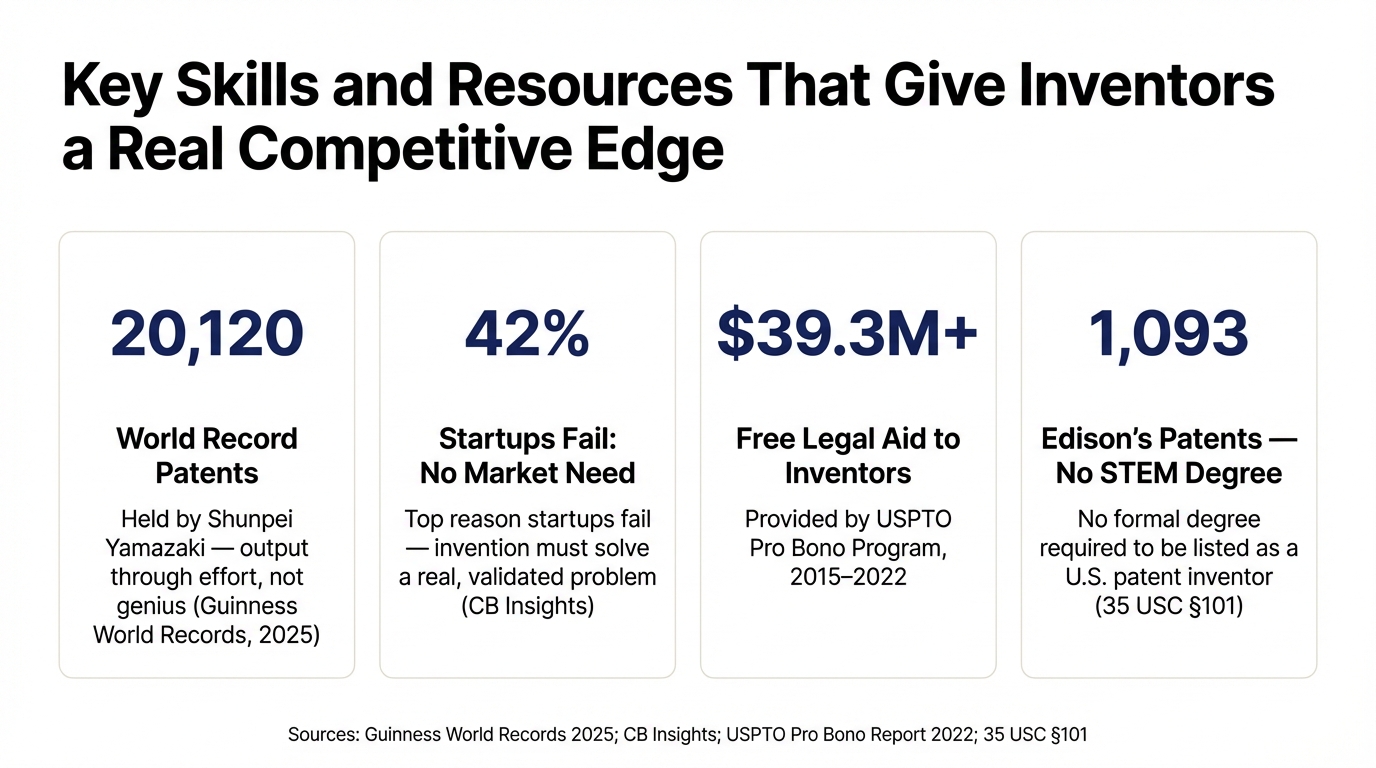 Key Skills and Resources That Give Inventors a Real Competitive Edge — Source: Guinness World Records 2025; CB Insights; USPTO Pro Bono Report 2022; 35 USC §101
Formal Education Helps But Is Not Required
U.S. patent law states that "whoever invents or discovers" a new and useful invention may obtain a patent — no degree required. Thomas Edison had no formal engineering credential and secured 1,093 patents. That said, technical training in your invention's domain accelerates both the development process and the quality of your patent disclosure. For software and AI inventions specifically, understanding how machine learning systems work at a technical level helps you communicate your invention clearly to your patent attorney, who will then draft claims designed to survive eligibility challenges under 35 U.S.C. § 101.
Your job is to focus on developing your invention and building your business. Your patent attorney's job is to handle the legal complexity, guide you through what the patent system requires, and protect your rights while you commercialize. Working with a registered patent attorney — regardless of your educational background — is one of the most practical investments you can make in your invention's future.
Business and Intellectual Property Literacy Is Just as Important as Technical Skill
A great inventor without intellectual property literacy is exposed at every step. According to Patently-O analysis, roughly 60% of U.S. patents are abandoned before their full term because owners miss maintenance fee deadlines. Public disclosure even one day before filing forfeits international patent rights entirely. Successful inventors treat IP education as part of the invention process: they understand the basics of what a United States Patent and Trademark Office application involves, they use confidentiality agreements before sharing prototypes, and they work with qualified patent counsel to avoid procedural mistakes that could destroy rights they earned through real work. For inventors who want to understand exactly how hard it is to get a patent and what strategies improve the odds, building that foundational awareness early — and pairing it with qualified patent counsel — pays dividends at every subsequent stage.
Building a Support System Accelerates Every Stage
The USPTO strongly encourages inventors to work with a registered patent attorney whenever possible. The patent system is complex, and while pro bono programs exist for under-resourced inventors, a DIY patent application carries significant risk — not just of rejection, but of producing a patent that cannot be enforced against real competitors.
A poorly scoped patent can leave enormous value on the table. Even a patent that issues without professional help may be unenforceable against well-funded competitors — and the revenue left on the table by not using a qualified patent attorney can far exceed the cost of counsel. For a relatively modest investment in the low five figures, a well-drafted patent can protect revenue potential in the high six, seven, or even eight figures. Pro bono assistance is available for inventors who qualify, and it is worth knowing those resources exist. However, if you want to maximize the value and enforceability of your patent, professional representation is not optional — it is the difference between a patent that protects real revenue and one that sits on a shelf. University technology transfer offices, SCORE advisors, and peer inventor groups all help shorten the learning curve. But the inventors who build durable, valuable patent portfolios treat qualified patent counsel as a core strategic asset — not an optional extra.
How Inventors Commercialize Their Patents and Generate Real Returns
Licensing Generates Revenue Without Manufacturing
Patent licensing allows you to collect royalties from companies that manufacture and sell products using your invention without ever building a product yourself. For independent inventors with limited capital, licensing is often the highest-return path because it converts your intellectual property into recurring income without operational complexity. The key to successful licensing is a well-drafted patent with broad claims that covers a commercially valuable function a target licensee is already using or planning to use. Understanding the relationship between a license and patent strategy before you file helps you design claims with the right scope from the beginning.
Selling Your Patent Outright Is a Faster but One-Time Outcome
Patent assignments transfer full ownership of your invention to a buyer in exchange for a lump sum. This path is faster and simpler than licensing but gives up all future upside. Assignment deals are common in acquisition scenarios, when large companies want to consolidate a technology stack, or when inventors need immediate liquidity. The price of a patent assignment depends almost entirely on the strength, breadth, and remaining life of the patent, plus the commercial value of the technology it covers. Before accepting an assignment offer, have your patent independently valued — buyers routinely make lowball offers to inventors who do not know what their IP is worth.
Using Your Patent to Raise Investment or Build a Company
For inventors who want to build a company around their invention, a granted patent is often a prerequisite for serious investor conversations. Venture capital firms and angel investors treat patent protection as evidence of defensibility. According to PitchBook data cited by Biz Journals, patented technology commands funding rounds 40–60% larger than unpatented equivalents — a direct signal that investors price IP protection into valuation from the earliest stages. Your patent is not just legal protection. It is a business development document that opens doors that remain closed to unprotected inventors. Understanding the full process for filing a patent before you begin investor conversations ensures you are never caught flat-footed on due diligence questions about your IP status.
Common Mistakes That Kill Inventions Before They Ever Reach the Market
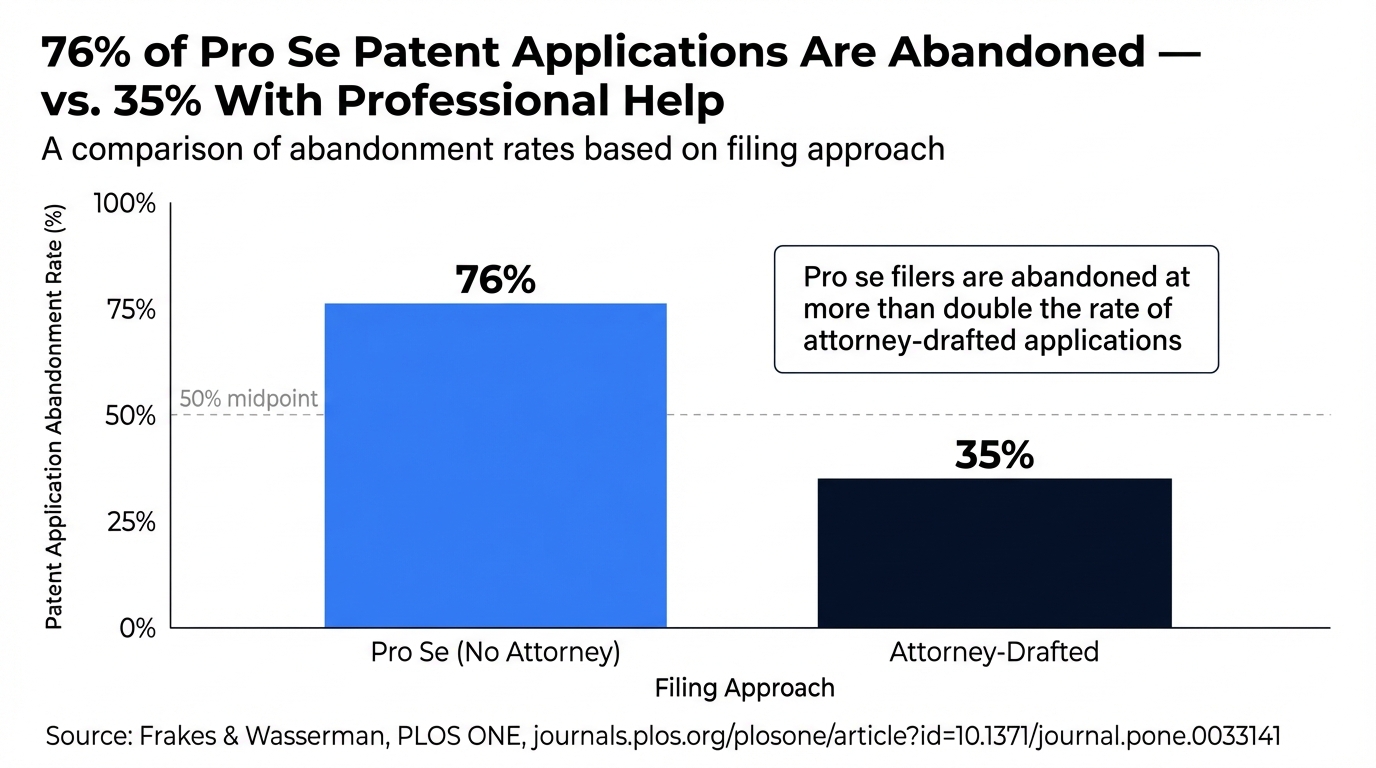 76% of Pro Se Patent Applications Are Abandoned — vs. 35% With Professional Help — Source: Frakes & Wasserman, PLOS ONE
Disclosing Before Filing Destroys Your Patent Rights
The single most preventable mistake in invention is public disclosure before a patent application is on file. In most countries outside the United States, any public disclosure before your filing date permanently bars you from obtaining a patent. Even in the U.S., where a 12-month grace period exists for the inventor's own disclosures, disclosure triggers risks that are entirely avoidable. A social media post, a trade show demonstration, a crowdfunding campaign, or an unprotected investor pitch can all constitute public disclosure. File at minimum a provisional patent application before any public presentation, investor pitch, or product launch. The question of how to patent an idea starts with protecting it before the world sees it — not after.
DIY Patent Applications Routinely Produce Unenforceable Claims
The USPTO allows inventors to file without an attorney. That does not make it a good strategy. Patent claim drafting is a specialized legal and technical skill that takes years to develop. Claims that are too narrow are easily designed around. Claims that are too broad get rejected or invalidated. Pro se applications (filed without professional help) face abandonment rates around 76% compared to roughly 35% for professionally drafted applications, based on research published in PLOS ONE by Frakes and Wasserman. Even a patent that issues without professional help may be unenforceable against real competitors — leaving substantial revenue on the table. The revenue left unprotected by not using a qualified patent attorney can far exceed the cost of counsel. Think of it this way: you could read about surgery, but you would still want a surgeon.
The cost of a poorly drafted patent is not the filing fee you paid. It is the value of the invention you failed to protect. Working with a registered patent attorney is the single most reliable way to produce claims that are both broad enough to matter and defensible enough to enforce.
Frequently Asked Questions About How to Become an Inventor
How much money do inventors make? Income varies widely based on how inventors commercialize their intellectual property. Inventors who license patents can earn anywhere from a few thousand dollars annually to substantially more depending on the technology and the royalty rate negotiated. Licensing royalty rates typically range from 1% to 10% of net sales, with higher rates in medical device and software categories. Inventors who build companies around their patents often realize returns through equity rather than direct royalties. The common thread among high-earning inventors is strong, well-drafted patent protection that provides genuine commercial leverage — a principle that applies at every stage of learning how to become an inventor.
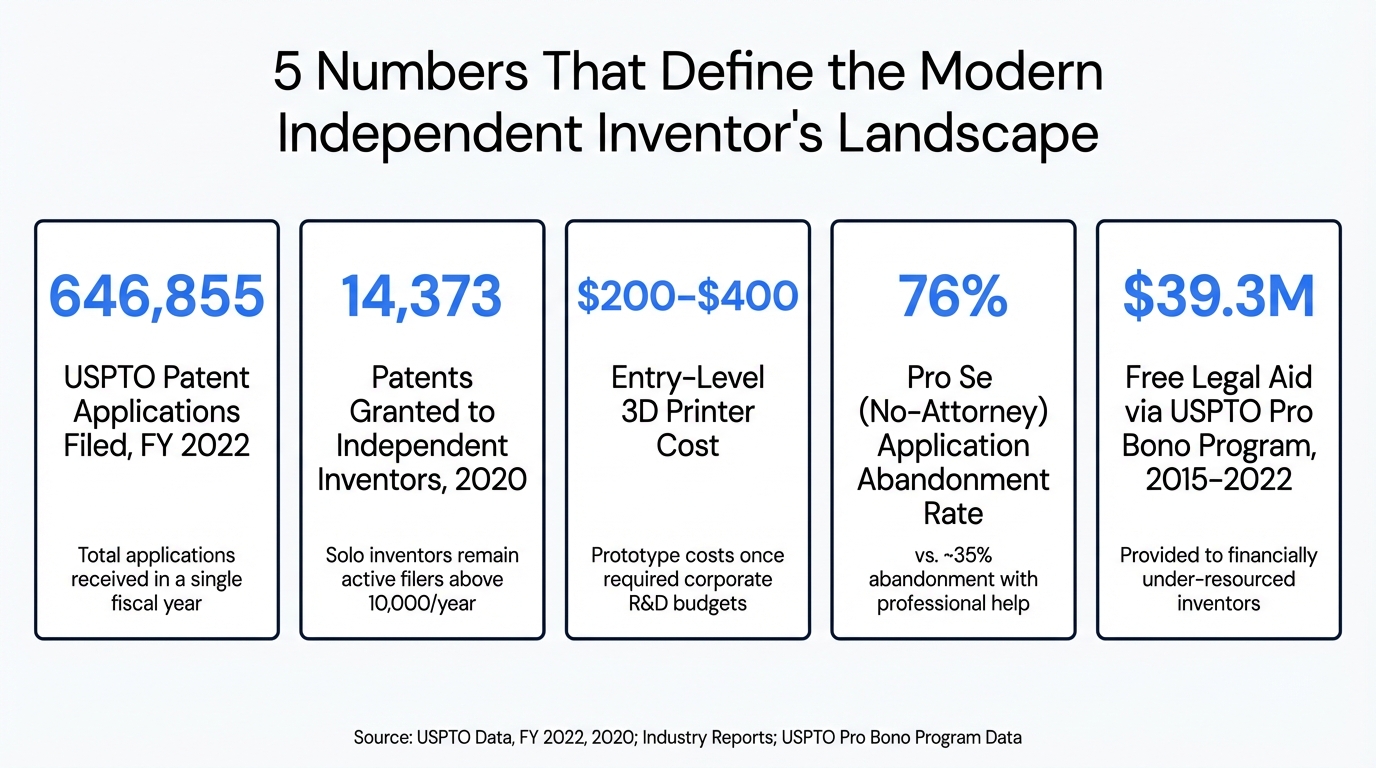 5 Numbers That Define the Modern Independent Inventor's Landscape — Source: USPTO FY2022 Stats: filewrapper.com; NSB 2024: ncses.nsf.gov; Pro Se Rate: journals.plos.org; Pro Bono Program: uspto.gov; 3D Printer Pricing: 3dprintingpricecheck.com
Who is the youngest inventor? The USPTO does not publish comprehensive data tracking the youngest patent holders, but there are documented cases of inventors under 18 receiving granted patents, typically in accessible technology categories like consumer products or simple mechanical devices. These cases share a common pattern: early exposure to structured problem-solving, mentorship, and the commitment to go through the full patent prosecution process. Age is not a qualifying factor for obtaining a United States patent — the statute requires only that the person conceived the invention.
What qualifications do I need to be an inventor? There are no formal educational requirements to file a patent application or be named as an inventor — one of the most encouraging facts for anyone researching how to become an inventor. Any person who conceives of a new and useful invention is legally entitled to inventor status on a patent application. Technical knowledge in your invention's domain significantly improves your ability to describe the invention with the specificity the enablement requirement demands, and basic IP literacy protects you from the procedural mistakes that eliminate rights most inventors never intended to give up.
Can I just sell my invention idea? An unprotected idea has almost no legal or commercial value on its own. Companies rarely pay for ideas without IP attached because there is no mechanism to enforce exclusivity — and many large companies have policies specifically prohibiting them from reviewing unprotected invention submissions to avoid disputes. What you can sell is a patent or patent application, which gives the buyer defined, enforceable rights. The path to selling an invention idea runs through a provisional patent application at minimum, which establishes your priority date and creates a legal instrument that can be included in any assignment or licensing negotiation.
Do I need to build a working prototype before I can file a patent? No — and it is often best to consult a patent attorney before building a prototype at all. The USPTO does not require a working prototype as a condition of filing. What matters is that you can describe your invention with enough detail that a person of ordinary skill in the relevant field could make and use it — this is called the enablement requirement.
Timing your conversation with a patent attorney correctly is critical. You do not want to wait too long — it is better to be a little early than too late. Many inventors file provisional patent applications based on a well-documented concept, then use the 12-month window to prototype, test, and refine before filing the nonprovisional application. If you are unsure whether you are ready, a consultation with a registered patent attorney can give you clear direction.
Does having a patent mean someone cannot copy my invention? A patent gives you the right to exclude others, but it does not automatically stop anyone. Enforcement is the patent owner's responsibility. If a competitor infringes your patent, you must take legal action to stop them and recover damages. This is one reason why patent quality matters so much. A patent with broad, well-drafted claims is worth enforcing. A patent with narrow or ambiguous claims may not justify the cost of litigation. Strong patents deter infringement because the enforcement risk is credible — and that deterrence begins with how the claims are drafted before the application is ever filed.
Your Next Steps to Inventor Success
The bottom line: most inventions that disappear into the gap between concept and market fail not because the idea was bad but because the inventor never took the legal step that converted the concept into an asset. Knowing how to become an inventor is only half the equation — protecting what you create is the other half. Inventors without patent protection hand their competitive advantage to the first well-funded company that notices what they built. Inventors with strong, well-drafted patents hold the leverage that makes every licensing deal, investor conversation, and acquisition negotiation possible.
If you have a new invention you believe is novel and commercially valuable, waiting is the one mistake you cannot afford. Every day without a filing date is a day someone else could file first. Thompson Patent Law's team of registered patent attorneys, each with engineering degrees and backgrounds spanning Fortune 500 companies and major law firms, stands behind every application. The first step is a Complimentary Patent Needs Assessment with one of our IP Intake Specialists, which gives you a clear picture of where you stand, what risks you face, and what to do next. According to Thompson Patent Law, its proprietary prosecution strategies have increased Alice eligibility success by 25–50% and have spared clients 1–2 years and five figures in prosecution costs.
You have already done the hard work of inventing. The next step is making sure it belongs to you.
Schedule a Complimentary Patent Needs Assessment
About the Author: Craige Thompson is a patent attorney, MBA, and electrical engineer leading a team of registered patent attorneys at Thompson Patent Law. The team brings engineering degrees and experience across individual inventors, startups, and Fortune 500 companies including Apple, Google, Intel, and Microsoft. Thompson Patent Law focuses on electrical, mechanical, software, medical device, and emerging technology patents, with a track record of over 1,500 patents issued.