- A patent search only tells you which specific claims are protected, not that an entire product is off-limits, since one product can be covered by patents held by many different owners.
- Checking a patent’s current legal status matters as much as finding it, because more than half of patents lapse early when owners stop paying maintenance fees, making them free for anyone to use.
- Free tools like USPTO Patent Public Search, Google Patents, and Espacenet are good for surfacing documents, but they cannot tell you whether your product infringes a specific claim — that requires attorney analysis.
- Searching only U.S. records leaves gaps, since the EPO’s Espacenet holds documents from more than 100 countries and a U.S.-only search says nothing about protection abroad.
- “Patent pending” only means an application was filed, not granted, so it is not yet enforceable, but the published application can still be searched to see what claims are being pursued.
More than 12 million patents have been granted by the United States Patent and Trademark Office since its founding, and according to USPTO records, the agency issued U.S. Patent Number 12,620,000 in May 2026. With roughly 646,855 applications filed in fiscal year 2022 alone, the odds that your idea, product, or business plan overlaps with existing intellectual property are not theoretical. They are statistically real, and the cost of finding out too late can be catastrophic.
Key Takeaways
- A patent search tells you which specific claims are protected, not whether an entire product is off-limits. One product can sit under dozens of overlapping patents held by different owners.
- Always check a patent's current legal status. Over half of patents expire before their full term because owners stop paying maintenance fees, and an expired patent is free for anyone to use.
- Free tools like USPTO Patent Public Search and Google Patents surface documents. They cannot tell you whether your product infringes a specific claim. That analysis requires a patent attorney.
- Searching only the United States patent office database leaves critical gaps. The EPO's Espacenet contains over 120 million patent documents from more than 100 countries.
- "Patent pending" means an application was filed, not that a patent was granted. The pending application is not enforceable, but a granted patent will be, and you can already search the published application to understand what claims are being pursued.
How to Know If Something Is Patented Before You Act — and Why It Can Save You Everything
A single missed patent can turn a promising product launch into a six-figure infringement lawsuit. The United States Patent and Trademark Office (USPTO) has issued more than 12 million patents since its founding, and approximately 646,855 new patent applications were filed in FY 2022. That number includes utility applications, design applications, and other application types combined. The density of patent coverage across technology sectors means that almost any commercially interesting idea has some overlap risk worth evaluating.
Before diving into search mechanics, it helps to understand the different types of patents you may encounter during a search, because utility patents, design patents, and other categories follow different rules and have different durations. And if you are not sure whether your idea even qualifies as a patentable invention rather than abstract ideas or other excluded subject matter, this guide on whether ideas can be patented explains where that line is drawn.
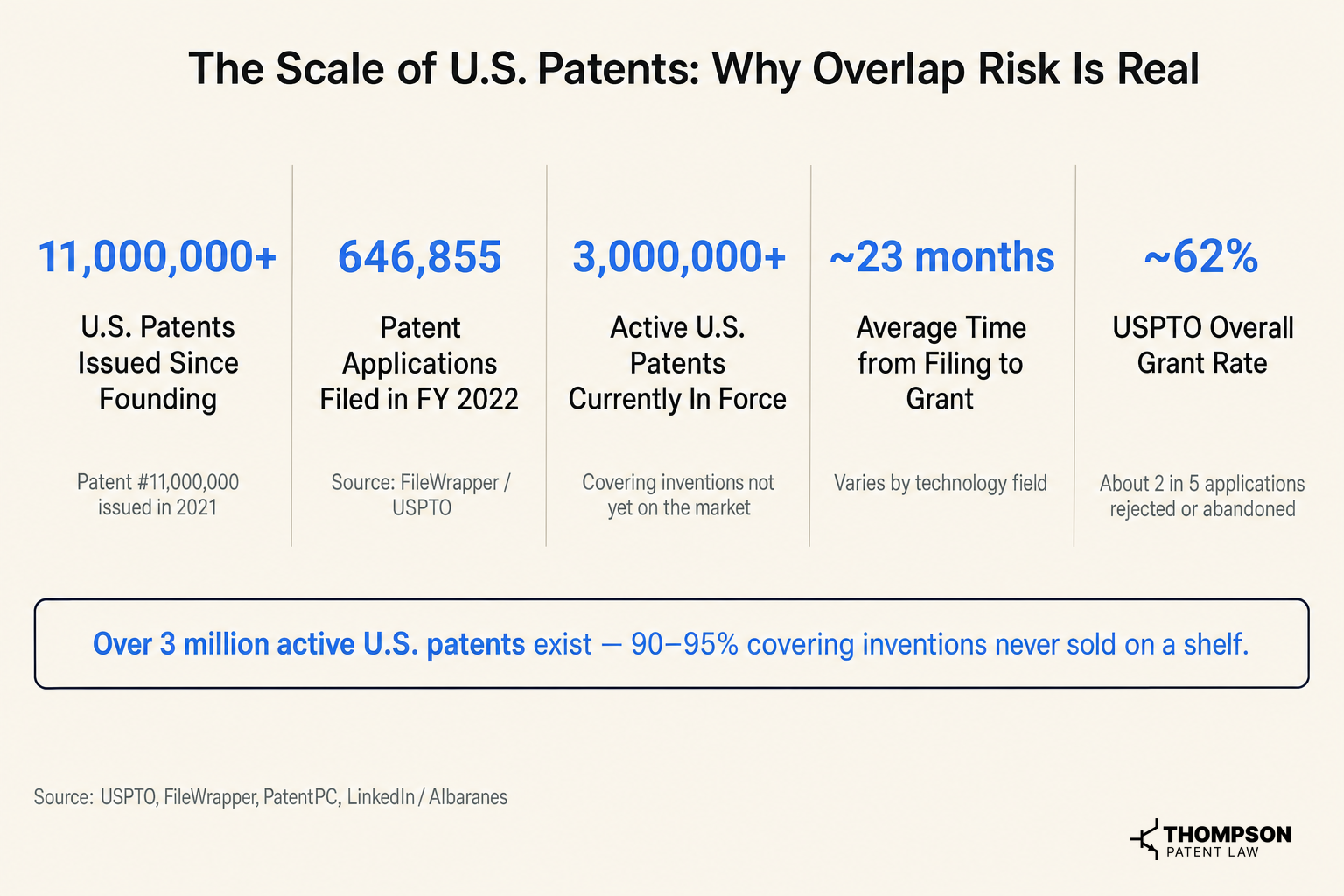 The Scale of U.S. Patents: Why Overlap Risk Is Real — Source: USPTO (patent #11,000,000 announcement); FileWrapper FY 2022 filing stats; PatentPC patent statistics 2024; LinkedIn/Albaranes
This guide walks through exactly how to know if something is patented, which tools give the most reliable results, what a patent search actually tells you and what it does not, and when a patent attorney needs to be involved. Whether you are protecting a new invention, checking a competitor's product, or clearing the path before filing a patent application, you will leave knowing what to do next.
What a Patent Search Actually Tells You and Why It Matters
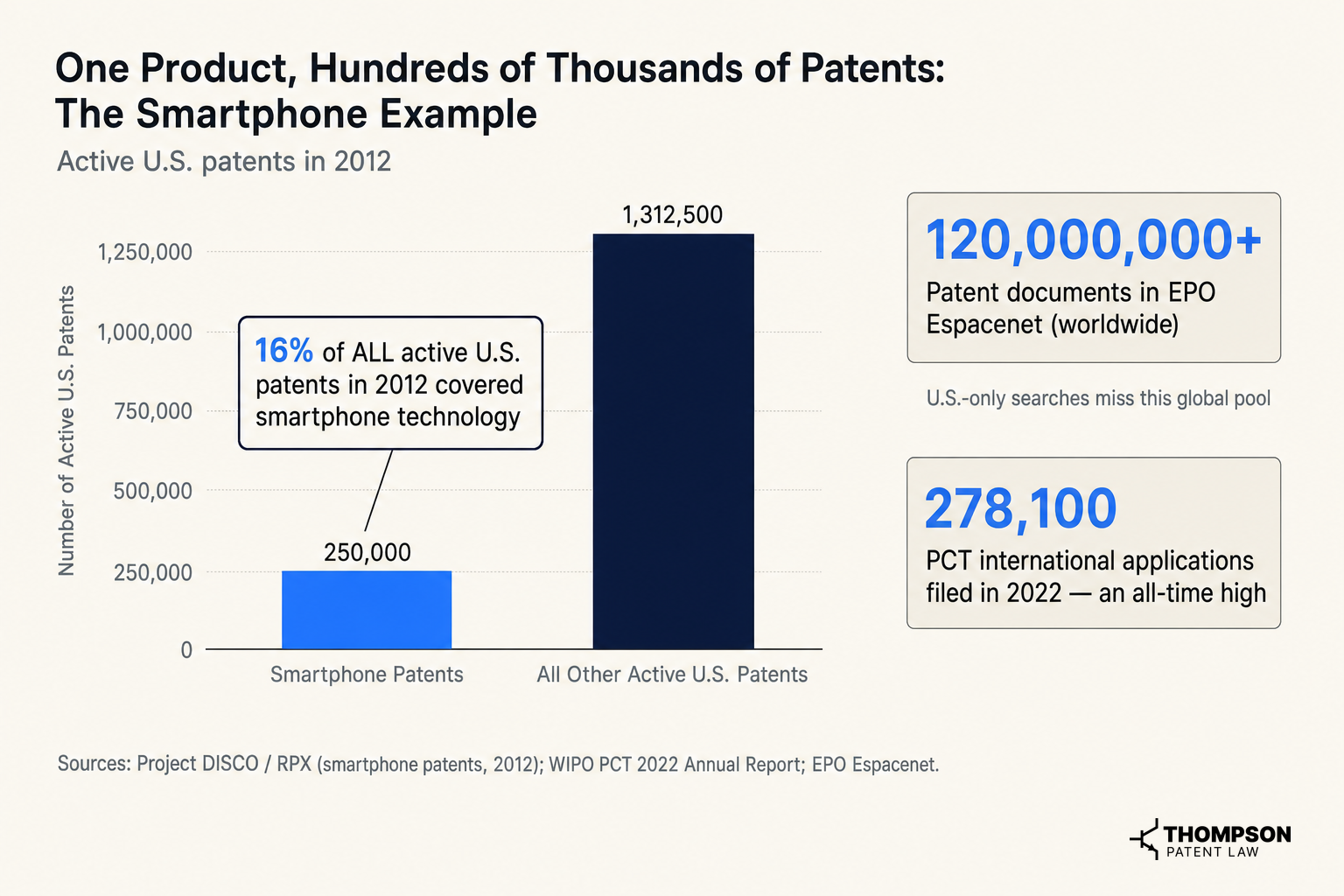 One Product, Hundreds of Thousands of Patents: The Smartphone Example — Source: Project DISCO / RPX (2012 smartphone patent count); WIPO PCT Annual Report 2022; EPO Espacenet
The Difference Between "Patented" and "Patent Protected"
Finding that a product has a patent does not mean the entire product is off-limits. A patented invention is protected claim-by-claim, not product-wide. A patent search reveals which specific claims are protected, and those claims may cover only one aspect of the product's function. The rest may be unprotected, separately protected by a different patent, or owned by a completely different company.
The smartphone is the clearest illustration of this. According to research published by Project DISCO, approximately 250,000 active U.S. patents, or about 16% of all active U.S. patents as of 2012, related to smartphone technology. As WIPO's analysis of the smartphone patent thicket notes, individual features like swipe-to-unlock, autocorrect, and push email have each been covered by dozens of separate patents held by different owners. Finding one patent that covers a product feature does not mean the field is clear. It means you have found one thread in what may be a much larger web.
Why the USPTO Database Is the Starting Point, Not the Finish Line
USPTO records cover United States patents only. A thorough patent search requires going further. The European Patent Office's Espacenet database contains over 120 million patent documents from more than 100 countries, dwarfing what the United States patent office holds. The World Intellectual Property Organization's Patent Cooperation Treaty (PCT) system saw 278,100 international patent applications filed in 2022, an all-time high, and the PCT now covers 158 contracting states. A product that appears unprotected in U.S. records may carry active foreign patents or patent protection in Europe, Asia, or Canada that could affect your ability to sell in those markets.
The practical rule: run searches across at least three databases before drawing any conclusions. USPTO Patent Public Search, Google Patents, and Espacenet each cover different ground, and conclusions drawn from any one of them alone are incomplete.
Patent Status Changes Over Time
A patent's existence in the database is not the same as its current enforceability. Utility patents last 20 years from their U.S. filing date, provided maintenance fees are paid at 3.5, 7.5, and 11.5 years after grant. Design patents last 15 years from the date of grant. According to research cited by Business Innovation Management, more than half of patents expire before their full term because owners stop paying maintenance fees. An expired or lapsed patent sends the invention into the public domain, where anyone can use it freely.
The critical habit: always check a patent's current legal status, not just its existence — this is one of the most important steps in how to know if something is patented. An expired patent is free for anyone to use. An active patent is not. For a deeper look at how duration and expiration work across different patent categories, see this breakdown of patent terms and duration guidelines.
How to Search the USPTO Patent Database Step by Step
How to Search the USPTO Patent Database: 5 Steps — Source: USPTO (Patent Public Search launch, 2022); USPTO MPEP (CPC system); PatentPC patent statistics 2024; USPTO Patent Maintenance Fees
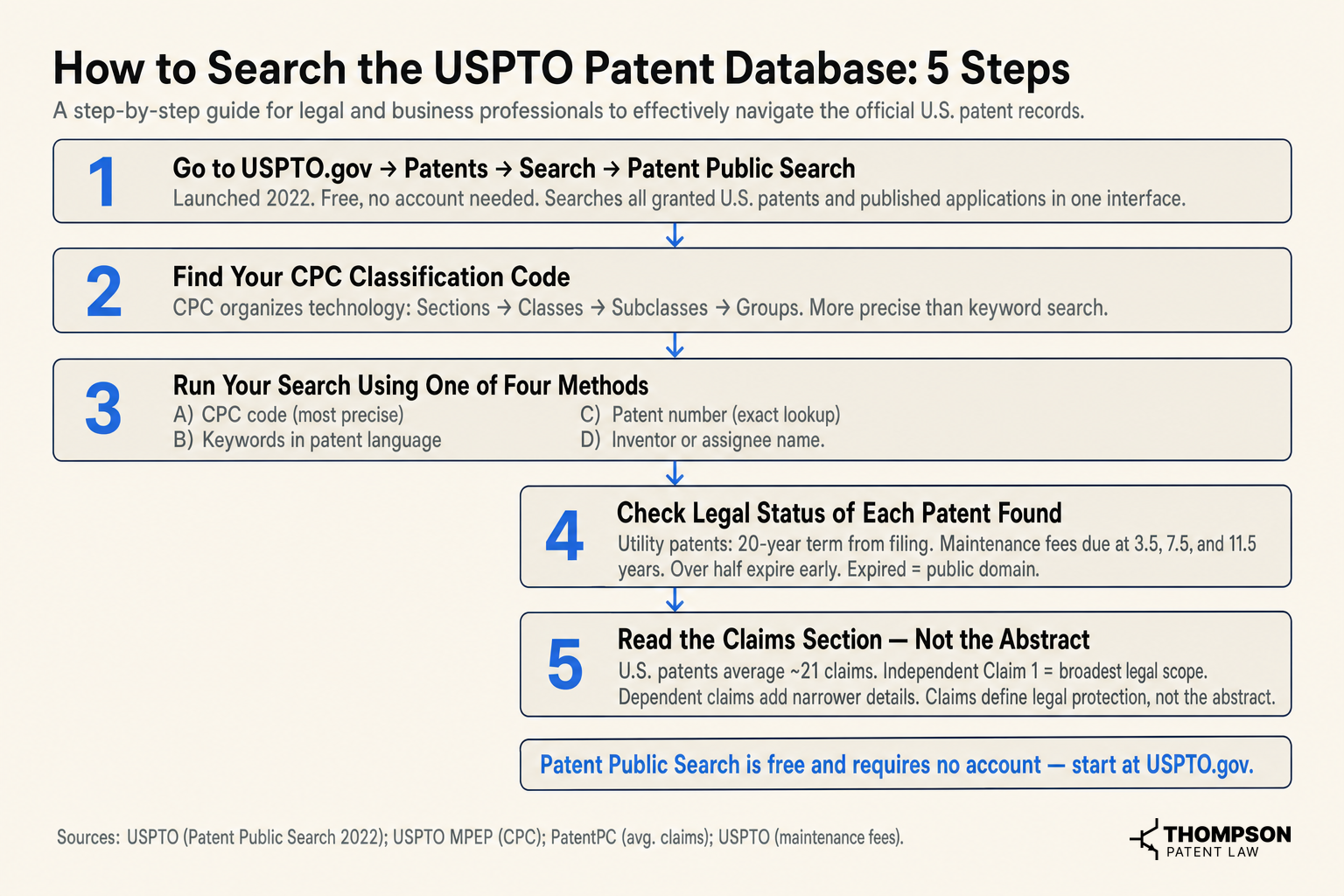 How to Search the USPTO Patent Database: 5 Steps — Source: USPTO (Patent Public Search launch, 2022); USPTO MPEP (CPC system); PatentPC patent statistics 2024; USPTO Patent Maintenance Fees
Finding the Right Search Tool on the USPTO Website
The USPTO launched its current search platform, Patent Public Search, in 2022, retiring its older Full-Text and Image databases. The new system provides one-stop access to all granted U.S. patents and published patent applications in a single interface. It is free, requires no account, and allows searching by keyword, patent number, inventor name, classification code, and date range.
Start at USPTO.gov, navigate to "Patents," then "Search," and select Patent Public Search. This is your primary database for United States patent records. Google Patents is a useful supplement, not a substitute, for the official USPTO record.
Searching by Keyword, Patent Number, and Inventor Name
Each search method in USPTO Patent Public Search serves a different purpose. Keyword searches work, but they require using the technical vocabulary found in patent claim language, which rarely matches the words a consumer or businessperson would use. Patent number searches are exact lookups, most useful when a patent number is physically marked on a product. Inventor names and assignee (company) name searches let you map out the full patent portfolio of a person or organization.
The most precise approach for technology searches uses cooperative patent classifications through the Cooperative Patent Classification (CPC) system, which organizes patents into a hierarchy of sections, classes, subclasses, and groups. Finding the right CPC code for your technology area first, then searching within that classification, returns far more relevant results than a general keyword search. The USPTO provides a CPC search tool specifically to help identify the right classification for any invention.
Reading a Patent Document to Understand What's Actually Protected
A patent document contains several sections: patent abstracts that briefly summarize the invention, a specification that provides the full technical description, drawings, and the claims — all of which are accessible through Patent Center, the USPTO's document retrieval system. Only the claims section defines the legal boundaries of protection. According to PatentPC's analysis of USPTO data, U.S. patents have about 21 claims on average, though only a handful are independent claims that set the core scope of protection. Dependent claims add specific limitations that narrow the invention further.
When you open any patent document, scroll directly to the claims. Claim 1 in a utility patent is almost always the broadest independent claim and establishes the outer boundary of what is protected. The abstract and specification provide context and background, but they do not define what you can or cannot do commercially.
A thorough step-by-step patent search process covers classification codes, claim interpretation, and how to document what you find in a way that is actually useful for a subsequent attorney review.
How to Use Google Patents and Other Free Search Tools
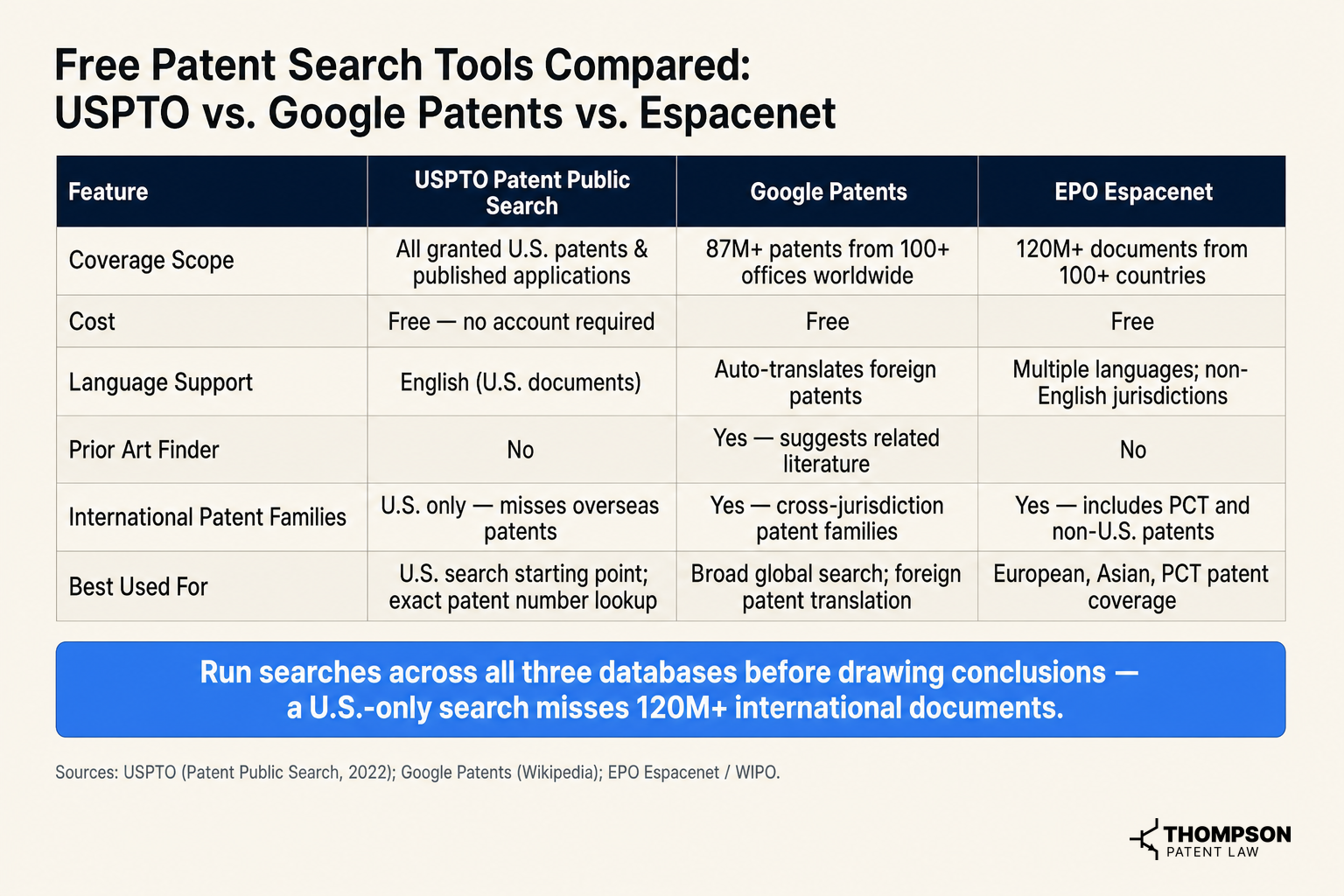 Free Patent Search Tools Compared: USPTO vs. Google Patents vs. Espacenet — Source: USPTO (Patent Public Search, 2022); Google Patents (Wikipedia); EPO Espacenet; WIPO
What Google Patents Offers That the USPTO Does Not
Google Patents indexes more than 87 million patents and applications from over 100 patent offices worldwide, with full-text search across at least 17 major offices including the USPTO, EPO, and China's patent office. The interface is cleaner than the USPTO's system and auto-translates foreign-language patents into English. Google Patents also includes a "Prior Art Finder" feature that surfaces related academic papers and technical literature, and some AI automation tools can further accelerate prior art discovery across large document sets.
Use Google Patents for broader international coverage and for its prior art search capability. Then verify any critical finding directly on the official USPTO or EPO databases before relying on it for legal or business decisions.
Keep in mind that when you search Google Patents or similar free public tools, your search queries — including the keywords that describe your invention — are submitted to a private company. Many patent attorneys advise inventors to be cautious about this, as those companies may use that data in ways outside your control. If you are concerned about protecting the confidentiality of your invention concept at the search stage, professional search tools with contractual data protections are the safer choice.
Using the European Patent Office and WIPO for International Coverage
If a product is sold globally, patent protection may exist in jurisdictions that a USPTO search would never surface. The EPO's Espacenet database covers publications from over 100 countries, including German utility models, Japanese patents, and Korean filings. WIPO's PatentScope covers all PCT applications, and with 158 countries participating in the PCT treaty, a single international application can spawn active patents across dozens of jurisdictions.
If your market includes Europe, Asia, or Canada, international patents may apply, so run the same search on Espacenet and PatentScope before concluding no patent protection exists. A clean USPTO result means the United States field may be clear. It says nothing about everywhere else.
The Limits of Free Patent Search Tools
Free tools retrieve documents. They do not perform legal analysis. One of the most significant gaps: free searches often surface one patent but miss related family members.
There is also a privacy consideration worth understanding before you begin. DIY patent searches on public databases such as Google Patents are subject to those companies' data handling policies. Many patent attorneys advise caution about submitting your invention keywords to free public tools, because private companies may use that search data for their own benefit — potentially exposing confidential details about your invention concept to third parties.
At Thompson Patent Law, we use proprietary search databases and professional-grade tools that are contractually protected. Your invention keywords and search criteria are not subject to the data practices of a third-party platform, so your confidential information stays confidential. The United States patent office processes roughly 170,000 continuation patent applications filed annually, and a patent family can include multiple continuations filed at different times, each with slightly different claims covering additional aspects of the same invention. In one well-documented case cited by the Los Angeles Times, an inventor kept a patent pending for 20 years through seven continuation filings before enforcement began.
A clean search result is not a legal clearance. It is a starting point for an informed conversation with a patent attorney.
How to Tell If a Physical Product Is Already Patented
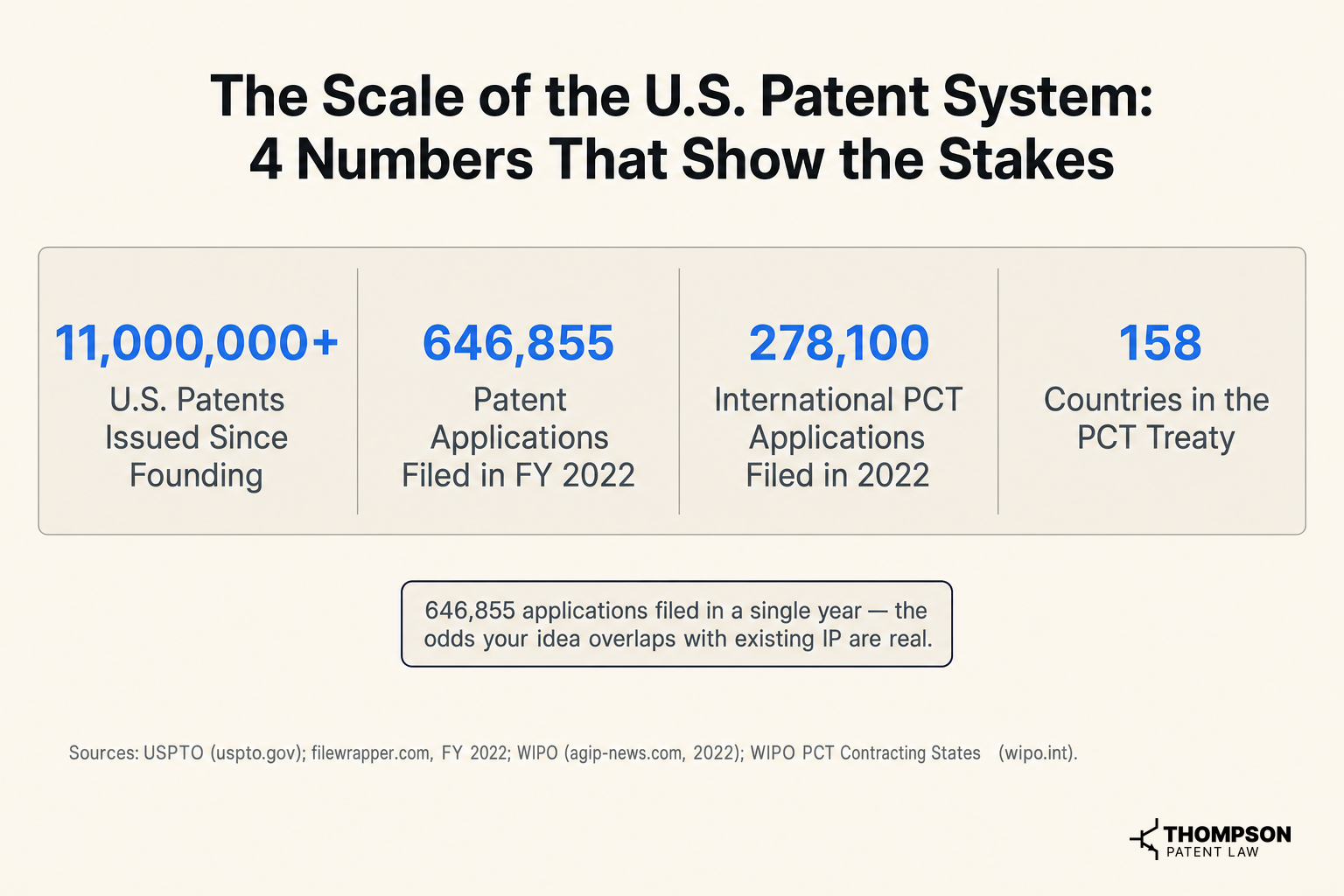 The Scale of the U.S. Patent System: 4 Numbers That Show the Stakes — Source: USPTO (uspto.gov, 2021); filewrapper.com (FY 2022); WIPO agip-news.com (2022); WIPO wipo.int
Looking for Patent Numbers Marked on Products
U.S. law under 35 U.S.C. §287(a) encourages patent holders to mark their products with the relevant patent number or with a virtual marking URL pointing to a page listing applicable patents. If you find "Pat." followed by a number, or a URL labeled "Patents:" on a product, its packaging, or its user documentation, that patent number is your fastest entry point. Look it up directly in USPTO Patent Public Search or Google Patents to see exactly which claims cover the item.
Be aware that false marking of an unpatented product as patented is illegal under 35 U.S.C. §292, with penalties for deceptive intent. Legitimate patent numbers on products are reliable starting points for your search.
What "Patent Pending" Actually Means for You
"Patent pending" means an application has been filed with the United States Patent and Trademark Office but has not yet been granted. During the pending period, the application is not enforceable; you cannot be sued for infringing a patent application. However, the average pendency at the USPTO runs approximately 23 months from filing to issuance, and most U.S. applications publish as public documents approximately 18 months after filing.
When you see a "Patent Pending" notice, search the USPTO's published applications database to find the application and read the claims being pursued. A granted patent will be enforceable from the grant date forward, and understanding what is being claimed gives you early warning before any enforcement is possible. For a fuller explanation of what pending status means and how to monitor it, see this guide on pending patent status.
When the Product Has No Marking at All
The absence of a patent mark does not mean the product is unpatented. Many patent holders simply choose not to mark, which is legal. The consequence under 35 U.S.C. §287 is that an unmarked patented product limits the owner's ability to recover damages for past infringement until actual notice is given, but the patent remains fully valid and enforceable going forward.
When no patent number appears on a product, knowing how to know if something is patented means shifting your search strategy to the manufacturer's name (searched as "assignee" in patent documents), the inventor's name if known, or a description of the product's key technical function. An unmarked product can still be fully protected, and the burden of finding the relevant patent falls on you.
How to Check If Your Own Invention Idea Is Already Patented
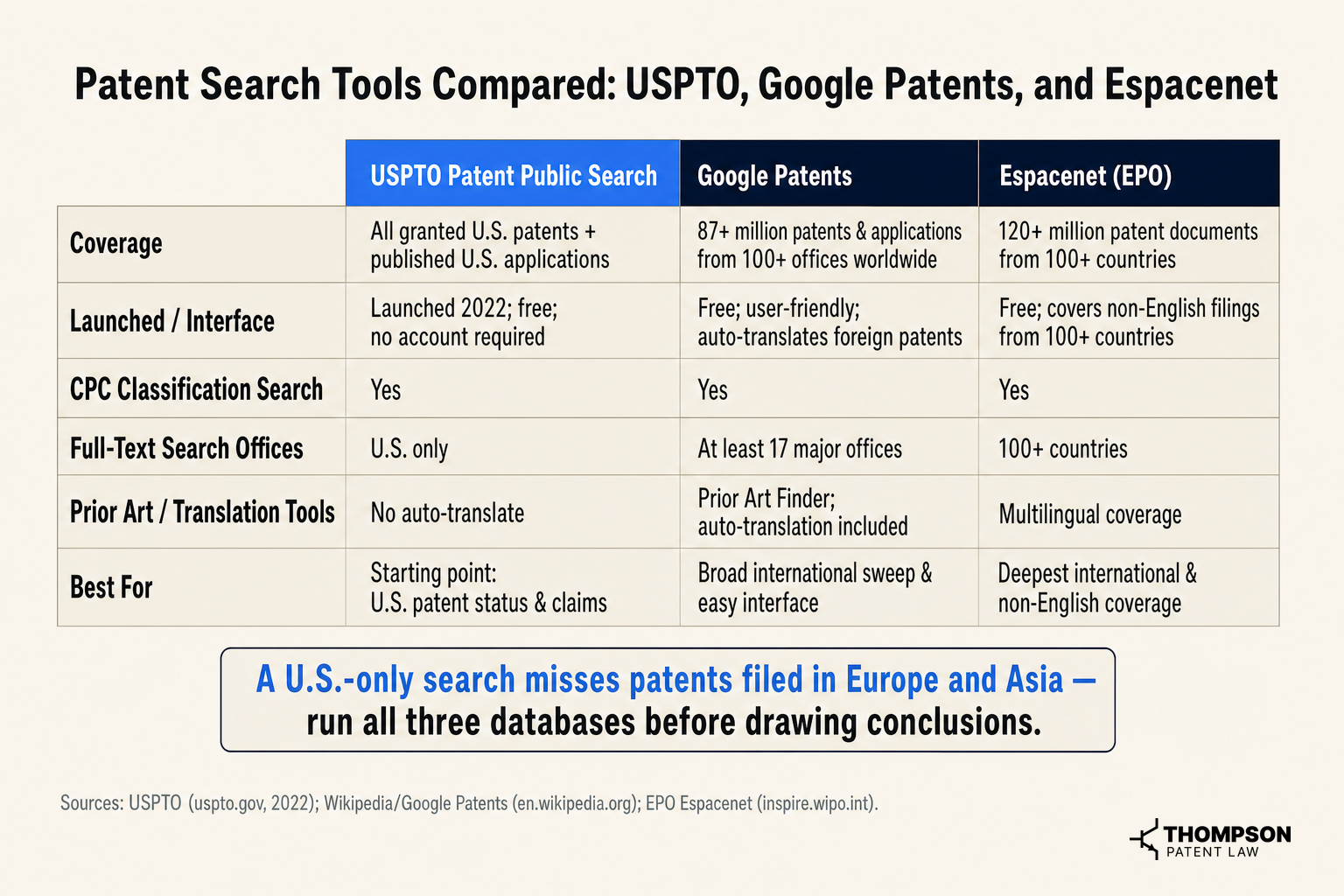 Patent Search Tools Compared: USPTO, Google Patents, and Espacenet — Source: USPTO (uspto.gov, 2022); Wikipedia/Google Patents (en.wikipedia.org); EPO Espacenet (inspire.wipo.int)
Running a Preliminary Novelty Search Before You File
Before spending money on a patent application, an inventor's first step is a preliminary patent search to determine whether the same invention already exists in issued patents or published applications. Understanding how to know if something is patented at this stage can save thousands of dollars in filing and prosecution costs. This is fundamentally different from a freedom-to-operate search, which asks whether you can sell a specific product without infringing existing patents — a question that also touches on patent eligibility for any claims you intend to assert. A novelty search asks whether your invention is new enough to be worth filing in the first place.
Quality patent preparation typically costs several thousand dollars in filing and attorney fees — but that investment saves inventors from the far greater cost of a failed application, a weak patent, or a competitor who designs around poorly drafted claims. The USPTO's overall grant rate is approximately 62%, meaning roughly two in five applications end up rejected or abandoned for those who file without sophisticated prosecution strategies. With experienced guidance and proprietary methodologies, that number looks very different. A preliminary search that reveals a pre-existing patent on the same concept saves all of those costs before a single dollar is spent on prosecution.
If you are ready to move from searching to filing and want to understand the patent application process, this step-by-step guide on how to patent a product walks through the full process from documentation through examination. Timing also matters: filing too early or too late can affect both patentability and the scope of protection available, which is why understanding when to get a patent is worth reviewing before you commit to a filing strategy.
Understanding Prior Art and Why It Determines Patentability
Prior art includes any public disclosure of the same invention before your filing date: issued patents, published patent applications, academic papers, trade show presentations, and even public sales of the product — none of which are products of human thought alone. The USPTO will reject any patent application where the claimed invention is anticipated by prior art under 35 U.S.C. §102, or is obvious in light of it under 35 U.S.C. §103. Obviousness is the most frequent rejection basis in USPTO examination, and examiners regularly combine multiple prior art references to build an obviousness case against a new application.
Your search should cover not just existing patents but also academic literature, trade publications, and product listings. Prior art is not limited to issued patents, and a clean patent search result is not the same as a clear patentability determination. It is also worth knowing upfront which categories of subject matter fall outside patent protection entirely; a review of things you cannot patent can save significant time before a search even begins.
The Gap Between a DIY Search and a Professional Patentability Opinion
A self-conducted search in USPTO Patent Public Search or Google Patents can surface obvious conflicts, but it cannot reliably identify all relevant prior art, interpret how claim language would be construed by an examiner, or evaluate whether the differences between your invention and the prior art are legally sufficient to support a patent grant — these are matters of legal information that require professional analysis.
There is a third consideration beyond accuracy and completeness: data privacy. When you enter invention-related keywords into Google Patents or other free public search tools, you are submitting potentially confidential information to a private company. Many patent attorneys would advise that this is unwise, because those companies are not bound by confidentiality obligations and may use your search data for their own purposes. Thompson Patent Law uses proprietary, professionally licensed search databases where your search criteria and invention keywords are contractually protected from third-party use — so your idea stays yours. For more information on what a professional opinion covers, consulting a registered patent attorney is the recommended next step. For anyone trying to understand how to know if something is patented with enough confidence to make business decisions, a formal patentability opinion is the appropriate next step. That analysis, delivered in the form of a formal patentability opinion, provides defensible legal conclusions that a database query cannot.
According to Thompson Patent Law, the firm achieves an allowance rate of up to 94%, compared to the USPTO's overall rate of approximately 62%. That gap reflects the difference between applications filed with rigorous upfront analysis versus those filed without it. A DIY search reduces wasted effort on a clearly obvious idea. A professional patentability opinion tells you whether you actually have a case worth filing.
Who You Should Hire to Help With a Patent Search
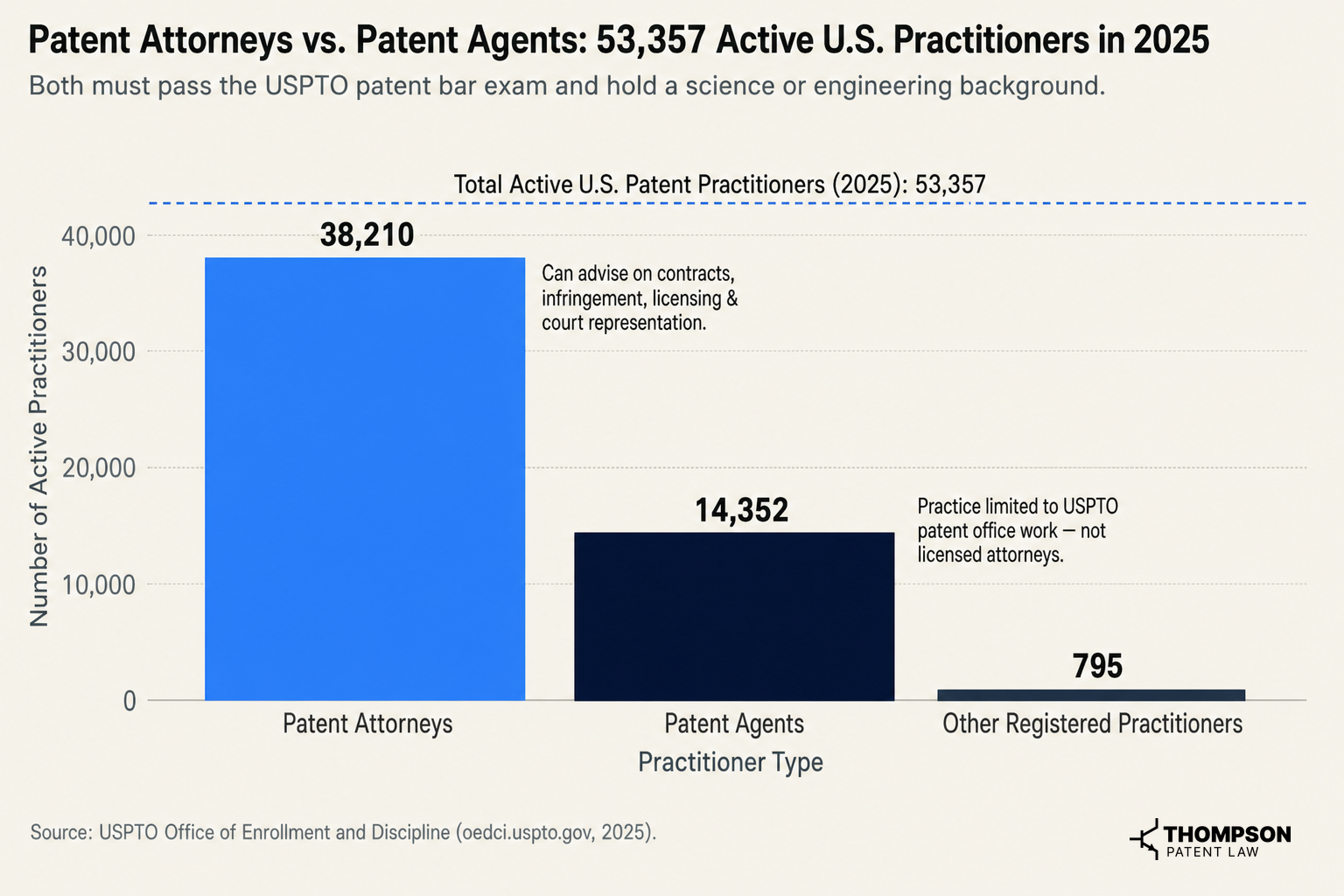 Patent Attorneys vs. Patent Agents: 53,357 Active U.S. Practitioners in 2025 — Source: USPTO Office of Enrollment and Discipline, 2025
Patent Attorney vs. Patent Agent: What's the Difference
Both patent attorneys and patent agents are licensed by the United States Patent and Trademark Office to prosecute patent applications and conduct patent searching. The distinction is that patent attorneys hold law degrees in addition to their technical credentials and can advise on litigation, licensing, and enforcement. Patent agents hold technical degrees and are registered to practice before the USPTO but are not licensed attorneys.
According to USPTO practitioner data, there are 53,357 active registered U.S. patent practitioners as of 2025, comprising approximately 38,210 patent attorneys and 14,352 patent agents. For a standalone prior art search, a qualified patent agent can be cost-effective. If your question extends to infringement risk, licensing strategy, or enforcement options, the broader legal context requires a patent attorney.
It is also worth noting that patents and trademarks are completely separate forms of protection. If you are unsure which type of intellectual property applies to your situation, this trademark vs. patent comparison clarifies the differences quickly.
When You Need Professional Help Instead of a Database Search
Specific situations call for professional legal analysis rather than a self-directed database search. The clearest case is a freedom-to-operate (FTO) analysis: the legal question of whether you can manufacture and sell a specific product without infringing any active patent claims. An FTO opinion requires a patent attorney to identify relevant patents, interpret how their claims would apply to your specific product design, and assess whether prosecution history estoppel or claim construction arguments limit the patent's scope.
If you are asking "Does this patent exist?" a database search can answer it. If you are asking "Can I sell this product without getting sued?" those are legal questions that require a freedom-to-operate opinion from a patent attorney, not a database query.
What Thompson Patent Law Does Differently in the Patent Search Process
Thompson Patent Law integrates patent searches into a broader patent strategy process rather than treating them as a standalone checkbox. A search result is evaluated in light of what claims can be drafted to protect the client's invention, not just what has already been filed by others. According to Thompson Patent Law, the firm has guided more than 1,500 patents to issuance and achieved allowance rates of up to 94%, with experience across Fortune 500 companies including Apple, Google, Intel, and Microsoft.
The practical implication: a search is only as valuable as the strategy built around it. A Complimentary Patent Needs Assessment at thompsonpatentlaw.com/patent-needs-assessment/ provides a direct evaluation of what your specific situation requires before any filing decisions are made. The assessment is led by Sean and David, our IP Intake Specialists, not by an attorney.
Common Mistakes That Lead Inventors to the Wrong Answer
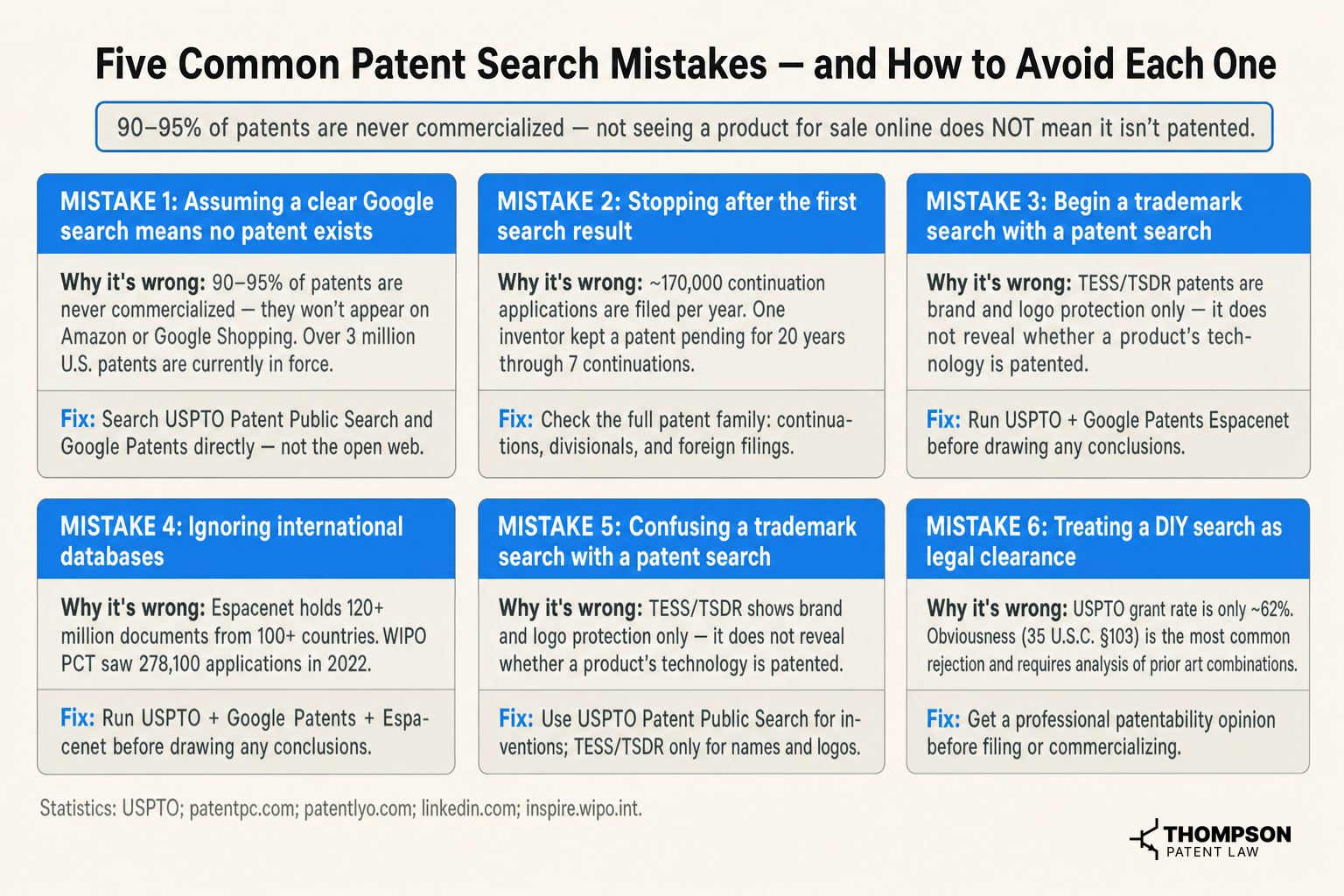 5 Common Patent Search Mistakes — and How to Avoid Each One — Source: USPTO; patentpc.com; patentlyo.com; linkedin.com; inspire.wipo.int; projectpq.ai
Assuming a Clear Google Search Means No Patent Exists
A Google web search and a patent search are completely different things. Patent documents are written in technical claim language that bears no resemblance to consumer product descriptions, brand names, or marketing copy. A product can have zero commercial web presence and still be covered by multiple active patents. Conversely, a product category that returns thousands of commercial results may have patents that have all expired.
A Google web search tells you whether a product is commercially available. It tells you nothing about patent information or patent status. If you want to know how to know if something is patented, the answer starts with a dedicated patent database search, not a general web search.
Stopping After the First Search Result
Patent families complicate any search. A single original invention can generate multiple continuation patent applications, each filed at different times with claims tailored to cover additional aspects of the technology. The USPTO processes roughly 170,000 continuation applications annually, and stopping after finding one relevant patent routinely misses the rest of the family. After locating any relevant patent, use its priority date and assignee name to search for all related family members and other patents in the same lineage. The original filing almost never tells the complete story.
Confusing a Trademark Search With a Patent Search
Trademarks protect brand names, logos, and source identifiers. Patents protect inventions and processes. These are separate forms of intellectual property governed by separate legal frameworks, and the USPTO maintains completely separate databases for each, including trademark resource centers for trademark information and brand-related inquiries. Trademark records are searchable in the USPTO's Trademark Electronic Search System (TESS) or the Trademark Status and Document Retrieval system (TSDR). A search in TESS will not surface any patent protection, regardless of how thorough it is, just as checking trademark application status tells you nothing about patent rights.
Run your patent search in USPTO Patent Public Search. A trademark search answers a completely different legal question and is not a substitute for a patent clearance search.
Frequently Asked Questions
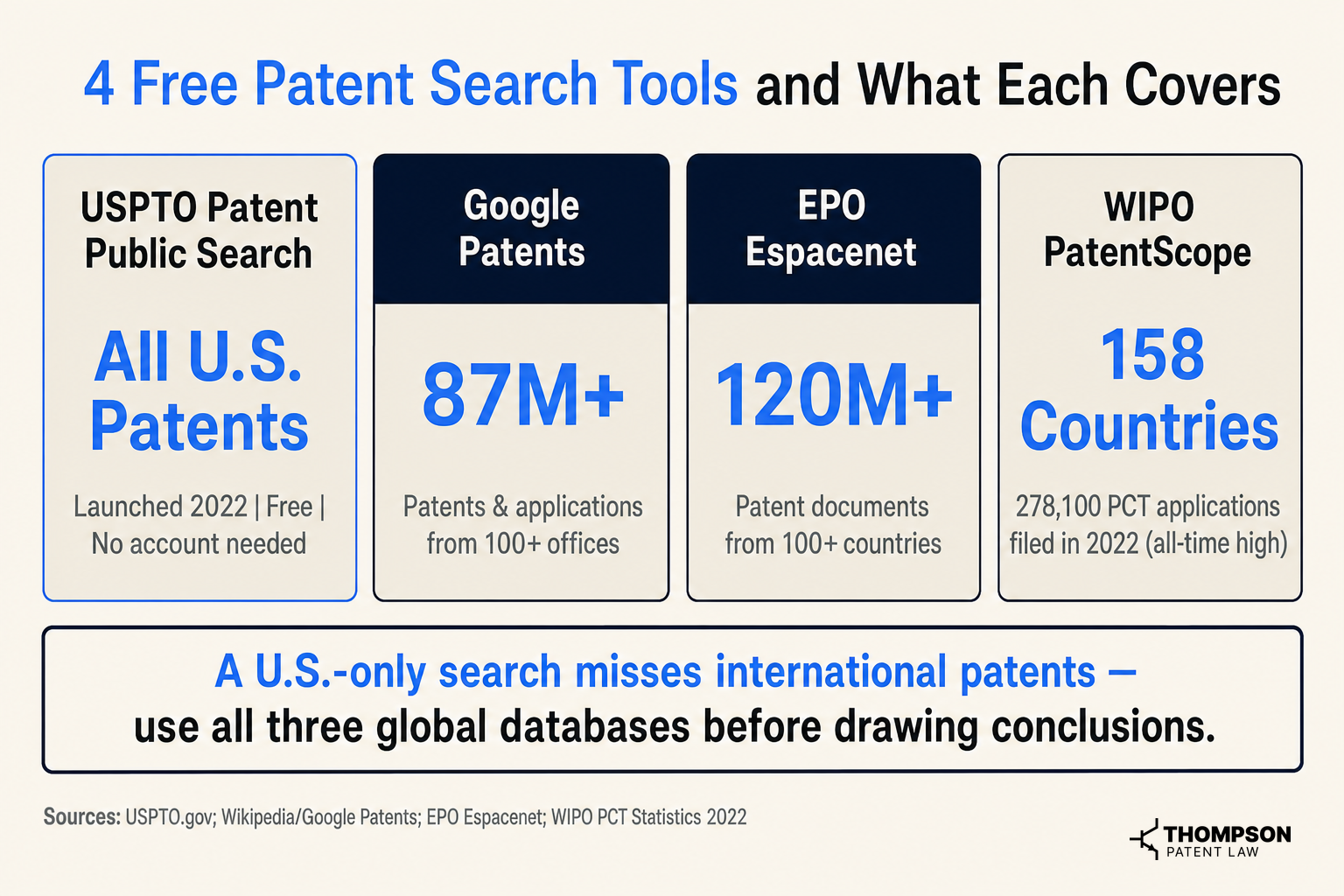 4 Free Patent Search Tools and What Each Covers — Source: USPTO.gov; Wikipedia/Google Patents; EPO Espacenet; WIPO PCT Statistics, 2022
How do I tell if an item is patented?
Start by looking for a patent number marked on the product itself, on the packaging, the bottom of the device, or in the user manual. If you find a patent number, look it up directly in the USPTO Patent Public Search at USPTO.gov. If there is no marking, search the manufacturer's name (as the assignee) and a description of the product's key technical function in the USPTO database and in Google Patents. The absence of a visible patent number does not mean the product is unprotected.
How can I check if a product has a patent?
The most reliable method is searching the USPTO Patent Public Search database using the company name listed as the assignee, the inventor's name if known, or the Cooperative Patent Classification (CPC) code that matches the product's technology. Google Patents is a strong supplementary tool because it also indexes patents from international patent offices. Keep in mind that a single product may be covered by multiple patents, so reviewing the full assignee portfolio matters more than any single search result.
Is a patent lookup free?
Yes. Access to patent records through the USPTO Patent Public Search database is completely free and requires no account or subscription. Google Patents is also free and covers more than 87 million patents from over 100 patent offices worldwide. The EPO's Espacenet and WIPO's PatentScope are also free. What you pay for when you hire a patent attorney or agent is not database access. It is the legal analysis of what the search results actually mean for your specific product and business situation.
How do I check if something is patentable?
Checking whether your own invention is patentable starts with a prior art search to determine whether the same invention already appears in issued patents, published applications, or other public disclosures. You run that search through USPTO Patent Public Search and Google Patents using relevant technical keywords and CPC codes. The search surfaces relevant documents. It takes a patent attorney or agent to evaluate whether the differences between your invention and the prior art are legally sufficient to support a patent application.
Can I search patents by product name or company?
You can search by company name, listed as "assignee" in patent documents, or by inventor name in USPTO Patent Public Search. However, patent documents use technical claim language rather than product brand names, so searching by the product's commercial name rarely returns useful results. Searching by the assignee company name or by the CPC classification code for the relevant technology area is far more effective.
Do I need a patent lawyer to search for patents?
No. The databases are free and publicly accessible, and anyone can run a basic search. A patent attorney's role is not to retrieve documents. It is to interpret them. Determining whether a patent's claims actually cover your product, whether the patent is still in force, and whether you have a freedom-to-operate concern requires legal analysis — not legal advice from a database — that a search alone cannot provide on its own.
What happens if I accidentally sell a product that's already patented?
Selling a product that infringes an active patent exposes you to infringement liability even without knowledge that the patent existed. Intent is not the legal standard. A patent owner can seek damages through the legal process, including lost profits or reasonable royalties, and can pursue injunctive relief to stop sales entirely. Under 35 U.S.C. §287, an unmarked patent limits past damages recovery until actual notice is given, but once notified, all future infringement carries full liability.
Your Next Steps to Patent Search Success
The real risk is not knowing what you do not know. A search that returns no results can mean the field is clear, or it can mean the search was incomplete. The difference between those two conclusions carries significant financial and legal consequences, whether you are an inventor trying to protect a new idea or a business trying to avoid patent infringement before a product launch.
The bottom line: a DIY database search and a professionally conducted patent clearance are not interchangeable. A free tool can tell you a patent exists. It cannot tell you whether that patent's claims actually reach your product, whether the patent family has related continuations you missed, or whether your own invention has a realistic path to protection. Inventors who skip professional analysis before launching or filing routinely spend far more resolving the problems that follow than the analysis would have cost upfront.
According to Thompson Patent Law, the firm has guided more than 1,500 patents to issuance, with allowance rates of up to 94% and experience spanning individual inventors through Fortune 500 companies including Apple, Google, Intel, and Microsoft. That track record reflects a strategy-first approach: evaluate what can be protected and what needs to be cleared before a single filing fee is spent.
The first step costs nothing. Schedule a Complimentary Patent Needs Assessment and get a direct answer about what your specific situation requires. Not a generic walkthrough, but a clear assessment led by Sean and David — experienced members of the Thompson Patent Law team — who have guided first-time inventors and global technology companies alike through this process.
Keep Innovating.
Craige Thompson
Patent Attorney, MBA, Electrical Engineer
Thompson Patent Law