


Key Takeaways
- Total cost splits into two buckets: fixed USPTO fees plus variable attorney fees, with attorney work making up the vast majority of filing-stage cost.
- Attorney drafting fees vary sharply by technology, from about $7,500 to $10,000 for simple mechanical inventions up to $16,000 or more for software, AI, and complex medical device applications.
- Small entity status cuts most patent-related USPTO fees by 60 percent and micro entity status by 80 percent, but claiming a status you do not qualify for can jeopardize your patent.
- Filing costs are only the start. Office action responses, issue fees, and maintenance fees at 3.5, 7.5, and 11.5 years add thousands over a patent's 20-year life.
- The cheapest filing path often costs the most. Pro se applications show lower allowance rates and narrower claims.
Written by Craige Thompson, Patent Attorney, MBA, Electrical Engineer. Craige Thompson is a Managing Principal Patent Attorney, electrical engineer, professional engineer, and MBA who helps innovators protect and monetize complex technologies. His experience spans patent prosecution, licensing, prior art searching, due diligence, opinions, reexamination, and litigation across electrical engineering, software, mechanical engineering, medical devices, and energy-efficiency technologies.
The non-provisional patent application cost that surprises most inventors is not the government fee — it is the attorney fee.
USPTO government fees for a new utility patent run roughly $2,000 for a large entity, $800 for a small entity, or $400 for a micro entity, covering basic filing, search, and examination fees. Drafting quality claims and a solid specification usually costs several times those government fees.
This guide breaks down both cost components — government fees and attorney fees — shows realistic ranges by technology type, and flags post-filing costs inventors frequently overlook.
What a Non-Provisional Patent Application Actually Costs (The Real Range)
All in, a typical non-provisional application runs roughly $9,000 to $20,000 or more at the filing stage, combining government fees and attorney work, with prosecution adding more. For what comes next, see the firm's guide to the process for filing a patent.
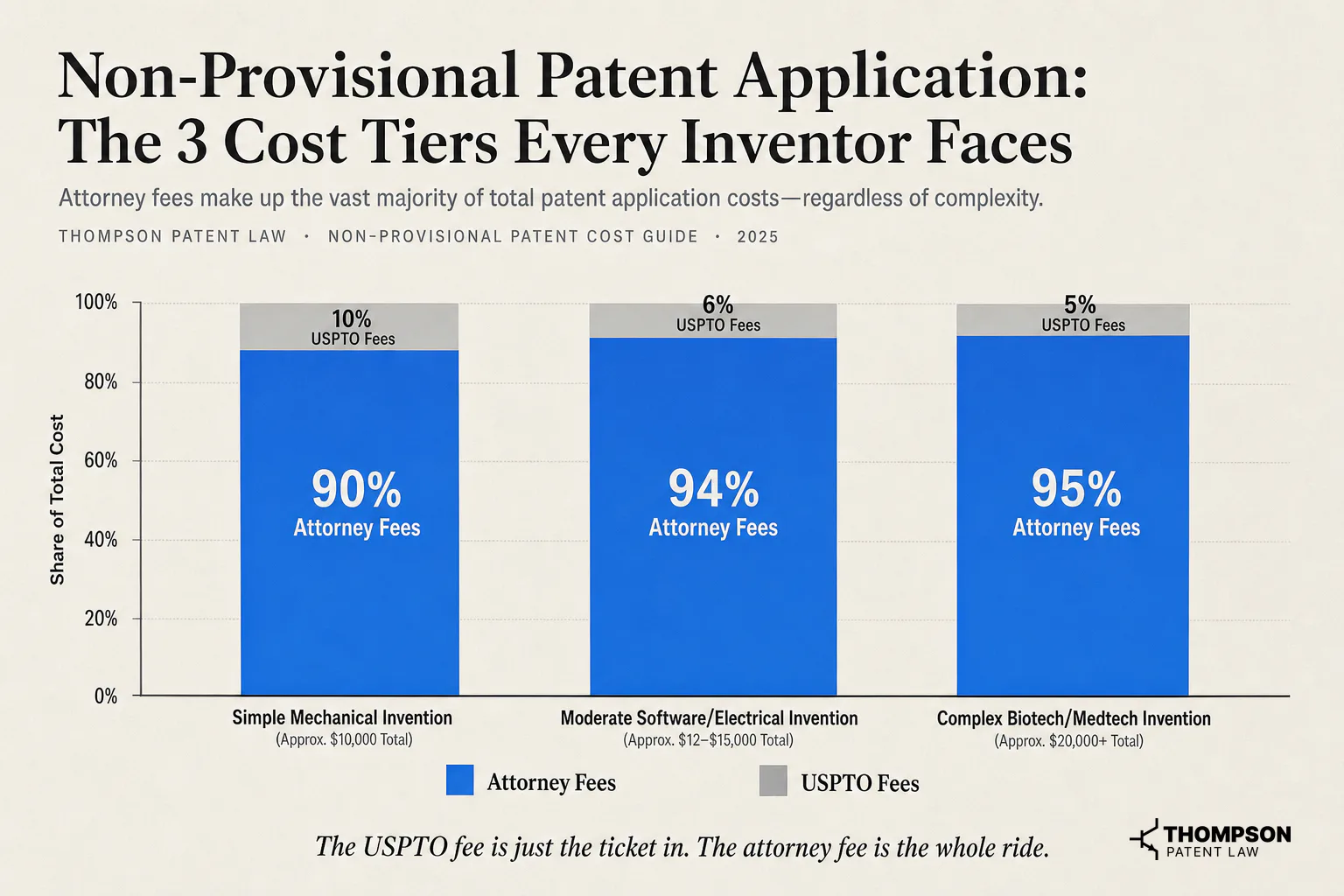 Non-Provisional Patent Application: The 3 Cost Tiers Every Inventor Faces — Source: AIPLA Survey (via BlueIron IP), 2023
The Two Cost Buckets Every Inventor Needs to Understand
Your cost splits into USPTO fees, which are fixed and public, and attorney fees, which reflect the complexity of drafting strong claims. The USPTO fee schedule is set by statute under 37 CFR, with current figures effective January 19, 2025. The United States Patent and Trademark Office, commonly called the United States Patent Office, administers these fees. USPTO fees are the floor, not the ceiling.
Why Total Cost Varies More Than Most Inventors Expect
Technology complexity, claim count, application length, and attorney experience all drive the range. Ask your attorney for an estimate covering both buckets before committing. If you are weighing self-filing, the firm's breakdown of DIY patent vs patent attorney is a useful next read.
How USPTO Filing Fees Break Down for a Utility Patent Application
These are the required minimums regardless of who files. A United States patent application requires payment of three separate fees at submission.
Basic Filing Fee, Search Fee, and Examination Fee
A standard utility application carries a basic filing fee, a search fee, and an examination fee. For a large entity these are about $350, $770, and $880 under the fee schedule effective January 19, 2025, totaling $2,000. The small entity fee totals roughly $800 and the micro entity rate about $400. Always file electronically through USPTO Patent Center to avoid the $400 non-electronic filing fee, which is a surcharge added to paper submissions.
Extra Claim Fees and the 20-Claim Threshold
The base fees cover up to 20 total claims and 3 independent claims. Beyond that, the current USPTO fee schedule adds surcharges for claims exceeding those thresholds, and long specifications can trigger additional per-sheet fees that accumulate quickly. Strategic claim drafting with experienced counsel avoids unnecessary fee exposure without sacrificing protection.
Small Entity, Micro Entity, and Large Entity Status
The USPTO grants small entities a 60 percent discount and micro entities an 80 percent discount on most patent-related fees. Verifying small entity status before each fee payment is essential because the small entity fee savings are forfeited if status changes. Small entity status covers independent inventors, small businesses under 500 employees, and nonprofits. The small entity fee is roughly half the large entity rate for most USPTO fees. Micro entity status adds stricter rules, including a maximum qualifying gross income equal to three times the prior year's median U.S. household income, currently $251,190. The micro entity fee discount of 80 percent applies to most fees, making it the lowest cost tier available. The USPTO micro entity status page posts this limit at $251,190 as of September 9, 2025, adjusted annually. Entity status must be certified accurately and re-verified at each fee payment, and claiming a discount you do not qualify for can be treated as inequitable conduct. Losing small entity status mid-prosecution requires paying the difference before the next fee is accepted.
Non-Provisional Patent Application Cost Ranges by Technology Type
Attorney fees are where the real spread lives. The ranges below reflect what experienced U.S. patent attorneys charge based on industry surveys.
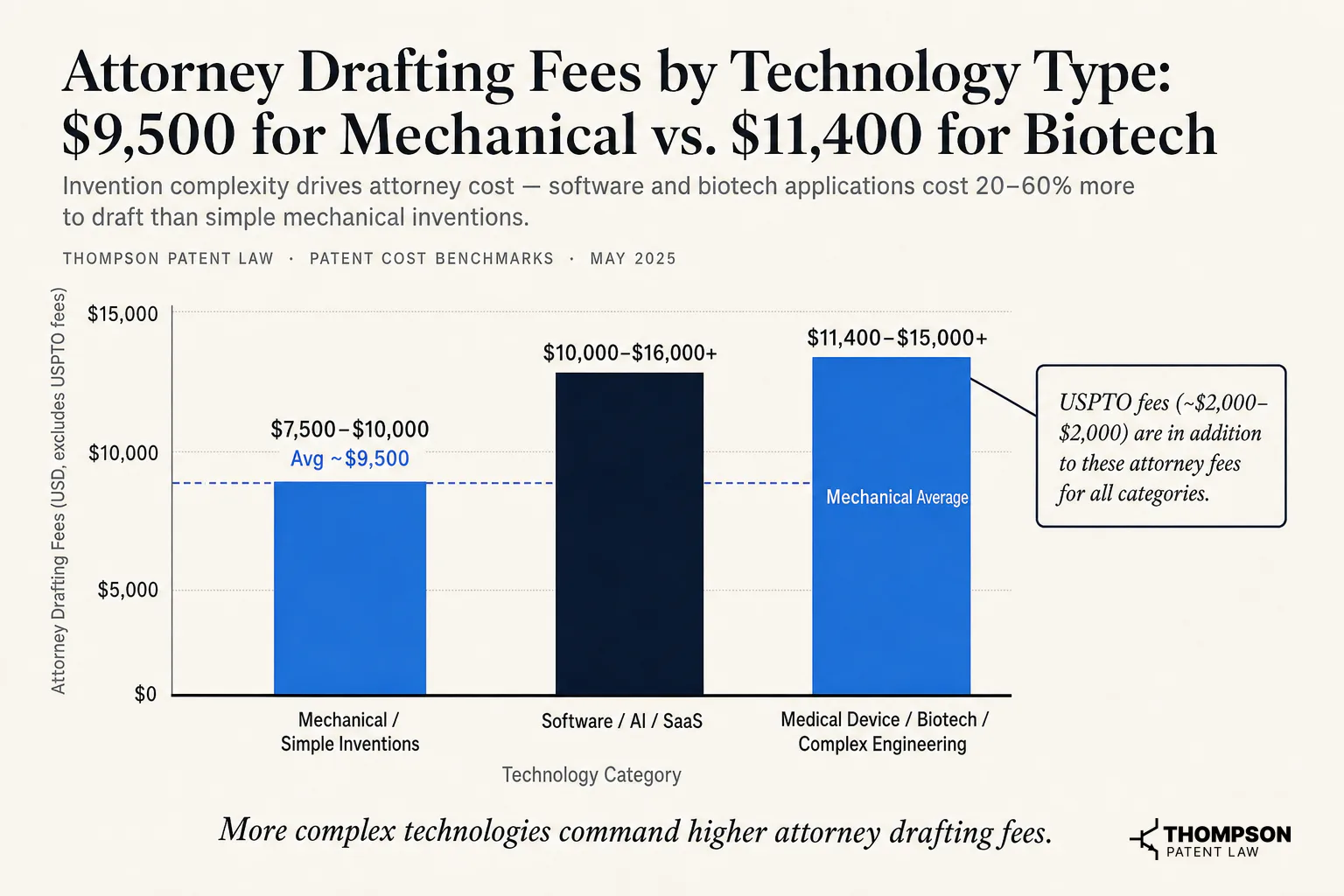 Attorney Drafting Fees by Technology Type: $9,500 for Mechanical vs. $11,400 for Biotech — Source: casrai.org (attorney fee benchmarks based on AIPLA Economic Survey 2023; USPTO fee figures effective January 19, 2025); blueironip.com
Mechanical and Low-Complexity Inventions
Drafting and filing low-complexity mechanical inventions commonly falls in the $7,500 to $10,000 range, with AIPLA survey data via BlueIron IP putting the average mechanical drafting fee at about $9,500. Even here, the gap between a broad claim and a narrow one decides whether the patent has real value.
Software, AI, and SaaS Inventions
Software and AI applications consistently cost more. They require careful claim drafting to survive subject matter eligibility challenges under 35 U.S.C. 101 and the Alice Corp. v. CLS Bank International framework. Expect roughly $10,000 to $16,000 or more in attorney fees, with electrical and computer drafting fees near $10,900 on average. If your invention is app-based, the firm's guide to patenting mobile apps covers drafting strategy.
Medical Device, MedTech, and Complex Engineering Inventions
MedTech and complex engineering inventions involve detailed specifications, multiple embodiments, and technical drawings. Complex engineering and chemistry drafting averaged about $11,400 in survey data from BlueIron IP, the highest among listed fields, because the documentation and strategy demand more attorney time.
How Provisional Patent Applications Affect Your Total Cost
Many inventors file a provisional patent application first, then convert to a non-provisional application, deferring part of the cost. For deadlines and sequencing, see the complete provisional patent timeline.
What a Provisional Patent Application Filing Costs
A provisional application carries lower USPTO fees, roughly $325 for a large entity, with correspondingly lower fees for small and micro entities. Provisional applications avoid search and examination fees and require no formal claims, so attorney fees are often lower too. They do not start the 20-year patent term, which is measured from the non-provisional application filing date under 35 U.S.C. 154. A provisional is only valuable if it fully supports the claims you will need later. See how long a provisional patent lasts.
The 12-Month Conversion Window and Its Cost Implications
You have 12 months from the provisional filing date to file a non-provisional application claiming priority under 35 U.S.C. 119(e). Miss it and the priority date is gone. The non-provisional still incurs full USPTO and attorney fees when filed. Plan your full-year patent budget before filing the provisional. Startups deciding when to move should review patent-first tactics.
Hidden and Post-Filing Costs Inventors Frequently Miss
Most inventors budget for filing and get blindsided by prosecution and post-grant fees. The timeline below shows government fees hitting at filing, allowance, and three maintenance intervals.
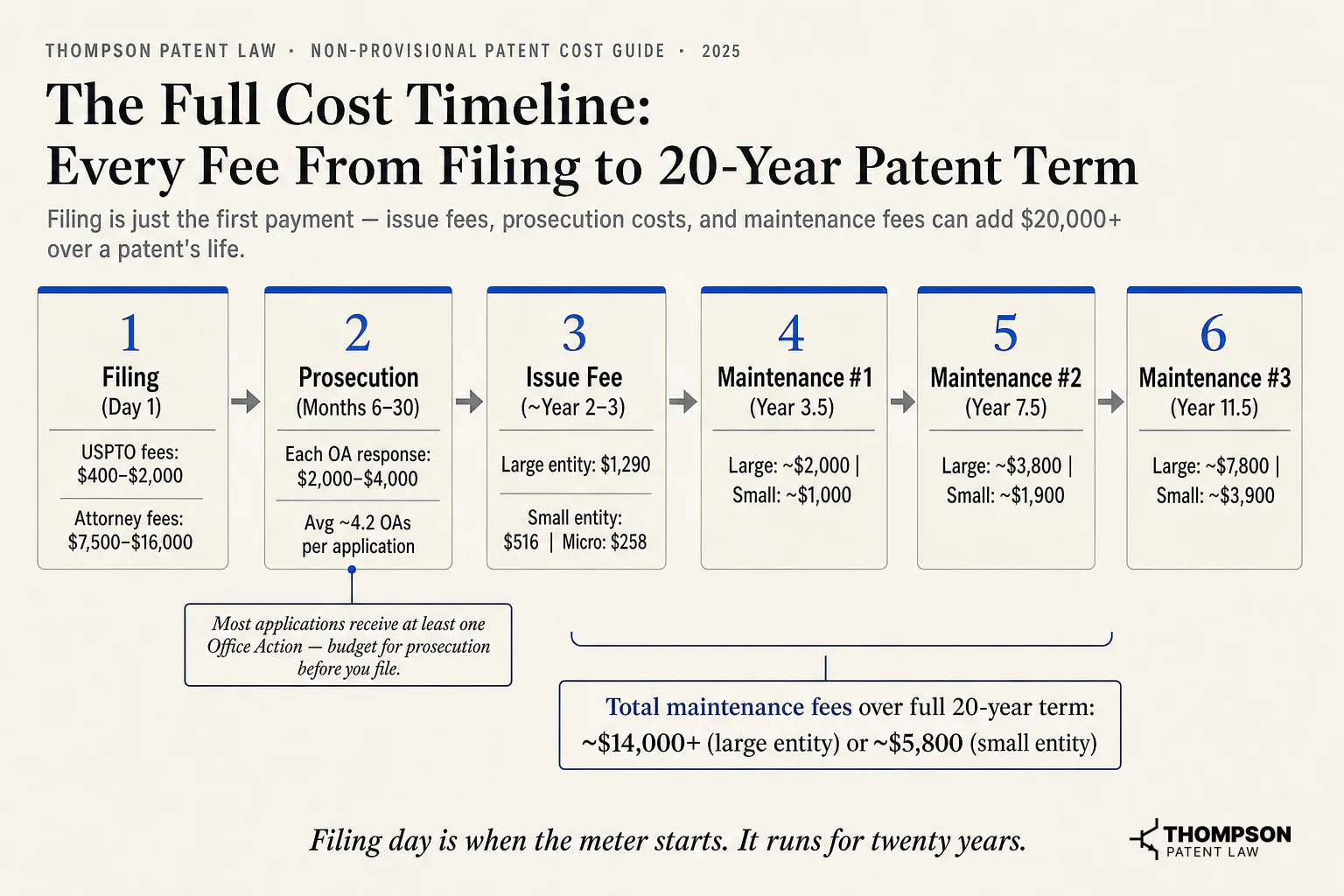 The Full Cost Timeline: Every Fee From Filing to 20-Year Patent Term — Source: casrai.org/guides/cost-of-filing-a-patent; patentbrief.org/maintenance-fees-guide; foxrothschild.com; USPTO Fee Schedule, effective January 19, 2025
Patent Prosecution Costs After Filing
After examination begins, a patent examiner will issue office actions, and obviousness rejections under 35 U.S.C. 103 are common. Attorneys typically charge $2,000 to $4,000 per office action response. Filing an incomplete application can also increase prosecution costs by requiring additional correspondence to cure deficiencies.
Paying a little more for a high-quality response — including interviewing the examiner and crafting persuasive arguments grounded in a proper framework for rebutting the examiner's prima facie case — may cost more upfront, but it is far less expensive than a cheap response that triggers multiple additional rounds of office actions. Weak prosecution can quietly destroy significant patent value, and saving a few hundred or even a thousand dollars in prosecution fees can cost millions in lost patent value. That is exactly why litigation-quality processes and strategies are so valuable and cost-effective.
When we last checked our data, our average office actions to allowance was 1.2. Investing a little more in each response saves years of prosecution time and thousands — or even tens of thousands — of dollars in prosecution costs, while preserving as much value as possible in the patent you are working so hard to obtain. A cheap office action response raises the question: why bother getting the patent at all?
AIPLA survey data via BlueIron IP indicate the average utility patent sees about 4.2 office actions over its life. Budget for at least one round above your filing cost. For what a rejection means, see will a patent application be rejected.
Issue Fee and Patent Maintenance Fees
Once allowed, an issue fee of about $1,290 for a large entity is due before grant. After grant, utility patents require maintenance fees at 3.5, 7.5, and 11.5 years, rising from roughly $2,000 to $3,800 to $7,800 for large entities per PatentBrief. A patent kept for its full term can incur $14,000 or more in maintenance fees. Factor it into your ROI calculation.
Why the Cheapest Option Often Costs More in the Long Run
Skimping upfront tends to cost more later. A weak application draws more rejections and can end with narrow protection or no patent at all. If you are gauging the difficulty, the firm's guide on how hard it is to get a patent sets realistic expectations.
What Gets Missed Without an Experienced Patent Attorney
Claim scope, prior art analysis, and prosecution strategy are the core of a valuable patent that secures meaningful patent rights. Except for inventors who represent themselves pro se, only registered patent attorneys and registered patent agents may represent inventors before the U.S. Patent Office in prosecution; unregistered non-attorney document-preparation services cannot act as representatives in prosecution.
One Juristat analysis found pro se applications in a software art unit had about a 57 percent allowance rate versus 76 percent for top patent firms, reported by Above the Law — a gap that largely reflects applicants who don't deploy sophisticated prosecution strategies with experienced counsel. Craige Thompson's team of registered patent attorneys with engineering backgrounds works to close that gap, bringing examiner-specific strategy and technical depth to every application.
"I forbid you from using the word 'simple' to refer to your own invention." — Craige Thompson
Many inventors are humble and instinctively reach for the word 'simple' to describe their own invention — and that is exactly the word I counsel them never to use. I have this conversation with many clients, and I counsel every one of them: do not use that word. If you ever assert your patent and an accused infringer holds up your own words to a jury — your own statement calling your invention simple — those words will undercut the value of your invention and the enforceability of your patent. Instead, describe your invention as sophisticated, elegant, insightful, or as meeting a long-felt unmet need. Call it low-complexity or robust. But for heaven's sake, do not denigrate your own invention.
The filing fee is identical whether the patent is strong or weak; the attorney fee buys the difference.
How Attorney Experience Affects Patent Quality and Prosecution Efficiency
An experienced patent attorney who understands examiner tendencies at the United States Patent and Trademark Office and Alice and obviousness arguments can reduce prosecution costs by avoiding predictable rejections. The 2012 Gaudry study found represented applicants secured broader, more valuable claims on average — sometimes with at least one claim covering the full inventive concept — while pro se claims tended to be narrower. Craige Thompson leads a team of registered patent attorneys with engineering degrees and experience protecting intellectual property for individual inventors to Fortune 500 companies including Apple, Google, Intel, and Microsoft. Ask counsel about experience in your technology area.
Frequently Asked Questions About Non-Provisional Patent Application Cost
How much does it cost to file for a non-provisional patent?
Government fees run about $400 for a micro entity, $800 for a small entity, and $2,000 for a large entity before excess claim charges. For a nonprovisional utility application, these fees are the mandatory starting point regardless of invention type. Attorney fees typically range from $7,500 for low-complexity mechanical inventions to $16,000 or more for complex software or MedTech cases. See what a patent really costs.
Can you file a non-provisional patent yourself?
Yes, but the risks go well beyond lower allowance rates. Claim drafting is a specialized legal skill, and errors in claim scope or specification support can result in a patent that competitors easily design around — or no patent at all. Pro se applicants also face strategic disadvantages during prosecution, including responding to obviousness and subject matter eligibility rejections without examiner-specific experience. Pro se applications show significantly lower allowance rates per Above the Law, and even granted pro se patents tend to carry narrower claims. The complexity of the process strongly warrants working with experienced patent counsel to protect your investment.
How long does a non-provisional patent take to get approved?
Most take about 2 to 3 years, with average total pendency near 25.7 months according to Fox Rothschild. For more information on pendency by technology area, the USPTO publishes monthly statistics on its website. A Track One prioritized examination request, at additional cost, targets disposition within about 12 months.
Are non-provisional patent applications public?
Yes. Most are published 18 months after the earliest effective filing date under MPEP 1120, unless you file a non-publication request. This rule applies to utility patent applications, but a design patent application is not subject to the same 18-month publication rule. See when patent disclosure happens.
Your Next Step Toward a Properly Filed Patent
The bottom line: non-provisional patent application cost is not a single number. It is a range shaped by technology type, entity status, claim strategy, and prosecution complexity. A cheaply drafted application can leave you with narrow claims competitors design around. A strong application built on Litigation Quality Patent® services protects real market territory.
Inventors who budget only for USPTO fees are routinely surprised by attorney fees and post-grant costs. Note that this article is for general informational purposes and does not constitute legal advice. Every month you wait, a competitor can file first and take the priority date.
Your action items:
- Schedule a Free Patent Needs Assessment to connect with a member of our team to discuss the realistic cost range for your invention.
- Map your full-year budget for both a provisional and non-provisional filing before you start.
- Confirm your small entity or micro entity status so you claim the right discount, since small entity status must match your true organizational size at each payment.
The right investment upfront spares you unnecessary rounds of prosecution and gives you a patent that defends your intellectual property and competitive advantage across its full term.
Craige Thompson
Patent Attorney, MBA, Electrical Engineer
Thompson Patent Law


