- Patent term adjustment (PTA) adds days to the back end of a patent’s 20-year term to compensate for USPTO examination delays, and applies automatically to utility patents under 35 U.S.C. § 154(b).
- The USPTO calculates PTA using three delay categories: 14-month milestones (A-delay), 3-year pendency (B-delay), and interference or appeal delays (C-delay), minus any applicant delay.
- Every extension of time you purchase and every RCE you file is deducted from your PTA day-for-day, making early responses one of the highest-value prosecution decisions you can make.
- Patent owners have only two months from the issue date to request PTA reconsideration at low cost. Miss that window and your only option is federal court.
- PTA and patent term extension (PTE) are governed by completely different statutes and address completely different delays. Understanding which applies to your patent determines your strategy.
More than 63% of U.S. patents filed since 2000 received patent term adjustment, with recipients gaining an average of 411 additional days of enforceable patent life, according to a comprehensive study of 4.5 million patents published on SSRN. That is more than a year of competitive exclusivity the United States Patent and Trademark Office owes you simply for taking longer than the law allows. If you never verify the calculation on your issued patent, you may be leaving that term on the table.
Why Your Patent's 20-Year Clock Doesn't Always Start at the Same Place
Patents in the United States are granted a 20-year term — not the older 17 years from issuance that governed pre-1995 patents — measured from the earliest effective filing date under 35 U.S.C. § 154. That 20-year window includes every month your filed application spends waiting at the United States Patent and Trademark Office, which means USPTO delay directly consumes enforceable patent life you never get to use. What is patent term adjustment, exactly? It is the statutory mechanism that fixes that problem by restoring days lost to agency backlog. For a deeper look at how that lifespan of a patent plays out across different scenarios, the stakes of PTA become even clearer.
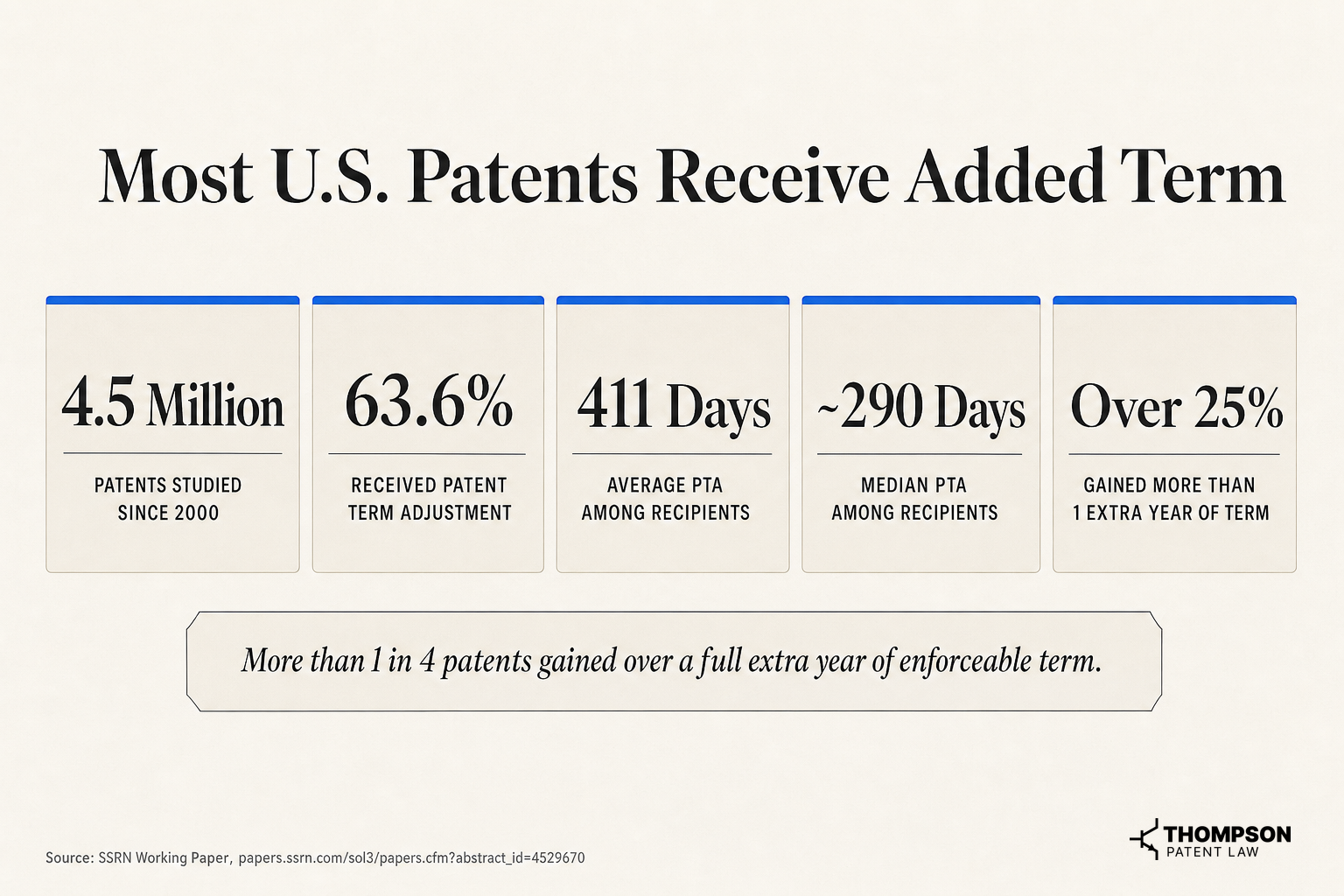 63.6% of U.S. Patents Since 2000 Received Patent Term Adjustment — Source: SSRN Working Paper (Crouch et al.), study of 4.5 million patents filed since 2000
The scale of this issue is larger than most inventors realize. That same study of 4.5 million patents found that 63.6% received patent term adjustment, with an average extension of 411 days among recipients and a median of approximately 290 days. Over a quarter of us patents gained more than one additional year, and some outliers gained substantially beyond the standard 20-year term. In high-value industries, each additional day matters enormously. For a pharmaceutical product generating $30 million per day in revenue, a single additional day of patent exclusivity is worth $30 million in sales, according to DrugPatentWatch. The stakes are just as real for technology companies whose products depend on a small patent family for competitive protection.
How the USPTO Calculates Patent Term Adjustment Under 35 U.S.C. § 154
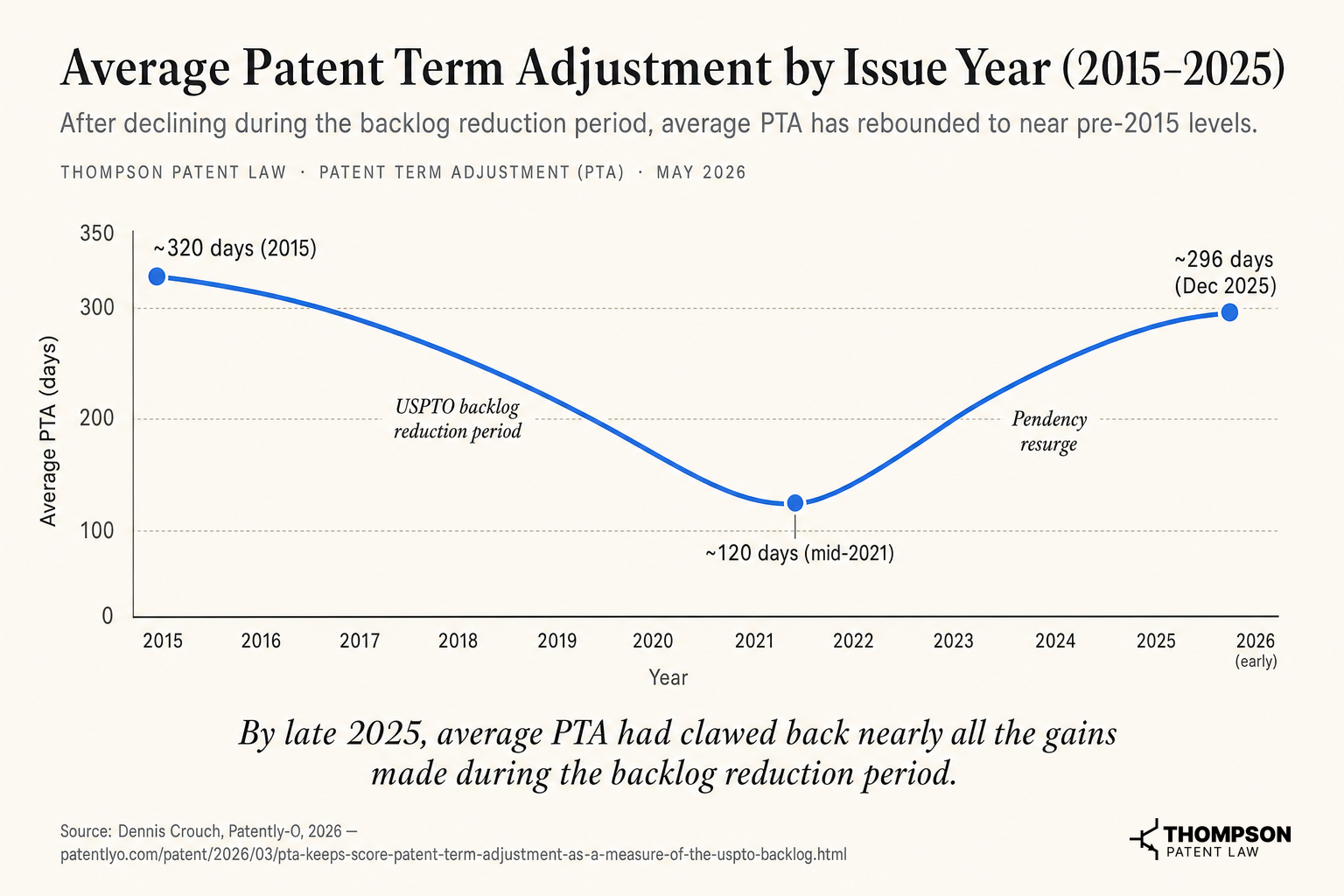 Average Patent Term Adjustment Fell to 120 Days by 2021, Then Rebounded to 296 Days by Late 2025 — Source: Dennis Crouch, Patently-O, 2026
The Three Delay Categories That Generate PTA
To understand what is patent term adjustment at its statutory foundation, start here: the American Inventors Protection Act of 1999 created the framework by defining three categories of USPTO delay under 35 U.S.C. § 154(b)(1). Category A covers failures to meet 14-month milestones, including issuing a first Office Action within 14 months of the application filing date or responding to applicant replies within 4 months. Category B captures any pendency exceeding three years from the application filing date to patent issuance. Category C accounts for delays from secrecy orders, interference proceedings, or appeals to the Patent Trial and Appeal Board or federal courts.
According to PatentlyO, when the United States Patent and Trademark Office misses any of these benchmarks, the patent term is extended day-for-day for each day of delay. Average PTA directly reflects the USPTO's backlog and three-year application pendency threshold: in 2015, the average patent received approximately 320 PTA days. That figure dropped to around 120 days by mid-2021 as the Office reduced its backlog, then climbed back to approximately 296 days by late 2025 as pendency increased again. Understanding how your patent filing date anchors these calculations is essential before prosecution begins.
How the USPTO Applies the Overlap Rule to Avoid Double-Counting
Because A-delay and B-delay can run concurrently during prosecution, the USPTO subtracts any days already counted under Category A from the Category B total. This overlap deduction is one of the most misunderstood and error-prone parts of PTA calculation. The Federal Circuit addressed this directly in Wyeth v. Kappos (2010), ruling that both A-delays and B-delays must be counted independently by the united states patent office, with only actual overlapping days subtracted. In that case, the USPTO had originally granted 462 PTA days; after the court's correction for improper overlap calculation, the patent earned 756 days, according to Harvard's JOLT Digest. The USPTO revised its methodology following Wyeth, but calculation errors remain common enough to justify independent verification on every patent.
Reading the PTA Determination on Your Issued Patent
The USPTO prints the total PTA in days — forming the patent term adjustment determination — on the front page of every issued patent. For utility patents filed after May 29, 2000, this number directly determines the adjusted expiration date. A patent with a filing date of January 1, 2006 and 500 days of PTA expires approximately 500 days after the date it would have otherwise expired without adjustment. Critically, the Notice of Allowance also includes a PTA determination that the applicant can verify before the patent issues. Reviewing that determination before issuance is far less expensive than challenging it afterward, because the two-month reconsideration window begins from the issue date, not the Notice of Allowance date. A patent expiration date calculated without verifying PTA can understate the true enforceable term. See also how to tell if a patent is expired for guidance on reading expiration dates correctly once PTA is factored in.
What Counts as Applicant Delay and Why It Reduces Your Patent Term Adjustment
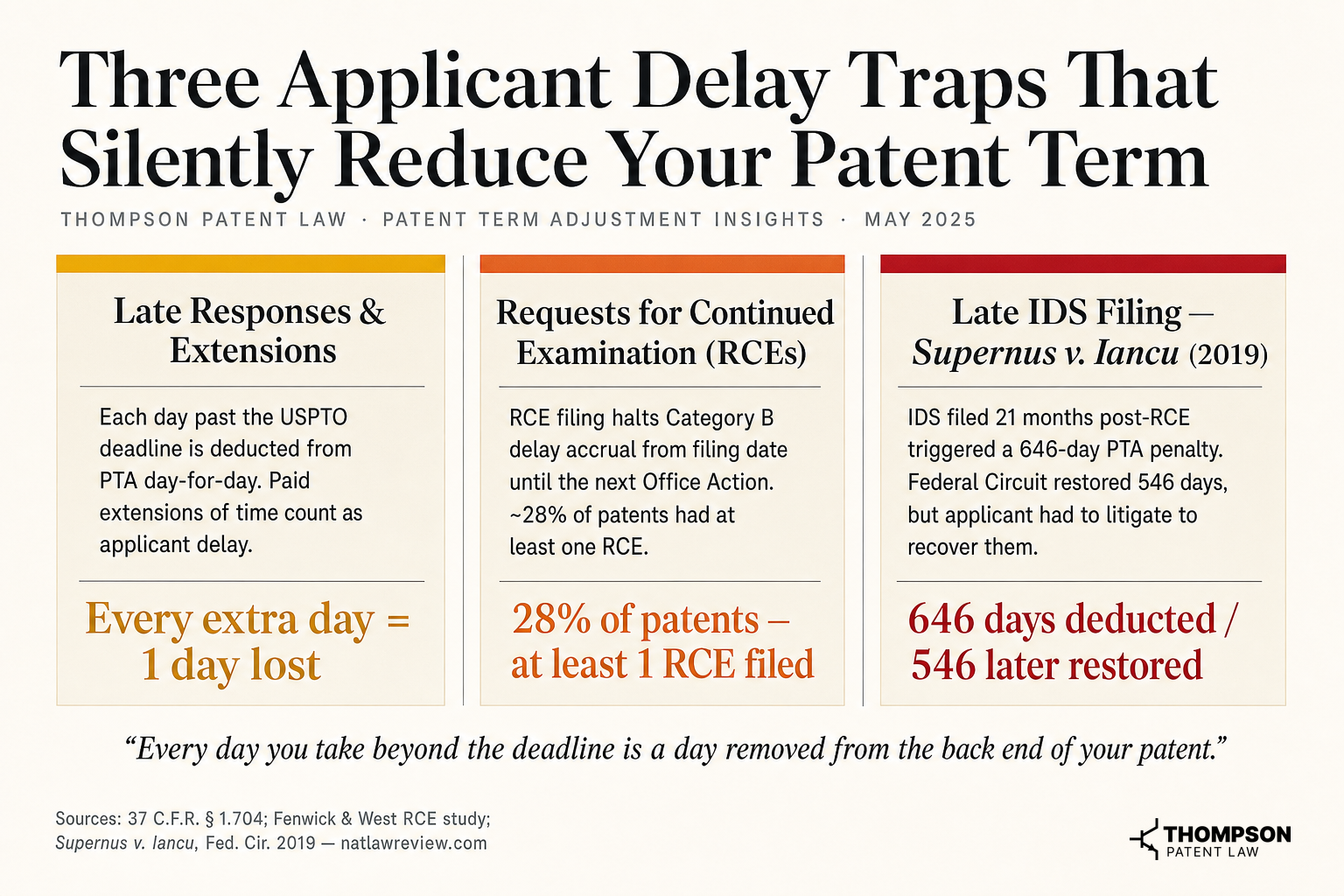 What Reduces Your PTA: Three Applicant Delay Traps and Their Real Costs — Source: National Law Review (Supernus v. Iancu); 37 C.F.R. § 1.704
Response Timing Is the Most Common Source of Applicant Delay
The USPTO reduces PTA by the number of days attributable to the applicant under 35 U.S.C. § 154(b)(2)(C) and 37 C.F.R. § 1.704. The most direct form is slow responses: if the USPTO allows three months to respond and the applicant uses four months through a paid extension, that extra month is subtracted from PTA day-for-day. Extensions of time do not protect PTA — they consume it, reducing the additional patent term the law would otherwise provide. This is one of the most overlooked aspects of what is patent term adjustment in practice. For applications with high commercial value, the cumulative PTA lost to routine extensions across a multi-year prosecution can reach several months. A disciplined patent timeline strategy that targets early responses at every stage is one of the most reliable ways to protect this value.
RCE Filings Create a PTA Reset That Catches Many Applicants Off Guard
When an applicant files a Request for Continued Examination, PTA accrual under Category B effectively pauses for the period the applicant controls. The USPTO treats an RCE as an applicant choice, not a USPTO delay, so that period does not count toward the three-year B-delay benchmark. Applications with multiple RCEs frequently show significant PTA erosion even when the total prosecution timeline looks lengthy on paper. Before filing an RCE, modeling the trade-off between prosecution strategy and PTA impact is a calculation worth making explicitly with your patent attorney.
Information Disclosure Statements Filed Late Can Trigger Applicant Delay Deductions
Under 37 C.F.R. § 1.704(c)(8) and (d), submitting an Information Disclosure Statement after certain prosecution milestones can itself generate applicant delay. The consequences can be substantial. In Supernus Pharmaceuticals v. Iancu (2019), the applicant filed an IDS 21 months after an RCE. The USPTO penalized 646 days of PTA for the post-RCE IDS timing. The Federal Circuit ultimately ruled that approximately 546 of those days had to be restored because the applicant did not yet have knowledge of the cited reference during that period, according to the National Law Review. The lesson is clear: coordinate IDS submissions with prosecution milestones and file them as early as possible to avoid permanent PTA reductions.
The Real Difference Between Patent Term Adjustment and Patent Term Extension
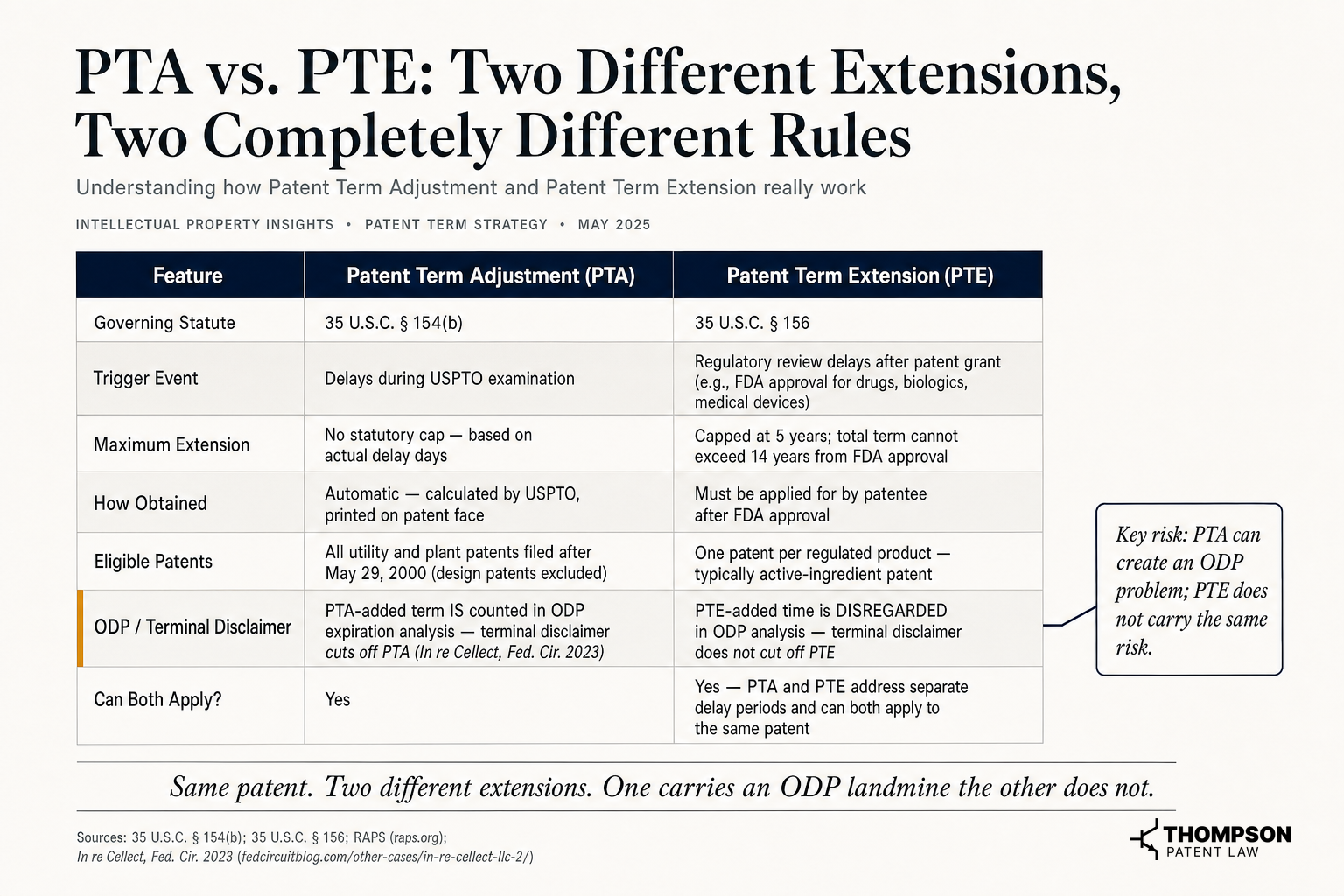 PTA vs. PTE: Two Different Extensions, Two Completely Different Rules — Source: 35 U.S.C. § 154(b); 35 U.S.C. § 156; RAPS Drug Discovery Today study, 2019; In re Cellect, Federal Circuit 2023
Patent Term Extension Applies to a Completely Different Regulatory Situation
Understanding what is patent term adjustment requires distinguishing it clearly from patent term extension: the two are governed by different statutes, apply in different circumstances, and cannot substitute for each other. Patent term extension under 35 U.S.C. § 156 compensates patent owners for time lost during FDA regulatory review of drugs, medical devices, food additives, or veterinary products. PTE is calculated from the regulatory review period, not USPTO prosecution delays, and a single patent may receive a maximum of five additional years of term. Critically, PTE cannot extend a patent beyond 14 years from the FDA approval date of the covered product, according to RAPS. In practice, nearly 49% of top-selling drugs with generic introductions between 2000 and 2012 received a PTE, with a median extension of 2.75 years.
If your patent covers a drug or medical device awaiting FDA approval, both PTE and PTA are potentially available but require separate processes. PTE requires a formal application submitted within 60 days of FDA approval, and unlike PTA it covers only the trademark office-approved product's specific regulatory review period. For a fuller picture of what happens when a patent expires and these extensions run out, the competitive and financial consequences are significant.
How Obviousness-Type Double Patenting Interacts with PTA
Obviousness type double patenting (ODP) is one of the most consequential PTA-related issues in patent prosecution. A terminal disclaimer ties a second patent's expiration to a related earlier patent's expiration — effectively linking it to an earlier application's expiration date — which can eliminate all PTA the second patent earned through USPTO delays. The Federal Circuit addressed this directly in In re Cellect (2023), a federal circuit decision that invalidated four related patents because their PTA-extended expiration dates ran past the expiration of a commonly owned earlier patent. The court held that for ODP analysis, a patent's expiration is evaluated after adding PTA, meaning PTA can itself create an improper term extension unless a terminal disclaimer was filed to align the expiration dates. Before filing a terminal disclaimer to overcome an ODP rejection, calculate the effect on your PTA-adjusted expiration. The trade-off can be substantial and irreversible.
How Patent Term Adjustment Applies to Software and Technology Patents
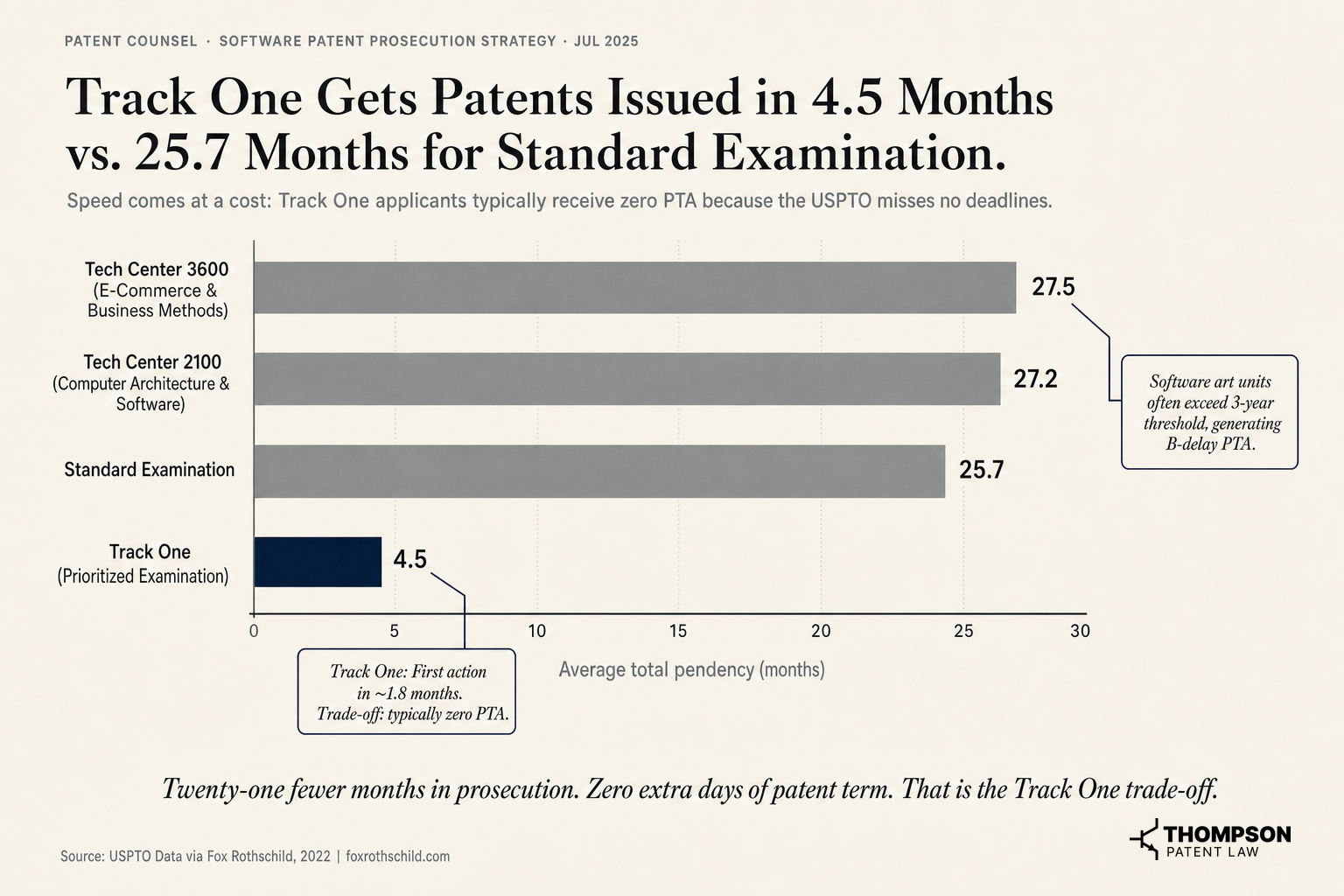 Track One Gets Patents Issued in 4.5 Months vs. 25.7 Months for Standard Examination — Source: USPTO Data via Fox Rothschild, 2022
Software Patent Applications Frequently Accumulate Substantial PTA Due to Art Unit Pendency
Many USPTO art units handling software and technology patent applications carry above-average pendency, which means these applications often generate meaningful Category B delay. Art units in the 700-class software and business method classifications frequently exceed the three-year B-delay threshold entirely — which is a key reason why what is patent term adjustment matters so much to software patent holders — generating substantial additional days of patent term. For tech startup founders and patent holders generally, this means the effective patent term on a software patent can extend meaningfully beyond the nominal 20-year period even without any deliberate filing strategy. The Patent Prosecution Highway is one underused mechanism that can accelerate examination in these slow art units without sacrificing substantive rights.
According to USPTO data, Track One prioritized examination reduces total pendency to approximately 4.5 months compared to 25.7 months for standard examination. That is a meaningful acceleration, but faster prosecution means fewer PTA days accruing. Whether to pay for Track One is a legitimate strategic trade-off: faster grant versus more PTA.
Alice Delays Generate PTA but Do Not Guarantee Stronger Claims
When USPTO examiners issue multiple § 101 rejections under the Alice Corp. v. CLS Bank International framework, the back-and-forth extends prosecution significantly and generates both A-delay and B-delay, and at least one claim will often emerge with a narrower scope than originally drafted. That additional PTA accrues regardless of how the § 101 dispute is resolved. However, the additional term adds no real value if the claims that survived § 101 scrutiny were narrowed to the point of limited enforceability. PTA is most valuable when paired with claims that are broad enough to matter commercially. According to Thompson Patent Law, structuring software patent claims to anticipate § 101 challenges from the outset, rather than amending reactively, can reduce unnecessary prosecution rounds and preserve both claim scope and PTA days for commercially meaningful term. Thompson Patent Law reports that its proprietary drafting techniques increase Alice eligibility success by 25 to 50%, which directly reduces the prosecution rounds that erode PTA.
How to Challenge the USPTO's Patent Term Adjustment Calculation
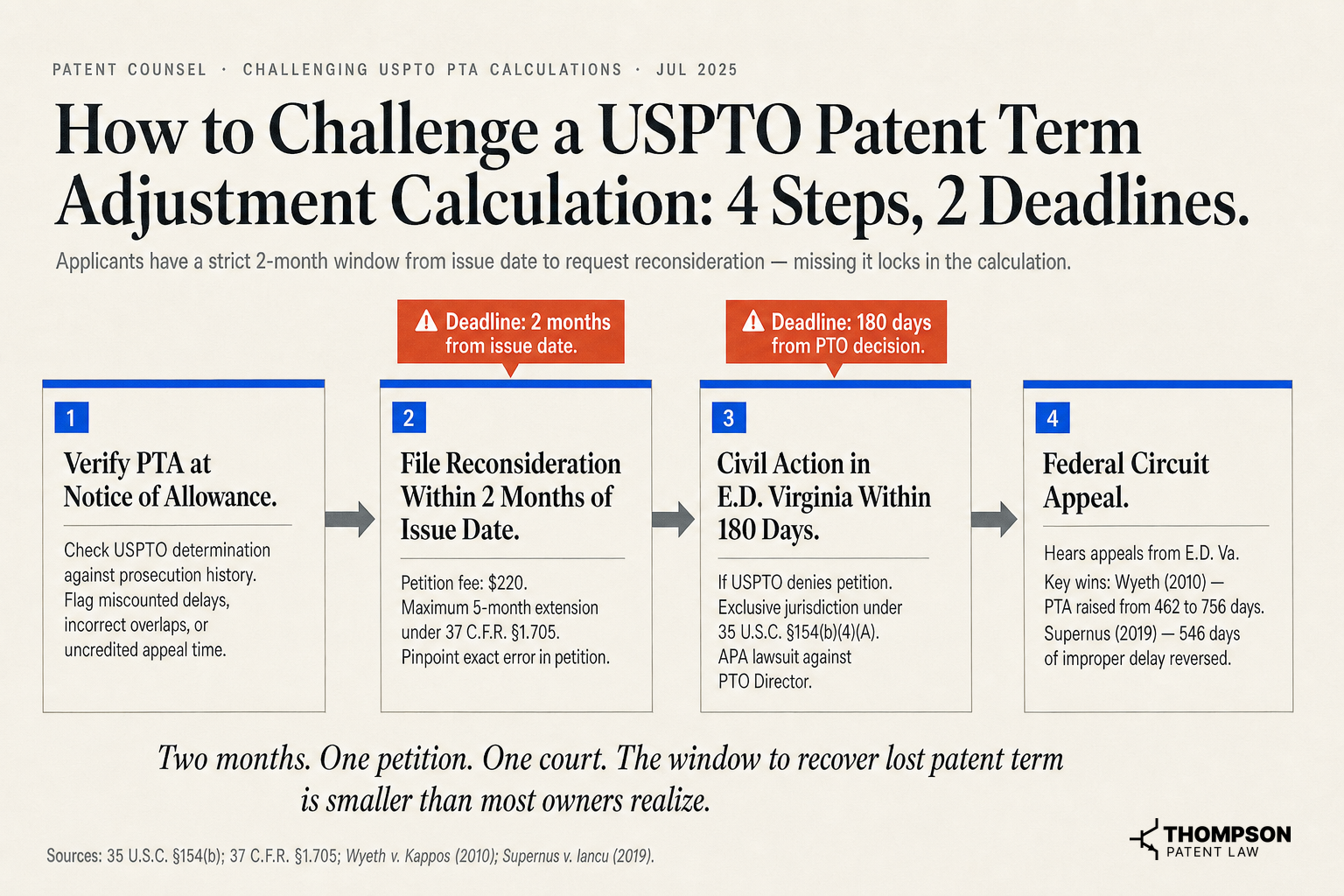 How to Challenge a USPTO Patent Term Adjustment Calculation: 4 Steps, 2 Deadlines — Source: 35 U.S.C. §154(b); 37 C.F.R. §1.705; Wyeth v. Kappos (Fed. Cir. 2010); Supernus v. Iancu (Fed. Cir. 2019)
The Two-Month Window to Request PTA Reconsideration
Patent owners who believe the USPTO miscalculated their PTA — a situation that arises more often than most realize once they understand what is patent term adjustment and how it is computed — have two months from the patent's issue date to file a request for reconsideration under 37 C.F.R. § 1.705(b). This is a hard deadline. After two months, the only recourse is a civil action in the U.S. District Court for the Eastern District of Virginia under 35 U.S.C. § 154(b)(4), which is significantly more expensive and uncertain. The reconsideration request must identify the specific error with particularity, referencing the patent number and each disputed delay period. Put this deadline in your docketing system on the day your patent issues. Because PTA also affects patent terms across different patent types in different ways, verifying the calculation against the correct statutory framework matters from the start.
Common Calculation Errors Worth Reviewing on Every Patent
The most frequently contested PTA errors fall into predictable categories: incorrect identification of the A-delay trigger date, miscalculation of the overlap between A-delay and B-delay, improper attribution of applicant delay for actions actually taken by the patent office, and failure to account for all Category C events. The Federal Circuit has reversed USPTO PTA determinations in multiple cases. In Wyeth v. Kappos, the court added nearly 300 days to the patent's term that the USPTO had wrongly withheld. These errors occur with enough regularity that reviewing the PTA breakdown on every Notice of Allowance is a practice that consistently pays for the time it requires.
What Happens When a PTA Dispute Reaches Federal Court
When an applicant is dissatisfied with the USPTO's reconsideration response, a civil action in the Eastern District of Virginia is the next step. The district court reviews the USPTO's determination under the Administrative Procedure Act, applying a deferential standard to the agency's interpretation of ambiguous statutory language. Despite that deference, the Federal Circuit has corrected USPTO PTA calculations in multiple high-profile cases where the agency's interpretation was inconsistent with the statute's plain text, and in each instance the patent process required applicants to act promptly. If a PTA dispute involves a commercially significant patent where the number of contested days represents substantial licensing or enforcement value, the economics of district court litigation can justify the investment. Consult a patent attorney who has handled PTA reconsideration before deciding.
Frequently Asked Questions: What Is Patent Term Adjustment and How Does It Work?
How does patent term adjustment work? Patent term adjustment adds days to the back end of a patent's 20-year term to compensate for delays caused by the USPTO during prosecution. The United States patent office calculates PTA by totaling delay days from three statutory categories under 35 U.S.C. § 154(b), subtracting any days attributable to the applicant, and printing the net adjustment on the issued patent's face. A patent with 365 days of PTA expires approximately one year later than it would without adjustment. For a broader look at how long patents last under different circumstances, PTA is one of several variables that affect the final answer.
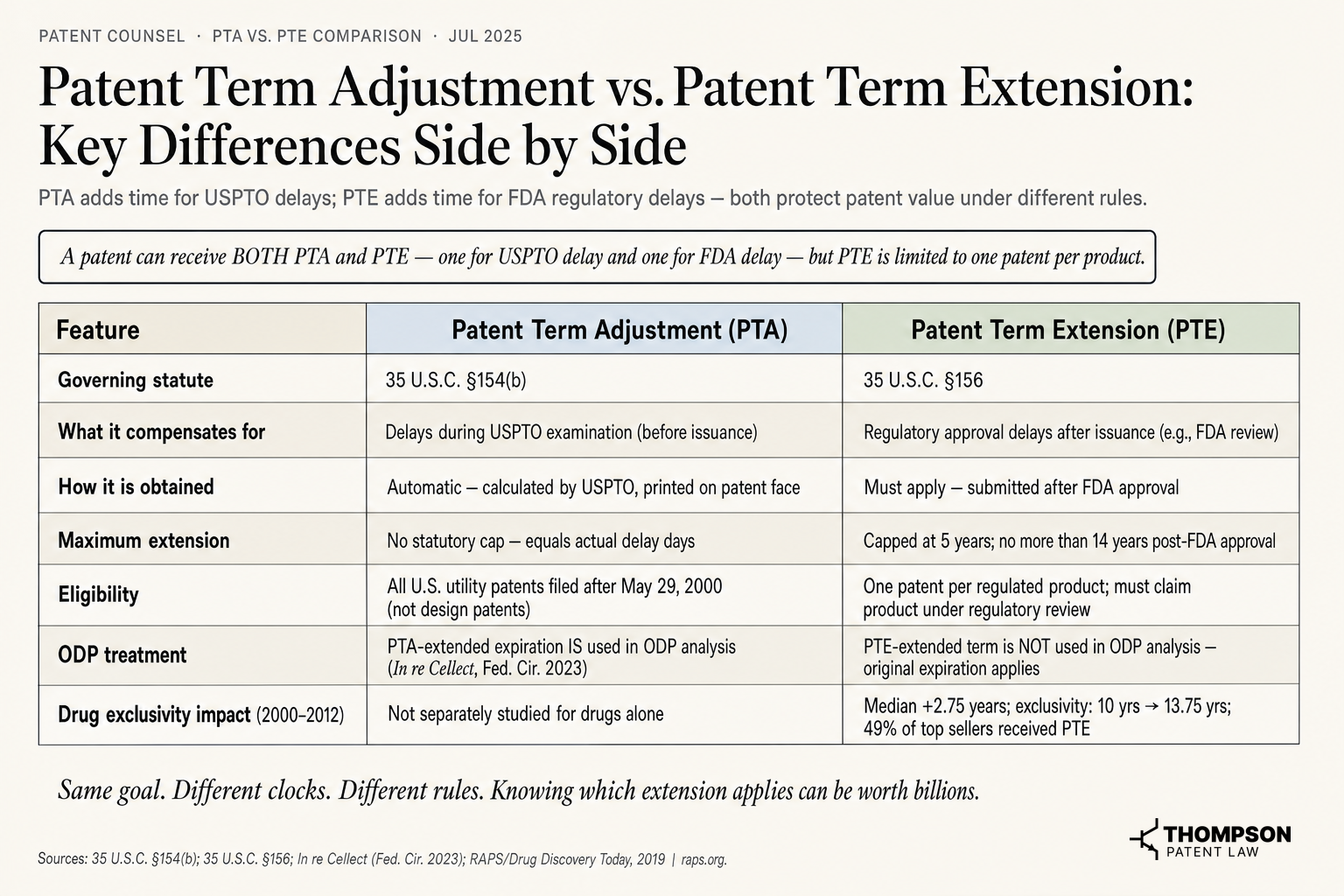 Patent Term Adjustment vs. Patent Term Extension: Key Differences Side by Side — Source: 35 U.S.C. §154(b); 35 U.S.C. §156; In re Cellect (Fed. Cir. 2023); RAPS/Drug Discovery Today study, 2019
What is the difference between patent term extension and patent term adjustment? Patent term adjustment compensates for USPTO prosecution delays and applies automatically to utility patents under 35 U.S.C. § 154(b), but does not apply to design patents, which are governed by different term rules. Patent term extension under 35 U.S.C. § 156 is a separate mechanism that compensates patent owners for time lost during FDA regulatory review of drugs, medical devices, and similar products. PTE requires a separate application, covers only the specific approved product, and is capped at five additional years. The two mechanisms address different delays, are calculated independently, and can both apply to the same patent in different circumstances.
What happens after a patent completes its full term of 20 years? Once a patent's term expires, including any PTA or PTE extension, the invention enters the public domain and the claims can no longer be enforced against patent infringement. Patent maintenance fees must be paid at 3.5, 7.5, and 11.5 years from issuance to keep the patent in force throughout its term, including through any PTA-extended patent expiration. Failure to pay allows the patent to lapse before any PTA-extended expiration date arrives.
Which countries have patent term adjustment? The United States has one of the most developed patent term adjustment systems under 35 U.S.C. § 154(b). Japan, South Korea, and Europe each have mechanisms to compensate for administrative delays, but the rules differ substantially from U.S. PTA in their triggers, calculation methods, and caps, and applicants must make reasonable efforts to comply with local procedural requirements to qualify. Applicants with international patent families should seek country-specific guidance rather than applying U.S. PTA logic to foreign counterpart applications.
Can you challenge the USPTO's PTA calculation if you believe it is wrong? Yes. Patent owners have two months from the issue date to file a request for reconsideration of the PTA under 37 C.F.R. § 1.705(b). The request must specifically identify the alleged error. If the USPTO denies the request, the patent owner can file a civil action in the U.S. District Court for the Eastern District of Virginia within 180 days of the USPTO's decision. The Federal Circuit has reversed USPTO PTA calculations in multiple cases, making challenges worth pursuing when the number of days at stake is commercially significant.
Do provisional patent applications affect patent term adjustment? Provisional applications do not directly generate PTA because they are never examined. The 20-year patent term runs from the earliest effective filing date of the nonprovisional application. Because a provisional patent application gives the applicant up to 12 months before filing the nonprovisional, and because PTA accrues from the nonprovisional's filing date, the provisional period does not reduce the PTA-eligible prosecution window. Using a patent term calculator when planning this timeline can help applicants visualize the impact of the provisional period on the final adjusted expiration. The provisional's priority claim affects what qualifies as prior art; it does not affect the PTA calculation.
Your Next Steps to Patent Term Adjustment Success
The bottom line: a patent with a miscalculated or poorly preserved PTA is a patent with less enforceable value than the law entitles you to. For inventors who don't deploy sophisticated prosecution strategies, preventable applicant delays, missed reconsideration windows, and terminal disclaimer missteps can silently erase months or years of intellectual property value and competitive exclusivity. Those who work with experienced counsel and actively manage their prosecution timeline walk away with the full patent life their invention deserves.
For tech startup founders and independent inventors whose core technology is tied to a small patent family, each additional month of enforceable term represents competitive exclusivity, licensing leverage, and investor value. For software patents in high-pendency art units, the PTA accumulating during examination may be the difference between an expiring patent that loses relevance before your market matures and one that protects you through peak commercialization.
To protect the full value of your patent's term, take these steps:
- Schedule a Complimentary Patent Needs Assessment to review how your prosecution history affects your patent's enforceable term.
- Verify the PTA determination on your Notice of Allowance before issuance, not after the two-month correction window opens.
- Build early-response discipline into every prosecution stage to prevent avoidable applicant delay deductions.
- Map any continuation or divisional filing strategy against terminal disclaimer exposure before filing.
Keep Innovating.
Craige Thompson
Patent Attorney, MBA, Electrical Engineer
Thompson Patent Law