- Proprietary technology is any innovation you own exclusively and control through patents, trade secrets, or copyright. A vague claim of ownership without legal protection behind it is not enforceable.
- Patents are the only protection that gives you offensive rights. You can stop a competitor even if they independently developed the same invention.
- Public disclosure before filing a patent application can permanently eliminate international patent rights. File a provisional patent application before any public announcement.
- Trade secrets protect what patents cannot: algorithms, formulas, and methodologies that depend on secrecy rather than exclusivity.
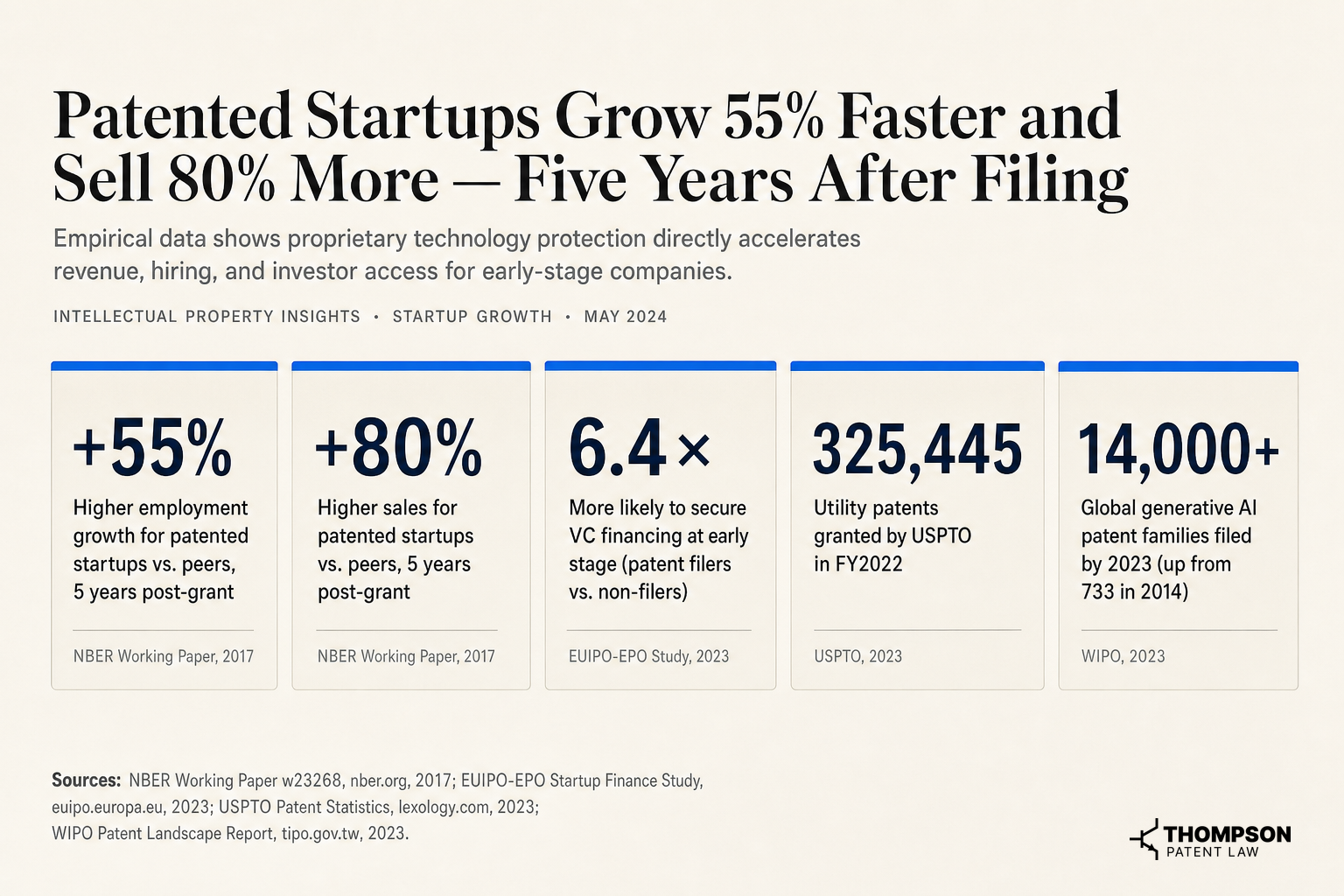
- Startups that obtained their first patent saw 55% higher employment growth and 80% higher sales five years later, according to [NBER research](https://www.nber.org/papers/w23268).
Intangible assets now account for approximately 92% of S&P 500 market capitalization, according to Ocean Tomo's 2025 study, up from just 17% in 1975. That shift has a single root cause: companies that own proprietary tech have learned to convert innovation into lasting market position, while companies that don't have watched competitors copy their way to parity.
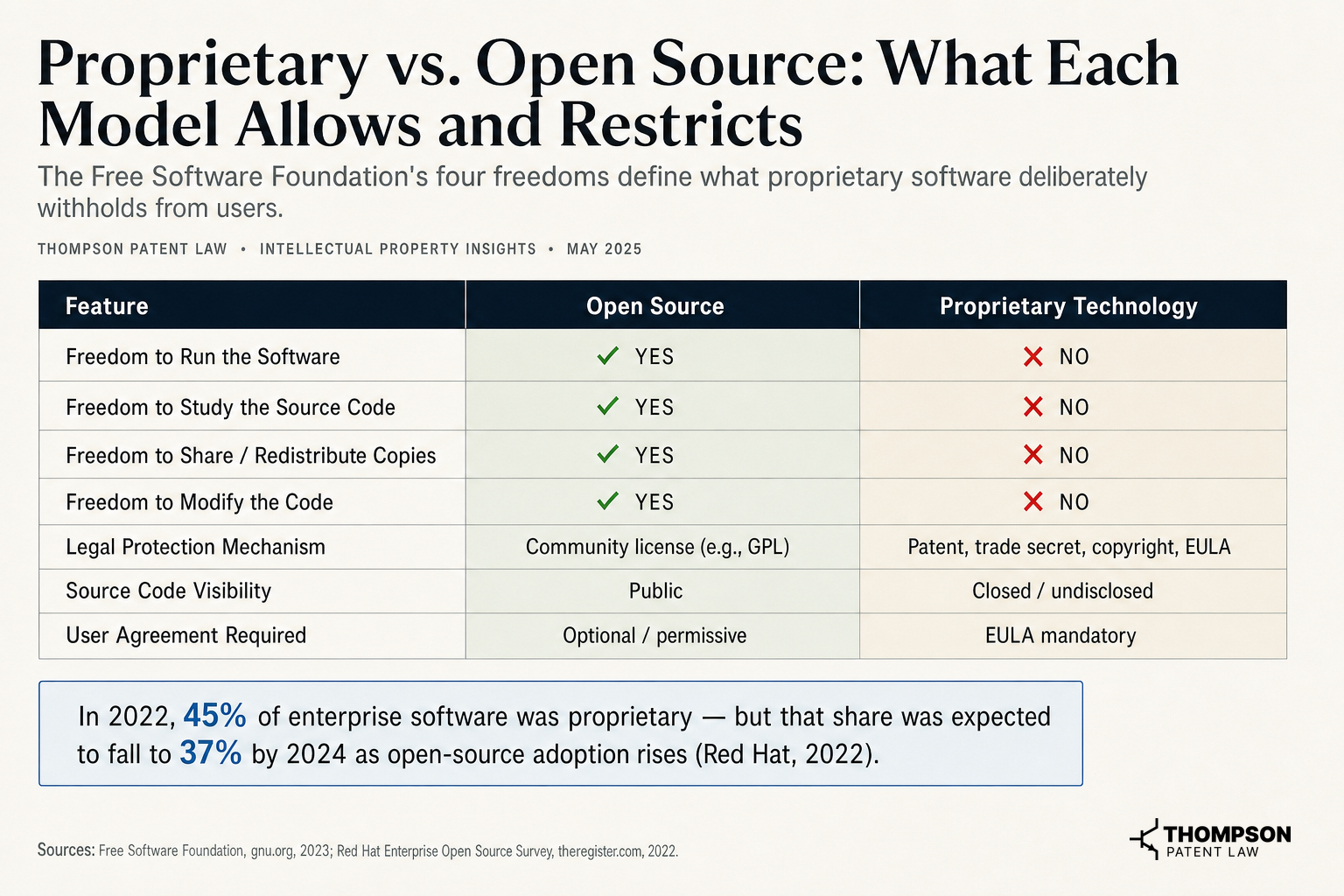 Proprietary vs. Open Source: What Each Model Allows and Restricts — Source: Free Software Foundation, gnu.org, 2023; Red Hat Enterprise Open Source Survey, theregister.com, 2022
What "Proprietary Technology" Actually Means in Plain English
The Core Definition Without the Legal Jargon
Merriam-Webster defines "proprietary" as "used, made, or marketed by one having the exclusive legal right." In practice, proprietary technology is any tool, system, process, or software a company owns exclusively and controls access to, typically protected by patents, trade secrets, or copyright. If your technology gives you a competitive edge and you control who uses it, it qualifies as proprietary technology worth protecting. Understanding this distinction is the foundation for every decision about when to file and how to protect your innovations.
How Proprietary Differs from Open Source and Closed Source Software
Proprietary software sits at one end of the availability spectrum, while free software and open source software sit at the other. The Free Software Foundation defines free software by four specific freedoms: the ability to run, study, share, and modify code. Proprietary software models deliberately withhold these freedoms, instead distributing software under an end user license agreement (EULA) that restricts copying, modification, and redistribution. Closed source software is a related but narrower term referring to source code that is not publicly available. A 2022 Red Hat survey found that 45% of enterprise software was proprietary, a figure expected to drop to 37% by 2024 as open source software usage rises.
Why the Word "Proprietary" Carries Legal Weight
When a company asserts a proprietary claim over technology, it is not just branding. It is a legal declaration of ownership that triggers specific intellectual property rights and enforcement mechanisms. Patent rights, trade secret law, and copyright all attach differently depending on how the technology was developed and disclosed. Using the term loosely, without the legal protections to back it up, leaves the business exposed to competitors who can freely copy what you have not formally protected.
How Proprietary Technology Creates a Durable Competitive Advantage
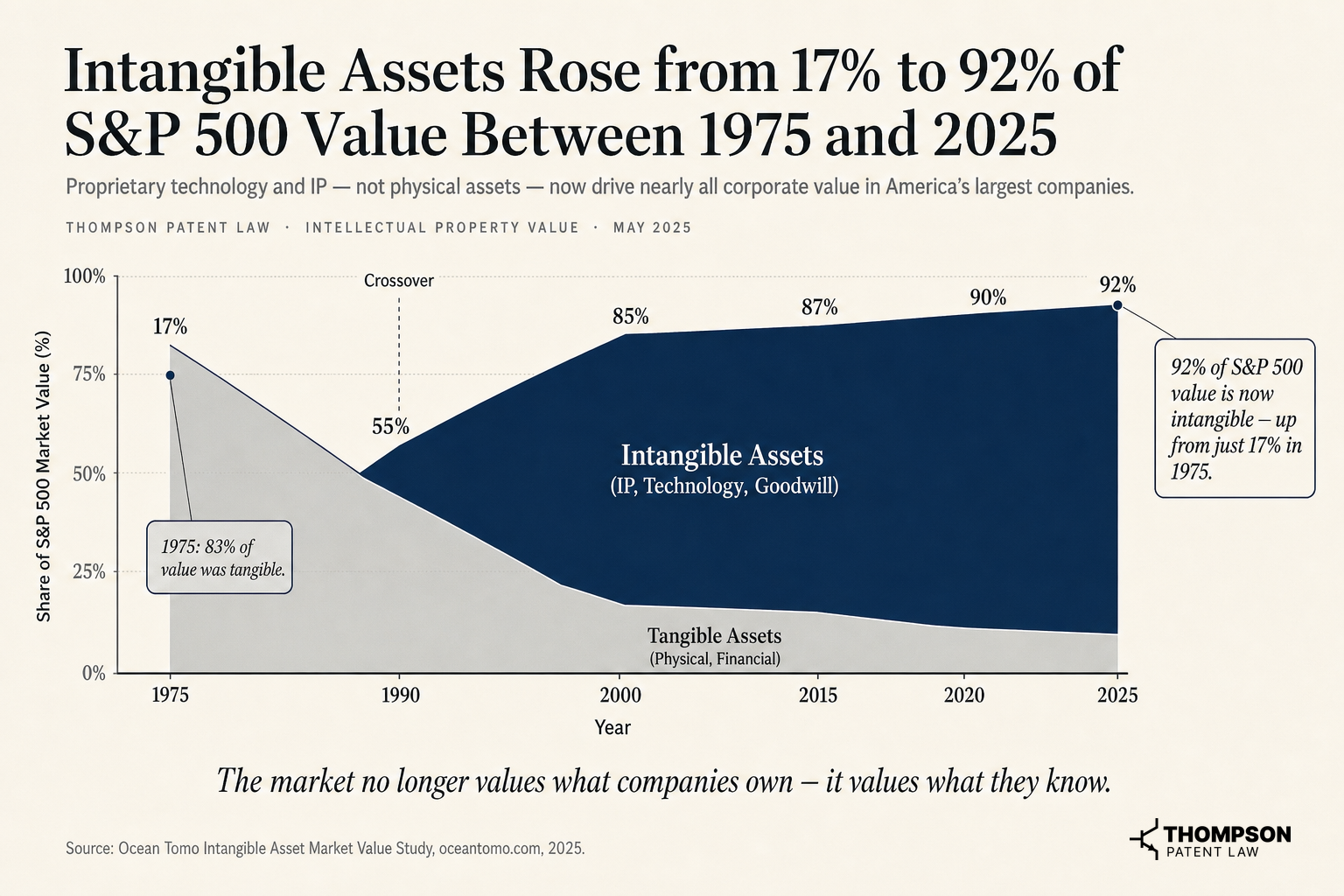 *Intangible Assets Rose from 17% to 92% of S&P 500 Value Between 1975 and 2025 — Source: ****Ocean Tomo ***Intangible Asset Market Value Study, 2025
The Business Logic Behind Owning Your Technology
Companies that own proprietary technology can price, license, and deploy it on their own terms, creating barriers competitors cannot easily replicate. The Ocean Tomo data is striking: intangible assets rose from 17% of S&P 500 value in 1975 to 92% by 2025, a complete inversion of corporate value composition over fifty years. Patents and trade secrets are not administrative overhead; they are the mechanism by which technology companies convert innovation into lasting market position. Structured invention harvesting is one of the most direct ways companies systematically identify and capture that value before competitors do.
Vendor Lock-In as a Feature, Not Just a Risk
Proprietary software vendors intentionally design systems that make switching costly, a dynamic called vendor lock-in. For the company selling the technology, this creates recurring revenue and long-term customer relationships. Understanding this dynamic matters whether you are building proprietary systems or evaluating them as a buyer, because the integration depth you build into your product today becomes a defensible moat tomorrow.
Proprietary Technology in the AI Age
Artificial intelligence and machine learning are rapidly becoming the new frontier for proprietary technology claims. Globally, patent families for generative AI grew from 733 in 2014 to over 14,000 by 2023, according to WIPO patent data, with more than 25% of all generative AI filings occurring in 2023 alone. If your product incorporates AI agents, training datasets, or software features built on proprietary AI systems, assess patentability before public disclosure. The window to establish rights in this space is narrowing faster than in almost any other technical field. For a deeper look at what qualifies, see Artificial Intelligence Patents in 2026: What's Patentable, What's Not, and What's at Risk.
Real-World Examples of Proprietary Technology Across Industries
Software and Technology Companies
The clearest examples come from dominant software companies. According to StatCounter data, Microsoft Windows held approximately 64% of global desktop OS market share as of early 2025, sustained entirely by Microsoft's exclusive control over the OS code and licensing. Adobe's proprietary software suite generated $17.6 billion in FY2022, with $10.46 billion from Creative Cloud subscriptions alone, according to Adobe's earnings report. Google's search algorithm, by contrast, is protected as a trade secret rather than a patent, specifically because publication would enable reverse engineering. Each choice reflects deliberate intellectual property strategy.
Startups that obtained patents saw 55% higher employment growth and 80% higher sales five years after filing, according to NBER research, a concrete demonstration of how early IP decisions compound into business outcomes. Understanding what a patent actually does for your competitive position is the starting point for making those decisions well.
Startups, Independent Inventors, and Small Businesses
Proprietary technology is not exclusive to Fortune 500 firms. A small business's unique manufacturing process, a startup's novel software development method, or an engineer's custom algorithm can all qualify for protection if properly documented and filed. A 2023 EUIPO-EPO study found that startups that filed patents had a 6.4 times higher likelihood of securing venture capital financing at the early stage than those with no IP filings. The gap between having something proprietary and legally owning it is closed only by acting, ideally before your first competitor copies it. Those unsure whether their concept clears the bar should read Can a Concept Be Patented? Here's What 86% of Applicants Learn the Hard Way.
Proprietary Technology in Emerging Fields
Robotics and automation, IoT and connected devices, clean energy, and medtech are all producing new inventions at a pace that makes early patent prosecution critical. IBM, Alphabet, and Microsoft each filed 400+ patent families on generative AI inventions by 2023, per WIPO data, illustrating the aggressive patent portfolio management strategies at play. Software features embedded in physical products create layered intellectual property questions that span utility patents, design patents, and trade secrets simultaneously. For companies building at the intersection of software and physical systems, automation and manufacturing patent strategy deserves early attention.
The Four Legal Tools That Actually Protect Proprietary Technology
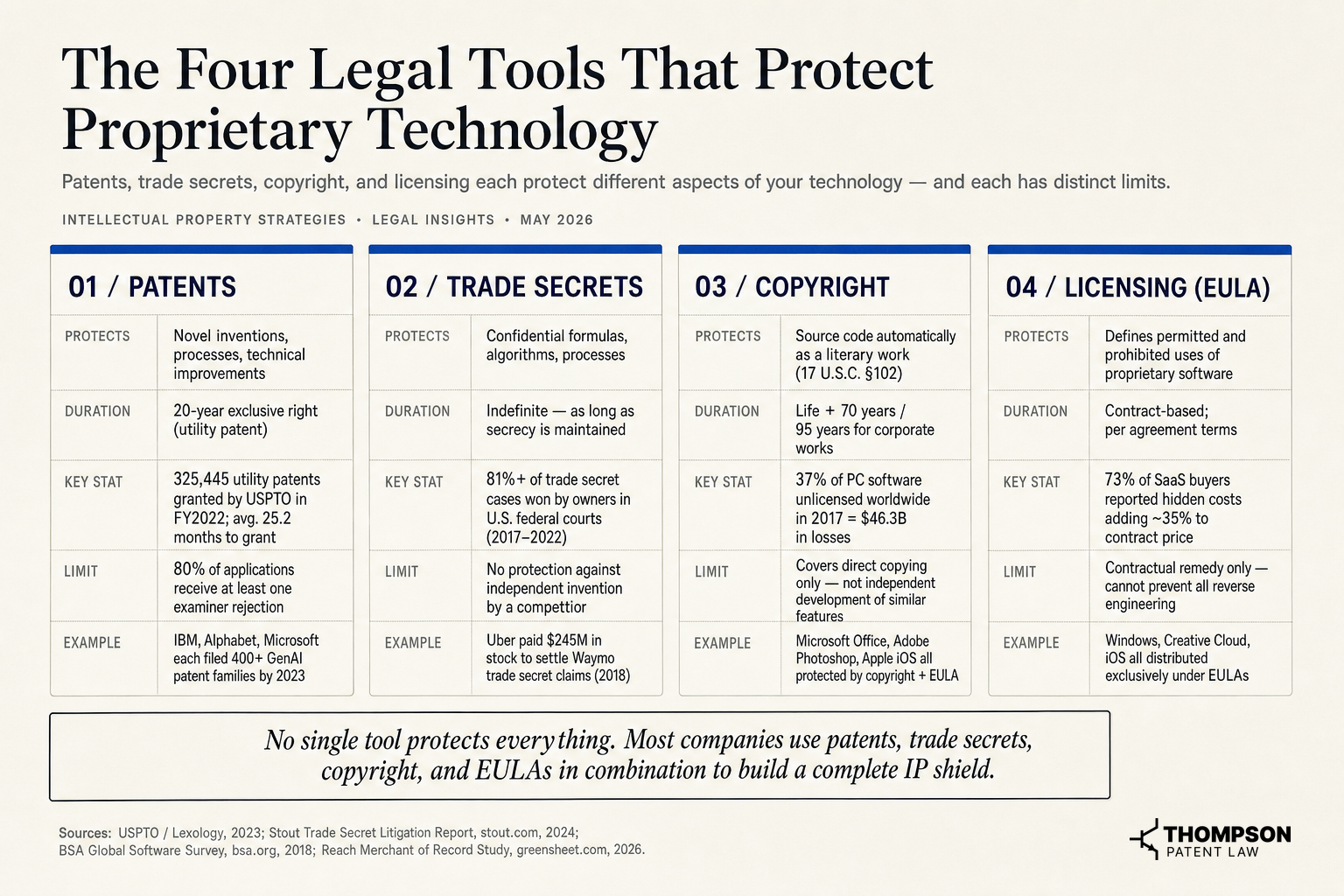
Patents Give You Exclusive Rights You Can Enforce
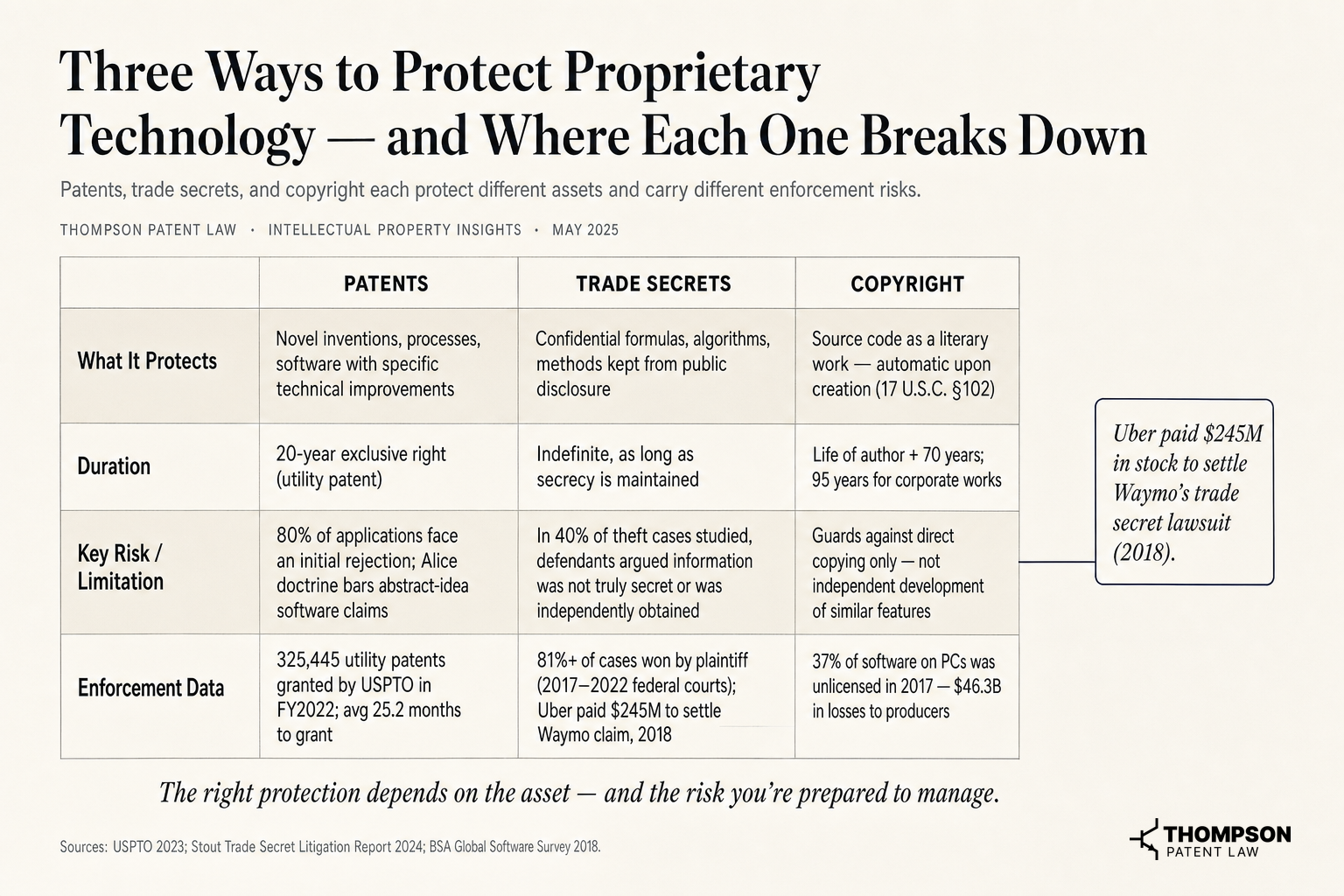
A utility patent grants the owner the right to exclude others from making, using, or selling the claimed invention for 20 years from the filing date. According to USPTO data, the USPTO granted 325,445 utility patents in FY2022, with an average time to grant of about 25.2 months. Critically, 80% of applications receive at least one examiner rejection before allowance, most often for obviousness, according to Big Patent Data analysis. Patents are the only protection that gives you offensive rights: you can stop competitors even if they developed the same technology independently. A poorly drafted patent, however, can give you a certificate that does nothing. Understanding what a patent actually protects before you file determines whether you end up with a real asset or a false sense of security.
Trade Secrets Protect What Patents Cannot or Should Not Disclose
Some proprietary technology is better protected as a trade secret than a patent, because publication is part of the patent process. The Defend Trade Secrets Act of 2016 created a federal civil remedy for misappropriation, and since then over 81% of trade secret cases that went to judgment in U.S. federal courts were decided in favor of the trade secret owner, according to Stout's 2024 Litigation Report. In Waymo v. Uber, Uber settled for $245 million after Waymo alleged theft of proprietary self-driving car secrets. If your competitive advantage depends on secrecy rather than first-mover exclusivity, trade secret protection combined with strong NDAs may outperform a patent.
Copyright and Licensing Cover Proprietary Software Distribution
U.S. law automatically protects computer software as a copyrighted literary work from the moment it is written under 17 U.S.C. § 102. However, copyright only prevents direct copying, not independent development of similar functionality. That is why most software development companies pair copyright with proprietary software licenses, specifically end user license agreements, to control what the end user can do with the software. Copyright protects your code; a well-drafted license agreement protects your business model. In 2017, 37% of software installed on PCs worldwide was not properly licensed, representing $46.3 billion in unlicensed use, according to the BSA Global Software Survey, underscoring why enforcement matters. For a broader overview of software IP strategy, see Top 3 Proven Methods for Protecting Software Intellectual Property.
How to Evaluate Whether Your Technology Qualifies for Patent Protection
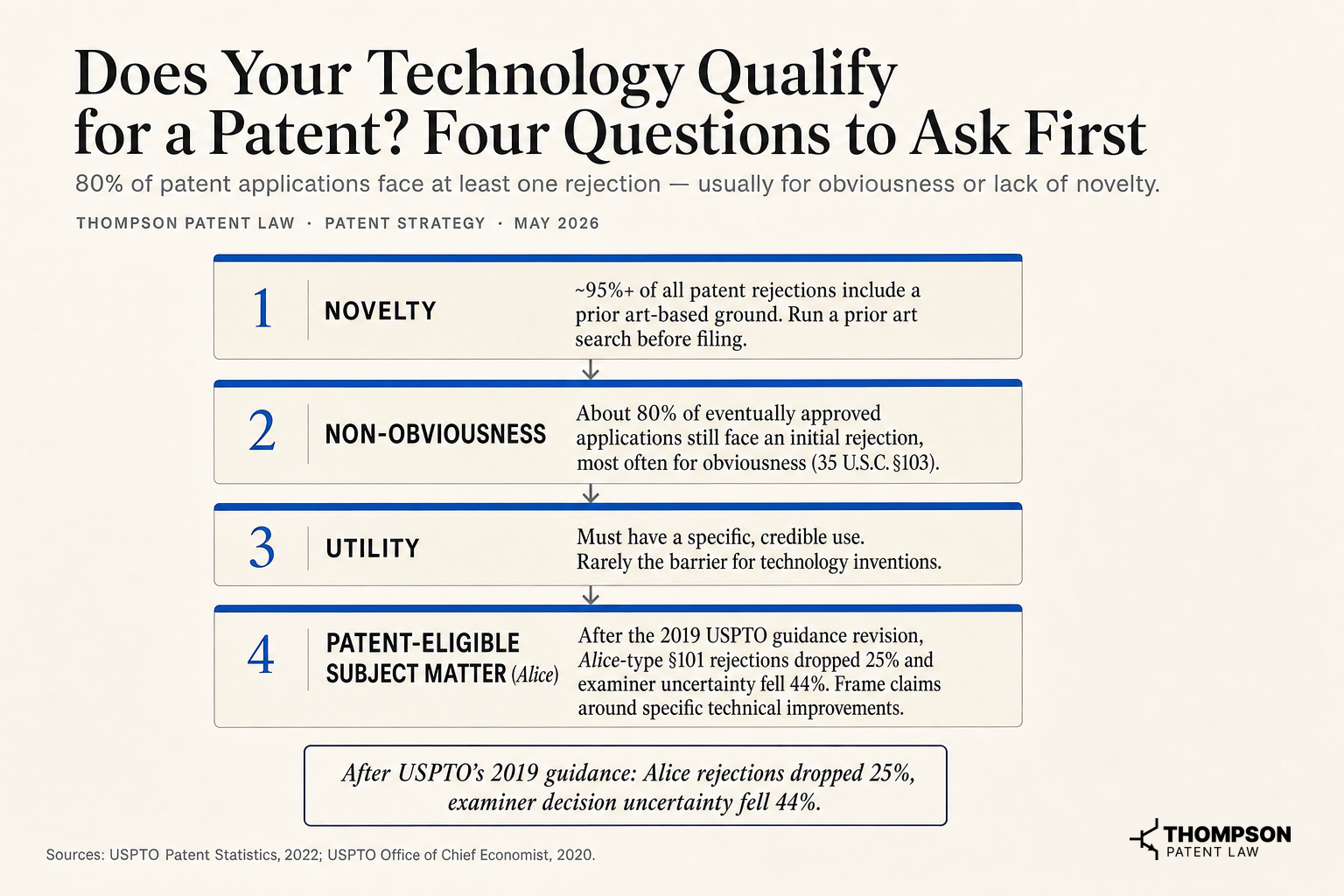
The Three Questions a Patent Attorney Asks First
Before filing, a competent patent attorney evaluates novelty, non-obviousness, and utility. Obviousness is the most common rejection ground at the USPTO and the most nuanced, requiring prior art searches and a prosecution strategy built around the specific claim scope you need. A prior art search before filing shapes the entire claim strategy and determines whether your patent will survive a post-grant challenge. Skipping this evaluation is the most common and costly mistake first-time applicants make. For those weighing whether to hire counsel at all, Do You Need an Attorney to File a Patent? lays out exactly what is at stake with a DIY approach.
Software Patents and the Alice Problem
Since the Supreme Court's decision in Alice Corp. v. CLS Bank International (2014), software patents face heightened scrutiny under 35 U.S.C. § 101. Applications that describe software as merely implementing an abstract idea on a generic computer are routinely rejected. Experienced patent prosecution counsel who understand how to frame software inventions as specific technical improvements to computer functionality can materially improve outcomes. According to Thompson Patent Law, its approach to Alice eligibility has demonstrated a 25-50% improvement in § 101 allowance outcomes for software patent clients, sparing them an average of one to two years and five figures in additional prosecution costs. Whether your software is patentable depends less on what it does and more on how the claims describe the technical problem it solves.
Common Mistakes That Destroy Proprietary Technology Rights Before You File
Public Disclosure Before Filing Is a Rights-Killer
In the United States, inventors have a one-year grace period after public disclosure to file a patent application, but most other countries have no grace period at all. Presenting at a conference, publishing a blog post, or pitching an investor without an NDA can permanently eliminate international patent rights. The solution is straightforward: get a provisional patent application on file before any public disclosure. A provisional patent application establishes your priority date for one year while you build toward a full utility application, and it does not count against your 20-year patent term. For a detailed breakdown of timing decisions, see When To Get A Patent: Timing Your Application For Maximum Protection.
Assuming NDAs Alone Are Sufficient Protection
Non-disclosure agreements create a contractual obligation not to disclose, but they do not create intellectual property ownership or prevent independent development of the same technology. If a competitor independently arrives at the same invention without breaching your NDA, you have no claim against them unless you hold a patent. NDAs are a necessary protection layer for confidential discussions, but they are not a substitute for formal IP rights. Use NDAs to protect conversations; file for patent protection to secure the rights an NDA cannot give you.
Frequently Asked Questions
What does "proprietary tech" mean? Proprietary tech refers to technology exclusively owned and controlled by a specific company or individual, protected through patents, trade secrets, or copyright. Unlike open source software, proprietary technology cannot be freely used, modified, or distributed without the owner's permission. The term covers software, hardware designs, manufacturing processes, algorithms, and any other technical innovation that the owner has taken legal steps to protect.
What is an example of proprietary technology in business? Classic examples include Google's search algorithm (protected as a trade secret), Microsoft Windows (proprietary software licensed under strict EULAs), and Coca-Cola's formula (a closely guarded trade secret for over a century). In smaller businesses, proprietary technology might be a custom software development platform, a unique manufacturing process, or a machine learning model built on internally developed training data. The common thread is exclusive ownership backed by legal protection.
What is an example of proprietary software? Adobe Photoshop, Microsoft Office, and Apple's iOS are among the most widely used proprietary software examples, all distributed under proprietary software licenses that restrict copying, modification, and redistribution. Most commercial software sold by software companies operates on a proprietary software model, where users purchase a license to use the software but do not own the underlying code. This is distinct from free software or open source software, where source code is publicly available.
What is an example of proprietary technology that was successfully patented? Amazon's one-click purchasing system (U.S. Patent No. 5,960,411) was enforced against competitors including Apple, which licensed it. The patent covered a specific method for completing an e-commerce transaction with a single user action, illustrating how a software-implemented process can qualify for patent protection when claims are drafted around a concrete technical method rather than an abstract idea.
Can proprietary technology lose its protection? Yes. Patents expire after 20 years from the filing date. Trade secrets lose protection if the information becomes publicly known, even accidentally. Copyright eventually enters the public domain. Poor prosecution or overly narrow claims can render a patent essentially unenforceable before expiration. Maintaining proprietary technology rights requires active management, including continuation applications, updated NDAs, and documented trade secret protocols.
Your Next Steps to Proprietary Technology Protection Success
The bottom line: a vague claim of ownership without a properly prosecuted patent, a structured trade secret program, or enforceable proprietary software licenses is not protection. Weak or absent IP leaves well-funded competitors free to copy what you built.
The decisions you make in the early stages of developing and disclosing technology determine whether that technology remains yours. File before you disclose. Draft claims for the scope you actually need. Choose between patent and trade secret protection deliberately, not by default. Every day of delay after public disclosure narrows your options, and in many international markets, it eliminates them entirely.
Schedule a Complimentary Patent Needs Assessment to find out exactly what you have, what it is worth protecting, and how to protect it correctly.
Keep Innovating.
Craige Thompson
Patent Attorney, MBA, Electrical Engineer
Thompson Patent Law