


- State business name registration and federal trademark registration are two separate legal systems — only federal registration protects your brand nationwide.
- The USPTO filing fee starts at $250–$350 per class, while a forced rebrand can cost hundreds of thousands of dollars or more.
- A thorough trademark search before filing is non-negotiable — refused applications forfeit their filing fees.
- Attorney-filed trademark applications reach publication at a 60% rate versus 42% for self-filed applications, according to USPTO data.
- Trademark rights require active maintenance: file your Section 8 declaration between years five and six, or lose the registration.
Over 660,000 new trademark applications were filed with the United States Patent and Trademark Office in fiscal year 2023, according to USPTO annual reporting, and priority goes to whoever files first. If your business name is not yet federally registered, a competitor can file a confusingly similar mark today, secure rights you cannot challenge, and leave you rebranding everything you have built. Trademark registration is not a formality — it is how you convert your business name into enforceable intellectual property.
What a Trademark Actually Does (and What It Does Not)
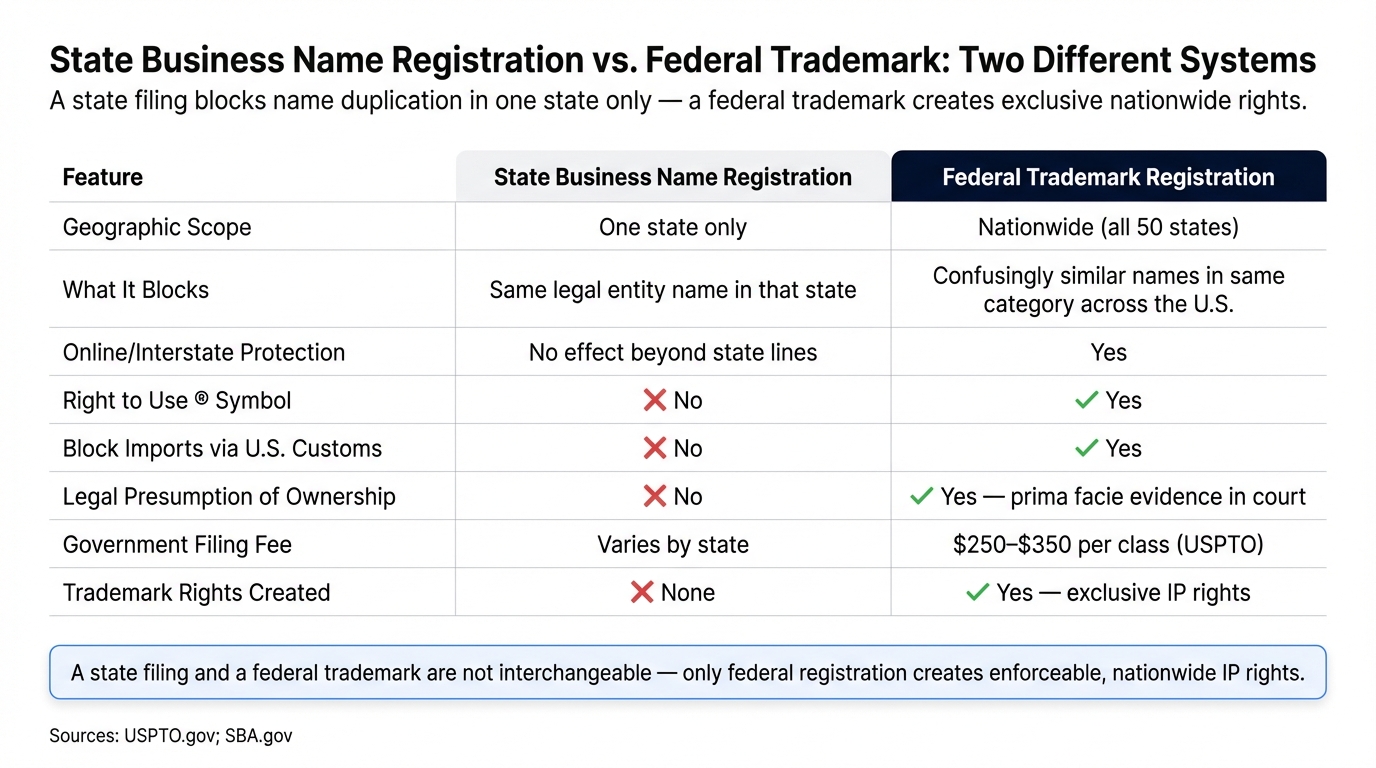
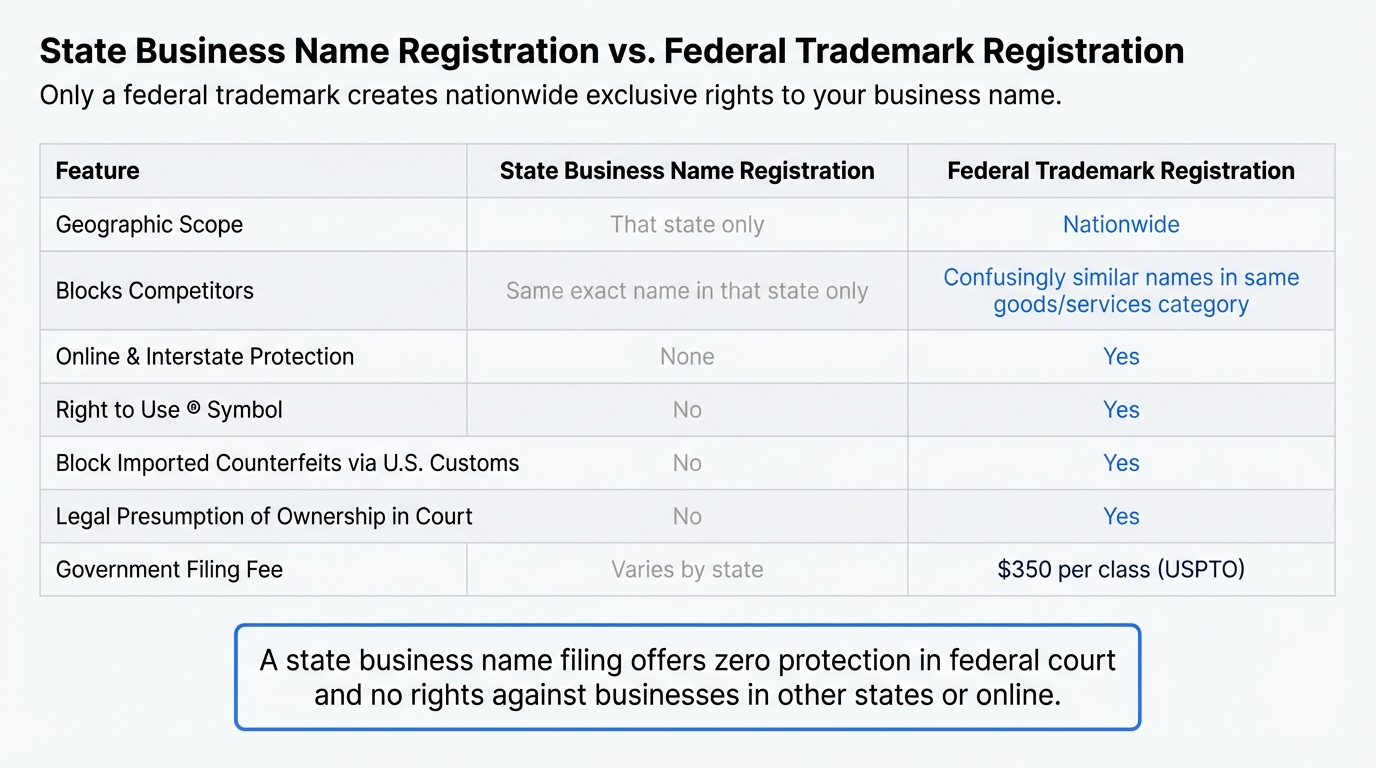 State Business Name Registration vs. Federal Trademark Registration — Source: USPTO Trademark Basics; SBA Business Name Guidance
A Trademark Creates Exclusive Rights, Not Just a Registration Record
A federal trademark gives you the legal right to stop competitors from using a confusingly similar name in your industry. The United States Patent and Trademark Office confirms that federal registration creates a legal presumption of your ownership and exclusive nationwide rights — not just a record that your name exists. Without it, another business can legally use a nearly identical name in another state or online and potentially force you to rebrand, even if you started first.
To understand how trademark protection fits within a broader IP strategy, see The Four Main Categories of Intellectual Property and What Each One Actually Protects.
The Difference Between a Business Name Registration and a Trademark
Registering one of your business names with your state as an LLC, corporation, or sole proprietorship does not give you trademark rights. According to the U.S. Small Business Administration, a state filing only prevents another business in that state from using the exact same legal entity name. It offers no protection at the federal level and no rights against businesses operating in other states or online. These are two completely separate legal systems, and confusing them is one of the most common and costly mistakes early-stage founders make. For a detailed breakdown, see Trademark vs Patent: Key Differences Simplified.
Trademark Protection Covers Name, Logo, Slogan — or All Three
A trademark can protect a business name, a logo, a slogan, or any combination of these as separate registered marks. Trademarks are organized into 45 distinct classes of goods and services under the international Nice Classification system, according to EUIPO. Each registration covers specific classes, so trademark protection is category-specific by design. Nike's swoosh and "Just Do It" are separate trademark registrations — each maintained independently and each enforceable on its own terms. For more on what qualifies for trademark protection, see What is a Trademark and Why It Matters to Your Business.
Why Trademarking Your Business Name Is Worth the Investment
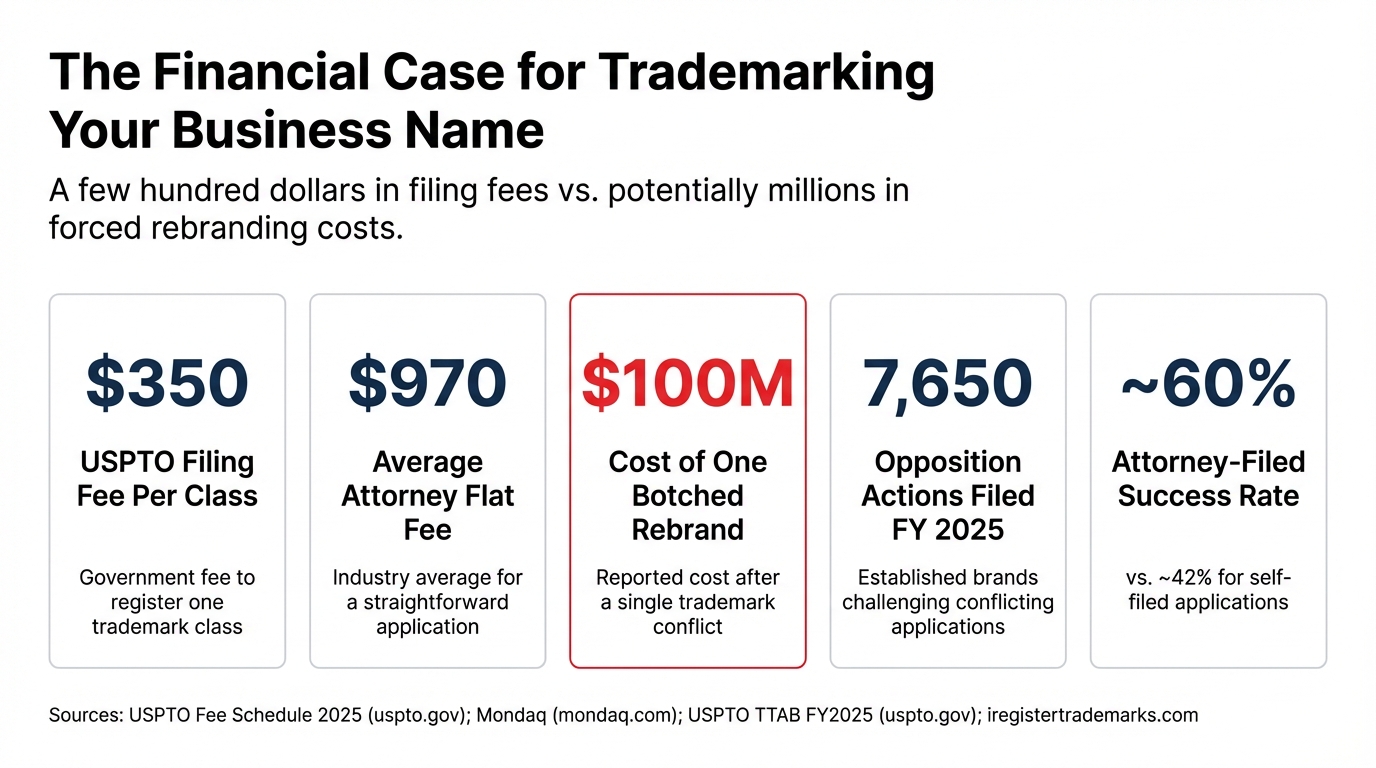 The Financial Case for Trademarking Your Business Name — Source: USPTO Fee Schedule 2025; Mondaq rebranding analysis; USPTO TTAB FY2025 filings; iregistertrademarks.com attorney success study; ContractsCounsel attorney fee analysis
Federal Registration Opens the Door to Legal Enforcement
Only a federally registered trademark gives you the right to sue in federal court, display the ® symbol, and record your mark with U.S. Customs and Border Protection to block infringing imported goods. The USPTO states that registration also puts potential infringers on constructive notice — meaning they cannot later claim ignorance of your rights. Common law trademark protection exists through commercial use, but it is geographically limited and far harder to enforce than a registered mark, which provides broader legal protections across the country. For a closer look at what trademarks can and cannot do for your business, see Can Trademarks Protect My Business?
Trademark Registration Protects Your Brand During Growth and Fundraising
Investors conducting intellectual property due diligence will verify whether your core brand assets are federally protected, and they may seek legal advice on the durability of your IP position. A missing trademark registration raises immediate questions about the durability of your competitive position. Many venture-backed startups are required to complete trademark registration as a condition of funding. An unregistered name also creates acquisition risk — a buyer inheriting an unprotected brand inherits unknown liability alongside it.
The Cost of Not Trademarking Is Often Higher Than the Cost of Filing
The USPTO filing fee starts at $250–$350 per class. One company spent a reported $100 million on a botched rebrand after a trademark conflict, according to Mondaq, underscoring why the united states patent office recommends securing registration before conflicts arise. New website builds, revised product packaging, updated collateral, and customer re-education after a forced name change routinely reach five or six figures even for small businesses. A single trademark registration, renewable every 10 years, costs a fraction of that exposure.
How to Search for Existing Trademarks Before You Apply
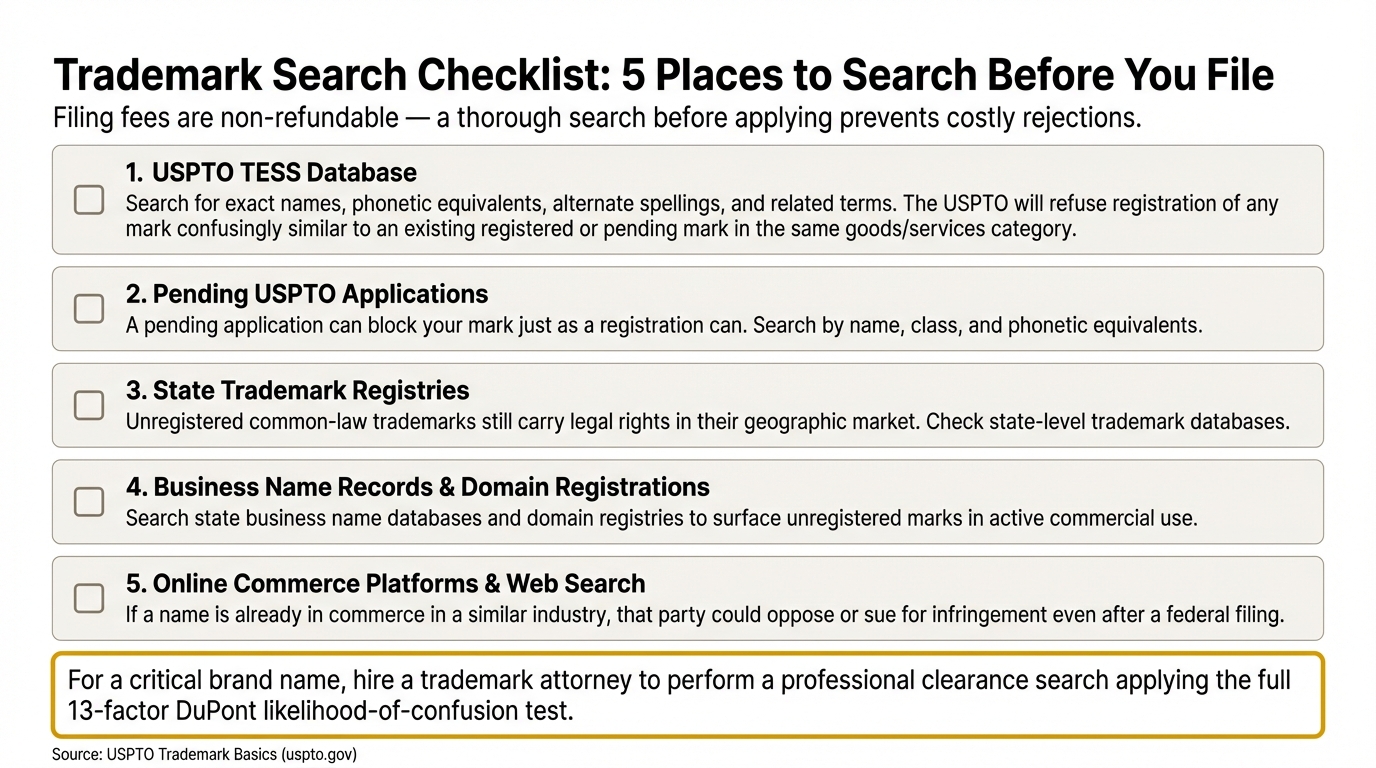 Trademark Search Checklist: 5 Places to Search Before You File — Source: USPTO Trademark Basics; USPTO Possible Grounds for Refusal
The USPTO Trademark Electronic Search System Is Your First Stop
Before filing any trademark application, search the USPTO Trademark Electronic Search System (TESS) for identical and similar marks in your category. The USPTO will refuse registration of any mark that is confusingly similar to an existing registered or pending mark covering related goods or services — and filing fees are non-refundable. Search not just for exact matches but for phonetic equivalents, alternate spellings, and visually similar marks.
Searching Beyond the USPTO Database
A USPTO search alone is not sufficient. Unregistered common law trademarks still carry legal rights in the geographic market where they are actively used. The USPTO recommends checking state trademark registries, domain registrations, social media handles, and online commerce platforms to surface unregistered marks that could block your application or create infringement exposure even after you register.
When to Hire a Trademark Attorney for the Search
A comprehensive trademark search goes beyond TESS to identify any similar trademark and analyze likelihood of confusion under the 13-factor In re E.I. DuPont de Nemours & Co. test, 476 F.2d 1357 (C.C.P.A. 1973) — the same legal standard the USPTO examining attorney applies when reviewing your application. Missing a "confusingly similar" mark because you only checked for exact matches is one of the most common reasons applications fail and filing fees are wasted; meeting all legal requirements from the start reduces this risk significantly. Attorney-led clearance searches reduce the risk of a costly refusal before you commit to a filing. A qualified Trademark Attorney brings both search expertise and strategic guidance that self-filed searches routinely miss.
The Step-by-Step Trademark Application Process at the USPTO
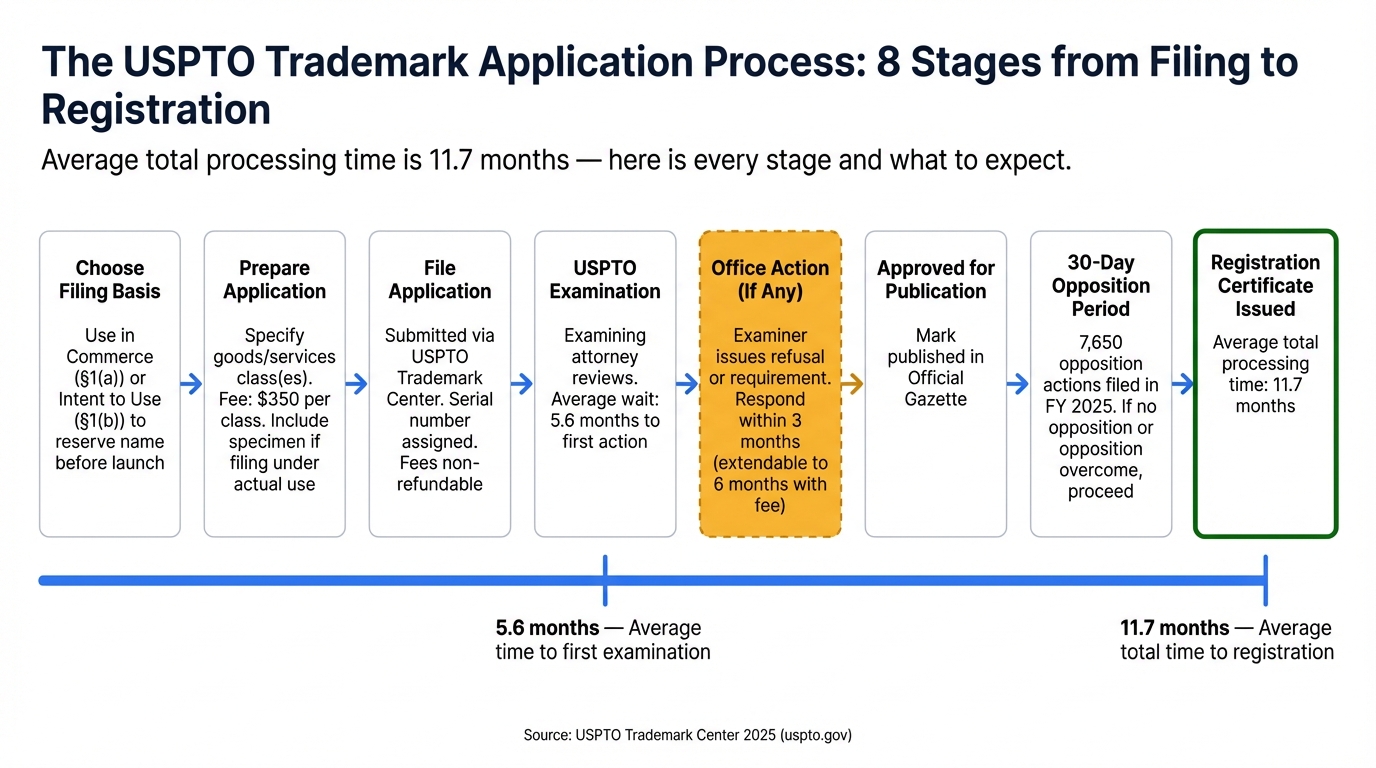 The USPTO Trademark Application Process: 8 Stages from Filing to Registration — Source: USPTO Trademark Center 2025; USPTO TTAB FY2025 Performance Data
Choosing the Right Filing Basis Before You Submit
Every USPTO trademark application requires a declared filing basis. Under 15 U.S.C. § 1051(a), "use in commerce" applications are for marks already being used in business. Under § 1051(b), an intent application lets you stake a federal priority claim before your product launches — strategically valuable, but they require an additional Statement of Use filing and fee before registration is granted, with application requirements varying by filing basis. If your business is pre-launch, an intent-to-use application secures your place in line at the United States Patent and Trademark Office.
Filing Through the USPTO Trademark Center
All new applications are filed electronically through the USPTO Trademark Center using the Trademark Electronic Application System (TEAS). You need a clear representation of the mark, a description of goods or services, the correct International Class, your filing basis, and a specimen showing commercial use if filing under actual use. TEAS Plus applications, which require stricter compliance with pre-approved descriptions, cost $250 per class. For complete trademark fee information, TEAS Standard applications cost $350 per class and allow more flexibility in descriptions, according to the USPTO's 2025 fee schedule. Most small businesses file in one to two classes, putting government fees at $250–$700 depending on the filing option chosen.
What Happens After You Submit
After filing, the United States Patent and Trademark Office assigns an examining attorney who typically reviews the application within about 5.6 months, according to a 2025 USPTO update. If the examiner identifies issues — likelihood of confusion, descriptiveness, or procedural defects — they issue an office action requiring a written response within three months, extendable to six; you can check your trademark status through the USPTO Trademark Center at any time. If approved, the mark is published in the trademark official gazette for a 30-day opposition period. The USPTO reported an average total processing time of 11.7 months for applications that reached registration in FY 2025, reflecting the average trademark filing and review cycle.
How to Respond to an Office Action Without Losing Your Application
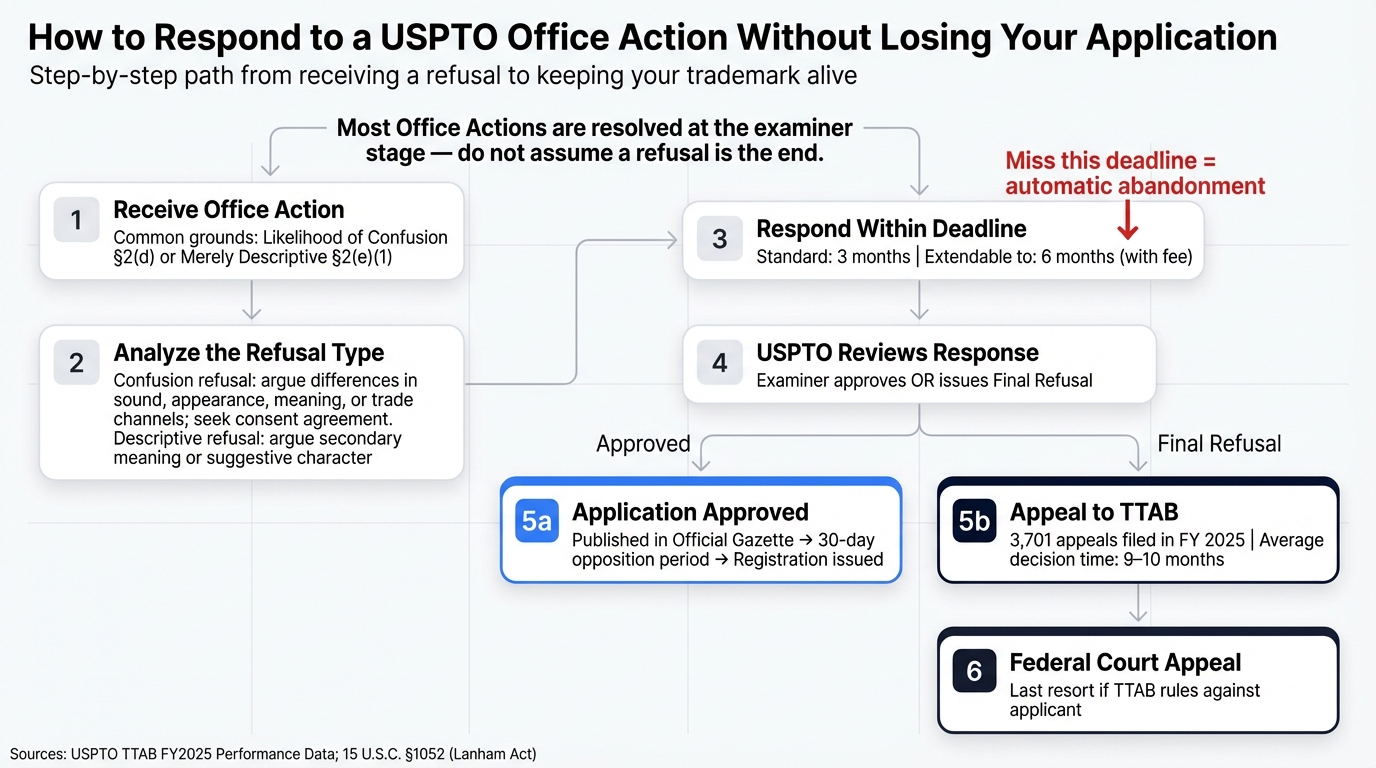 How to Respond to a USPTO Office Action Without Losing Your Application — Source: USPTO TTAB FY2025 Performance Data; 15 U.S.C. §1052 (Lanham Act)
The Most Common Office Actions and What Triggers Them
The two most frequent USPTO office actions are likelihood-of-confusion refusals under Lanham Act § 2(d) and "merely descriptive" refusals under § 2(e)(1). A mark like "Fast Coffee" for a coffee shop would likely trigger a descriptiveness refusal. A mark similar in sound or appearance to an already-registered mark triggers a confusion analysis. Correctly identifying the refusal type is essential — the wrong response strategy wastes your entire response window.
Responding Effectively to a Likelihood of Confusion Refusal
A § 2(d) refusal under trademark act section 2(d) does not end your application. Your response can argue that the marks are sufficiently distinct in appearance, sound, or meaning, that the goods or services occupy different commercial channels, or that consumers are sophisticated enough to distinguish them. You can also submit consent letters or co-existence agreements from the cited mark's owner. According to USPTO Trademark Trial and Appeal Board (TTAB) statistics, applicants filed 3,701 appeals after final refusals in FY 2025 — confirming that many applicants successfully push back before ever reaching that stage.
When to Appeal to the Trademark Trial and Appeal Board
If the USPTO examining attorney maintains a final refusal, you can appeal to the Trademark Trial and Appeal Board (TTAB), also known as the trademark trial board, an administrative tribunal within the United States Patent and Trademark Office that handles trademark appeals and inter partes disputes including oppositions and cancellation proceedings. TTAB appeals are document-driven and typically resolve in nine to ten months. They are a legitimate path to registration, not a last resort.
What Trademark Registration Gets You and How to Keep It
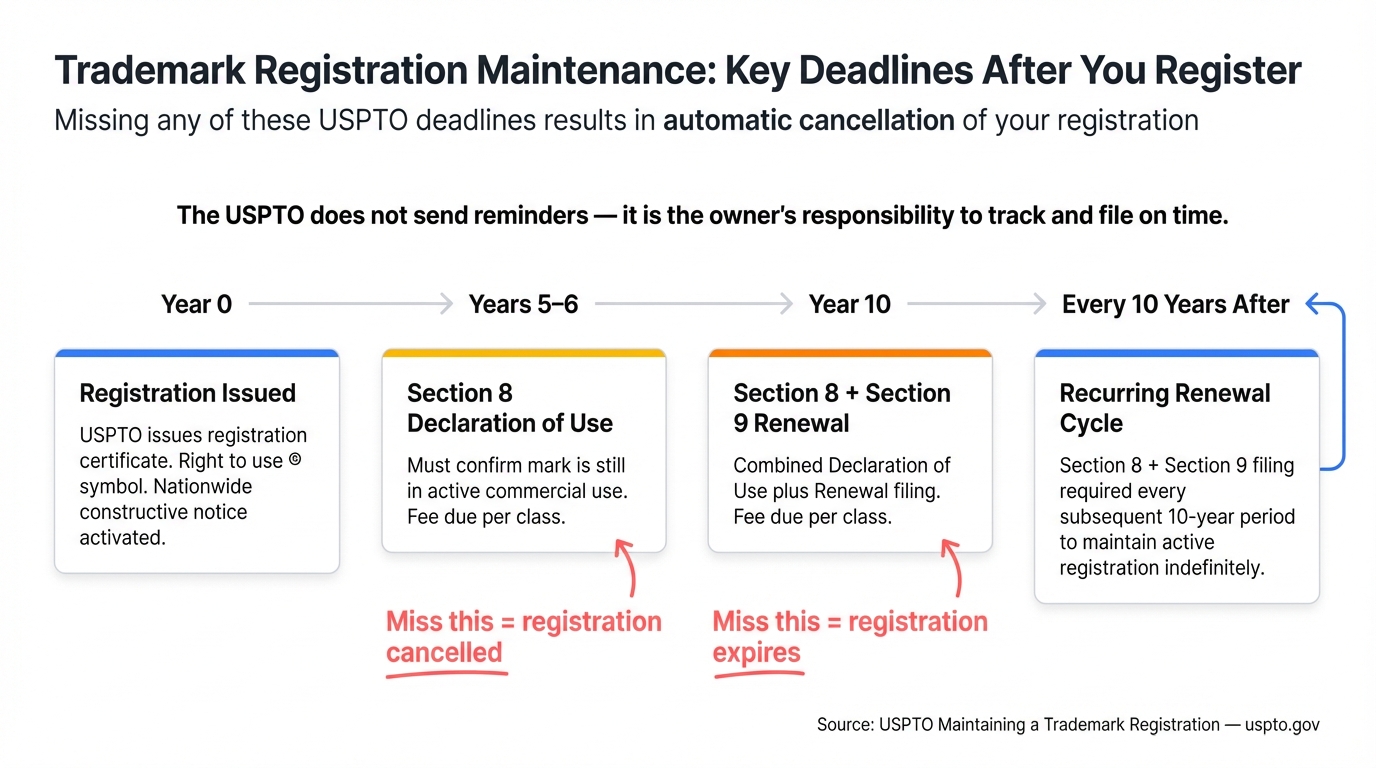 Trademark Registration Maintenance: Key Deadlines After You Register — Source: USPTO — Maintaining a Trademark Registration
The Rights That Come With a Federal Registration Certificate
Once registered, your mark appears in the official United States Government trademark registry, maintained by the united states patent office as part of the federal IP system. You gain exclusive nationwide intellectual property rights in your registered class, the legal presumption of ownership, the right to use the ® symbol, and the ability to sue in federal court for infringement. Under 15 U.S.C. § 1072, registration creates constructive notice — future infringers cannot claim they were unaware of your mark's existence. To understand the full scope of what different IP rights protect, see Understanding The Different Types Of Trademarks.
Maintaining Your Trademark Registration Over Time
Federal trademark registration does not last automatically. You must file a Declaration of Use (Section 8) between the fifth and sixth years after registration, and again between the ninth and tenth years. At the ten-year mark, file a combined renewal (Sections 8 and 9) to extend registration for another decade. Under 15 U.S.C. § 1058, failure to file on time results in cancellation. Many trademark owners lose registrations simply by missing these deadlines — calendar them at the moment of registration.
Monitoring and Enforcing Your Trademark After Registration
The trademark office does not police infringement on your behalf. Monitoring services such as Thomson CompuMark and Corsearch scan new trademark applications and commercial activity for conflicting marks. Failing to challenge infringement can weaken or extinguish your rights through abandonment or acquiescence. A cease and desist letter is typically the first legal action step, and it only carries weight when backed by a registered mark.
International Trademark Protection for Growing Businesses
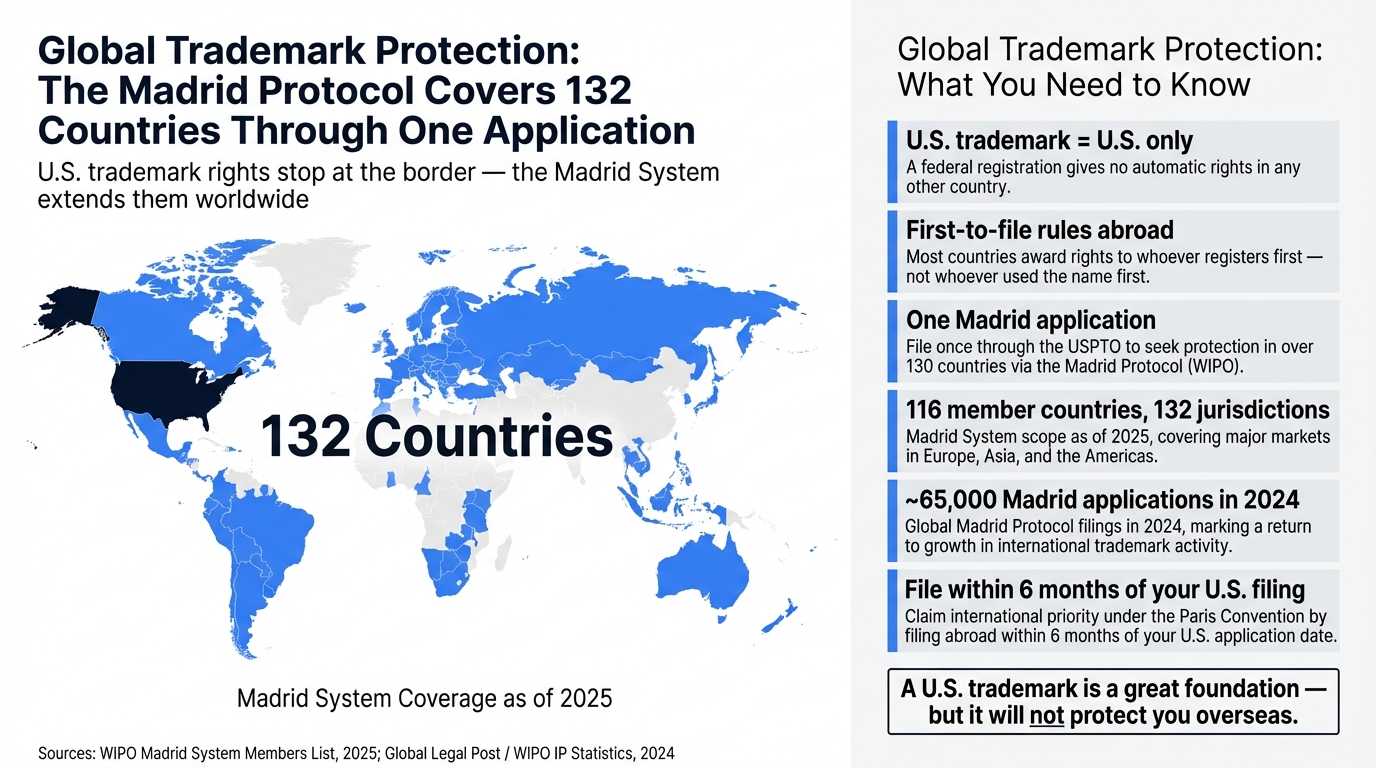 Global Trademark Protection: The Madrid Protocol Covers 132 Countries Through One Application — Source: WIPO Madrid System Members List, 2025; Global Legal Post / WIPO IP Statistics, 2024
Why U.S. Registration Does Not Protect You Abroad
Federal trademark registration with the United States Patent and Trademark Office — the official government organization for intellectual property in the United States — protects your mark only within the United States. International trademark law is territorial — each country or region maintains its own registry. If you sell internationally, competitors in other countries can legally use your brand name unless you file there independently. The World Intellectual Property Organization (WIPO) tracks this exposure through its global trademark data.
The Madrid Protocol Simplifies Multi-Country Filing
The Madrid Protocol, administered by WIPO, allows U.S. trademark owners to pursue international trademark registration through a single application covering 130-plus member countries. You file through the USPTO as an international application, pay one consolidated fee, and designate the countries where you want trademark protection. Each designated country examines the application type and filing under its own standards. This is significantly more cost-effective than filing separate national applications — and as the WIPO Madrid System demonstrates, it reaches 132 countries through a single filing process.
FAQ
How do I trademark a small business name? The process is the same regardless of business size: search the USPTO Trademark Electronic Search System for existing marks, file a new application through the USPTO Trademark Center, pay the applicable fee per class ($250 under TEAS Plus or $350 under TEAS Standard), and respond to any office actions the examining attorney issues. The USPTO's own data shows that applicants represented by a trademark attorney have significantly higher allowance rates — attorney-filed applications reach publication at a 60% rate versus 42% for self-filed applications. For a name representing core brand equity, professional guidance typically pays for itself. See also Can a Trademark Help Protect an Original Idea? for more context on what trademark registration covers.
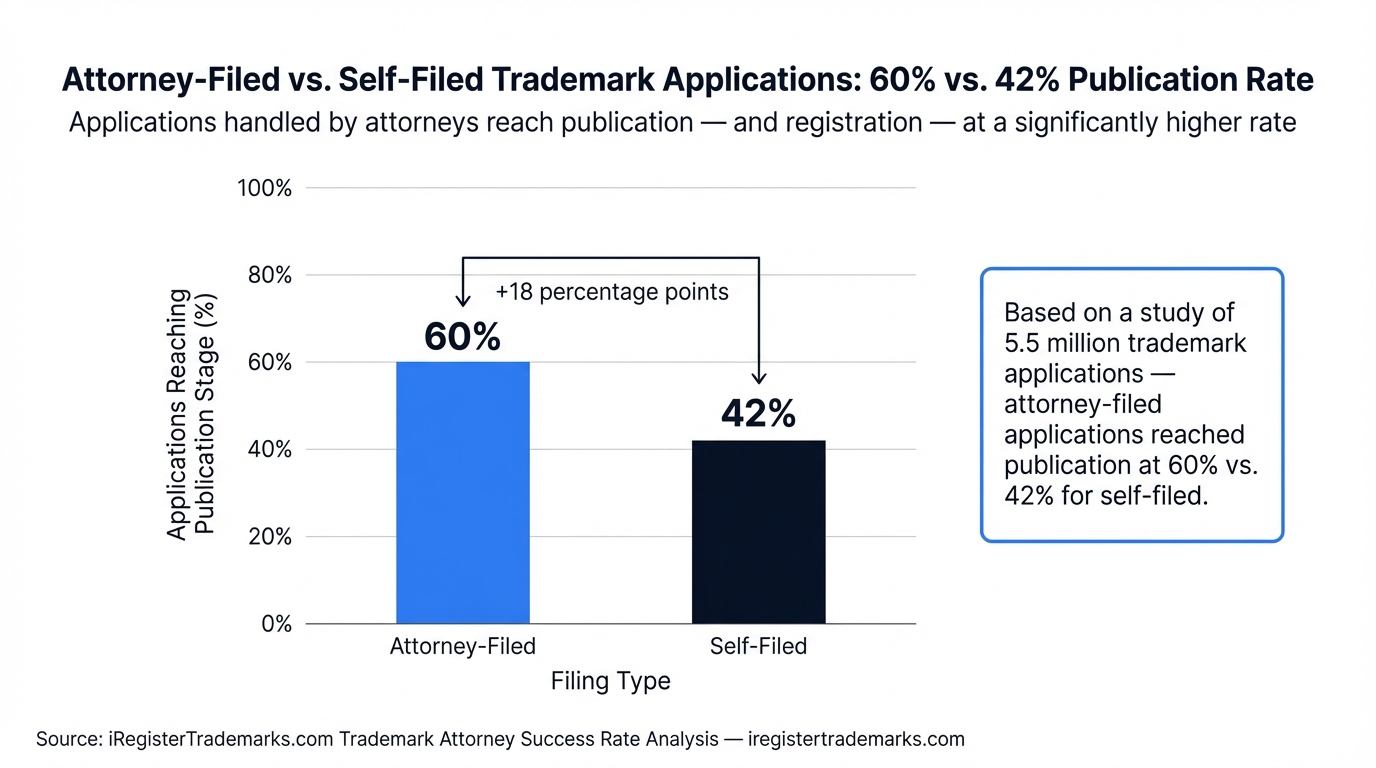 Attorney-Filed vs. Self-Filed Trademark Applications: 60% vs. 42% Publication Rate — Source: iRegisterTrademarks.com Trademark Attorney Success Rate Analysis
Can I trademark my business myself? Yes — the USPTO allows any applicant to file directly through the Trademark Electronic Application System without hiring an attorney. However, the USPTO strongly recommends consulting a trademark attorney because errors in mark distinctiveness, filing basis, specimen requirements, or class selection trigger office actions or outright refusals. Filing fees are non-refundable, and a rejected application costs you both money and months of processing time.
How much does it cost to trademark my business? USPTO filing fees are currently $250 per class under TEAS Plus and $350 per class under TEAS Standard. Most businesses file in one to three classes. Attorney fees for a straightforward trademark application typically range from $1,000 to $2,000. Budget additionally for office action responses ($500–$1,500 if needed), any additional fees for maintenance filings at years five through six, and again at year ten. Total cost for a complete trademark registration process including professional fees commonly runs $1,500 to $3,500.
Is it worth trademarking your business name? For any business competing on brand recognition, yes. Federal trademark registration is the only way to secure nationwide exclusive rights to your business name, access federal court enforcement, and put competitors on constructive notice of your ownership. As your business grows, raises capital, or approaches acquisition, a registered trademark becomes a quantifiable intellectual property asset. The cost of registration is almost always lower than the cost of a forced rebrand or a prolonged infringement dispute.
Your Next Steps to Trademark Registration Success
Every day you operate without federal trademark registration, a competitor can file a us trademark application for a confusingly similar name, claim priority at the u.s. patent office, and put you in the position of defending or abandoning the brand you built. With over 660,000 trademark applications filed in fiscal year 2023 and the USPTO processing them on a first-come, first-served basis, waiting is a genuine risk — not a theoretical one.
The bottom line: a weak or absent trademark registration leaves your business name exposed to competitors who file first, while a properly secured federal registration — issued by the united states government — gives you nationwide exclusive rights, federal court access, and a quantifiable IP asset that strengthens every future business transaction.
The path to trademark protection is manageable: search thoroughly using TESS and beyond, file correctly the first time with the right basis and class selections, and respond to office actions with targeted legal arguments. Working with a trademark lawyer is not a luxury — it is how you avoid the filing mistakes that waste fees and delay registration by six months or more. If your business also involves protectable technology or products, you may want to explore patent protection through How Do You Patent a Product? Step-by-Step Guide to Protect Your Invention and When To Get A Patent: Timing Your Application For Maximum Protection to build a complete IP strategy.
Schedule a Complimentary Patent Needs Assessment to discuss protecting your business name and the technology behind it. According to Thompson Patent Law, the firm has issued more than 1,500 patents and brings Fortune 500 experience — including work with Apple, Google, Intel, and Microsoft — to clients at every stage. You've worked hard to create your brand. Make sure you protect it. The sooner you file, the sooner your rights are secured — before a competitor claims what should be yours.
 State Business Name Registration vs. Federal Trademark: Two Different Systems — Source: USPTO.gov; SBA.gov


