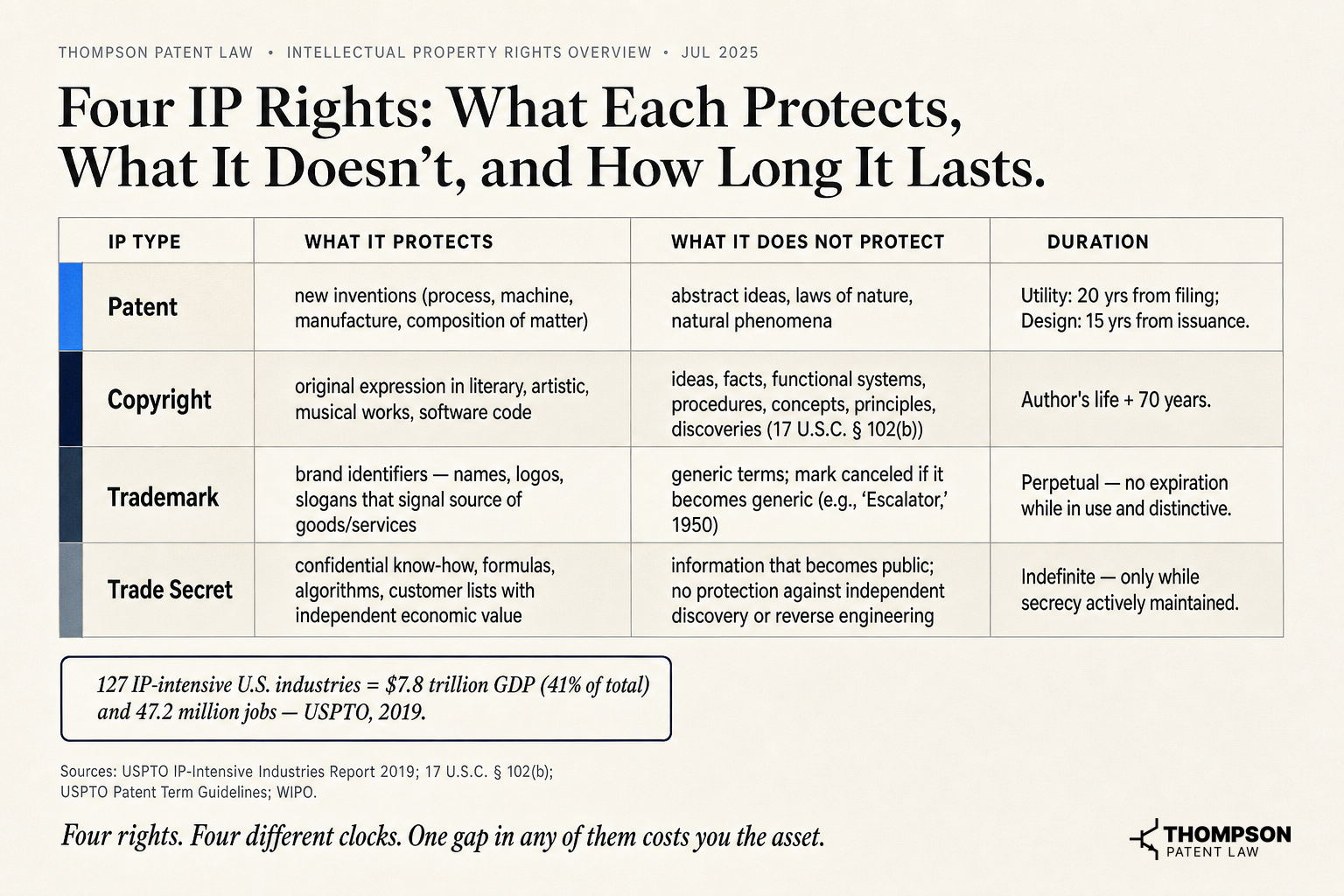
- Intellectual property rights come in four types: patents protect inventions, copyrights protect original works, trademarks protect brand identity, and trade secrets protect confidential business information. Most inventions and products qualify for more than one.
- Copyright protection arises automatically the moment you fix an original work in tangible form, but you must register copyrighted works with the U.S. Copyright Office to sue and unlock statutory damages up to $150,000 per work.
- A patent is only as valuable as its claims. Self-filed applications are abandoned at far higher rates than attorney-drafted ones, which is why claim drafting is a legal discipline, not paperwork.
- Public disclosure before filing can destroy your patent rights, especially abroad where most countries require absolute novelty with no grace period for those who do not plan their filing strategy carefully.
- The highest-leverage move an inventor can make is talking to a patent attorney before disclosing or filing, when strategy mistakes are still fixable.
*Written by Craige Thompson, Patent Attorney, MBA, Electrical Engineer.* Craige Thompson is a Managing Principal Patent Attorney, electrical engineer, professional engineer, and MBA who helps innovators protect and monetize complex technologies. His experience spans patent prosecution, licensing, prior art searching, due diligence, opinions, reexamination, and litigation across electrical engineering, software, mechanical engineering, medical devices, and energy-efficiency technologies.
An independent inventor spent two years building a genuinely novel device, then showed it to a potential manufacturing partner under a handshake agreement. Eighteen months later, that partner was selling the product nationwide, and the inventor had no patent, no signed contract, and no legal claim to the invention he created. Stories like this happen because the inventor did not understand the one thing that separates a protected idea from a free one. That one thing is a working knowledge of intellectual property rights. This intellectual property rights introduction is built for people in exactly that position, founders, independent inventors, engineers, and creators who have made something valuable and need to understand how to keep it.
By the end of this guide, you will know what intellectual property rights are, how each of the four main categories protects a different kind of creation, which rights matter most to inventors versus creators, and what your first practical steps look like before you file anything or show your work to anyone. We focus primarily on U.S. intellectual property law, since that is the framework most readers operate under, while pointing to the international bodies that extend protection abroad, including the World Intellectual Property Organization and the TRIPS Agreement.
Intellectual property rights are legal tools that give you exclusive rights over creations of the mind. They convert intangible assets, the ideas, expressions, brands, and confidential know-how you produce, into protectable, enforceable property. The four main IP categories are patents, copyrights, trademarks, and trade secrets. Each works differently, each has its own duration, and each leaves gaps the others can fill. Get the combination right and competitors cannot easily copy you. Get it wrong and you may discover, like the inventor above, that legal protection you assumed you had never existed.
What Intellectual Property Rights Actually Protect (And What They Don't)
Intellectual property rights give their owner exclusive legal control over creations of the mind, the same way physical property rights give you control over land or equipment. The difference is what you own. The World Intellectual Property Organization defines intellectual property as creations of the mind, including inventions, literary and artistic works, designs, symbols, names, and images used in commerce, and ip laws in member countries are built around this definition. That definition is the cleanest introduction to intellectual property rights you will find, and the term intellectual property itself covers every category in a single sentence.
The Core Concept Ownership Over Intangible Assets
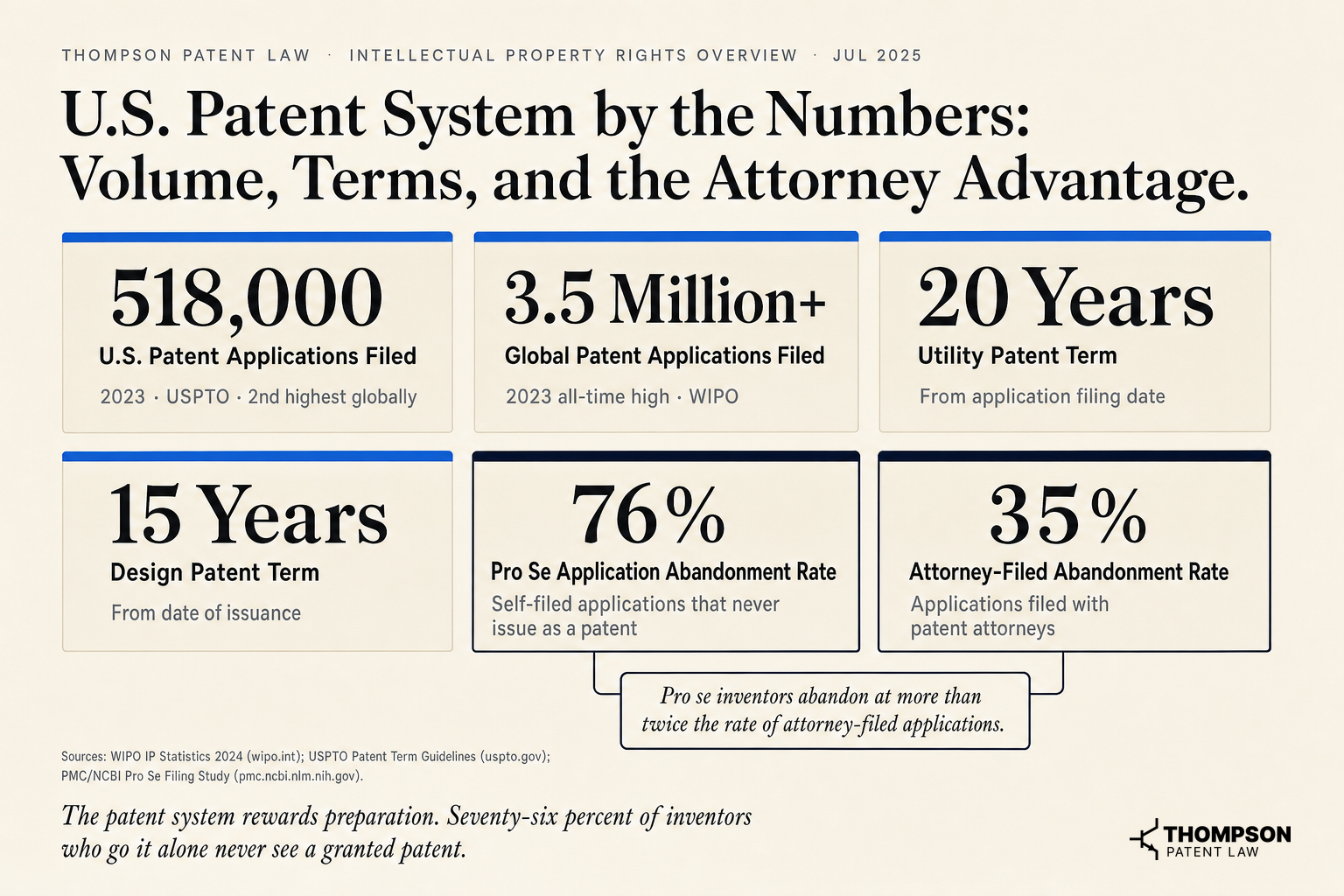
IP rights cover intangible assets, not the physical object itself. A patent protects the invention, the method or apparatus, not the specific machine sitting on your shelf. If you want a fuller picture of where the boundary falls, our explainer on what a patent protects walks through it. Copyright protects the expression in a book, not the paper it is printed on, and these legal protections travel with the creation wherever someone tries to reproduce it. This distinction matters because it means your rights travel with the idea wherever someone tries to reproduce it. Globally, IP protection is everywhere. In 2023, inventors worldwide filed over 3.5 million patent applications, an all-time high, according to WIPO.
Why Exclusive Rights Matter for Business Value
Exclusive rights translate directly into money. They support licensing revenue, investor confidence, competitive advantage, and market exclusivity. The scale is enormous. The USPTO found that 81 IP-intensive industries accounted for $7.8 trillion of U.S. GDP, roughly 41 percent of the total, and supported 47.2 million jobs in 2019. For a closer look at how IP supports a company, see our overview for business owners.
The Boundaries What IP Rights Cannot Do
IP rights are not unlimited. Each has scope limits, duration limits, and carve-outs. Copyright does not protect ideas, facts, or functional systems. Under 17 U.S.C. § 102(b), copyright never extends to any idea, procedure, process, system, or method of operation. Patents do not cover abstract ideas. Trademarks only protect source identification. Knowing these limits is as important as knowing what each right covers.
How Patents Protect Inventions Under U.S. Patent Law
The United States is one of the busiest patent jurisdictions on earth. In 2023, the U.S. patent office received about 518,000 patent applications, second only to China, according to WIPO. A granted utility patent confers an exclusive right for a limited period of 20 years from the filing date, the most powerful form of intellectual property protection most inventors will ever hold. If you are weighing whether you even need one, our guide on whether you need a patent to sell a product is a useful starting point.
What Qualifies as a Patentable Invention
Under 35 U.S.C. § 101, a patentable invention must fall into one of four statutory categories, a process, a machine, a manufacture, or a composition of matter. Abstract ideas, laws of nature, and natural phenomena are excluded. Beyond category, patent law imposes three core requirements. The invention must be novel, non-obvious, and useful. Obviousness is the single most common reason applications are rejected, which is why how you frame the invention matters from the first draft. Our breakdown of utility patent requirements covers each of these in depth.
Types of Patents Utility, Design, and the Provisional Application
U.S. patent law offers several patent types. Utility patents cover how something works and run 20 years from filing. Design patents cover the ornamental appearance of an article and last 15 years from issuance. A provisional patent application is a placeholder that establishes a priority date without starting the 20-year clock, and it is available for utility patents only, not design patents.
How Patent Rights Are Enforced and Why Claim Scope Matters
A patent is only as strong as its claims, and the patent holder's ability to enforce those rights depends entirely on their scope and quality. Patent claims define the legal boundary of your exclusive right, and narrow or poorly drafted claims leave competitors free to design around you. Patent infringement occurs when someone makes, uses, sells, or imports the claimed invention without authorization from the patent owner. The commercial value lives in the claims, not in the fact that a certificate was granted. For the mechanics of getting strong claims allowed, see our guide on how to draft patent claims that get allowed.
What Copyright Law Covers for Creators of Original Works
Copyright protection attaches the moment you fix an original work in a tangible medium of expression. No application, no examination, no waiting. This makes copyright the most accessible form of intellectual property protection, and also the most misunderstood, because protection existing and being able to enforce it are two different things.
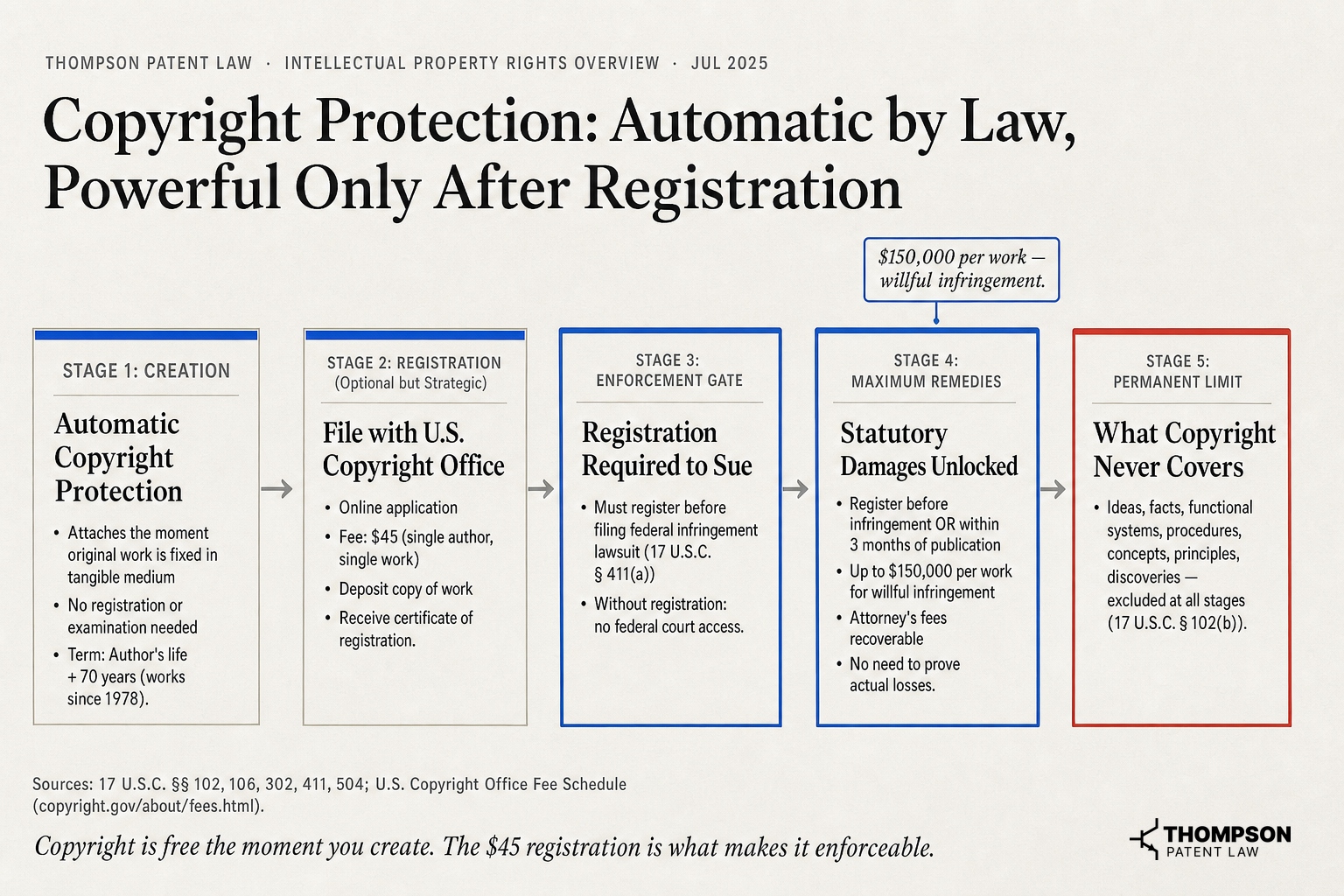 Copyright Protection: Automatic by Law, Powerful Only After Registration — Source: U.S. Copyright Office Fee Schedule; 17 U.S.C. §§ 102, 411, 504
How Copyright Protection Arises Automatically
Under 17 U.S.C. § 102(a), copyright exists upon creation. The categories of copyrighted works are broad, literary works, musical works, dramatic works, artistic works, sound recordings, and computer programs all qualify. The U.S. Copyright Office confirms that original works of authorship are protected automatically. Registration is not required for protection to exist, but it is required before you can sue.
The Rights a Copyright Holder Actually Controls
Copyright is a bundle of separate exclusive rights under 17 U.S.C. § 106: reproduction, distribution, public display, public performance, and creation of derivative works. The copyright holder can license each right independently. This is exactly how music licensing, book publishing deals, and software agreements are structured, slicing one work into multiple revenue streams.
Copyright Duration and the Public Domain
For works created after January 1, 1978, copyright protection lasts the life of the author plus 70 years. After that, copyrighted works enter the public domain and anyone can use them freely. Works first published in 1927, for instance, entered the U.S. public domain in 2023. Copyright protection on fact-heavy compilations is thin, because the underlying facts remain free for all.
How Trademarks Protect Brand Identity and Source Recognition
About 3.1 million U.S. trademark registrations were active in 2022, a measure of how thoroughly brands saturate commerce. Trademarks are the IP right that protects the link between a product and the company that makes it, which is a different job entirely from protecting the product.
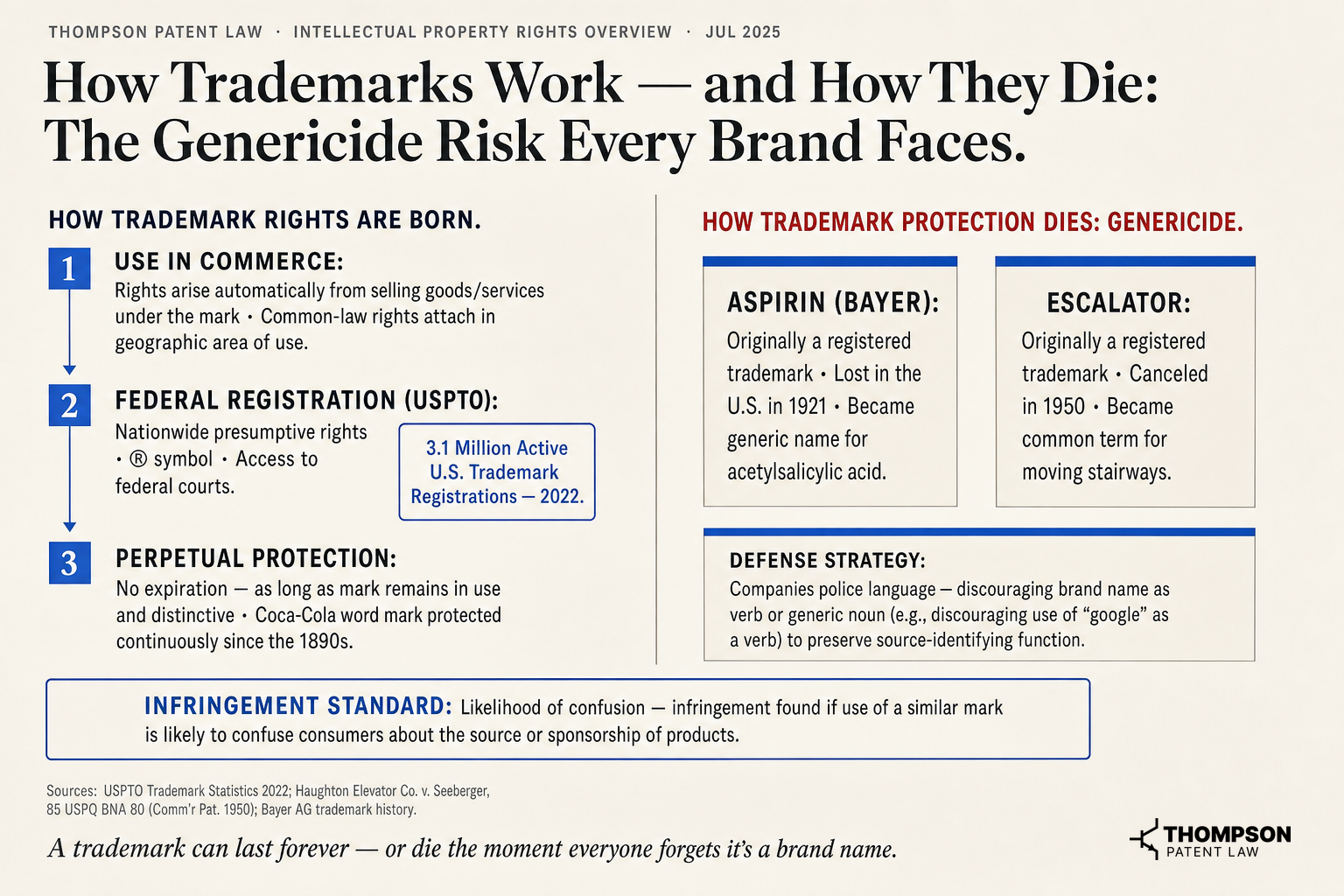 How Trademarks Work — and How They Die: The Genericide Risk Every Brand Faces — Source: USPTO Trademark Statistics 2022; Haughton Elevator Co. v. Seeberger, 85 USPQ BNA 80 (Comm'r Pat. 1950)
What a Trademark Actually Is And What It Isn't
A trademark is any word, name, symbol, device, or combination used to identify the source of goods or services and distinguish them from competitors. A service mark does the same job for services, and both trademarks and service marks are registered with the USPTO to obtain federal protection. Trademark rights protect source identification, not creative expression and not inventions. Your logo, your product name, your tagline, those are trademark territory.
Federal Registration Versus Common Law Trademark Rights
In the United States, trademark rights arise from use in commerce. Simply selling goods under a mark gives you common law rights in your geographic area. Federal registration with the USPTO expands that dramatically, providing nationwide constructive notice, the right to use the ® symbol alongside a registered trademark, and a stronger foundation for enforcement. A trademark search and clearance check before adopting a name prevents adopting a brand someone else already owns.
Trademark Infringement and the Likelihood of Confusion Standard
Trademark infringement turns on a single test, whether the use of a similar mark is likely to confuse consumers about the source of goods or services, a standard rooted in unfair competition principles. Trademark rights can last indefinitely with continued use, but they can also be lost. Genericide kills a mark when it becomes the common name for the product. "Escalator" was a trademark until 1950, when a commissioner ruled it had become generic in Haughton Elevator Co. v. Seeberger. Active use and policing keep a mark alive.
Why Trade Secrets Offer Protection Without Registration
The Coca-Cola formula has been protected as a trade secret since the company's early years, far longer than any patent could ever run. That single fact captures the entire appeal and the entire risk of trade secret protection. There is no registration, no expiration, and no examination, but the protection vanishes the instant secrecy fails.
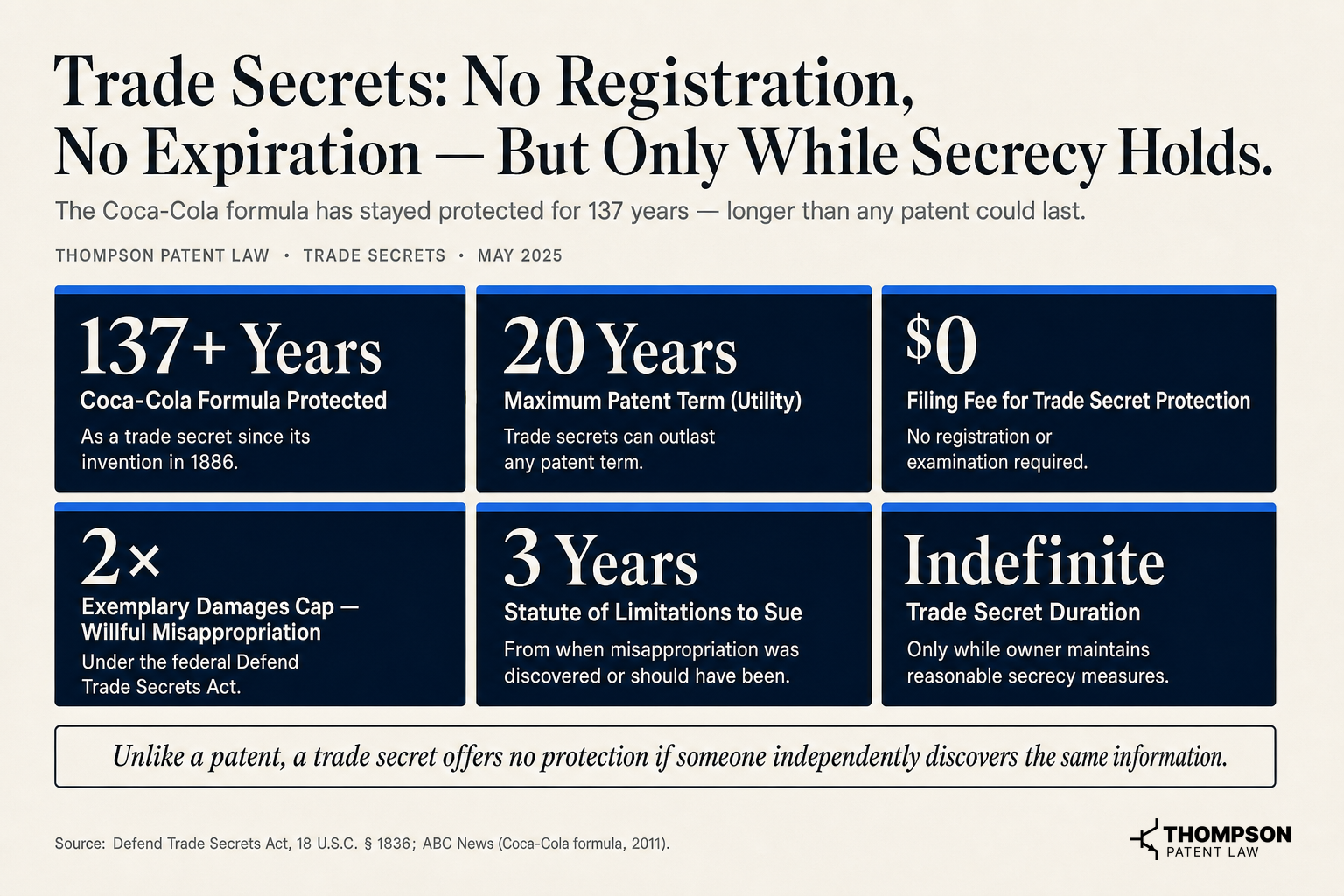 Trade Secrets: No Registration, No Expiration — But Only While Secrecy Holds — Source: Defend Trade Secrets Act, 18 U.S.C. § 1836; ABC News, 2011
What Makes Information a Protectable Trade Secret
A trade secret is confidential business information that gives a competitive economic advantage, provided the owner takes reasonable measures to keep it secret. Manufacturing processes, formulas, customer lists, algorithms, and business strategies all qualify. Under the Defend Trade Secrets Act of 2016, information qualifies only if the owner took reasonable measures to keep it secret, it derives independent economic value from being unknown, and it has some industrial application or commercial use. State laws based on the Uniform Trade Secrets Act provide parallel protection.
Trade Secrets vs Patents Choosing the Right Strategy
The trade-off is fundamental. A patent discloses your invention publicly in exchange for a time-limited exclusive right of 20 years. A trade secret can last forever but disappears if someone independently invents or reverse-engineers it. Coca-Cola chose secrecy because a formula can be hidden indefinitely. Choosing between patent and trade secret protection is one of the core decisions in any IP strategy.
Non-Disclosure Agreements as a Trade Secret Tool
Non-disclosure agreements contractually bind partners, employees, and investors not to disclose confidential information. An NDA is not itself an IP right, but it serves as evidence that you took reasonable measures to protect your trade secrets. It supports protection without replacing it.
The Four Main IP Types Side by Side for Inventors and Creators
Most valuable products carry more than one type of intellectual property at once, and the difference between a strong position and a weak one is whether you recognize and claim all of them. Intangible assets now make up roughly 90 percent of the market value of S&P 500 companies, according to Ocean Tomo, so layering your rights is not academic.
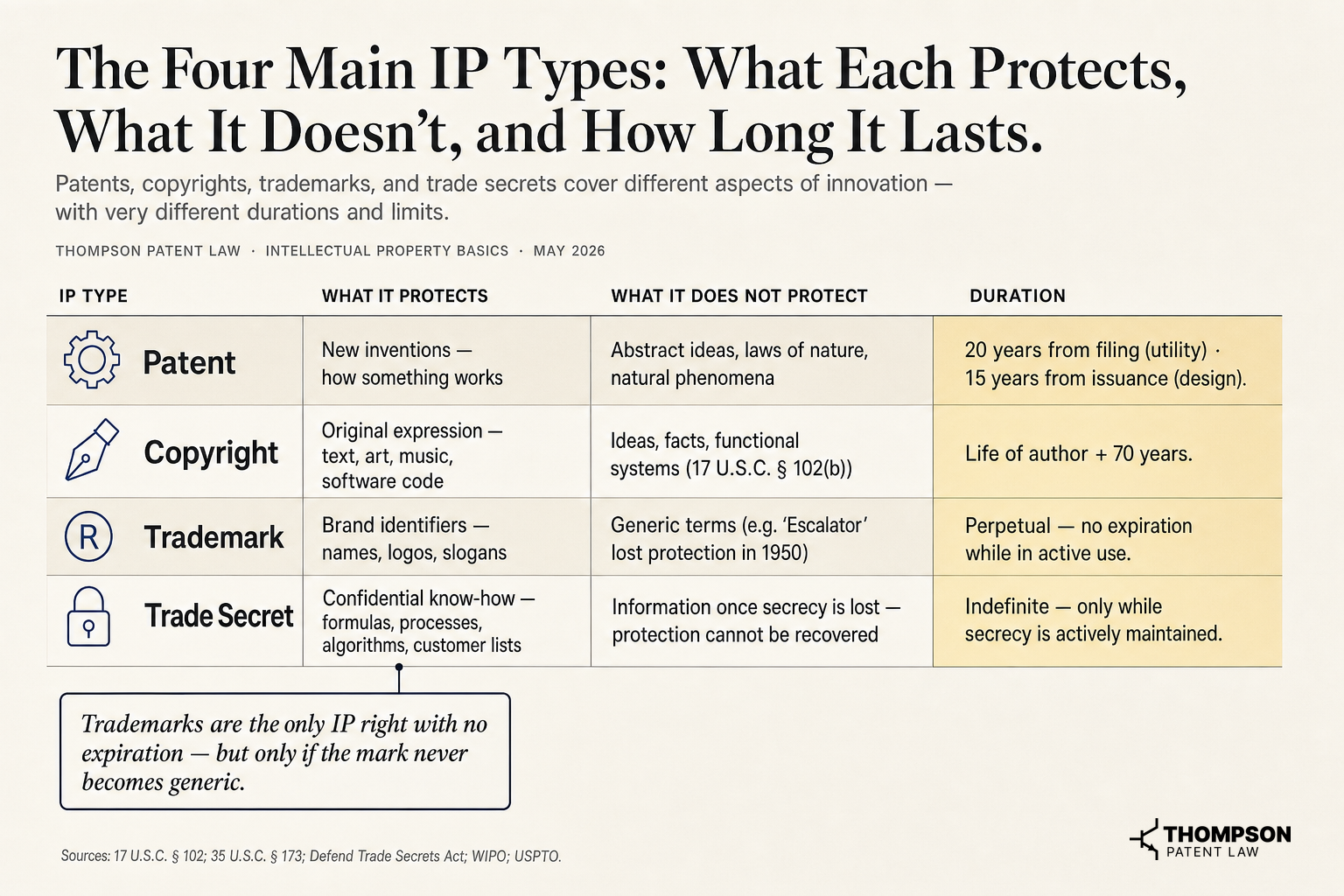 The Four Main IP Types: What Each Protects, What It Doesn't, and How Long It Lasts — Source: 17 U.S.C. § 102; 35 U.S.C. § 173; Defend Trade Secrets Act 18 U.S.C. § 1836; WIPO; USPTO
Which IP Rights Apply to Inventors
Inventors building new technologies typically need patents for functional innovations and novel apparatus, trade secrets for unpatented know-how, and trademarks for the brand around the product. Many inventions qualify for overlapping intellectual property protection across multiple categories at the same time. Relying on a patent alone usually leaves value on the table. It is worth noting that patents come in narrow statutory families, utility and design, and the United States separately recognizes plant patents for certain asexually reproduced varieties, though those rarely concern technology founders or creators.
Which IP Rights Apply to Creators of Creative Works
Authors, designers, musicians, and software developers lean on copyright for original copyrighted works, trademark for their studio or creator brand, and trade secrets for unpublished methods. Software is the clearest example of overlap. Code qualifies for copyright protection as a literary work among copyrighted works, while the underlying method or system may qualify for patent protection.
When IP Categories Overlap and Why That Matters Strategically
Consider a single software application. The code is protected by copyright, the method by patent, the brand name and logo by trademark, and the proprietary algorithm by trade secret. Recognizing and claiming all four builds a far more defensible position than relying on any one. A layered IP strategy is much harder for a competitor to route around.
How U.S. Patent Law Fits Into the Global IP Framework
A united states patent protects you in the United States only. Cross a border without foreign protection and competitors there are free to copy you. The 518,000 U.S. patent applications filed in 2023 sit within a global total of more than 3.5 million, with China's CNIPA leading at roughly 1.64 million, according to WIPO. International treaties exist precisely to bridge these national borders.
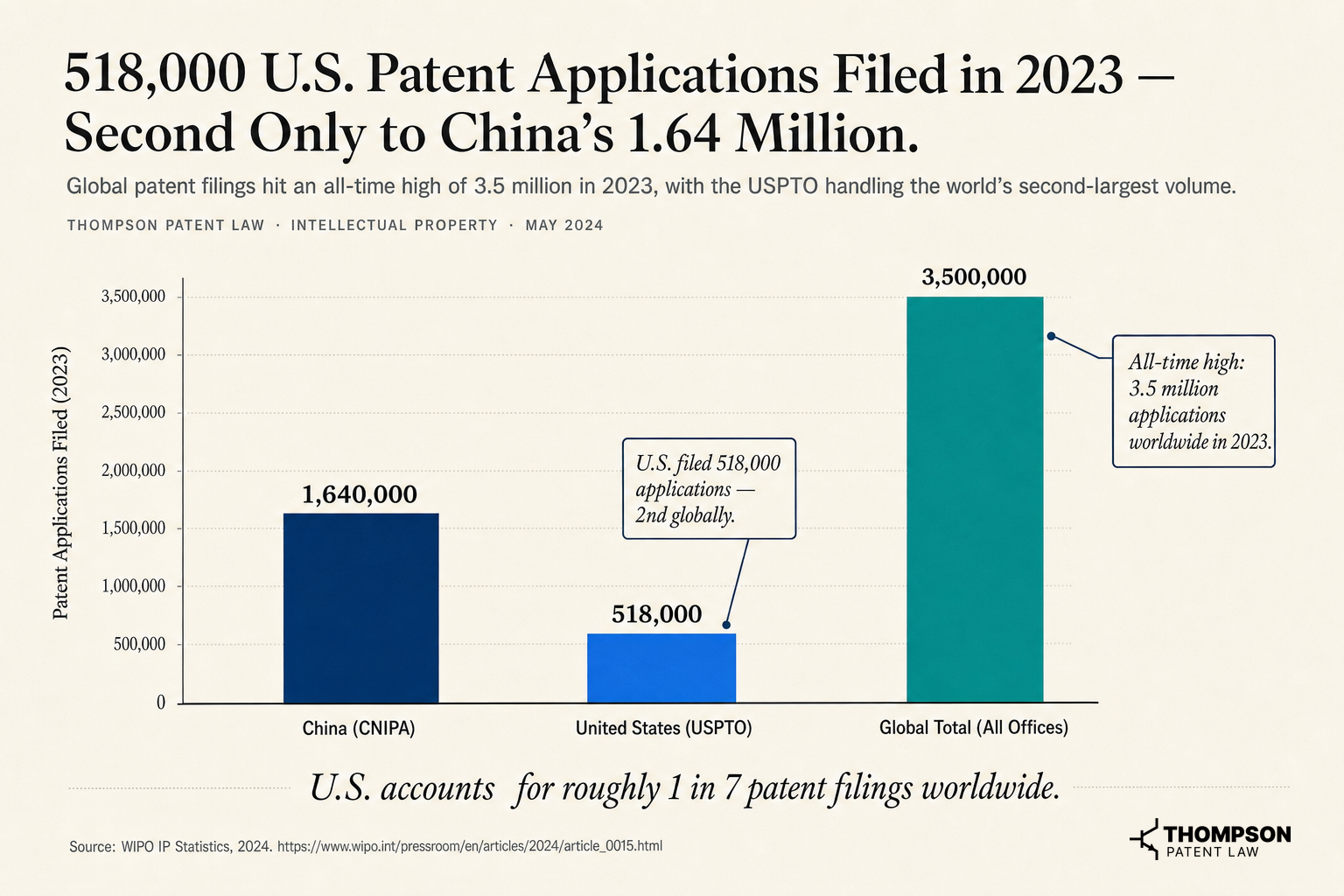 518,000 U.S. Patent Applications Filed in 2023 — Second Only to China's 1.64 Million — Source: WIPO IP Statistics, 2024
The Role of WIPO and International IP Standards
The World Intellectual Property Organization is the United Nations agency for global IP. It administers the key treaties, including the Patent Cooperation Treaty for international patent applications, the Berne Convention for copyright, and the Paris Convention for industrial property. The PCT now has 158 member states, letting an inventor pursue protection across many countries through a single filing.
The TRIPS Agreement and Minimum Standards for IP Rights
The Agreement on Trade-Related Aspects of Intellectual Property Rights, known as TRIPS and administered by the World Trade Organization, sets minimum standards all WTO member countries must meet. These trade related aspects include a minimum 20-year patent term, baseline copyright terms, trade secret protections, and standards that developed countries pushed to establish a global IP floor. TRIPS matters because it guarantees a floor of protection across most of your trading partners, supporting economic growth by reducing IP-related barriers to trade.
Geographical Indications and Industrial Designs in International IP
Geographical indications identify a product as originating from a specific region where quality or reputation is tied to that origin, like Champagne or Parmigiano Reggiano. Industrial designs protect the ornamental or aesthetic aspects of a product. Both are valid IP categories under the WIPO framework that U.S.-based inventors with international reach often overlook.
What the U.S. Patent Office Actually Does in the Patent Process
The U.S. patent office does not rubber-stamp applications. Its examination process is adversarial, which is the single biggest reason professional claim drafting matters from the first filing. A self-filed application is abandoned without issuing at a far higher rate than an attorney-drafted one, according to research published in PMC, which found that pro se applications were abandoned at a substantially higher rate than attorney-filed applications. The full process for filing a patent is worth understanding before you start.
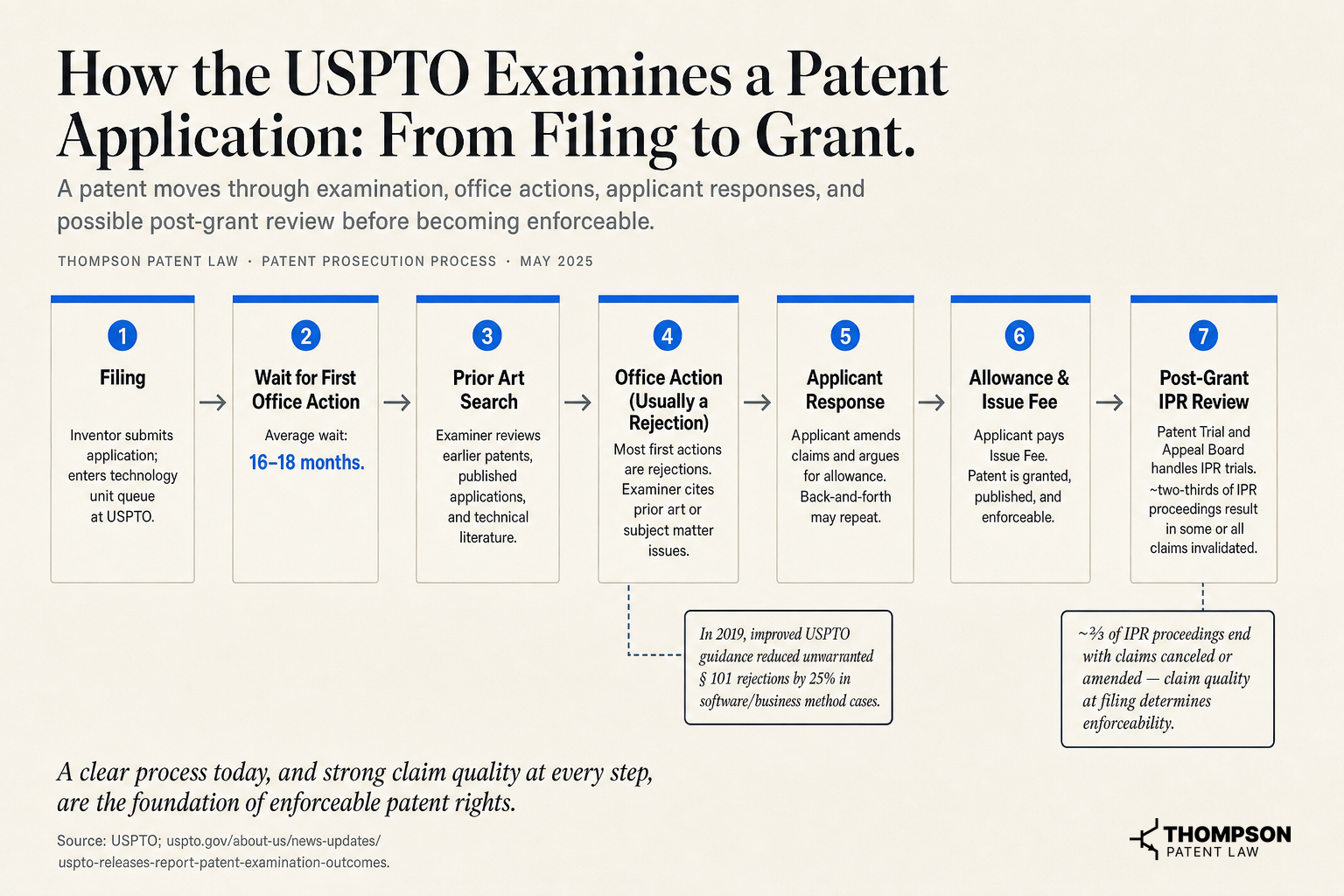 How the USPTO Examines a Patent Application: From Filing to Grant — Source: USPTO Patent Examination Report; USPTO Alice/§101 Guidance Report, 2019
From Application to Examination How the USPTO Reviews Patent Applications
When you file with the United States Patent and Trademark Office, your application is assigned to a patent examiner with technical expertise in your field, and patent attorneys typically manage this process to maximize the chance of allowance. The examiner runs a prior art search and issues an Office Action that accepts or, far more often, rejects the claims. A new application typically waits well over a year for its first Office Action. The applicant then amends and argues until the application is allowed or finally rejected. Our step-by-step guide on how to patent a product maps the full sequence.
Prior Art and Why Novelty Is the First Gating Requirement
Prior art is any publicly available evidence that your invention existed before your priority date, including prior patents, published articles, public demonstrations, or prior commercial use. A prior art search before filing is critical. The U.S. patent office maintains a public patent database that serves as a starting research tool. Skip the search and you risk investing in an application that an existing reference will defeat.
The Patent Cooperation Treaty and Filing Internationally
A single Patent Cooperation Treaty application filed through the USPTO establishes a priority date and begins examination across more than 150 countries. It gives you up to 30 months from the priority date to decide which national patent offices to enter. Compared with filing directly in each country, the PCT delays and consolidates the heaviest costs.
How Copyright Registration Works Through the U.S. Copyright Office
Copyright registration unlocks statutory damages of up to $150,000 per work for willful infringement, an amount that often dwarfs any provable actual loss. That single remedy is why registration, although optional for protection, is rarely optional in practice for any work with commercial value.
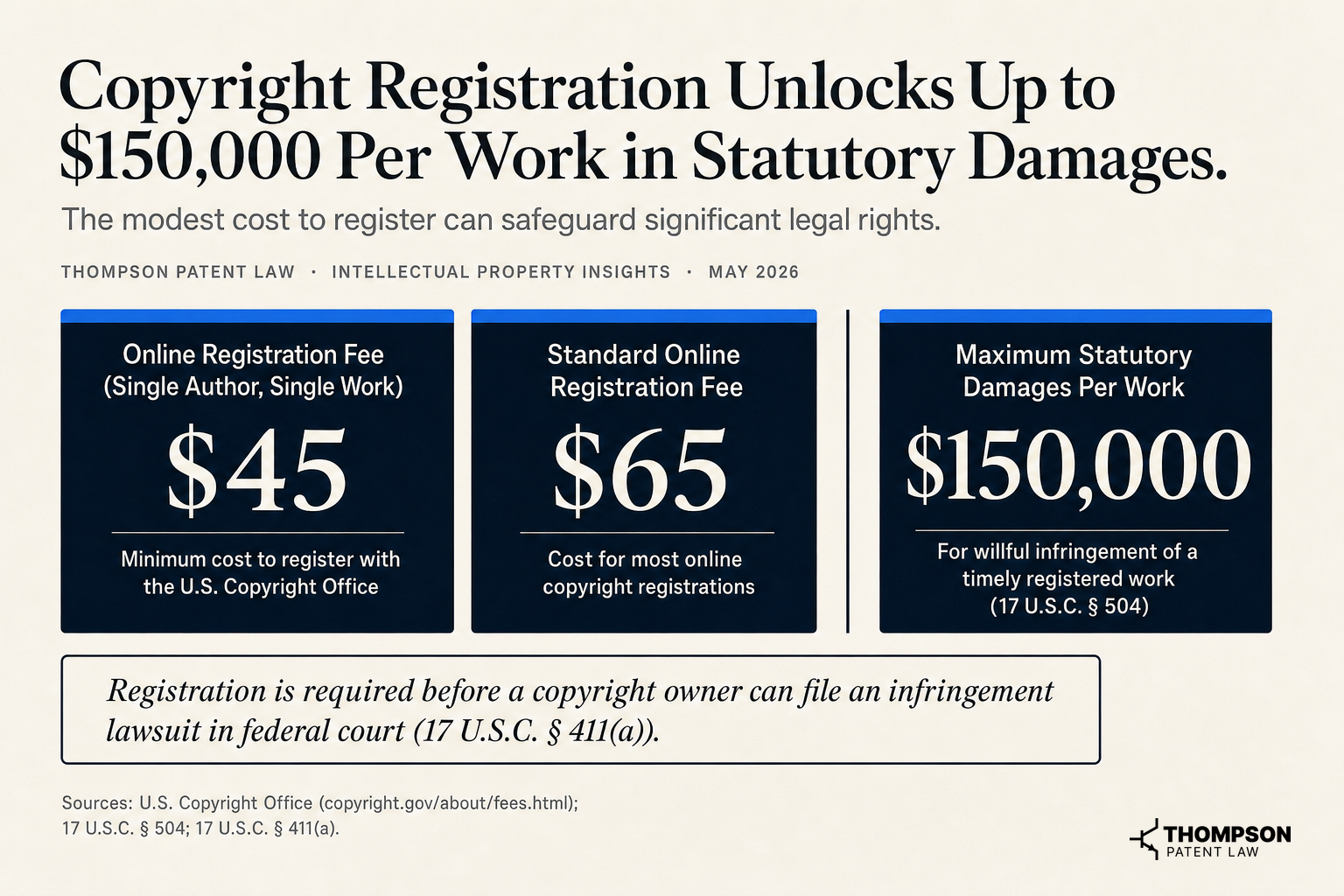 Copyright Registration Unlocks Up to $150,000 Per Work in Statutory Damages — Source: U.S. Copyright Office Fee Schedule; 17 U.S.C. § 504; 17 U.S.C. § 411(a)
Registration Is Optional but Strategically Important
Copyright exists automatically, but registration with the U.S. copyright office creates a public record of copyright ownership and is required before you can file an infringement lawsuit in federal court under 17 U.S.C. § 411. It is also inexpensive relative to the protection it secures. Registering copyrighted works is a modest investment that preserves access to statutory damages and attorneys' fees, and every copyright owner should complete this step before commercial release. Register before infringement occurs.
What Copyright Registration Does and Does Not Cover
Registration covers the specific version of the work you deposit. It protects original works but not facts, ideas, systems, or methods of operation. When you build on someone else's copyrighted work, you may be creating a derivative work that requires permission. Registration is fast and inexpensive relative to patents, which makes it a baseline step for any creator producing original copyrighted works.
Copyright in the Digital Age Software, Code, and Computer Programs
Computer programs, including computer software of all kinds, are protected as literary works under U.S. copyright law. Copyright protects the specific expression of your code, not the underlying functional idea, which is patent territory. That gap is exactly why software developers so often need both copyright protection for the code and a patent for the method the code implements. If you are wondering where that line falls, our piece on whether you can patent computer code breaks it down.
The Strategic Difference Between Strong IP and Weak IP
Not all patents are created equal. A granted patent is not automatically valuable, and a weak one can be worse than none at all because it lulls you into a false sense of security while leaving competitors free. Among patents challenged through inter partes review, a significant share end with claims canceled or amended, a reminder that issuance is not the same as strength. With sophisticated claim drafting up front, though, inventors can build patents that hold up under exactly this kind of challenge.
Why Not All Patents Are Created Equal
Narrow claims, poor specification support, or concessions made during prosecution can produce a patent competitors design around in an afternoon. A weak patent can even help competitors by mapping out a narrow protected space and signaling that the broader field is open. Prosecution strategy, not just the existence of a filing, determines whether a patent does any work.
How Claim Drafting Quality Determines Enforcement Value
Patent claims are the legal boundary of the right. Broad, well-supported independent claims combined with progressively narrower dependent claims create layered protection that holds up under challenge. A patent drafted for convenience rather than strategy provides thin coverage. Claim drafting is a high-stakes legal discipline, not administrative paperwork, and retrofitting weak claims after grant is often impossible. This is the core of Litigation Quality Patent® services, building claims engineered to survive challenge rather than simply to issue.
Common IP Strategy Mistakes That Hurt Inventors and Creators
The most frequent errors are predictable and largely preventable, public disclosure before filing, which destroys novelty, especially abroad, using a generic NDA that does not match the information at risk, relying on copyright alone for software while leaving the method unpatented, and failing to register trademarks before investing in brand equity. Each is a real, often irreversible risk for those who do not plan ahead, and each is straightforward to avoid with the right strategy in place.
When to Use a Provisional Patent Application as Your Starting Point
A provisional patent application buys you 12 months and a priority date at a fraction of the cost of a full utility filing. Used well, it is a powerful first move. Used carelessly, it offers a false sense of security that can collapse a year later. Our provisional patent timeline lays out the critical deadlines.
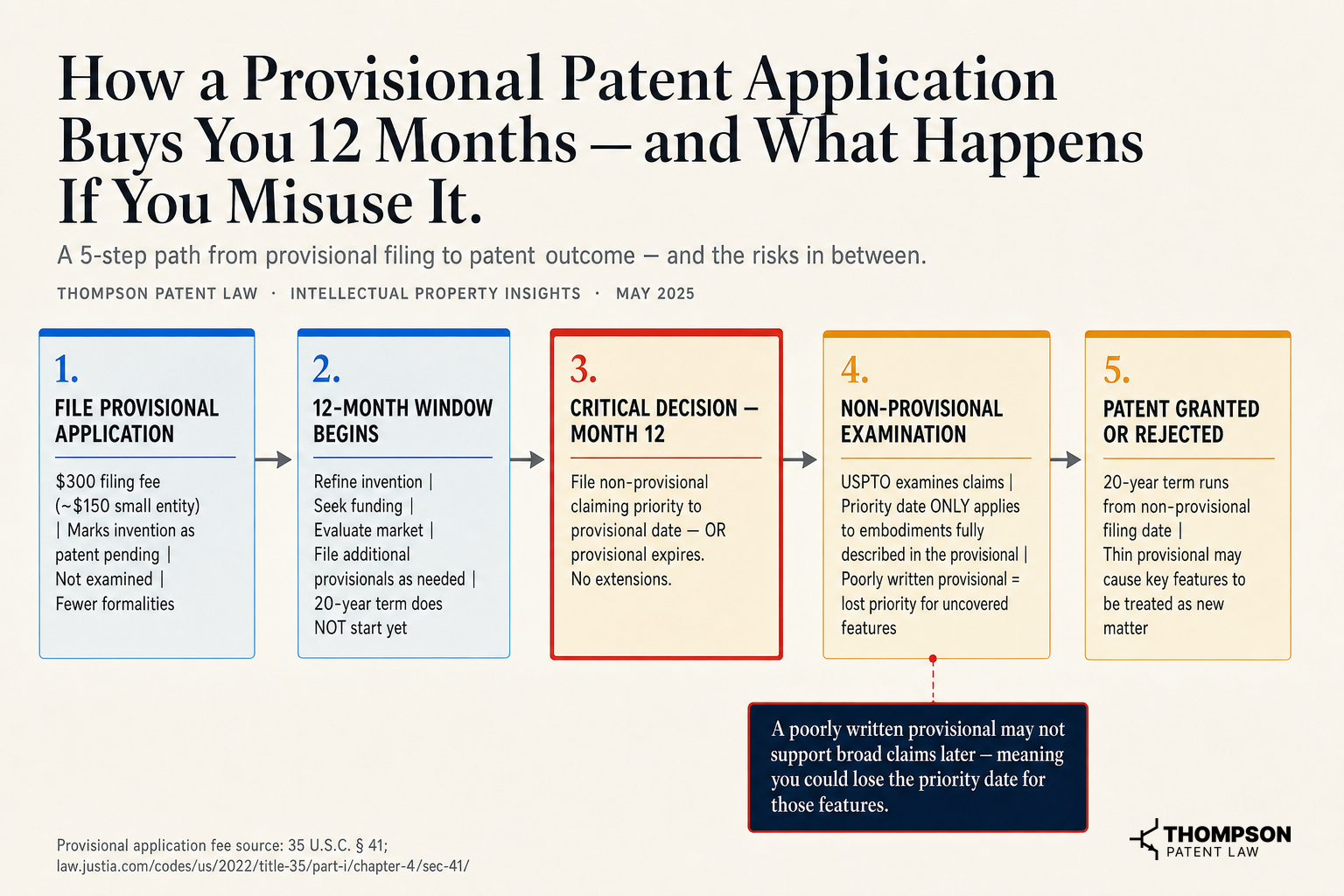 How a Provisional Patent Application Buys You 12 Months — and What Happens If You Misuse It — Source: 35 U.S.C. § 41; USPTO; Research text
What a Provisional Patent Application Does And Doesn't Do
A provisional patent application establishes a priority date with the USPTO at lower cost than a full utility patent application. It gives you 12 months to develop the invention, seek investors, and prepare a non-provisional application. Critically, it is never examined and never becomes a patent on its own, and it is available for utility patents only, not design patents. It buys time without starting the 20-year term.
How Provisionals Fit Into a Larger Patent Strategy
A provisional patent application is the right first step when the invention is early-stage, the budget is limited, or you need to test market fit before committing to full prosecution costs. It is the wrong move when a competitor may file first and speed to examination matters, or when the invention is already fully developed and ready for a complete application.
The Risk of Filing a Poorly Written Provisional
The priority date a provisional creates extends only to subject matter actually disclosed in it. A thin or incomplete provisional patent application may not support the full scope of the non-provisional claims you file 12 months later, effectively erasing your priority date for key elements. A provisional patent application is only as valuable as its technical disclosure.
How IP Rights Create Real Economic Value for Inventors and Businesses
Intellectual property rights are not abstract legal concepts. They are balance-sheet assets that drive economic development by rewarding innovation and enabling licensing markets. In 2022, U.S. businesses earned tens of billions of dollars from exports of IP licenses and royalties, according to the Bureau of Economic Analysis, making IP licensing a significant slice of international trade.
IP as a Business Asset Licensing, Valuation, and Investment Leverage
IP rights are assignable and licensable. A patent can generate royalty revenue without the inventor manufacturing anything. A trademark can be franchised. Copyrights are routinely sold and licensed. IP-intensive industries also pay substantially higher wages than non-IP industries, according to the USPTO, a sign of the economic value these rights concentrate. To understand why that value exists at all, see how patents act as an incentive to innovation.
IP and Investor Due Diligence in Startup Financing
For startups, IP is a funding prerequisite, not an afterthought, and technology transfer agreements often hinge on the strength of a startup's patent portfolio. Patent applications signal technical defensibility, and pending and granted patents appear on cap tables and due diligence checklists. Venture investors evaluate patent portfolios to gauge whether a startup can hold a defensible position, which is why early IP strategy directly affects whether a round closes.
IP Due Diligence Knowing What You Own Before You Need It
IP due diligence is the process of auditing what you own, what you have licensed in and out, and whether your freedom to operate is clear. It matters most before product launch, acquisition, or partnership. Gaps discovered during diligence, like a core technology that was never patented, are costly to fix retroactively and can lower a deal price or kill it.
What Happens When IP Rights Are Violated
IP violations carry severe legal and financial consequences across all four IP types, from copyright damages up to $150,000 per work to patent damages that can be tripled for willful infringement. The remedies are real, but so are the limits, and the limits often turn on whether you took the right steps before the violation occurred.
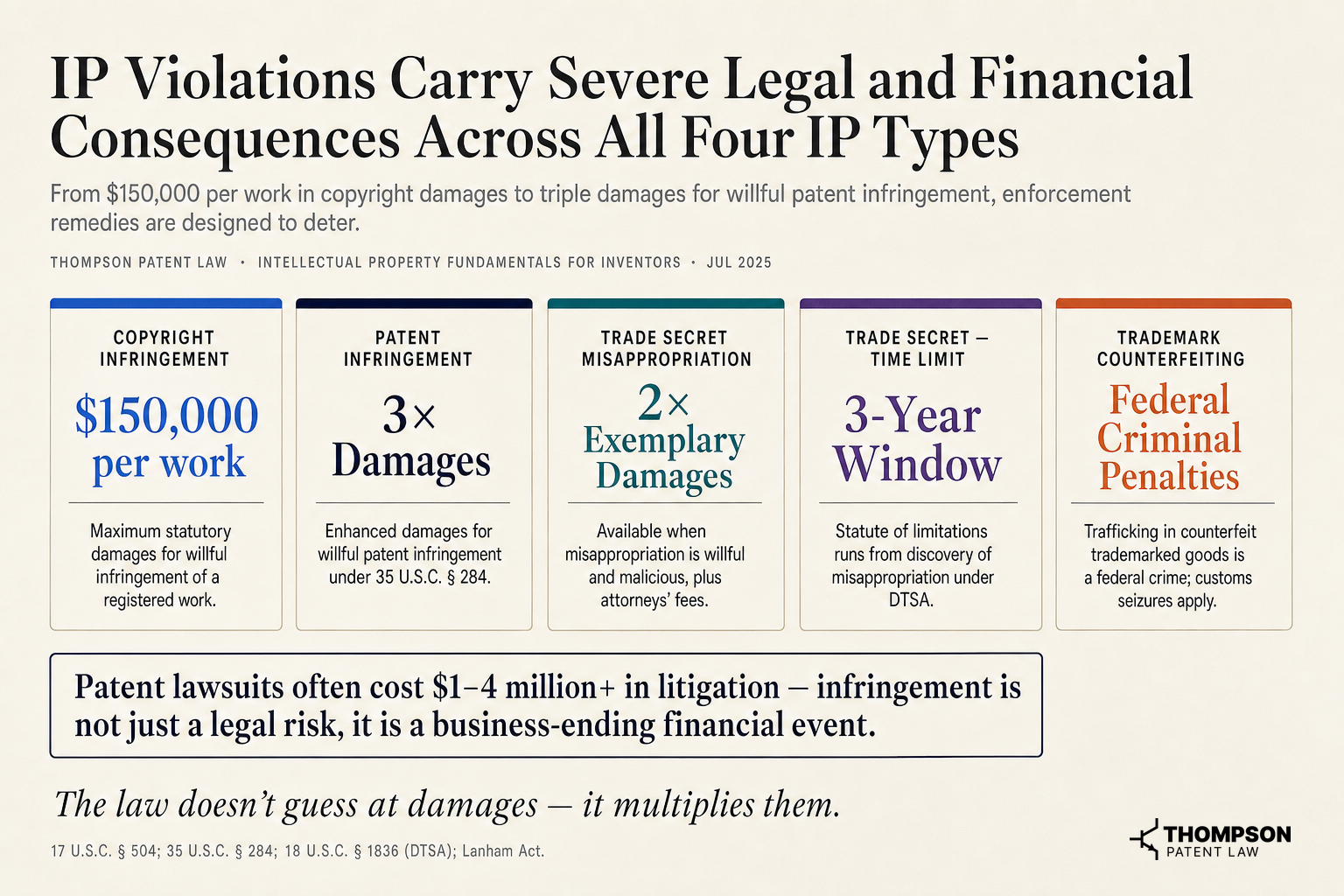 IP Violations Carry Severe Legal and Financial Consequences Across All Four IP Types — Source: 17 U.S.C. § 504; 35 U.S.C. § 284; 18 U.S.C. § 1836 (Defend Trade Secrets Act); Lanham Act
Copyright Infringement What It Is and What Remedies Exist
Copyright infringement is reproducing, distributing, displaying, performing, or making derivatives of copyrighted works without authorization. Remedies under the Copyright Act include injunctions, actual damages, and statutory damages for timely registered works. Copyright infringement does not require intent to be actionable, though willful infringement raises the damages ceiling to $150,000 per work. Registration before infringement is the prerequisite for statutory damages.
Patent Infringement Direct, Indirect, and Willful
Patent infringement comes in three forms, direct infringement, making, using, selling, or importing the patented invention without authorization, induced infringement, actively encouraging another to infringe, and contributory infringement, supplying a component with no substantial non-infringing use. Willful infringement can trigger treble damages under 35 U.S.C. § 284. Because patent infringement is strict liability, exposure exists even without knowledge of the patent, which is why freedom-to-operate analysis matters before launch.
Trade Secret Misappropriation and the Enforcement Window
Trade secret misappropriation under the DTSA and state law means acquiring a trade secret through improper means or disclosing it without consent. Remedies include injunctions, actual damages, and exemplary damages for willful misappropriation. Under the DTSA, claims must be brought within three years of discovery. Separately, patent infringement damages reach back no more than six years under 35 U.S.C. § 286. IP enforcement windows are finite, and delay can foreclose your remedies permanently.
The Role of IP in the Software and Technology Sector
Software is the clearest case in all of intellectual property law where relying on a single right is a mistake. A single product sits at the intersection of copyright for the code, patent for the method, trade secret for proprietary algorithms, and trademark for the branding. Leave any one gap and a competitor walks through it.
Why Software Innovation Requires a Layered IP Strategy
Copyright protects your code against literal copying, but it will not stop a competitor who independently writes new code that performs the same function. A patent can stop that, because it protects the underlying method rather than the expression. Software companies that lean on copyright alone leave their core methods exposed to anyone who reaches the same result by a different path.
Overcoming Alice Software Patents and Section 101 Eligibility
Software patents face a unique hurdle under Alice Corp. v. CLS Bank International (2014), which holds that an abstract idea implemented on a generic computer is not patent-eligible under 35 U.S.C. § 101, a challenge that does not apply in the same way to three types of traditional utility inventions, machines, manufactures, and compositions of matter. Claims that tie the innovation to a specific technical improvement can overcome a § 101 rejection. After the USPTO's 2019 guidance, eligibility rejections in affected areas dropped by about 75 percent, from roughly 40 percent to 10 percent, according to the USPTO, showing that careful claim framing changes outcomes.
AI Patents and the Emerging Questions Around Inventorship
Under current U.S. patent law, an AI cannot be listed as an inventor. A human who directs, controls, or contributes to the conception of the invention must be named. The Federal Circuit confirmed this in Thaler v. Vidal (2022), holding that the Patent Act requires a human inventor. When a person and an AI tool collaborate, joint inventorship rules apply, but a human must still be identified.
How to Start Building an IP Strategy Before Your First Filing
You almost certainly already own protectable intellectual property, and the most common mistake is not recognizing it before it is too late to protect. Copyright already covers the materials you have written. Trade secret law already covers confidential processes you keep internal. Patent-eligible methods may already sit inside the product you are developing.
The IP Audit Identifying What You Already Own
Start with an inventory. What have you created, when, and in what form does it exist? Original documents, diagrams, and code carry automatic copyright protection as copyrighted works. Confidential know-how qualifies as a trade secret if you mark it and control access. A product name used in commerce may carry common law trademark rights. The audit turns scattered work into a map of rights you can act on.
Timing Decisions When to File and When to Wait
In the United States, inventors get a one-year grace period after public disclosure to file a patent application. Most other countries require absolute novelty with no grace period at all. File too early with an incomplete disclosure and you get a weak application. Disclose publicly before filing and you can forfeit international rights entirely for those who do not plan their filing sequence carefully. The grace period is a risk buffer, not a strategy.
Getting a Complimentary Patent Needs Assessment as Your First Step
Speaking with our team before you file or disclose is the highest-leverage step an inventor can take. Once you engage the firm, a patent attorney identifies which IP rights apply, flags prior art risks, and builds a filing strategy matched to your business objective. This guide is written by Craige Thompson, a patent attorney, MBA, and electrical engineer, and Thompson Patent Law offers a Complimentary Patent Needs Assessment as a no-cost starting point for U.S.-based inventors and founders.
How International IP Treaties Protect Inventors Beyond U.S. Borders
Three treaties do most of the heavy lifting for inventors and creators operating globally, covering 158, 182, and 164 countries respectively. The Patent Cooperation Treaty handles patents, the Berne Convention handles copyright, and TRIPS sets the trade-wide floor. Together they make extending protection across borders far simpler than filing country by country from scratch.
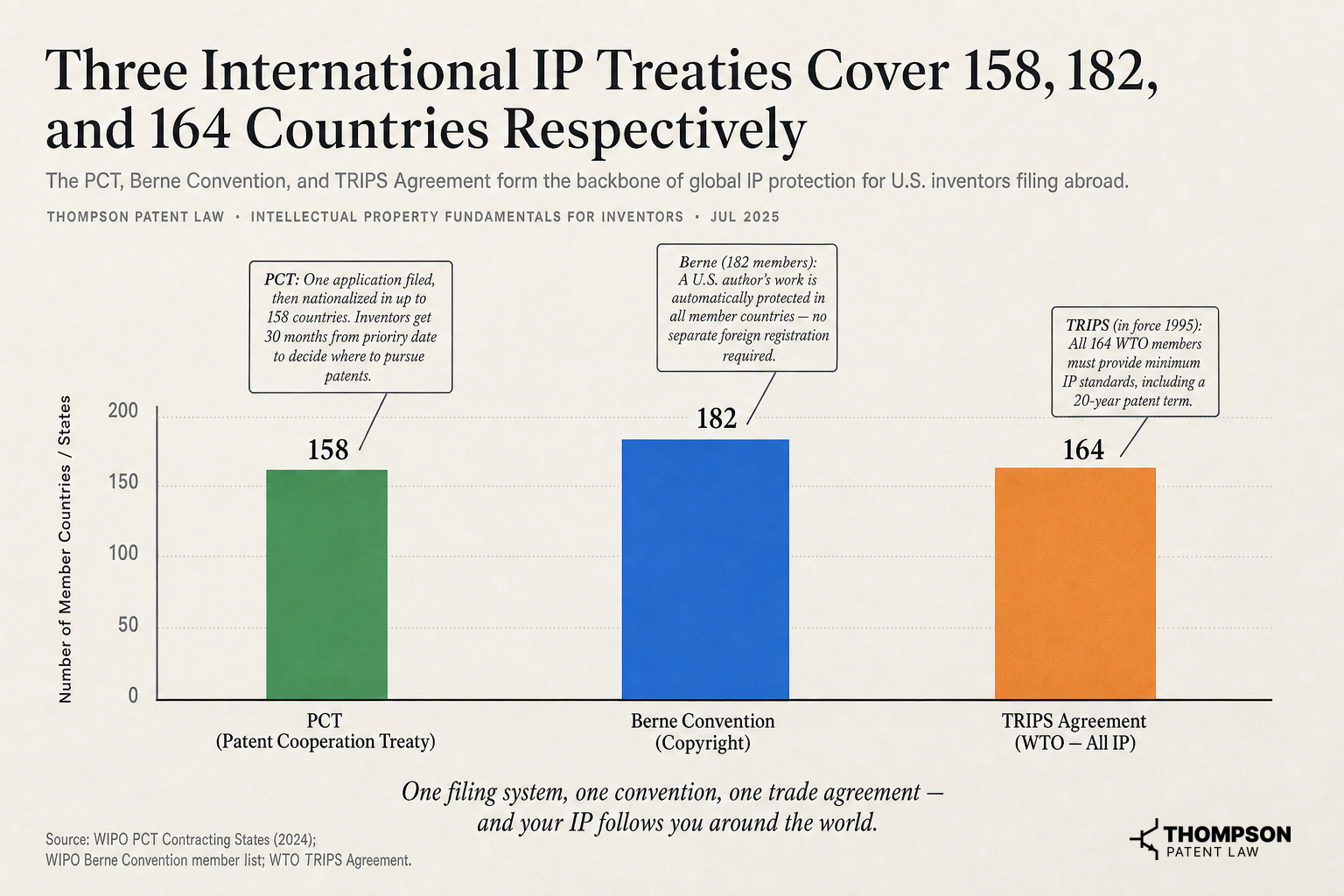 Three International IP Treaties Cover 158, 182, and 164 Countries Respectively — Source: WIPO PCT Contracting States, 2024; WIPO Berne Convention Members; WTO TRIPS Agreement
The Patent Cooperation Treaty One Application, 150+ Countries
A single Patent Cooperation Treaty application filed through the USPTO begins an international search phase, then lets you enter the national phase in individual countries by month 30. The PCT now spans 158 member states, making the united states patent system one node in a globally interconnected framework. It is not a global patent, because you must still enter and pay in each country, but it preserves your options while delaying the country-by-country costs.
The Berne Convention and Global Copyright Standards
The Berne Convention, administered by WIPO, provides automatic copyright protection for original copyrighted works across its 182 member countries with no registration formality in each one, and its copyright laws bind every member state to the principle of national treatment. A U.S. author's work is protected in every Berne member state under the principle of national treatment. Berne requires a minimum life-plus-50-year term, recognizes moral rights, and bars formality requirements.
TRIPS, the WTO, and Minimum IP Standards in Global Trade
Because TRIPS mandates minimum standards for all WTO member countries, inventors and creators licensing into international markets start with a baseline level of protection in those markets. But TRIPS sets a floor, not a ceiling. Protection quality and enforcement speed vary considerably above that floor, and the United States offers significantly stronger protection than many member states.
Frequently Asked Questions About Intellectual Property Rights
What is the basic introduction of IPR?
Intellectual property rights, or IPR, are legal rights that give creators and inventors exclusive control over their intangible creations for a defined period. The four main categories are patents for inventions, copyrights for creative works, trademarks for brand identifiers, and trade secrets for confidential business information. These rights exist because without them, competitors could freely copy innovations, erasing the incentive to invest in development. This basic introduction to intellectual property rights is the foundation every founder and creator should understand. According to WIPO, intellectual property covers creations of the mind used in commerce.
What is the introduction to the intellectual property law?
Intellectual property law is the body of federal and international law that creates, defines, and enforces IP rights across other types of creative and technical output beyond physical goods. In the United States, patent law and copyright law derive from Article I, Section 8 of the Constitution, which empowers Congress to promote the progress of science and useful arts. Federal statutes including the Patent Act, the Copyright Act, the Lanham Act, and the Defend Trade Secrets Act implement that power, while WIPO and WTO treaties coordinate standards internationally.
What are intellectual property rights in simple terms?
Think of intellectual property rights as property deeds for ideas. Just as a deed gives you exclusive control over a piece of land, an IP right gives you exclusive control over how a specific invention, brand, or creative work is used. A patent gives you the exclusive right to make, use, or sell your invention for up to 20 years. A copyright gives you the exclusive right to reproduce your creative work, and a trademark gives you the exclusive right to use your brand in commerce. Each right is enforced through the legal system.
What are the 4 pillars of IP?
The four pillars of intellectual property are patents, copyrights, trademarks, and trade secrets, and understanding the different types of rights within each pillar is essential for any inventor or creator. Patents protect inventions in exchange for public disclosure. Copyrights protect original works of authorship fixed in a tangible medium, including literary works, artistic works, musical works, software, and sound recordings, all of which fall under copyrighted works. Trademarks protect brand identifiers such as names and logos. Trade secrets protect confidential business information that provides competitive advantage as long as the owner takes reasonable measures to keep it secret. Most businesses hold assets in more than one pillar.
What is the introduction of intellectual property?
Intellectual property refers to creations of the human intellect, including inventions, literary and artistic works, designs, brands, and confidential processes. Unlike physical property, it has no tangible form, and its value comes from the exclusive legal rights attached to it. The first U.S. patent law dates to 1790, built on a simple premise. Granting time-limited exclusive rights incentivizes innovation by letting creators recover their investment. Today intangible assets like IP make up roughly 90 percent of the value of major companies, according to Ocean Tomo.
How are IP rights different from physical property rights?
Physical property rights attach to tangible objects like land and equipment, while intellectual property rights attach to intangible ideas, expressions, and identifiers. The practical difference is that IP rights must be created and defined through a legal system, since there is no physical possession to point to. A patent must be applied for and examined, a trademark is strongest when registered, and copyright on copyrighted works arises automatically but requires registration to enforce fully. Most IP rights also expire, unlike physical property, which makes proactive strategy essential.
Do I need an attorney to protect my intellectual property?
You are not legally required to use an attorney for most IP filings, but attempting the patent system without a registered patent attorney is one of the costliest mistakes inventors make. Research published in PMC found that self-filed patent applications were abandoned at a far higher rate than attorney-filed ones. Claim drafting is a legal and technical discipline, and claims written without expertise routinely produce patents competitors design around. A consultation with a patent attorney before any public disclosure is the highest-leverage step you can take.
Your Next Step if You Have an Invention or Creative Work to Protect
Intellectual property rights are the mechanism that converts creative output and technical innovation into protectable, enforceable, licensable business assets.Without them, competitors are legally free to copy what took you years and significant resources to build. This guide has walked through what each of the four IP rights covers, how they overlap, what the key legal requirements are, and where the most common and most expensive strategic mistakes occur, from disclosing too early to leaning on a single right when a layered strategy was available.
The bottom line, a weak patent that competitors design around in an afternoon can be worse than no patent at all, while a strong, strategically drafted patent becomes a defensible business asset that holds up under challenge. A copyright registration is inexpensive and protects automatically, but a patent earns its value through claim drafting that competitors cannot route around. A provisional patent application buys time, but only to the extent of what it actually discloses. The difference between strong protection and a false sense of security usually comes down to decisions made before the first filing, when an experienced patent attorney can still shape the outcome.
Every month you wait to lock in a priority date is a month a competitor can file first or a public disclosure can quietly destroy your foreign rights. In a first-to-file world, hesitation has a real and often irreversible price for inventors who delay, the better path is to move deliberately and early, with a strategy mapped before you file or disclose.
This article was written by Craige Thompson, a patent attorney, MBA, and electrical engineer who leads a team of registered patent attorneys with engineering degrees and backgrounds spanning industry and major law firms. The team's practice focuses on building strategically engineered patents rather than paperwork, with experience guiding everyone from individual inventors to Fortune 500 companies. If you have an invention or creative work worth protecting, the practical next step is to Schedule a Complimentary Patent Needs Assessment, a no-cost, no-commitment starting point where a member of our team helps identify which IP rights apply to your situation, flags timing risks, and maps out a strategy before a mistake gets made that cannot be undone.
Action items to take now:
- Schedule a Complimentary Patent Needs Assessment before you disclose your work to anyone outside an NDA.
- Inventory your existing IP, the copyrighted works, confidential processes, and patent-eligible methods you may already own.
- Run a prior art search and a trademark clearance check before you commit budget to a filing or a brand.
Done right, an early and layered IP strategy turns years of work into assets you can license, defend, and build a competitive advantage around. Done late, those same assets can slip into the public domain or into a competitor's hands. The return on getting it right early, measured in preserved rights and avoided rework, far outweighs the cost of acting before a mistake is made.
Keep Innovating,
Craige Thompson Patent Attorney, MBA, Electrical Engineer
Thompson Patent Law