- A patent is personal property under 35 U.S.C. § 261, so it can be sold, inherited, or assigned, but the transfer must be in writing and signed to be valid.
- Assignment permanently transfers patent ownership, while a patent license only grants permission to use the patented invention without giving up title.
- Record the assignment with the U.S. Patent Office within three months of signing, or it can become void against a later good-faith purchaser.
- A single joint owner cannot transfer the entire patent alone, so confirm every co-owner has assigned their rights before any deal.
- Chain of title gaps from DIY assignments can make a patent unenforceable or unsellable, as *Stanford v. Roche* showed when a flawed assignment cost a university its rights.
*Written by Craige Thompson, Patent Attorney, MBA, Electrical Engineer.* Craige Thompson is a Managing Principal Patent Attorney, electrical engineer, professional engineer, and MBA who helps innovators protect and monetize complex technologies. His experience spans patent prosecution, licensing, prior art searching, due diligence, opinions, reexamination, and litigation across electrical engineering, software, mechanical engineering, medical devices, and energy-efficiency technologies.
An inventor who spent four years building a technology sits across from an acquirer's lawyer, and the deal stalls on one question: does the patent actually transfer cleanly? A patent can be transferred under U.S. law, but a single missing signature, an unrecorded document, or a vague assignment agreement can collapse the entire transaction.
Every transfer analysis starts with the same foundational question: who are the inventors, and did every one of them transfer all of their rights to the person now purporting to sell or license the patent? Inventorship determines ownership, and a patent filed with the wrong inventor on record can quietly unravel an entire deal. This guide explains how patent transfer works in the United States, what forms it takes, what the U.S. Patent Office requires, and exactly where the process breaks down.
Yes a Patent Can Be Transferred and Here Is What That Means
Inventors are the natural owners of their patents. Under U.S. patent law, the right to a patent originates with the inventor, and every ownership chain traces back to that starting point. Before any transfer can be evaluated, the threshold question is whether the correct inventors were identified and whether each of them has properly transferred their rights.
U.S. law treats patents and pending patent applications as personal property. Under 35 U.S.C. § 261, patents "shall have the attributes of personal property" and are assignable "by an instrument in writing." A patent owner, whether an individual inventor, a company, or a federal agency, holds rights that are separable and transferable. The question is never whether transfer is allowed, but whether it is executed correctly. For a deeper look at how ownership missteps undermine value, see these patent ownership mistakes.
Patent Applications Can Transfer Before a Patent Issues
Transfer is not limited to an issued patent. A patent application, including a provisional application and a PCT application filed under the Patent Cooperation Treaty, can be assigned before the patent grants. A deal happening before grant should begin the transfer process immediately, with the assignment tied to the application number and filing date. If you are still early in the process, this simple guide to provisional patent application basics explains what you can transfer and when.
The Two Ways to Transfer Patent Rights Assignment vs Licensing
The USPTO recorded over 10.5 million patent assignments and other transactions since 1970, according to the USPTO Office of Chief Economist. The two transfer tools work very differently, and choosing the wrong one can quietly cost you ownership or revenue.
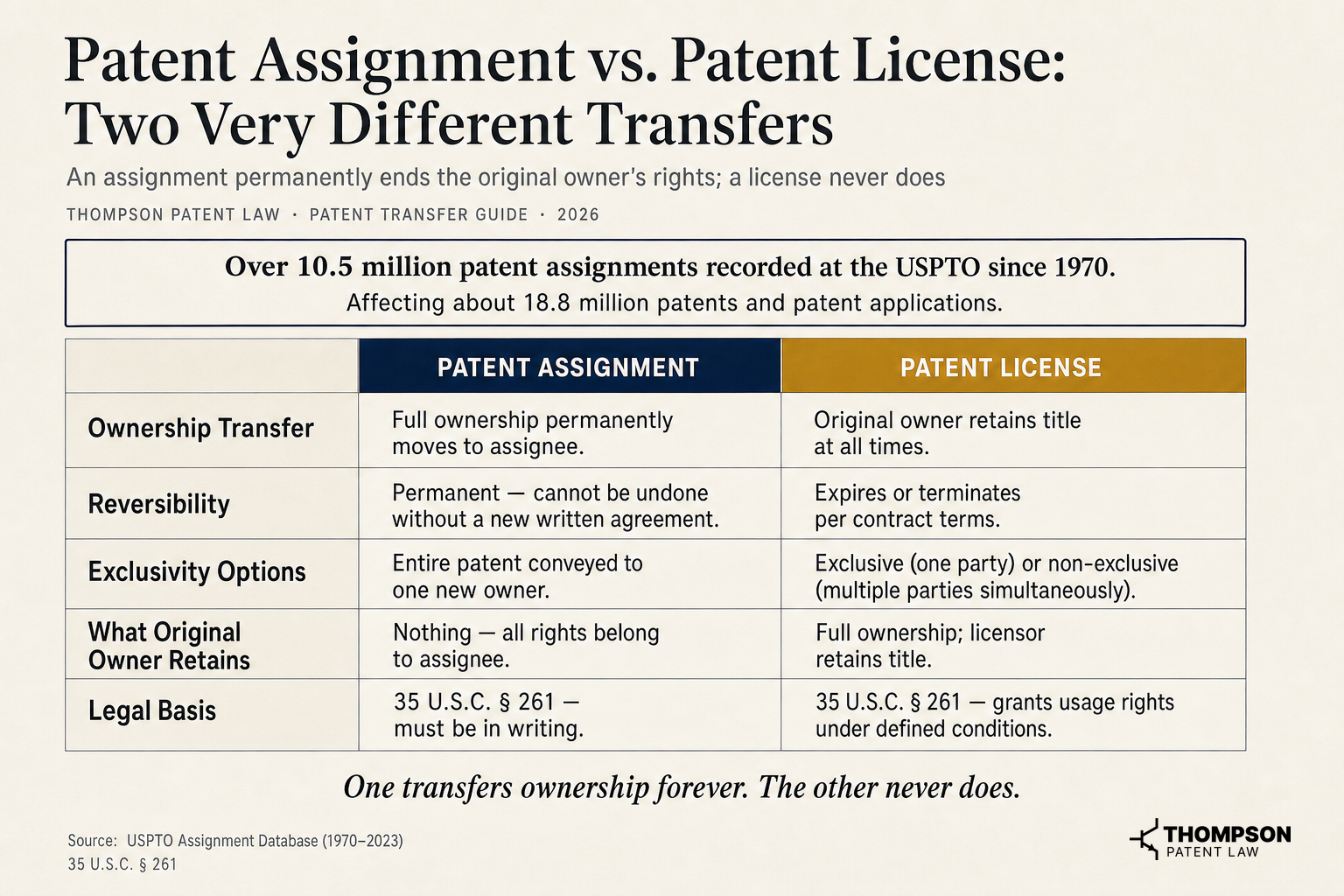 Patent Assignment vs. Patent License: Two Very Different Transfers — Source: USPTO Office of Chief Economist, 2024
What a Patent Assignment Actually Does
A patent assignment permanently transfers patent ownership. After a valid assignment, the original owner holds no rights to the patented invention, those rights belong entirely to the assignee. This is the right tool when a buyer wants full title. Large technology companies rely on this mechanism constantly, as detailed in this look at how patent acquisition became a billion-dollar weapon of big tech.
What a Patent License Does Instead
A patent license does not transfer ownership. It grants a third party permission to use the patented technology under defined terms while the patent holder keeps title. A license can be exclusive, granting rights to one party only, or non-exclusive. To monetize your patent without giving up ownership, licensing is the tool, not assignment.
What a Valid Patent Assignment Agreement Must Include
A patent assignment agreement must be in writing and signed by the patent owner to be enforceable. Under 35 U.S.C. § 261, oral agreements and handshake deals have no legal effect on patent title.
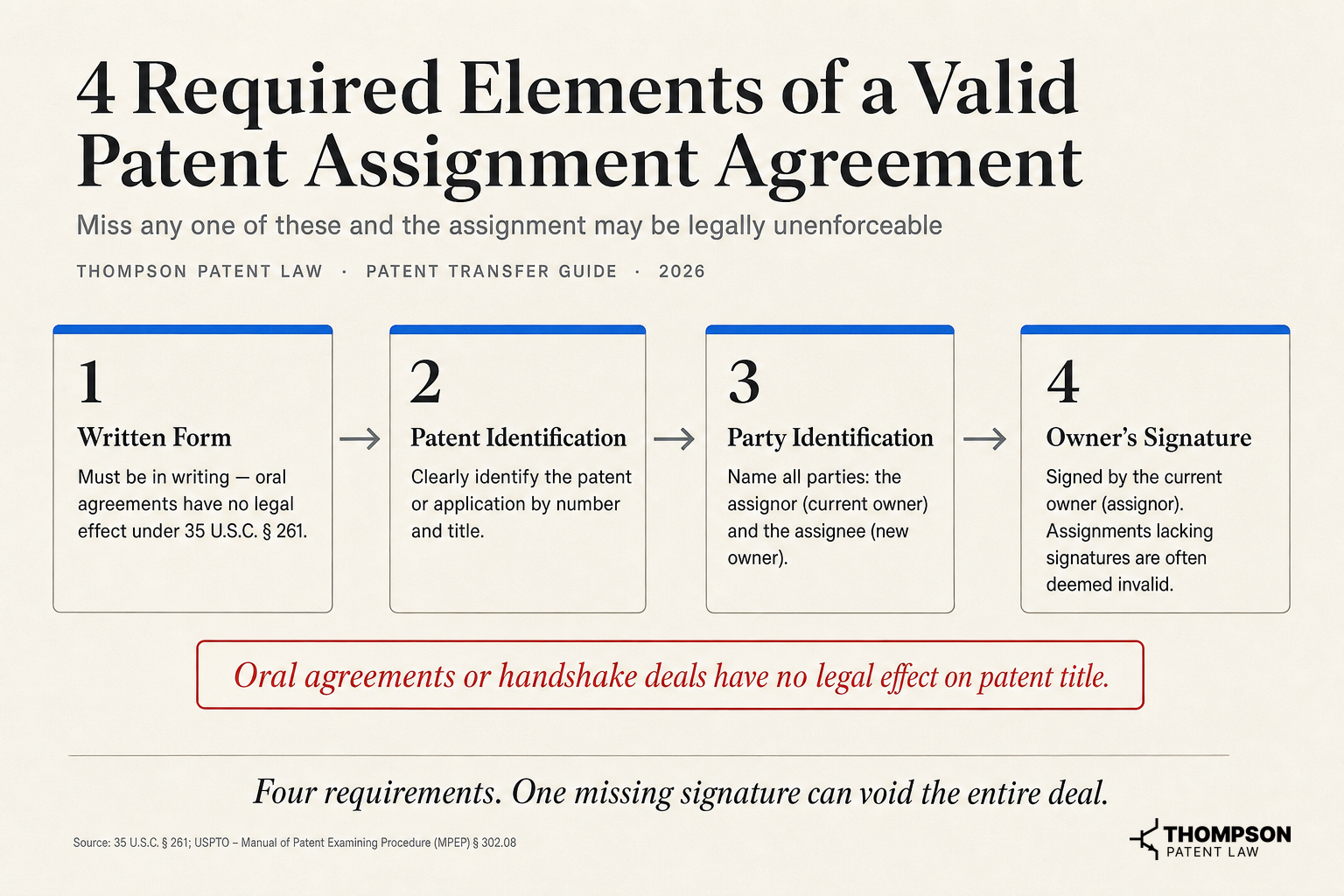 4 Required Elements of a Valid Patent Assignment Agreement — Source: 35 U.S.C. § 261, U.S. Code, 2026
The Core Requirements for an Enforceable Assignment
The agreement must clearly identify the patent or application by number and title, name the assignor and assignee, and be signed by the current patent owner. Four elements anchor a valid assignment, a written instrument, clear identification of the patented invention, named parties, and the owner's signature. Verbal deals mean nothing for patent ownership.
Warranties Representations and What Else to Address
A well-drafted agreement also includes representations of clear title, warranties against undisclosed liens, and provisions covering confidential information and ongoing patent prosecution. A bare-bones internet form often omits the protections that matter most in a dispute, including future rights to continuation and divisional applications. Precision matters most in technical fields, where patent counsel should speak fluent engineer to capture what the assignment actually covers.
How to Record a Patent Assignment With the USPTO
Recording an assignment with the United States Patent Office is not required to make the transfer valid between the two parties, but it is critical for protecting the new owner against third-party claims under intellectual property laws.
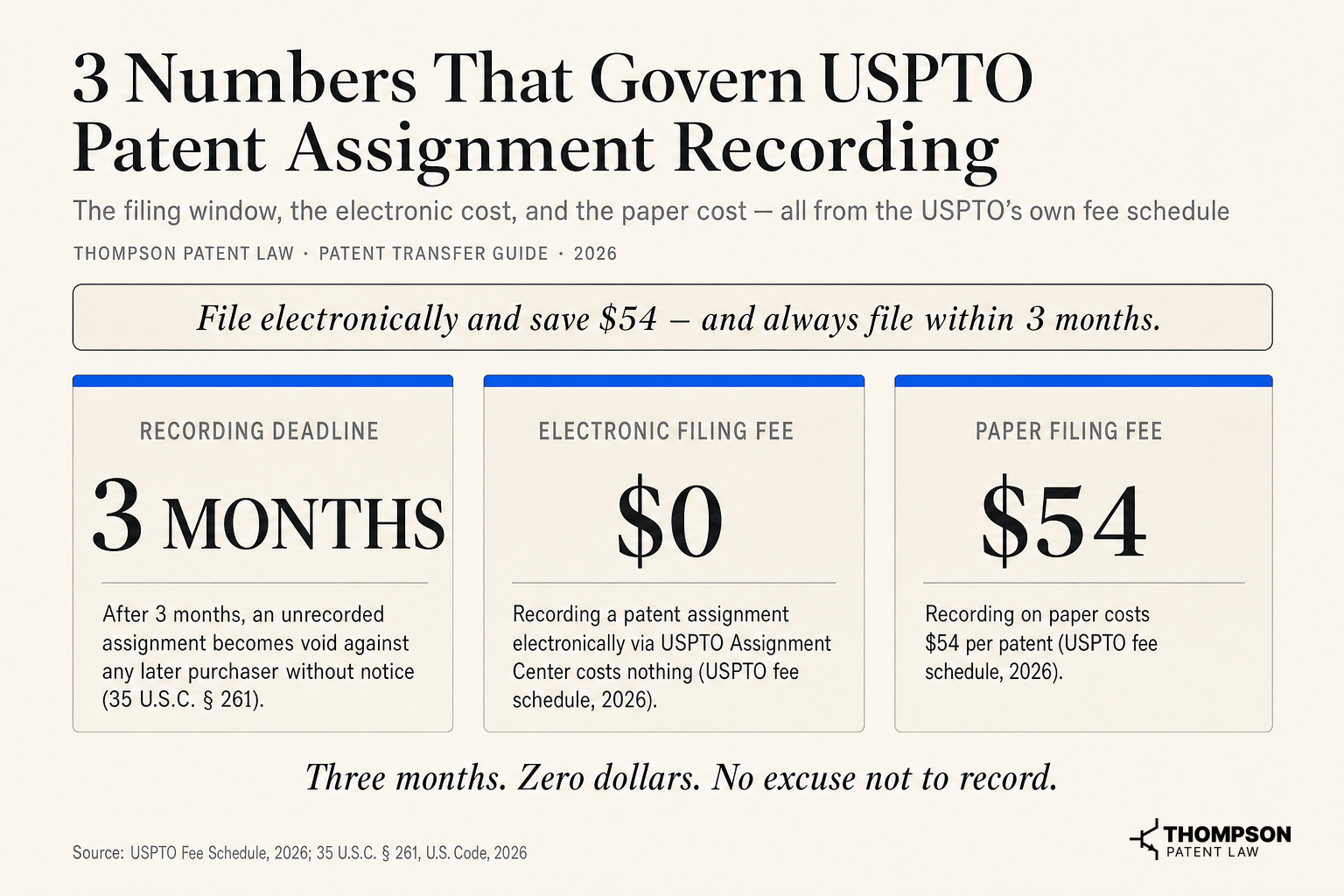 3 Numbers That Govern USPTO Patent Assignment Recording — Source: USPTO Fee Schedule, 2026; 35 U.S.C. § 261, U.S. Code, 2026
Why Recording With the USPTO Matters
Under 35 U.S.C. § 261, an unrecorded assignment becomes void against a later purchaser who buys without notice unless it is recorded with the US patent office within three months of signing. Electronic recording through the USPTO Assignment Center is far cheaper than paper recording, per the USPTO fee schedule. Miss the window and you create a title gap that surfaces in due diligence.
How to File Through the USPTO Assignment Center
The USPTO Assignment Recordation Branch operates the electronic Assignment Center. Submission requires the signed assignment document, the relevant patent or application number, and a cover sheet. Assignments of a PCT or European patent application may also need registration with the European Patent Office, relevant national patent offices, or the European patent register. Recording is a straightforward administrative step, but it must be completed, not assumed.
Joint Ownership Complicates Patent Transfers Significantly
Joint ownership creates red flags that catch many inventors off guard. Under 35 U.S.C. § 262, each joint owner can make, use, sell, or import the patented invention on their own, without the consent of the other co-owners and without sharing profits.
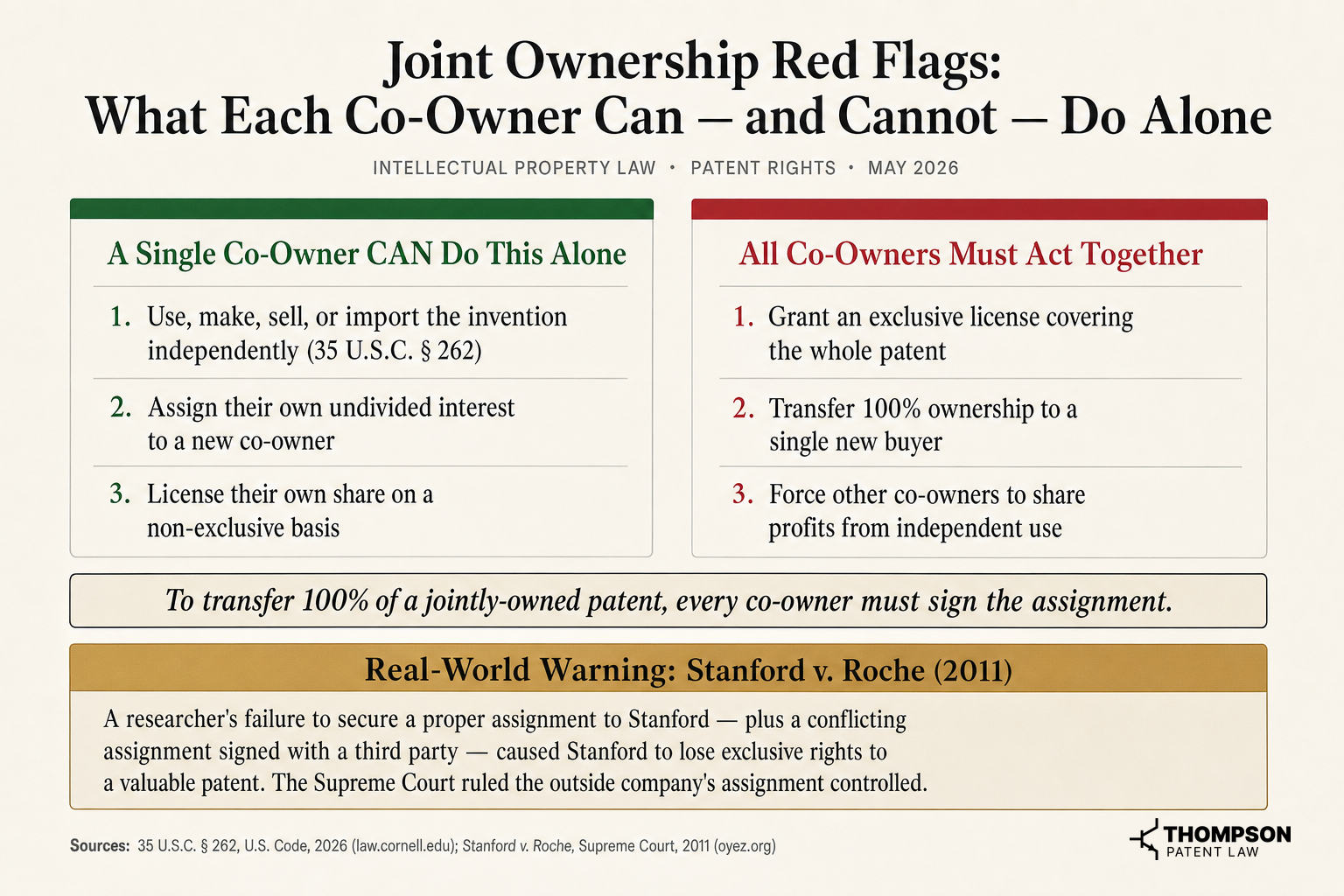 Joint Ownership Red Flags: What Each Co-Owner Can — and Cannot — Do Alone — Source: 35 U.S.C. § 262, U.S. Code, 2026; Stanford v. Roche, Supreme Court, 2011
What Joint Ownership Means for Each Co-Owner
Here is the trap. One co-owner can assign only their own undivided interest. No single joint owner can transfer 100% of the patent alone, and no one inventor can grant an exclusive license covering the whole patent, because that would cut off the others' rights. To convey full ownership, every co-owner must sign the assignment.
This is why inventorship must be verified before any negotiation begins. A patent filed with the wrong inventor — or missing a co-inventor — creates a chain-of-title defect that can make an entire deal irrelevant. Confirm who the correct inventors are, confirm that each one has transferred all of their rights, and only then evaluate what the seller or licensor actually has to offer.
How Employment Agreements Affect Ownership First
Many inventors do not actually own their patent rights. The vast majority of issued patents are issued to companies rather than individual inventors, according to USPTO data. Employment agreements routinely require an employee inventor to assign patent rights to the employer automatically under applicable patent laws, a pattern common across software, semiconductor, and medical device teams. Verify the legal owner, not just the named inventor.
What Can Go Wrong When Transferring Patent Rights Without an Attorney
A clean chain of title is what acquirers and licensees actually buy. When it breaks, the patent can become unenforceable, though sound drafting and recording practices prevent the problem.
The Chain of Title Problem
A clear chain of title means every transfer, from the original inventor to the current owner, is documented and recorded throughout the patent process. The chain always begins with inventorship: if the wrong inventor was named on the application, or if a co-inventor was omitted, every subsequent transfer document may be built on a flawed foundation.
One missing assignment, one unrecorded transfer, or one ambiguous agreement covering the claimed invention creates a defect that can sink standing in a patent infringement lawsuit. In Stanford v. Roche, decided by the Supreme Court in 2011, a researcher's conflicting assignment to an outside company defeated Stanford University's claim to a valuable patent. These standing problems trace directly back to weak documentation, a recurring theme in the crisis in patent quality.
For a buyer or licensee, the critical due-diligence question is always: who were the inventors, and did every one of them transfer all of their rights to the party now claiming to own or license the patent? If that question cannot be answered cleanly, the transfer cannot proceed safely.
Why DIY Assignments Create Expensive Problems Later
Generic templates miss jurisdiction-specific requirements, fail to capture continuation and divisional applications, and lack the precision to survive a dispute. A flawed assignment may leave the original owner with residual claims the buyer never expected. Companies often discover during due diligence that a prior owner still holds rights to an improvement, for example an unrecorded interest in a cable management apparatus because a DIY assignment did not transfer "all continuations and divisions."
AI-generated documents carry the same risk in a different form. AI tools can produce NDA term sheets, disclosure documents, and assignment drafts that look complete but miss the questions that matter most — starting with whether the correct inventors are named on the patent application. An experienced patent attorney asks those foundational questions first, because getting inventorship right is what makes every other document relevant. The cost of drafting it correctly is a fraction of the cost of cleaning up a bad one.
Frequently Asked Questions
How do I transfer ownership of a patent?
Execute a written assignment agreement signed by the current patent owner that clearly identifies the patent or application being transferred. Then record it with the U.S. Patent Office through the Assignment Center within three months to protect the new owner, as 35 U.S.C. § 261 provides. Most people who need to transfer a patent to someone have a patent attorney prepare and file the assignment.
What happens to a patent after 20 years?
A U.S. utility patent expires 20 years from its effective filing date. After expiration, the patented invention enters the public domain, so anyone can make or use it without permission or royalties, according to the World Intellectual Property Organization. Patents can also lapse earlier if maintenance fees go unpaid.
What is the most ridiculous patent granted?
One frequently cited example is the "Method of exercising a cat" patent, U.S. Patent No. 5,443,036, granted in 1995, which covers using a laser pointer to make a cat chase the light, as The Guardian reported. Such oddities show that even strange inventions sometimes clear the U.S. Patent Office and its trademark office counterpart, though patent protection for truly novel inventions remains the primary goal.
What happens to a patent if the owner dies?
A patent is personal property under patent law, so it becomes part of the deceased owner's estate and passes to heirs by will or intestate succession. U.S. law extends patent grants to the inventor's "heirs or assigns." The executor can assign the patent to an heir, and that transfer should be recorded with the USPTO.
Where Your Patent Rights Actually Stand
A patent that is not transferred correctly may not legally belong to the person who thinks they own it, and that gap tends to surface at the worst moment, in the middle of a deal or a dispute. The analysis always starts in the same place: who are the inventors, and did each of them transfer all of their rights to the party now claiming ownership? That single question determines whether everything else — the assignment agreement, the recorded documents, the deal itself — is built on solid ground.
Craige Thompson, a patent attorney, MBA, and electrical engineer, leads a team of registered patent attorneys with engineering backgrounds who draft, review, and record patent assignment agreements that protect your ownership position. If you are not certain your chain of title is clean, take the Complimentary Patent Needs Assessment to find out exactly where your patent rights stand before your next transfer. Keep Innovating.
Keep Innovating,
Craige Thompson, Patent Attorney, MBA, Electrical Engineer
Thompson Patent Law