


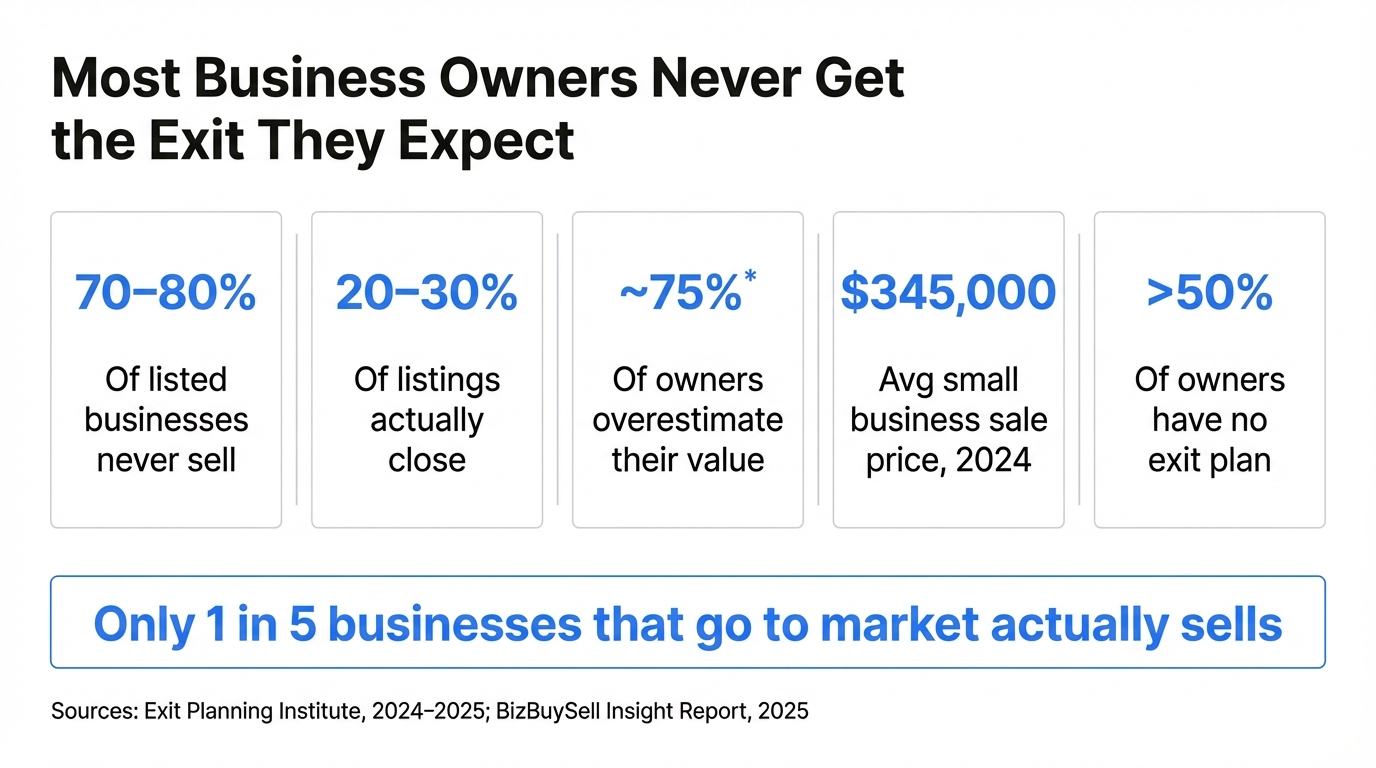
- Between 70% and 80% of businesses listed for sale never sell, and preparation — not the quality of the business — is usually the deciding factor.
- Owners who start exit planning three to five years before their target date consistently achieve better outcomes than those who prepare for less than 12 months.
- Patent protection on core products, processes, or technology is one of the most direct ways to increase a business’s sale price, because a granted patent transfers a legally defensible advantage to the buyer that an unpatented process does not.
- The right exit strategy — outside sale, family or management succession, or an ESOP — depends on personal goals, timeline, and financial needs, not on what worked for someone else.
- Taxes on a business sale can consume a large share of proceeds depending on deal structure, and getting tax planning wrong at the letter-of-intent stage is very hard to reverse.
Between 70% and 80% of small businesses put up for sale never end up selling, according to research from the Exit Planning Institute. The reason is almost never that the business is bad. It is almost always that the owner waited too long to prepare. Business exit planning is the discipline that separates the owners who convert decades of work into real wealth from those who discover, too late, that a business and a sellable asset are not the same thing.
This guide walks through what exit planning actually involves, which exit strategy fits different situations, and what steps to take right now, whether your target exit is two years away or ten.
Key Takeaways
- Between 70% and 80% of businesses listed for sale never sell. Preparation, not the quality of the business, is usually the deciding factor.
- Business owners who start exit planning at least three to five years before their target date consistently achieve higher sale multiples than those who prepare for less than 12 months.
- Patent protection on core products, processes, or technology is one of the most direct ways to increase a business's sale price and valuation multiple, because granted patents transfer legally defensible competitive advantages to the buyer.
- The best exit strategy depends on your personal goals, timeline, and financial needs, not on what worked for someone else.
- Taxes on a business sale can consume 20% to 35% or more of proceeds depending on deal structure. Getting tax planning wrong at the LOI stage can cost six figures and is very hard to reverse.
- Exit planning is a team sport. A coordinated group of advisors, including a CPA, M&A attorney, financial planner, and — where patents are a material asset — a strategic patent attorney, consistently outperforms any single generalist advisor working alone.
What Business Exit Planning Actually Is (and Why Most Owners Start Too Late)
Exit planning is the process of preparing your business for a transition of ownership in a way that protects your financial future, rewards your years of work, and keeps the company healthy after you leave. It is not a single event, a form to fill out, or a conversation to have with a broker six months before you want to close. It is a multi-year, multi-disciplinary process that touches valuation, legal structure, tax strategy, operations, and personal financial planning simultaneously.
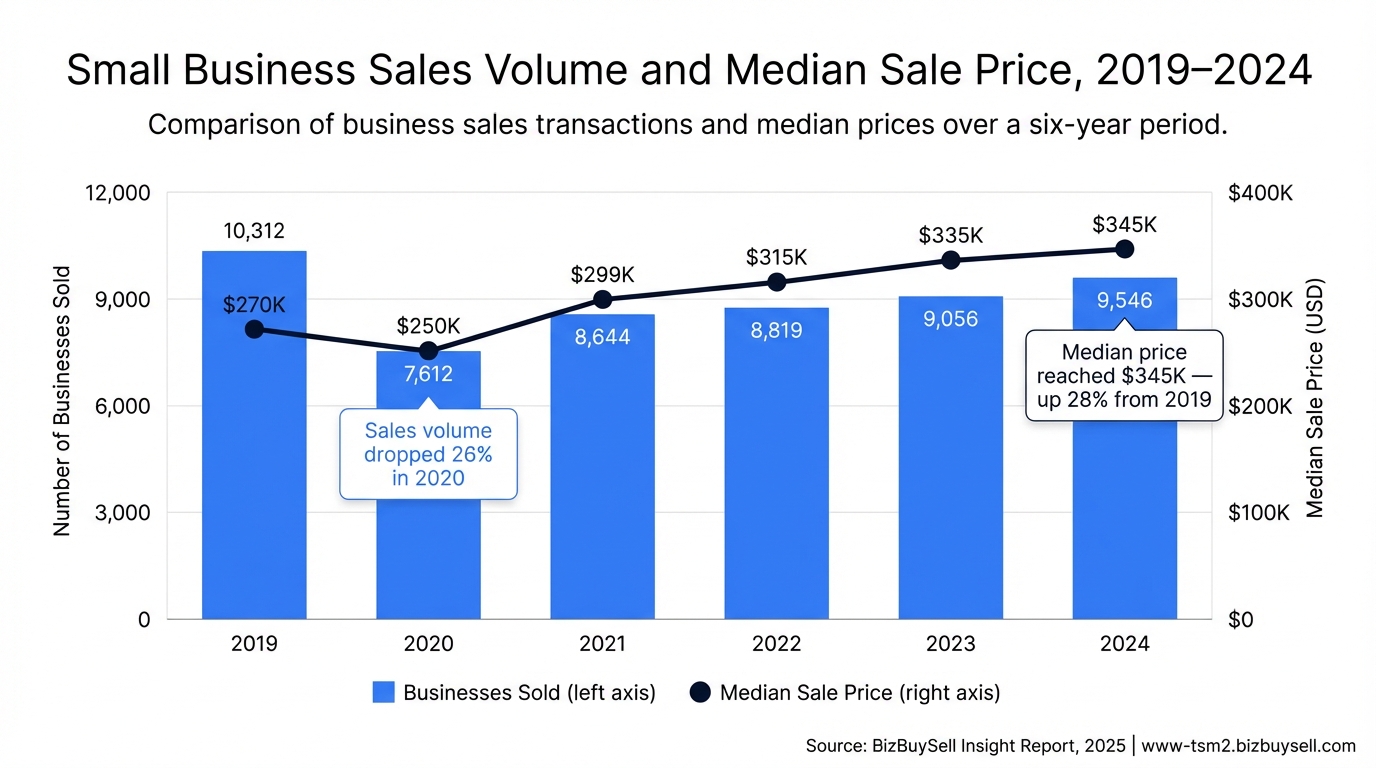 Small Business Sales Volume and Median Sale Price, 2019–2024 — Source: BizBuySell Insight Report, 2025
According to the Exit Planning Institute, only 20% to 30% of businesses that go to market actually sell. The primary reason is inadequate preparation. Owners who received less than they expected, or who could not find a buyer at all, often had less than 12 months of preparation behind them.
The data from BizBuySell's 2025 Insight Report tells the same story from the buyer side: the median small business sale in 2024 closed at roughly 2.61 times annual cash flow and 0.69 times revenue. Those numbers are modest, and they represent the average, which means underprepared sellers are pulling them down. The chart above shows how sale volumes and median prices have moved since 2019. Notice that price alone does not tell you whether a seller was ready.
Most business owners spend more time planning a two-week vacation than they spend on business exit planning — the process that will determine whether 20 or 30 years of work translates into life-changing wealth or a fire-sale disappointment. Business long term success depends on treating the exit with the same rigor as the build. The exit process deserves better than an afterthought.
Why Starting Your Exit Plan Early Changes the Financial Outcome
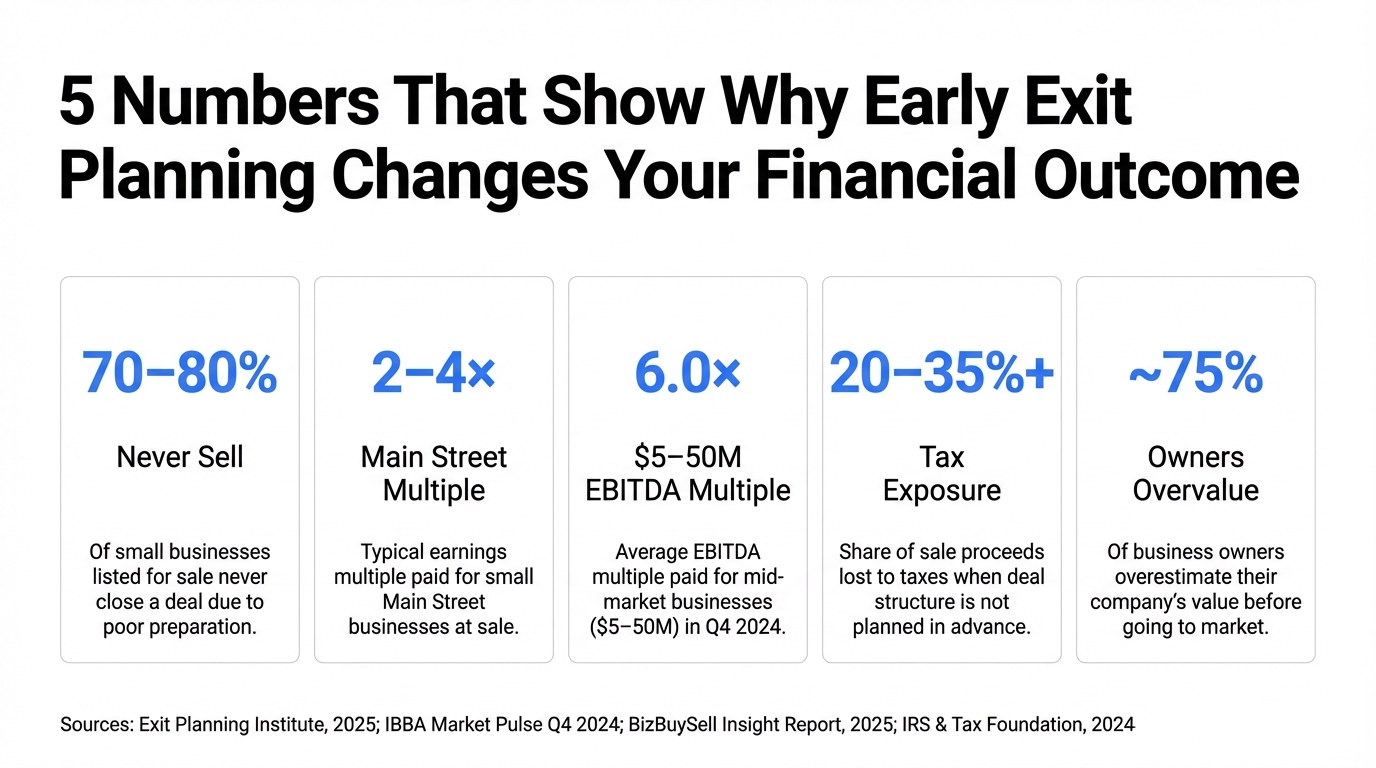 5 Numbers That Show Why Early Exit Planning Changes Your Financial Outcome — Source: Exit Planning Institute, 2025; IBBA Market Pulse Q4 2024; BizBuySell Insight Report, 2025; IRS & Tax Foundation, 2024
The Gap Between What Owners Expect and What They Receive
The Exit Planning Institute's State of Owner Readiness survey found that nearly 75% of business owners overestimate their company's value or neglect critical preparation steps. A business generating $500,000 in annual earnings does not automatically command $2.5 million at closing without clean financials, documented systems, and transferable customer relationships. The BizBuySell Insight Report shows the average sale price for small businesses in 2024 was $345,000, a figure that reflects what unprepared sellers actually receive, not what prepared ones can achieve.
Understanding this gap early gives you time to close it. Owners who began the business exit planning process with three or more years of runway consistently report fewer surprises, more competing offers, and better final terms. Knowing when to file and when to act applies as much to business transitions as to intellectual property protection: timing shapes outcomes in ways that cannot be recovered after the fact.
How Business Valuation Shapes Every Decision You Make
Business valuation is not just a number you receive at closing. It is a diagnostic tool that tells you exactly which parts of your business are driving value and which are dragging it down. According to the IBBA Market Pulse Q4 2024 report, businesses in the $5 million to $50 million range sold at approximately 6.0 times EBITDA in Q4 2024, while Main Street businesses typically traded at 2 to 4 times earnings. The gap between those multiples is not random. It reflects the presence or absence of the factors that make a business genuinely transferable.
One of the most consistent value killers is owner dependency. Research from Pinnacle Equity found that small firms derived more than 50% of their value directly from the owner's personal involvement. When a buyer looks at a business where the owner is the primary rainmaker, the primary client relationship, and the primary operational decision-maker, they price in the risk of that owner leaving. The result is a lower multiple, more aggressive earnout requirements, or no offer at all.
Patent protection is one of the most direct ways to counteract this discount. A business whose core technology, process, or product is covered by a granted patent holds value that is independent of any individual — including the owner. Buyers pay higher multiples for legally defensible competitive advantages precisely because those advantages transfer with the business.
If patents represent a significant fraction of your business valuation, your deal team should include a senior patent attorney skilled in both strategy and business — not merely someone who has been writing patents for a long time, but someone with a combination of business litigation and patent strategy experience. This is particularly powerful if that attorney also has an engineering background deep enough to appreciate your technology, assess how defensible it truly is, and articulate the competitive advantage it represents to a buyer.
The patent component of your exit valuation should be assessed as a function of the present value of future cash flows attributable to those patents — through licensing revenue across multiple fields of use, enforcement awards, reduced competition, greater market share, and improved profit margins that the patent protection enables. These are not merely theoretical benefits; a strategic patent attorney can help you build and document that monetization track record years before your exit so that buyers and their advisors see demonstrated results, not projections. That demonstrated monetization is what sophisticated buyers will pay a premium to acquire.
In practice, a granted patent can shift a buyer's perception of a business from a replicable operation to a defensible market position — a distinction that is often reflected in a meaningfully higher sale price and stronger negotiating leverage for the seller. An unpatented innovation, no matter how effective, is priced as a replicable process rather than a protected asset.
A formal fair market value assessment, requested at least three to five years before your target exit, gives you enough time to actually act on what it reveals.
The Personal Financial Readiness Piece Most Owners Ignore
Even a successful business sale can leave an owner worse off if personal financial planning was not integrated into the business exit planning process from the start. Federal long-term capital gains tax runs 15% to 20%, plus a 3.8% net investment income tax for higher earners, and state taxes can add another 5% to 13% depending on where you live. In total, 20% to 35% or more of the sale price often goes to taxes if not planned properly. Depreciation recapture on an asset sale is taxed as ordinary income at rates up to 37%, which is why a $4 million asset sale and a $4 million stock sale can produce six-figure differences in after-tax proceeds.
Many business owners discover post-sale that their personal financial picture is not retirement-ready even after a seven-figure transaction. Working with a financial advisor who specializes in business transitions, not just general wealth management, is a critical and often overlooked step. Model at least three post-sale tax scenarios before you accept any letter of intent from a potential buyer.
The five numbers in the chart above capture why early action changes the financial outcome for business owners in ways that feel abstract until you do the math on your own situation.
The Most Common Business Exit Strategies and Which One Fits Your Goals
No single exit strategy is right for every business owner. The best choice depends on your personal goals, your timeline, your financial needs, and who you want the business to serve after you leave. Here are the four most common paths.
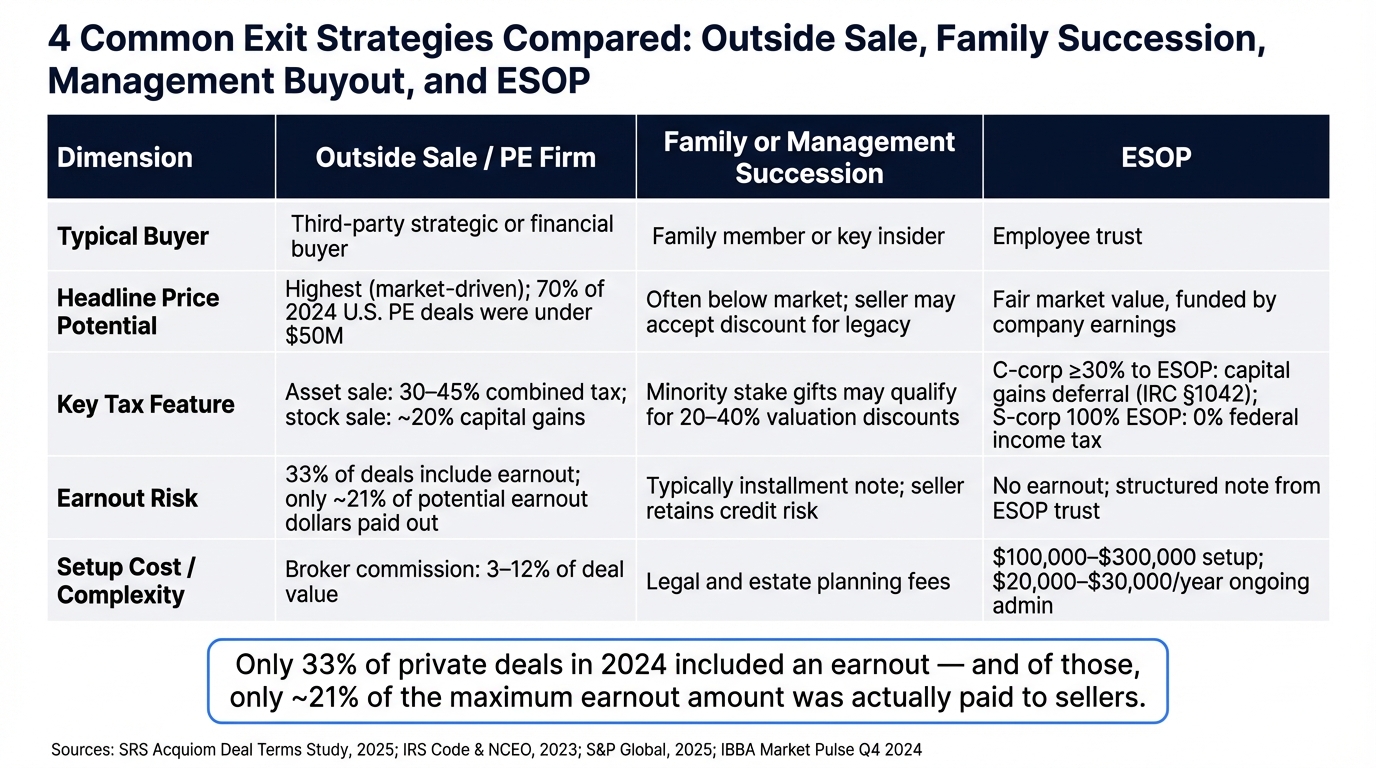 4 Common Exit Strategies Compared: Outside Sale, Family Succession, Management Buyout, and ESOP — Source: SRS Acquiom Deal Terms Study, 2025; IRS Code & NCEO, 2023; S&P Global, 2025; IBBA Market Pulse Q4 2024### Selling to an Outside Buyer or Private Equity Firm
A third-party sale to a strategic buyer or private equity firm typically produces the highest headline purchase price, but it also involves the most complex negotiation, the longest due diligence process, and the highest probability of earnout provisions tying your final payout to post-sale performance. According to SRS Acquiom's 2024 M&A Deal Terms Study, approximately 33% of private business acquisitions in 2024 included an earnout provision. In the same year, 70% of U.S. private equity acquisitions were under $50 million as firms continued pursuing lower middle market add-ons.
Earnouts sound reasonable in a term sheet, but they frequently become sources of dispute. Sellers should negotiate earnout measurement criteria with the same intensity they give the headline price. If a private equity sale is your goal, start building a management team now that can operate without you. That transferable leadership layer is what sophisticated buyers are actually acquiring.
Succession Planning Within the Family or Leadership Team
Succession planning through a family member or key employee is the most emotionally complex exit strategy and frequently the most financially undervalued one. The Conway Center for Family Business reports that only 30% of family businesses successfully transition to the second generation, and just 12% reach the third. Those numbers are not a reflection of family business quality. They reflect how rarely formal succession planning documentation is put in place.
A PNC Bank survey found that while 60% to 70% of owners intend to pass the business to family or insiders, only 15% have a written succession or buy-sell agreement in place. Under IRS rules, gifts or sales of minority stakes in a family business may qualify for valuation discounts of 20% to 40% for lack of control and marketability when calculating estate and gift taxes. Those discounts are available to owners who plan properly and unavailable to those who do not. A written buy-sell agreement is not optional in a family or management succession. It is the document that prevents disputes from becoming lawsuits.
Employee Stock Ownership Plans as a Transition Vehicle
An employee stock ownership plan (ESOP) allows a business owner to sell some or all of their ownership to employees through a trust, often with significant tax advantages. According to the National Center for Employee Ownership (NCEO), in 2023 (the most recent year for which data is available), there were 6,609 ESOP plans in the United States, covering 15.1 million participants (including 10.9 million active employees) with total plan assets exceeding $2 trillion.
The tax advantages are substantial. Owners of C-corporations who sell at least 30% to an ESOP can defer capital gains tax through an IRC Section 1042 rollover. S-corporations that become 100% ESOP-owned pay zero federal income tax on profits going forward. That is not a typo. The tradeoff is cost and complexity: establishing a leveraged ESOP typically runs $150,000 to $300,000 in legal, valuation, and setup fees, with ongoing administration of $20,000 to $30,000 per year. ESOPs work best for profitable, stable businesses with at least 20 or more employees. For the right business, the structure offers an exit that rewards loyal employees while maximizing owner proceeds.
The comparison table below shows how these three strategies, alongside a management buyout, differ on timeline, tax profile, and control transfer speed.
How to Build Your Exit Plan Step by Step
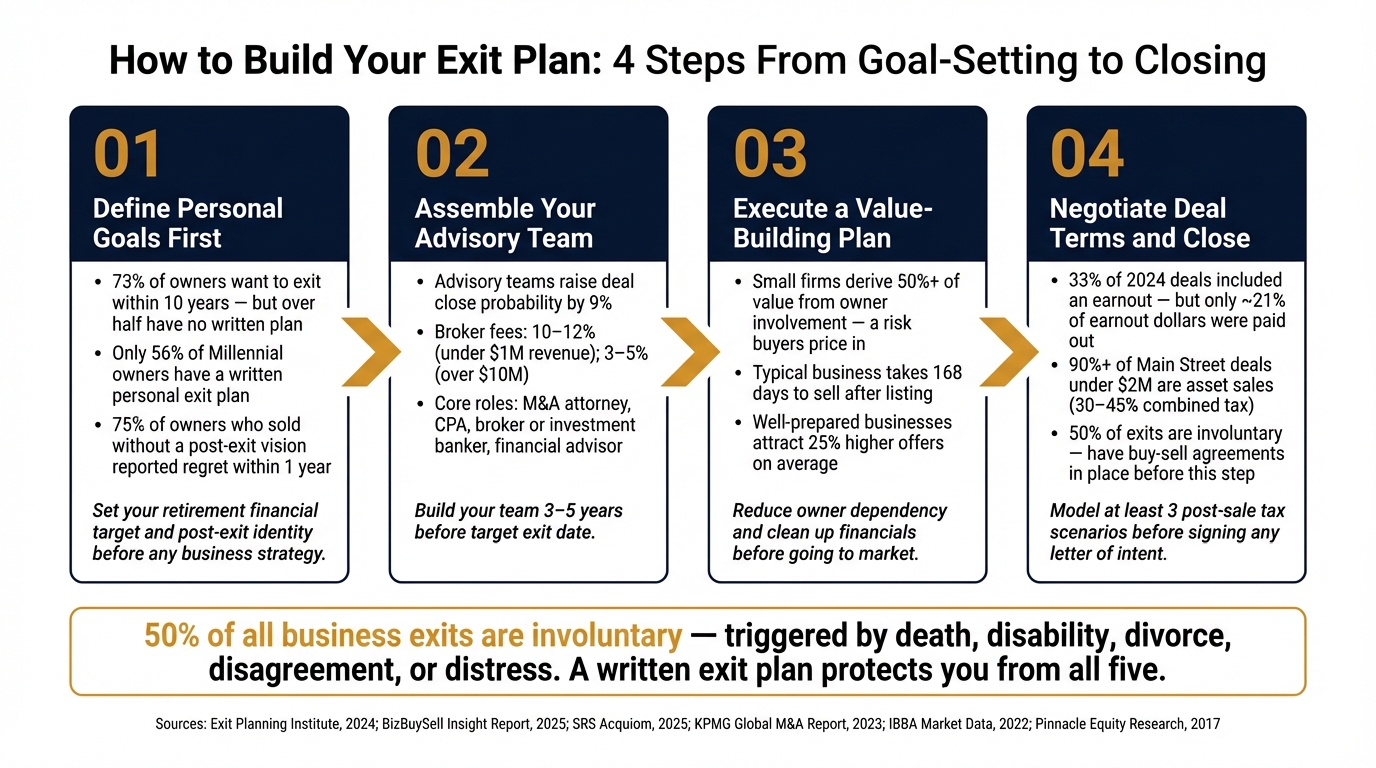 How to Build Your Exit Plan: 4 Steps From Goal-Setting to Closing — Source: Exit Planning Institute, 2024; BizBuySell Insight Report, 2025; SRS Acquiom, 2025; KPMG Global M&A Report, 2023; Pinnacle Equity Research, 2017
Step 1: Define Your Personal Goals Before You Define Your Business Goals
The most common mistake in business exit planning is starting with the business and working backward to the person. The right sequence is the opposite. Your personal goals, the lifestyle you want post-exit, the timeline you need, and the minimum financial outcome that makes the transition worthwhile, must be defined first. Every business-level decision flows from them.
According to the Exit Planning Institute's 2024 research, 73% of business owners want to exit within 10 years, yet over half have no written exit plan. Only 56% of millennial-generation owners have a written personal exit plan in place. The same research found that 75% of owners who sold their business regretted it within a year, largely because they had not defined what they wanted to do after the sale closed. A clear picture of what comes next is not soft advice. It directly affects deal behavior. Owners who know what they are moving toward are less likely to accept bad earnout terms out of anxiety or to re-enter the business after closing.
Before your first planning meeting, write down three numbers: your target exit date, your minimum acceptable sale price, and your estimated personal annual spending in retirement. Those three numbers define the actual planning problem you are solving. This foundation is also what makes business long term success possible on both sides of the transaction: for the seller who needs the proceeds to fund retirement, and for the buyer who needs a company that can operate without its former owner.
Step 2: Assemble the Right Exit Planning Team
Business exit planning is not a single advisor's job. A complete exit planning team typically includes a CPA who understands transaction tax structure, an M&A attorney who can draft purchase agreements and address legal implications, a financial planner who can model post-sale personal wealth, and a business broker or investment banker depending on deal size. If patents represent a meaningful share of your business's value, a strategic patent attorney — one with both litigation experience and business acumen — belongs on this team as well. Some business owners also work with a dedicated exit planning consultant who coordinates the full process.
Business brokers charge roughly 10% to 12% commission on Main Street business sales under $1 million in revenue, with fees dropping to approximately 3% to 5% for middle market deals above $10 million, according to industry transaction data. A coordinated advisory team is not cheap, but a KPMG Global M&A analysis found that transactions with dedicated advisory teams had a 9% higher likelihood of closing successfully than those managed by the owner alone. Attempting to manage the exit process with a single generalist advisor routinely costs business owners hundreds of thousands of dollars in avoidable taxes, poorly structured deals, or missed buyers.
Build your business exit planning team at least two to three years before your target exit. That timeline allows each advisor to do their job properly rather than rushing through critical decisions under deal pressure.
Step 3: Execute a Value-Building Plan Before Going to Market
The period between deciding to exit and actually going to market is the highest-leverage window in the entire exit process. This is when you reduce owner dependency, document systems and processes, clean up your financials, resolve pending legal issues, and address customer concentration problems. Businesses that complete a structured value-building period of 24 to 36 months before listing consistently achieve higher sale multiples than those that go to market immediately after deciding to sell. According to IBBA survey data, businesses that invested in pre-sale preparation averaged meaningfully higher EBITDA multiples than unprepared peers.
Intellectual property is one frequently overlooked value driver. Proprietary processes, branded methods, and patented technology can meaningfully increase a buyer's perception of defensibility and transferable value — and directly affect the sale multiple a business commands. Patents signal to buyers that a core product, process, or technology is legally protected from replication, which reduces competitive risk and supports a higher valuation.
Maximizing the patent component of your exit valuation, however, requires more than filing patents. It requires a strategic patent attorney who can help you develop a monetization plan — through licensing, enforcement, competitive positioning, or field-of-use licensing across multiple markets — and, critically, demonstrate that the present value of future cash flows attributable to those patents is not merely theoretical but is already reflected in your income statement and profit margins. That demonstrated monetization track record, built over three to five years before your exit, is what transforms a patent portfolio from a line item into a material driver of your sale price.
In competitive due diligence, buyers routinely assign higher EBITDA multiples to businesses with granted patents because those patents represent legally enforceable barriers that competitors cannot simply copy — barriers that transfer fully to the new owner at closing. A business with granted patents on its key innovations is a fundamentally different asset in due diligence than one with unprotected methods that any competitor could copy the day after closing. Understanding what a patent actually does for your business before you go to market can make the difference between a buyer seeing a defensible asset and a buyer seeing a business that any competitor could replicate.
Create a written 12-month value improvement plan targeting the two or three factors most likely to increase your business's sale multiple. Every dollar spent improving transferability before a sale typically returns several times over in increased proceeds.
The roadmap in the chart above breaks this process into four concrete phases, from goal-setting through closing.
Step 4: Go to Market With the Right Timing and the Right Buyers
Going to market without completing the first three steps of business exit planning is how owners end up in that 70% to 80% that never sells. When you are genuinely ready, which means financials are clean, systems are documented, owner dependency is reduced, and your team is in place, the market timing and buyer identification work should happen with your broker or banker leading the process. Potential buyers need to see a business that runs without you, not one that runs because of you.
The principle of acting before you have to applies directly here. Patent-first thinking for startups and R&D teams captures the same logic: protecting your most valuable assets before you are under pressure produces dramatically better outcomes than scrambling to protect them during a transaction. Patents filed and granted before you go to market appear on a buyer's due diligence checklist as confirmed, transferable assets. Patents still pending — or never filed — appear as risks. That distinction can shift a buyer's offer meaningfully, and it cannot be corrected once a deal is in motion. In practical terms, a granted patent portfolio can be the single line item in a due diligence report that justifies a higher purchase price — because it is the one asset that legally prevents a competitor from replicating your business the moment the sale closes.
What a Smooth Transition Looks Like After the Sale Closes
Transition Periods, Earnouts, and What You Agree to Stay For
Most business sales include a transition period during which the seller remains involved to transfer relationships, knowledge, and operational context to the new owner. Transition periods typically range from 30 days to 24 months depending on deal structure, business complexity, and buyer requirements. Achieving a smooth transition during this period often determines whether earnout milestones get hit and whether the buyer relationship remains constructive or turns adversarial.
Earnout provisions were present in about 33% of private acquisitions in 2024, according to SRS Acquiom. They become sources of dispute far more often than buyers or sellers anticipate at signing. Before accepting any purchase agreement with an earnout, have your M&A attorney negotiate a dispute resolution mechanism and clearly defined, measurable performance metrics into the contract. Vague earnout language is almost always interpreted against the seller.
Employee and Customer Communication During the Transition
One of the most damaging things that can happen during a business transition is losing key employees or key customers before or immediately after closing because communication was mishandled. Research on ownership transitions consistently shows voluntary turnover spikes in the range of 20% to 40% in the first six months post-close when communication is reactive rather than proactive. Buyers know this, which is why retention agreements for key employees are increasingly standard in deal terms.
Developing a communication plan belongs in your business exit planning process long before you are in active negotiations. The communication cascade moves in a specific order: owner to key management first, then management to staff, then staff-facing announcements to customers. Getting the sequence wrong, or letting rumors outpace official communication, is one of the fastest ways to destroy the value you spent years building.
The Emotional Side of Exiting a Business That Competitors Rarely Discuss
Why Identity and Attachment Complicate Even Well-Planned Exits
Business owners frequently describe the exit process as emotionally harder than they anticipated, even when the financial outcome exceeded expectations. For many, the business is not just a financial asset. It is the structure around which their professional identity, daily purpose, social relationships, and sense of accomplishment are organized. RBC Wealth Management's research on business exit planning found that many owners delay starting the business exit planning process not for financial reasons but because beginning requires confronting a future they have not yet envisioned.
The research from the Exit Planning Institute adds a sharper data point: 75% of owners who sold reported regretting it within 12 months of closing. That regret rate is not about the money. It is about what happens when the business, which provided structure, identity, and purpose, is no longer there.
Setting Personal Goals for Life After the Transaction
The practical solution is straightforward, even if executing it is not: define what you are moving toward before you finalize what you are leaving. Business owners who have a clear picture of their post-exit life, whether that means a new venture, time with family members, philanthropy, consulting, or full retirement, report higher post-sale satisfaction regardless of sale price. This also affects deal behavior in measurable ways. Owners with defined post-exit personal goals are less likely to sabotage negotiations, accept unfavorable earnout terms out of anxiety, or violate non-compete agreements by re-entering the market.
Write a one-page description of your ideal life 12 months after closing. Do it before your first formal planning meeting. The exercise surfaces assumptions that will affect every decision you make during the exit process.
The Legal Framework Every Business Exit Plan Must Address
Buy-Sell Agreements, Operating Documents, and Deal Structure
The legal architecture of business exit planning begins long before a buyer appears. A properly drafted buy-sell agreement governs what happens to ownership interests when a partner dies, becomes disabled, wants to sell, or goes through a divorce. It also establishes a predetermined valuation methodology so no one is surprised at the moment of transition. A Forbes analysis of buy-sell agreements noted that despite nearly 32 million small businesses in the U.S., only 15% of owners have an actual written succession or buy-sell agreement in place.
Many business owners discover too late that their operating agreement or shareholder agreement contains transfer restrictions that complicate or outright block their preferred exit strategy. Reviewing these documents with a qualified business attorney three to five years before your intended exit is not excessive caution. It is basic legal risk management. The cost of a legal review is trivial compared to the cost of discovering a blocking provision when a buyer is already at the table.
Intellectual property protections belong in this legal review as well. Patents, in particular, are a legally enforceable barrier that can materially increase the sale price a business achieves: a granted patent on a core product or process gives a buyer exclusive rights they cannot obtain any other way, which is reflected in higher multiples and stronger negotiating leverage for the seller. During due diligence, buyers and their advisors specifically check whether key innovations are patent-protected; businesses that arrive at the table with granted patents are routinely valued more favorably than those with pending applications or no filings at all, because only a granted patent represents a confirmed, transferable asset. Unprotected innovations, by contrast, are priced as if any competitor could replicate them — because they can. Understanding when to secure patent protection relative to your exit timeline can meaningfully affect how buyers assess proprietary technology, branded processes, or defensible methods that your business has developed over time.
Tax Structure, Deal Terms, and Why Legal Advice Is Not Optional
How a deal is structured produces dramatically different tax outcomes for both buyer and seller. An asset sale triggers depreciation recapture taxed as ordinary income at rates up to 37%, while a stock sale allows most proceeds to be treated as long-term capital gains. A $4 million asset sale and a $4 million stock sale can produce a six-figure difference in after-tax proceeds for the seller. Installment sales add another dimension, allowing sellers to spread gain recognition across multiple tax years, which can reduce the effective rate but introduces collection risk if the buyer's business underperforms.
Federal labor law also creates exposure during transition periods, particularly around WARN Act notification requirements for larger businesses and proper handling of employee benefits. Never accept or counter a letter of intent without your M&A attorney and CPA present. Deal structure decisions made at the LOI stage are very difficult to reverse once negotiations have advanced, and the legal implications of getting them wrong compound quickly.
Frequently Asked Questions About Business Exit Planning
What is exit planning in business?
Business exit planning is the process of preparing a business for a transition of ownership in a way that maximizes value for the owner, ensures business continuity, and aligns the transaction with the owner's personal and financial goals. It typically involves business valuation, tax planning, legal structure review, operational improvements, and personal financial planning, all coordinated years before the intended exit date. According to the Exit Planning Institute, owners who engage in formal exit planning consistently achieve better financial outcomes than those who approach the process reactively.
What is the best exit strategy for a business?
There is no single best exit strategy. The right choice depends on your personal goals, timeline, financial needs, and the nature of your business. The most common exit strategies include selling to a third-party buyer (which typically maximizes headline price), succession planning to a family member or key employee (which prioritizes continuity), and employee stock ownership plans (which offer significant tax advantages for eligible businesses). The best strategy is the one aligned with what you actually want your life and legacy to look like after the sale closes.
What are the 5 D's of exit planning?
The 5 D's of exit planning refer to five involuntary events that can force a business transition before an owner is ready: Death, Disability, Divorce, Disagreement among partners, and Distress (financial). These represent the five scenarios a solid exit plan must address even when an owner intends to exit on their own timeline, because any one of them can trigger an ownership change under circumstances that are far less favorable than a planned sale.
What are the 4 C's of exit planning?
The 4 C's framework, used by some exit planning advisors, refers to Continuity, Control, Capital, and Culture. These are the four dimensions a business must manage through any ownership transition to preserve long-term value for the seller, the buyer, employees, and customers. Understanding how each dimension is affected by the chosen exit strategy helps owners and advisors make better structural decisions.
How early should I start planning my business exit?
Most business exit planning professionals recommend starting the process at least three to five years before your target exit date. The Exit Planning Institute's research shows that business owners who begin planning within 12 months of wanting to exit consistently achieve lower valuations and fewer options than those who prepared earlier. Starting early gives you time to close the gap between what your business is worth today and what it needs to be worth for your financial goals to work.
Do I need a team of advisors or can I handle exit planning myself?
Exit planning is a multi-disciplinary process that intersects tax law, business law, financial planning, and transaction strategy simultaneously. Attempting to manage all of these areas without a coordinated team is one of the most common and costly mistakes business owners make. A complete exit planning team should include at minimum a CPA experienced in business transactions, an M&A or business attorney, a financial planner specializing in business transitions, and a business broker or investment banker appropriate to your deal size. For businesses where patents represent a significant portion of value, a strategic patent attorney with litigation experience and business judgment is also an essential team member — not merely a patent drafter, but an advisor who can help demonstrate and maximize the monetization value of your IP assets.
What is an employee stock ownership plan and is it right for my business?
An employee stock ownership plan (ESOP) is a qualified retirement plan in which employees receive an ownership interest in the company through a trust. For selling business owners, ESOPs offer potential federal income tax advantages including the ability to defer or eliminate capital gains tax in certain structures under IRC Section 1042. According to the NCEO, in 2023 there were 6,609 ESOP plans covering 15.1 million participants with total assets exceeding $2 trillion. ESOPs work best for businesses with stable profitability, at least 20 or more employees, and sufficient cash flow to absorb $150,000 to $300,000 in initial leveraged setup costs. For the right business, an ESOP can be the most financially efficient exit available.
Your Next Steps to Business Exit Planning Success
Most business owners spend 20 or 30 years building something worth protecting, then give the exit itself six months of planning. Between 70% and 80% of businesses listed for sale never sell, and the gap between that outcome and a successful, well-priced transaction is almost always explained by preparation, not business quality.
 80% of Businesses Listed for Sale Never Sell — Exit Planning Is the Difference — Source: Exit Planning Institute, 2024–2025; BizBuySell Insight Report, 2025
The bottom line: owners who start the exit planning process with at least three to five years of runway, assemble the right advisory team, and invest in making their business genuinely transferable consistently achieve better prices, better terms, and fewer post-sale regrets than those who do not. Owners who wait until a buyer appears, or until a health event or partner dispute forces the issue, typically end up in the 70% to 80% that never closes, or they close on terms that do not reflect what the business was actually worth.
The business you have today is not necessarily the business that will sell at the price you need. But it can be, given time and the right team. Business long term success depends on making that investment before you need to, not while the clock is already running.
Whether your exit is five years away or closer than you would like, the time to start is now. A coordinated plan protects what you have built, maximizes what you receive, and puts you in control of the outcome rather than leaving it to circumstances.
Schedule a Complimentary Patent Needs Assessment to understand how intellectual property strategy fits into your broader exit plan, and what steps to take first. The assessment takes less than 20 minutes and gives you a clear starting point for the decisions that will shape the final chapter of your business.
Keep Innovating,
Craige Thompson
Patent Attorney, MBA, Electrical Engineer
Craige Thompson is a patent attorney, MBA, and electrical engineer leading a team of registered patent attorneys at Thompson Patent Law. The team brings engineering degrees and experience spanning individual inventors to Fortune 500 companies including Apple, Google, Intel, and Microsoft, along with backgrounds from major law firms and industry.


