


Key Takeaways
- Under current U.S. law, every patent application must name at least one human inventor who contributed to conception of the claimed invention. AI cannot be listed as an inventor, full stop.
- Obviousness rejections under §103 are statistically more common than §101 eligibility rejections for AI patent applications. Claim the unexpected technical result, not just the AI architecture.
- A provisional patent application filed before any public disclosure, including conference talks or arXiv preprints, secures your priority date while the technology matures.
- AI-generated creative works and generated works more broadly cannot receive copyright protection on their own. Human creative decisions made during selection, editing, and arrangement are what the Copyright Office actually protects.
- Trained model weights and training pipelines are almost always better protected as trade secrets. The methods those models implement are strong patent candidates.
The United States Patent and Trademark Office received over 3,000 patent applications listing AI as a contributor to an invention in a single recent year, yet not one of those applications could legally name AI as an inventor. That gap between what artificial intelligence systems can actually do and what intellectual property law currently recognizes is at the heart of AI and intellectual property disputes today — and how IP law is applied in practice — is the central challenge every AI founder, engineer, and technology company faces right now. Patent applications are being rejected, amended, and strategically rewritten because of it, and the companies catching up after the fact are paying for the delay in both time and money.
Why AI Inventions Are Rewriting the Rules of Patent Eligibility
AI-related U.S. patent applications have risen 33% since 2018 and now appear in roughly 60% of all technology categories. IBM alone filed 1,591 AI-focused patent applications between 2019 and 2024, leading all companies in AI innovation filings, according to Axios. The volume is extraordinary. The legal framework governing who owns what in those filings is still catching up.
For a deeper look at how the USPTO has been developing its approach to artificial intelligence patents, including what is patentable and what remains at risk, the evolving examination landscape rewards close attention.
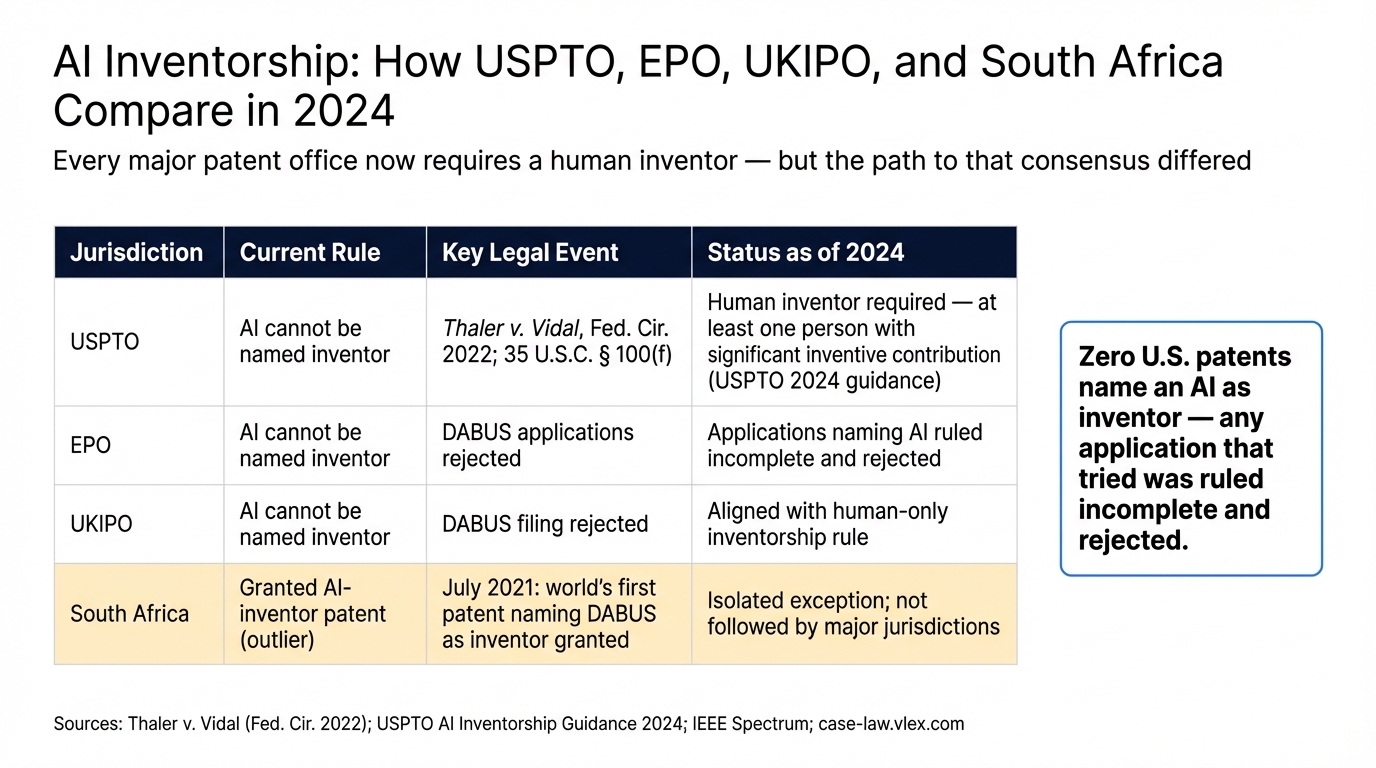 AI Inventorship: How USPTO, EPO, UKIPO, and South Africa Compare in 2024 — Source: Thaler v. Vidal (Fed. Cir. 2022); USPTO AI Inventorship Guidance, 2024; IEEE Spectrum, 2021
The USPTO Has Drawn a Hard Line on AI Inventorship
The rule is unambiguous. Under 35 U.S.C. § 100(f), an "inventor" is defined as a natural person. In Thaler v. Vidal (Fed. Cir. 2022), the Federal Circuit confirmed that AI cannot be listed as an inventor on a U.S. patent. The USPTO's February 2024 guidance built directly on that ruling: a patent must have at least one human inventor who made a significant inventive contribution. Failing to identify that human before filing is not a correctable oversight after the fact.
Before filing any application that involves AI-assisted development, every human decision point in the inventive process must be identified and documented. Those human contributions are what establish legally valid inventorship, and they are what protect intellectual property rights when applications face scrutiny during prosecution.
What "Conceived by a Human" Actually Means in Practice
Inventorship is not about who typed the application or which software produced a draft. The legal doctrine of conception requires the formulation of a complete and operative idea of every feature of the claimed invention in the mind of a human inventor. The complication with generative AI models is that a large language model or other generative AI system may produce an unexpected technical output that a human then selects and develops. Selecting a useful AI output is different, legally, from conceiving the claimed invention.
The USPTO's 2024 guidance addresses this directly: a human who merely recognizes that an AI-generated result is interesting has not necessarily conceived the invention. A human who identifies a specific technical problem, directs the AI toward a solution, and then meaningfully shapes the output into a claimed invention has a much stronger inventorship argument. Document every one of those decisions contemporaneously during R&D. For a comprehensive look at how documentation practices affect patent rights, the evidentiary standard is more demanding than most engineering teams expect.
How the UK, European, and International Patent Offices Are Approaching the Same Problem
The international consensus mirrors the U.S. position, though the path there was not uniform. South Africa briefly granted the world's first patent naming an AI as inventor in July 2021, listing the DABUS system. The European Patent Office rejected those same DABUS applications under J 0008/20 and J 0009/20, as did the UKIPO. Australia's early court approval was overturned on appeal. The World Intellectual Property Organization has published formal policy positions through its Conversation on IP and AI series confirming that existing IP frameworks require human authorship or inventorship.
For companies filing Patent Cooperation Treaty (PCT) applications internationally, there is no single global inventorship standard yet, and the diverging treatment of AI and intellectual property across jurisdictions complicates compliance planning. Your documentation strategy must account for diverging national requirements, particularly as EPO examination practice continues to evolve.
How AI and Intellectual Property Intersect Across Every Stage of the Patent Process
Intellectual property AI interactions extend far beyond the basic question of who owns AI-generated inventions, including generated inventions that no human directly conceived. IBM's 1,591 AI patent filings in five years illustrate how aggressively sophisticated companies are staking claims across the entire AI technology stack. The question for any company building AI products is where in that stack your own protectable innovations actually live, and how to deploy the full range of intellectual property rights available to you at each layer.
Intellectual property rights in this space span patents, trade secrets, and copyrights, and the most effective strategies use all three deliberately. The Innovation Hub at Thompson Patent Law tracks how these strategies are evolving across technology sectors in real time.
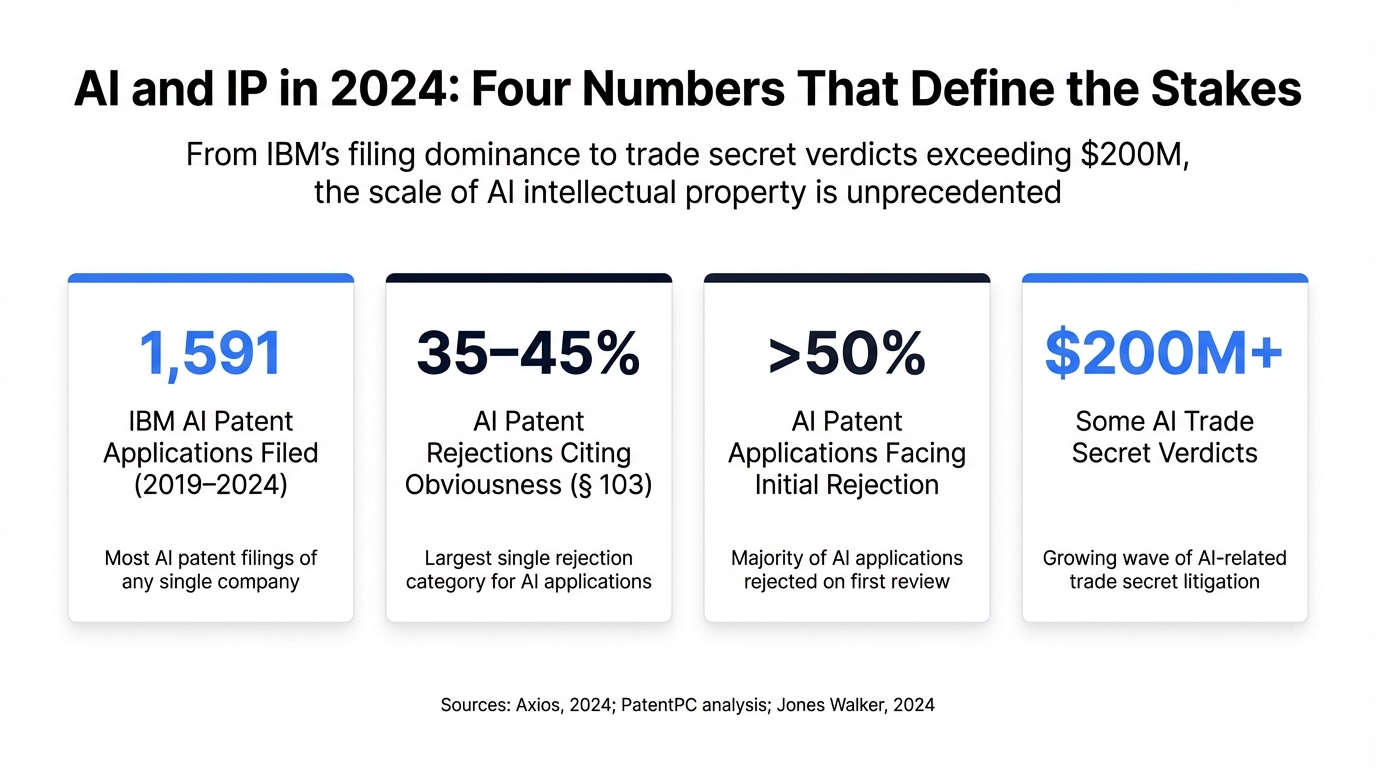 AI and IP in 2024: Four Numbers That Define the Stakes — Source: Axios, 2024; Jones Walker, 2024
AI as a Tool in Prior Art Searches and Patent Drafting
Practitioners are already using AI tools to conduct prior art searches, generate initial claim drafts, and analyze prosecution history. The USPTO has addressed this directly: its January 2024 guidance confirms that all existing rules governing accuracy and candor "apply regardless of how a submission is generated." The human attorney remains responsible for every claim, every citation, and every argument. Submitting AI-generated references containing errors is treated as serious misconduct.
Using AI to assist drafting is legally permissible and increasingly common. The obligation to verify the output before filing falls entirely on the practitioner. For a realistic assessment of why AI replacing lawyers in patent prosecution remains a distant prospect, the gap between AI drafting assistance and AI legal judgment remains significant.
Training AI Models on Patented Technology Creates Infringement Risk
When generative AI models are trained on technical literature, patent documents, or proprietary datasets, they may internalize patented methods as part of their learned behavior. An OECD report on intellectual property issues in AI trained on scraped data identifies this as an active legal risk. No court has ruled directly on patent infringement through the training process, but the Getty Images lawsuit against Stability AI for using 12 million proprietary images in training data demonstrates how aggressively rights holders are pursuing these claims.
Freedom-to-operate analyses for AI products now need to cover the training pipeline, not just the final system's outputs. This is a meaningful expansion of the traditional freedom-to-operate scope, and companies that skip it are accepting unquantified infringement exposure.
Protecting the AI Model Itself as Intellectual Property
Trained model weights, architecture choices, and fine-tuning methods represent substantial commercial value. Companies use three overlapping protection strategies: patents on the underlying methods, trade secret protection for the model weights themselves, and copyright registration on original training code, with intellectual property law governing how each layer of protection is secured and enforced. Most sophisticated firms use all three for different components.
Trade secret protection for AI models is growing rapidly. According to Jones Walker, AI-related trade secret litigation is surging globally, reflecting broader trends in AI regulation and enforcement, with some verdicts exceeding $200 million. OpenAI declined to disclose GPT-4's architecture or training data, a deliberate decision to preserve trade secret protection that a patent filing would have eliminated. The underlying methods those large language models implement remain strong patent candidates if they meet eligibility standards. For a fuller treatment of the methods for protecting software intellectual property, the interplay between these three strategies is where most value is either captured or lost.
What Makes an AI-Assisted Invention Patentable Under Current U.S. Law
Given the legal framework above, what actually gets through prosecution? The answer depends on two distinct legal tests, and most AI companies are fighting on the wrong front. Understanding how AI and intellectual property analysis applies at each stage of examination separates companies that build durable patent portfolios from those that accumulate vulnerable ones.
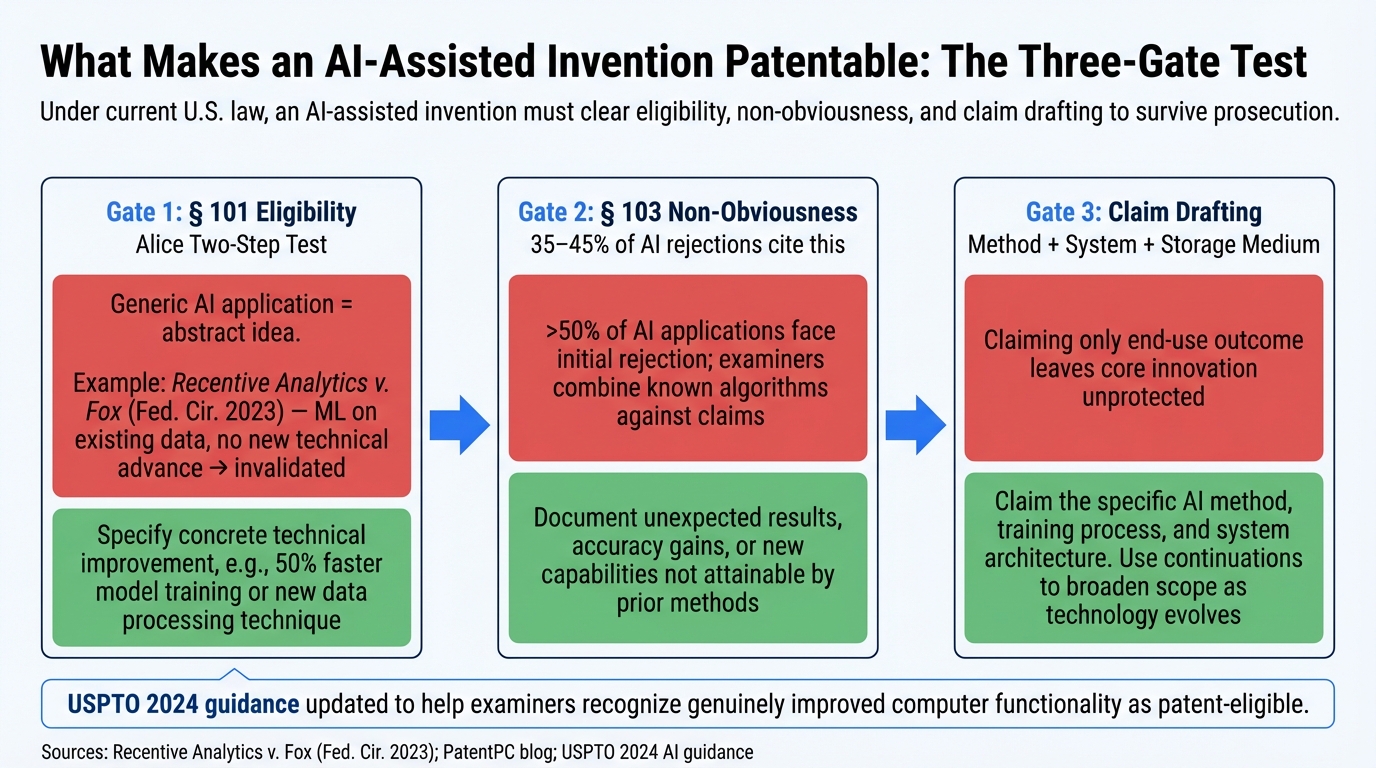 What Makes an AI-Assisted Invention Patentable: The Three-Gate Test — Source: Recentive Analytics v. Fox (Fed. Cir. 2023); USPTO AI Strategy 2024 via ipwatchdog.com
The Two-Step Alice Framework Still Governs AI Software Patents
Most AI inventions are implemented in software, which means they must survive the two-step eligibility test from Alice Corp. v. CLS Bank International under 35 U.S.C. § 101. The core question is whether the claim is directed to an abstract idea, and if so, whether it includes something "significantly more." In 2023, the Federal Circuit invalidated an AI-based prediction patent in Recentive Analytics v. Fox because it simply applied machine learning to existing data without any new technical advance. By contrast, AI patent claims that specify a concrete performance improvement, such as a 50% reduction in processing time or a measurably improved data structure, consistently fare better under Alice scrutiny.
The USPTO's 2024 guidance encouraged examiners to recognize genuinely improved computer functionality as patent-eligible. The key is framing claims around specific technical improvements, not around the use of AI as a tool. According to Thompson Patent Law, proprietary claim structuring techniques have improved §101 eligibility outcomes by 25-50% compared to generic AI claim approaches. The firm's analysis of the USPTO's latest eligibility guidance for AI patents explains how those techniques apply to current examination practice.
Obviousness Is the Bigger Threat to AI Patent Applications Than Eligibility
While §101 draws more attention, §103 obviousness rejections are where AI applications most frequently fail. Over half of AI-related applications face initial rejection, and a substantial share of those rejections cite obviousness, according to patent prosecution analysis. Examiners combine known machine learning architectures with prior art datasets and argue the claimed combination was predictable to a skilled practitioner.
To defeat these rejections, applications must document unexpected results. If your AI system achieves an accuracy rate, processing speed, or capability that prior art could not predictably achieve by combining known techniques, that non-obvious gap is your prosecution argument. Build that evidence during R&D, not during prosecution. For those who don't deploy sophisticated prosecution strategies, §103 rejections can extend timelines by a year or more and add five figures in prosecution costs that a well-structured application would have avoided.
How Claim Drafting Strategy Determines Whether an AI Patent Survives
The difference between an AI patent that survives and one that fails is almost always in how the claims are structured from the start. Applications that claimed only the end-use application, such as "using AI to do X," repeatedly fail. Successful AI patents claim the specific algorithmic technique, the training process, and the system architecture that solves a defined technical problem.
Effective AI patent applications include method claims covering the training process, apparatus claims on the system configuration, and storage medium claims capturing the software implementation. Filing continuation applications as the technology matures allows claim scope to expand to cover improvements that were not claimed in the original filing. Draft independent claims that state the technical problem, the specific AI-implemented solution, and the measurable technical improvement, then build dependent claims around the variations. The same principles that govern patenting mobile apps apply directly to AI-implemented systems, where the layered claim structure is what creates enforcement leverage.
AI-Generated Content and the Copyright Question Every Creator Needs to Understand
Patent protection addresses the methods and systems underlying AI technology. Copyright addresses something different: the expressive outputs AI systems produce. The rules governing AI-generated creative works and other generated works are equally settled, and equally unfavorable to anyone expecting automatic protection.
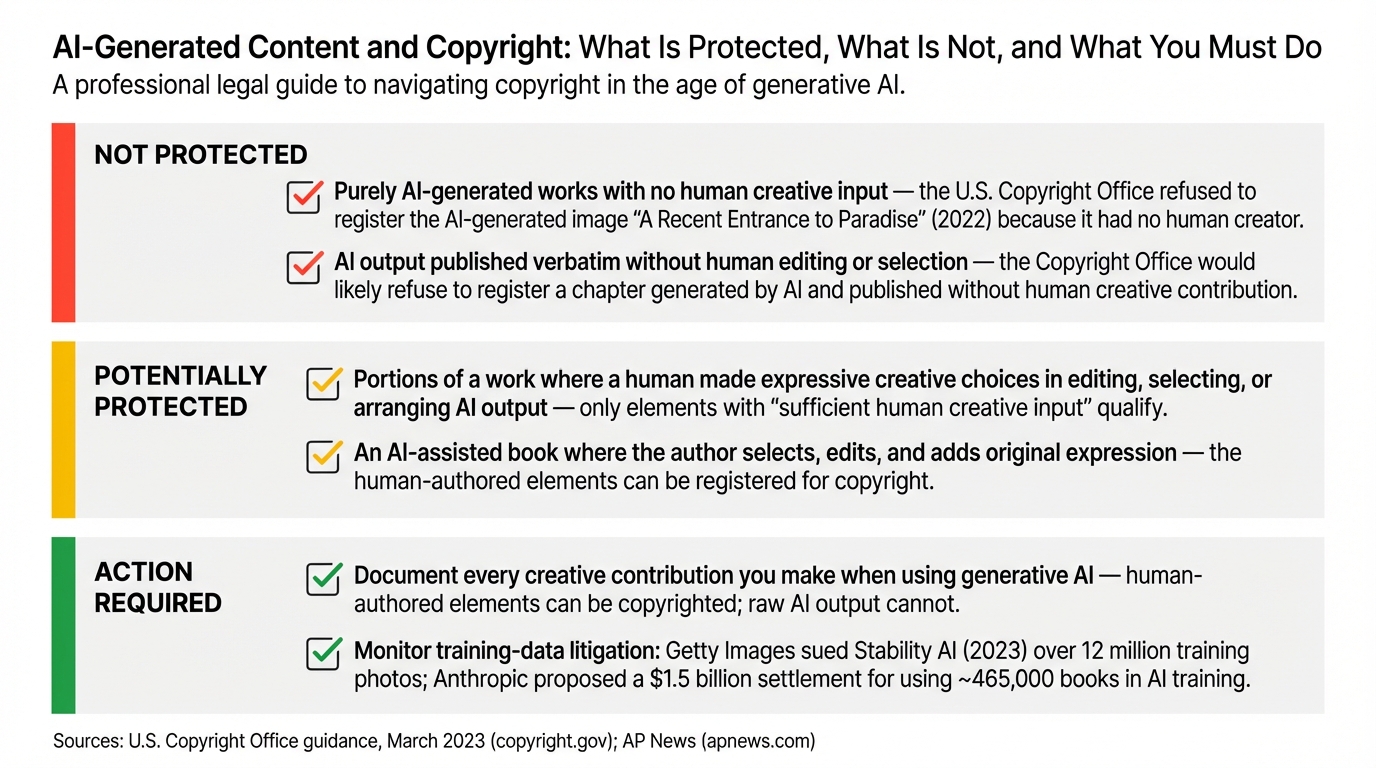 AI-Generated Content and Copyright: What Is Protected, What Is Not, and What You Must Do — Source: U.S. Copyright Office guidance, March 2023; AP News, 2023
The U.S. Copyright Office Has Rejected Pure AI Authorship Consistently
The Copyright Office has refused to register creative works and other generated works created entirely by AI systems in a consistent line of decisions since 2022. In the most prominent case, the Office declined to register an AI-generated image titled "A Recent Entrance to Paradise" because it had no human creator, a decision upheld by federal courts and left intact by the Supreme Court's refusal to hear the appeal. The Office's March 2023 guidance makes the standard explicit: any portion of a work that is entirely machine-generated is not protected by copyright. Only the portions reflecting sufficient human creative input qualify.
If you are creating works with AI assistance, document every human creative decision, including selection, arrangement, editing, and modification, because human creativity embedded in those choices is what copyright law actually protects. Those documented choices are what copyright law actually protects, and without that record, even substantial human involvement in the creative process becomes difficult to establish.
What the AI Training Data Copyright Debate Means for Developers
The lawsuits currently working through federal courts represent the most consequential ai and intellectual property questions the industry faces, implicating the rights of copyright owners across creative industries. Getty Images sued Stability AI in 2023, alleging that training generative AI models on 12 million proprietary images constituted infringement rather than fair use. The Authors Guild and others have brought parallel claims against OpenAI and Anthropic over the use of copyrighted creative works in training large language models, raising fundamental questions about how IP laws in various jurisdictions treat training data. In a signal of the financial stakes, Anthropic proposed a $1.5 billion settlement to authors over the use of approximately 465,000 books in training its AI systems.
Congress has also entered the picture. The Generative AI Copyright Disclosure Act, introduced in the U.S. House, would require AI developers to disclose the copyrighted works used to train generative AI models before those models are released publicly. The Generative AI Copyright Disclosure Act reflects growing legislative pressure on AI companies to document and disclose their AI training data practices. If the Generative AI Copyright Disclosure Act becomes law, companies that failed to track their training data sources will face immediate compliance exposure. AI companies are currently advancing fair use arguments based on the transformative nature of training, and courts have allowed these cases to proceed without a definitive ruling. If your business depends on AI tools trained on third-party content, these cases will directly affect your legal exposure when they reach judgment.
How to Build an AI Patent Strategy That Holds Up Under Scrutiny
Legal analysis only matters if it produces action. Here is how to structure an AI patent strategy that accounts for the rules above — including the evolving standards around AI and intellectual property — and secures meaningful IP rights across the full technology stack.
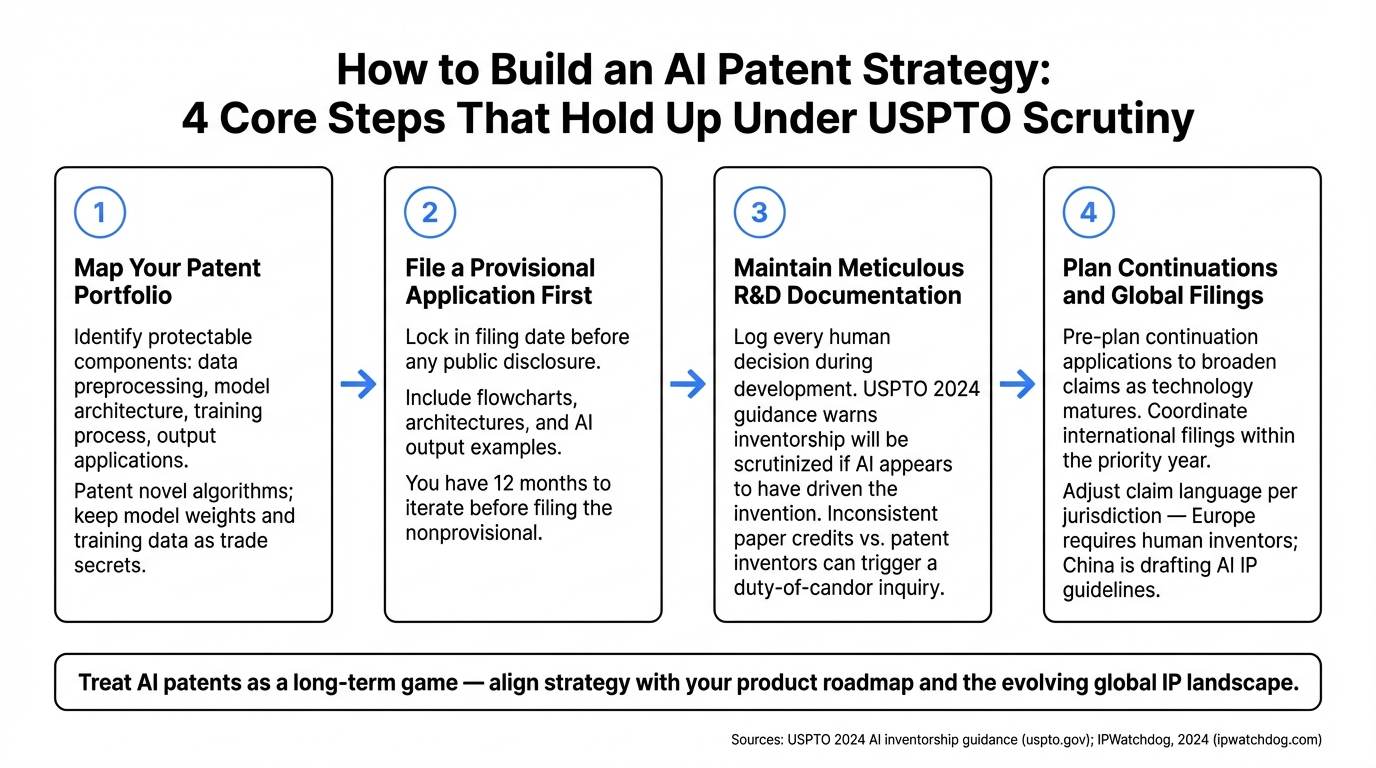 How to Build an AI Patent Strategy: 4 Core Steps That Hold Up Under USPTO Scrutiny — Source: USPTO 2024 AI inventorship guidance; IPWatchdog, 2024
Start with a Patent Portfolio Map Before Filing Anything
An AI system has multiple patentable components: the data preprocessing method, the model architecture, the training process, the inference engine, and specific applications. Filing a single application on one component while leaving the rest unprotected gives competitors a roadmap to design around your patent.
According to WIPO's Technology Trends report on artificial intelligence, AI patent filings have accelerated across all technology sectors, with machine learning methods accounting for the largest share. Map every component of your AI system against the patent-versus-trade-secret decision matrix before filing anything. Filing without a portfolio strategy creates AI and intellectual property gaps that competitors will find and exploit. The patent-first approach outlines how to sequence filings strategically so that priority dates align with your actual development milestones.
Provisional Patent Applications Buy Critical Time for AI Development
AI systems change rapidly during development. A well-drafted provisional patent application establishes a priority date while giving the development team 12 months to refine claims before the nonprovisional must be filed. The critical error most companies make is treating the provisional patent application as a rough placeholder. A provisional patent application is only as strong as its technical disclosure. If the provisional patent application does not describe the specific implementation you ultimately claim in the nonprovisional, you do not have that priority date for those claims.
File before any public presentation, including investor demos, conference talks, and arXiv preprints. Each of these constitutes a public disclosure that starts the one-year statutory bar under 35 U.S.C. § 102(b)(1)(A). For a complete explanation of what pending patent status means and what it protects during the gap between filing and issuance, the provisional patent application period carries its own strategic implications.
Documentation Practices That Make or Break AI Patent Prosecution
The evidentiary record created during AI-assisted R&D determines whether claims survive prosecution and whether issued patents survive later validity challenges. Inventor records should capture every significant human decision made during AI-assisted development: which AI output was selected and why, what modifications were made, and what technical problem each decision was designed to solve, similar to how human creators document their authorship contributions in other IP contexts.
That documentation serves two purposes. First, it establishes inventorship by creating a contemporaneous record of human conception. Second, it builds the factual record supporting non-obviousness arguments during prosecution. The person who decided which AI output to pursue, modify, and develop into a claimed invention is the inventor, and their choices need to be recorded at the time they are made, not reconstructed later. For those who don't maintain rigorous contemporaneous records, the consequences can be severe: the lesson from cases like Stanford v. Roche is that documentation failures can invalidate rights that looked secure for years.
The Biggest Mistakes Companies Make When Patenting AI Technology
Waiting Too Long to File Destroys Valuable Patent Rights
The United States has operated under a first-inventor-to-file system since the America Invents Act. A public disclosure of your AI technology, whether a conference presentation, a preprint on arXiv, or a product launch, triggers the one-year statutory bar under 35 U.S.C. § 102(b)(1)(A). After that year, your own disclosure can be used against your patent application as prior art if you have not filed. AI research culture, with its norm of rapid preprint publication, is particularly dangerous in this respect, especially as AI and intellectual property law struggles to keep pace with how quickly these technologies evolve. File a provisional patent application before the presentation, not after.
Claiming the Wrong Thing Leaves the Real Innovation Unprotected
AI patent applications are frequently drafted to claim the application layer, meaning the user-facing product feature, rather than the novel technical method the AI system actually implements. Courts and examiners analyze the level of abstraction at which a claim is directed. A claim directed to "displaying personalized content using artificial intelligence" claims an abstract result. A claim directed to the specific neural network architecture, training objective, and data structure — potentially incorporating text mining or data mining techniques — that generates measurably more accurate personalization claims a technical solution.
Identify the specific technical problem your AI system solves that no prior system solved the same way. That technical solution, not the user experience it enables, is the subject of your independent claim. The same principle applies whether you are working on software systems generally or AI-specific implementations, as explained in the practical guide to patenting computer software.
FAQ
Does AI violate intellectual property? The intersection of AI and intellectual property raises concerns on two fronts. Training an AI model on copyrighted works without authorization may constitute copyright infringement, which is the central question in pending cases including The New York Times v. OpenAI. AI-generated outputs that closely reproduce protected creative works, or AI systems that implement patented methods, can separately infringe existing intellectual property rights. Whether infringement has occurred depends on the jurisdiction, the nature of the training data, and how the output was produced.
Can you patent an AI invention if the AI created it without human direction? Not in the United States. Under the Federal Circuit's 2022 decision in Thaler v. Vidal and the USPTO's 2024 guidance, every named inventor on a U.S. patent application must be a natural person who contributed to conception of the claimed invention. If a human identified, selected, or meaningfully shaped the AI's output into the claimed invention, that human qualifies as an inventor. If no human made a qualifying inventive contribution, the invention cannot currently be patented in the U.S.
Can you write a book using AI and sell it? Yes, but copyright protection depends on how much human creative authorship went into it. The U.S. Copyright Office has consistently refused to register generated works and other creative works produced entirely by AI with no human creative input, treating such works the same as other generated works lacking qualifying authorship. Portions written, edited, selected, and arranged by a human author can receive copyright protection. The AI-generated portions, without sufficient human creative contribution, likely cannot. Document your creative decisions carefully if you intend to register the work.
What is the difference between patenting AI and protecting AI as a trade secret? Patents protect specific methods and systems publicly in exchange for a 20-year monopoly from the nonprovisional filing date. Trade secrets cover confidential information of commercial value for as long as secrecy is maintained. Trained model weights and training pipelines are usually better protected as trade secrets because patenting requires public disclosure. The methods those generative AI models and large language models implement are often strong patent candidates. Most sophisticated AI companies use both strategies to secure different IP rights across different components of their systems, achieving comprehensive IP protection for each layer of the technology stack.
What is the 30% rule for AI? The "30% rule" is not a recognized legal standard in U.S. patent law or copyright law. If you have encountered this term in a specific context such as a licensing agreement or internal policy, its meaning depends entirely on the contract or policy document in which it appears. There is no USPTO, Copyright Office, or judicial standard by this name governing AI-generated content or AI inventions.
What is the Generative AI Copyright Disclosure Act? The Generative AI Copyright Disclosure Act is proposed federal legislation that would require developers to publicly disclose the copyrighted works used to train generative AI models before those models are released. If enacted, the Generative AI Copyright Disclosure Act would significantly affect how AI companies document and manage their training data, with direct implications for copyright infringement exposure and licensing obligations. The bill reflects congressional attention to the unresolved tensions between AI training practices and existing intellectual property rights frameworks.
Your Next Steps to AI Patent Strategy Success
The legal framework governing AI and intellectual property is still forming, but the rules that exist today are being enforced today. Patent applications are being rejected for insufficient human inventorship documentation, AI training data disputes are approaching trial, and companies without contemporaneous R&D records are losing those arguments. For those who don't act before public disclosure, the statutory bar closes off options that cannot be recovered.
The bottom line: a weak AI patent strategy leaves your most valuable technical innovations exposed while sophisticated competitors build portfolios around the same technology space. A strong strategy, built before the first product demo, secures IP rights across the full stack, from the training method and model architecture to the inference process and application layer.
Thompson Patent Law works with technology companies and founders to build patent strategies for AI-assisted inventions, from structuring human inventorship documentation to drafting claims that survive §101 and §103 challenges to filing provisional patent applications before any public disclosure creates a statutory bar. The team brings engineering backgrounds and Fortune 500 prosecution experience to bear on the specific challenges that large language models, generative AI models, and AI-implemented systems present during examination.
Schedule a Free Patent Needs Assessment to identify what in your AI technology is protectable, which protection strategy makes sense for each component, and what needs to happen before any public disclosure locks you out of your own priority date. According to Thompson Patent Law, clients who engage before public disclosure spare themselves an average of one to two years and five figures in prosecution costs compared to those who file reactively. The right time is before the demo, not after.


